The Laughter Of Puritans

When Tocqueville visited America, he wasn’t impressed with our humor, claiming that “people who spend every day in the week making money, and the Sunday in going to Church, have nothing to invite the muse of Comedy.” Reviewing John Beckman’s American Fun: Four Centuries of Joyous Revolt, Ben Schwarz thinks that’s not the whole story:

The country’s true comic muse, [Beckman] suggests, has always resided in rebellious, unacceptable humor and entertainment. He begins this chronicle with the forgotten hedonist pilgrim Thomas Morton and his lively seventeenth-century settlement, Merry Mount. The name alone was a pornographic joke to the locals. In his satirical poetry, Morton referred to Puritan leader Myles Standish as “Captain Shrimpe,” and at Merry Mount he encouraged forbidden Maypole dancing, refused to recognize bonded service, embraced Native American culture aesthetically, and Native American women literally. Within a year, Standish’s and Morton’s followers negotiated at gunpoint for Morton’s expulsion from the New World, after which Standish had the pilgrim playboy’s Maypole chopped down. From there, Beckman offers a narrative history touching on the revolutionary bonhomie of Samuel Adams’s taverns (a barroom insurgency that led, in turn, to the rowdy, whooping Boston Tea Party), the subversive revelry of plantation slave culture, Western prank journalism, P. T. Barnum, jazzmen, flappers, merry pranksters, and riot grrrls. In American Fun, humor and music catalyze cultural subversion, breaking out spontaneously in response to intolerant majority rule.

Above is a 1993 standup routine from Bill Hicks that Letterman initially refused to air. Update from a reader:

The whole interview with Bill Hicks’ mom is priceless:

In addition to being sugar-sweet and tack-sharp, Mrs. Hicks offers some fascinating background on her son. He wasn’t an easy comic for a parent to watch, and her pain at his loss remains palpable. The whole visit was an unusual move by a talk show host, but it was as close as Letterman could come to correcting the mistake … especially since he used the opportunity to go ahead and show the original routine in full.

Previous Dish on Hicks here and here.

Mammograms, Reconsidered

A long-term study published this week found that mammograms don’t increase women’s odds of surviving breast cancer:

The University of Toronto study split a group of 89,835 women in two. Half of them got mammograms, and half did not. After 25 years, the rate of death from breast cancer was the same in both groups. Some of the women who underwent mammograms ended up with unnecessary treatment.

The research is well done and will influence a global conversation. Dr. Richard Wender, chief of cancer control for the American Cancer Society, said an expert panel will factor this research into new guidelines to be released within the year. Until then, current recommendations stand.

Moreover, they can actually be harmful:

The BMJ study calculated that 22 percent — more than 1 in 5 — breast cancers diagnosed by a screening mammogram represented an overdiagnosis. These were breast cancers that did not need treatment, and the women who received these diagnoses needlessly underwent treatments that could damage their hearts, spur endometrial cancer or cause long-lasting pain and swelling. …

These treatments are totally worth it if it means that you avoid dying from the cancer. But if they’re aimed at curing a cancer that was never going to become deadly, then what early diagnosis has actually done is made a healthy person sick. I think it’s safe to say that no one wants that. Treatments and awareness about breast cancer seem to have created most of the improvements in breast cancer outcomes, and we should celebrate those accomplishments.

Still, Kate Pickert says regular mammograms are likely here to stay:

Otis Brawley, chief medical officer for the ACS, has been outspoken about the downside of various types of cancer screening, arguing that benefits are often over-stated. But even he points out that the ACS examined the ongoing Canadian study when the group last updated its breast cancer screening guidelines seven years ago and concluded that annual mammograms for women over 40 were still warranted. (Findings from the study back then were similar to those published this week.) The ACS will take a fresh look at the research on mammography this year and may change its recommendations, but there’s no guarantee.

Cohn gets Ezekiel Emanuel’s take:

“There will never be a truly definitive mammogram study,” says Emanuel, who was longtime head of the National Institutes of Health Bioethics Department and is now a vice provost at the University of Pennsylvania. “You’re in this circle where you will never resolve the issue. You need a long timeline to get the best results, but in that time span the technology always improves—and people will always say, well, this is based on old technology so it’s not so relevant anymore.”

Aaron Carroll adds:

If you’re not going to be swayed at all by a randomized controlled trial of 90,000 women with 25 year follow up, excellent compliance, and damn good methods, it might be time to consider that there’s really no study at all that will make you change your mind.

John Horgan thinks it’s up to patients to stop demanding expensive, ineffective medical tests:

[U]ltimately, the responsibility for ending the testing epidemic comes down to consumers, who too often submit to—and even demand–tests that have negligible value. Our fear of cancer, in particular, seems to make us irrational. When faced with evidence that PSA tests and mammograms save very few lives, especially considering their risks and costs, many people say, in effect, “I don’t care. I don’t want to be that one person in a million who dies of cancer because I didn’t get tested.” Until this attitude changes, the medical-testing epidemic won’t end.

But Leah Libresco sympathizes with patients:

It’s tempting to be skeptical whenever a medical recommendation is reversed. If the last thing they told us was wrong, why should we trust them again? However, health care has changed since the advent of mammography. The old studies on the benefits of mammography weren’t necessarily wrong, just out of date. As awareness of breast cancer has increased, self-screenings have begun to do the work of mammography. As cancer drugs have improved, it’s no longer critical to identify diseases at their earliest stages to be able to survive.

But for a patient, who just hears conflicting recommendations, and not a discussion of research methods or the history of medicine, it’s hard not to come away with a sense of unease.

Crafting A Condolence Letter

Saul Austerlitz considers it:

A condolence letter is a strange hybrid of forms. It is for the mourner, but about the deceased. It is formal, but emotional. It gestures simultaneously at the past, the present and the future. It seeks to provide solace while acknowledging that there is no genuine solace to be provided. It follows a rigorous order while retaining an open-ended flexibility. … A good condolence letter requires balance, demanding an “I” capable of turning its attention away from itself, and toward a missing other. It is about what death requires of all of us who are left behind, and often finds us incapable of providing: compassion. A condolence letter is an act of self-erasure. It is also an acknowledgment of failure. We provide comfort, but never enough; we pay tribute, but never fulsomely enough; we remember, but not deeply enough. We fail. We can only offer condolences, because we are unsure if they will be taken. All we can do is make the attempt.

A Poem For Thursday

From “far memory, a poem in seven parts” by Lucille Clifton:

my knees recall the pockets
worn into the stone floor,
my hands, tracing against the wall
their original name, remember
the cold brush of brick, and the smell
of the brick powdery and wet
and the light finding its way in
through the high bars.

and also the sisters singing
at matins, their sweet music
the voice of the universe at peace
and the candles their light the light
at the beginning of creation
and the wonderful simplicity of prayer
smooth along the wooden beads
and certainly attended.

(Reprinted from Angles of Ascent, A Norton Anthology of Contemporary African American Poetry, edited by Charles Henry Rowell © 2013 by Charles Henry Rowell. Used by kind permission of BOA Editions, Ltd. Video of the poet Sharon Olds reading from the work of Clifton last November, during a Poetry Society of American event honoring iconic black poets)

Can The Embargo Be Broken?

Keating ponders a new poll on the Cuba embargo:

A majority of Americans, and even a majority of Cuban-Americans in Florida (who also supported Barack Obama over Mitt Romney in the last election), may now oppose the embargo, but older voters with visceral personal experience of Castro’s Cuba feel more strongly about it.

The number of people whose votes and donations are determined by their support for the embargo may be dwindling, but it’s probably still greater than the number whose vote and donations are determined by opposition to it. Still, the numbers indicate the downside isn’t as bad as it once was. The reactions to Obama’s handshake with Raúl Castro turned out to be fairly mild. Could something more dramatic be coming?

Greg Weeks doubts it. He argues that it “simply does not matter what a majority of Americans support if they do not really care about it”:

The tiny minority of Americans of oppose normalization care about it very deeply. On a list of priorities it would be high; for some, number one. Therefore they will fight very hard, expend considerable political capital, and spend a lot of money to make sure the embargo and other similar policies remain firmly in place.

Larison chimes in:

The good news is that support for the utterly useless embargo of Cuba has been getting steadily weaker over time, and there is good reason to assume that it will continue to wane until the embargo is finally lifted. Even though this will happen many decades later than it should have, it is encouraging to know that there is some limit to how long such senseless policies can endure. The embargo is a good example of the kind of needlessly harmful policies the U.S. can pursue when it allows its dealings with another country to be shaped almost entirely by ideological and emotional factors. It is also a monument to our government’s remarkable inability to abandon some failed policies decades after their futility has become obvious.

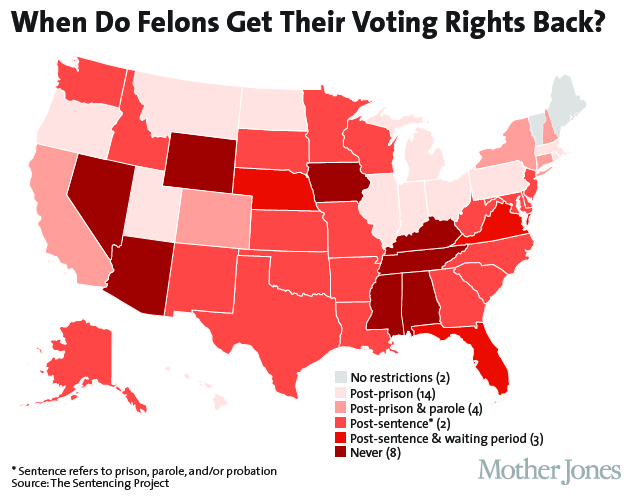
The Felon’s Franchise

felons-01_0

Attorney General Eric Holder is urging states to overturn laws that bar people convicted of felonies from voting. How many Americans do these laws affect? Quite a few:

Nearly 6 million Americans are barred from voting due to felony disenfranchisement laws. Moreover, the bulk of disenfranchised felons—75 percent—are no longer in prison. Approximately 2.6 million of those remain disenfranchised despite having completed all parts of their sentence (prison time, parole, probation) because they live in states that bar felons from the polls for life. …

Felony disenfranchisement disproportionately affects people of color. Black men are incarcerated at a much higher rate than the rest of the population. According to the Urban Institute, 11.4 percent of African American men aged 20 to 34 were in prison in 2008, compared with just 1.8 percent of white men. One out of every 13 black Americans of voting age can’t vote due to criminal disenfranchisement laws, a number much higher than for any other demographic. This ratio is more stark in Florida, Kentucky, and Virginia, where more than 1 in 5 black adults is barred from the polls. Overall, 2.2 million black Americans have lost the right to vote because of felony disenfranchisement laws.

Roger Clegg brings up the usual objections:

[Holder] conveniently ignores the reason for felon disenfranchisement, namely that if you aren’t willing to follow the law, then you can hardly claim a role in making the law for everyone else, which is what you do when you vote. We have certain minimum, objective standards of responsibility, trustworthiness, and commitment to our laws that we require of people before they are entrusted with a role in the solemn enterprise of self-government. And so we don’t allow everyone to vote: not children, not noncitizens, not the mentally incompetent, and not people who have been convicted of committing serious crimes against their fellow citizens.

But Kevin Drum thinks restoring their rights is pretty fundamental to democracy:

I believe the right to vote is on the same level as free speech and fair trials. And no one suggests that released felons should be denied either of those. In fact, they can’t be, because those rights are enshrined in the Constitution. Voting would be on that list too if it weren’t for an accident of history: namely that we adopted democracy a long time ago, when the mere fact of voting at all was a revolutionary idea, let alone the idea of letting everyone vote. But that accident doesn’t make the right to vote any less important.

A probationary period of some kind is probably reasonable. But once you’re released from prison and you’ve finished your parole, you’re assumed to have paid your debt to society. That means you’re innocent until proven guilty, and competent to protect your political interests in the voting booth unless proven otherwise. No free society should assume anything different.

Meanwhile, Rick Hasen notes how resistant conservatives are to early voting, which would also expand the franchise:

[C]onservative critics of early voting runs don’t just mistrust early voters; they mistrust voters in general. As I explained here, there is a fundamental divide between liberals and conservatives about what voting is for: Conservatives see voting as about choosing the “best” candidate or “best” policies (meaning limits on who can vote, when, and how might make the most sense), and liberals see it as about the allocation of power among political equals. Cutting back on early voting fits with the conservative idea of choosing the “best” candidate by restraining voters from making supposed rash decisions, rather than relying on them to make choices consistent with their interests.

Beinart points out the contradiction between the GOP’s desire to attract more black votes and its efforts to restrict voting:

Do the Republicans pushing these restrictions really want to keep blacks from voting? Not exactly. The more likely explanation is that they want to keep Democrats from voting. As the Republican majority leader of the Pennsylvania state legislature said in 2012, the requirement for voter ID “is gonna allow Governor Romney to win the state of Pennsylvania.”

The problem, of course, is that limiting Democratic voting means limiting African-American voting. And in a country that for much of its history denied African Americans the right to vote, pushing laws that make it harder for African Americans to exercise that right touches the rawest of nerves. As long as many African Americans feel the GOP doesn’t want them to vote, it’s unlikely anything the GOP says to African Americans is going to have much positive impact.

Marriage Equality Update

The Dish covered the debate in Indiana over whether to add an initiative for a constitutional banning marriage for gays to the ballot this fall. I was optimistic, given some Republican opposition to the idea; one of our Indiana readers wasn’t. Today, the inability of the state House and Senate to agree on the wording of the measure means it will be shelved for the foreseeable future. Another day, another win.

Liberalism vs Religious Liberty?

The case of the Little Sisters of the Poor with respect to Obamacare is a fascinating one. Here’s a rather aggressive column by Linda Greenhouse dismissing their worries. Here’s an excellent rebuttal by Ramesh Ponnuru. His key point is about the nuns’ refusal to sign the form that triggers the ACA’s procedures for religious exemptions:

Page 2 declares that the form is the “instrument” that triggers the requirement that a third-party administrator provide contraceptive coverage. The nuns don’t want to take any action that (they believe) involves them in facilitating immoral acts, which includes causing other people to perform immoral acts. Signing the form would (in their view) do that. Note, by the way, that houses of worship, which are truly exempt from the administration’s contraceptive mandate, do not have to sign any such form to get that exemption. That fact makes a hash both of Greenhouse’s claim that the Little Sisters of the Poor are “exempt from the mandate” and her (and the administration’s) claim that certification is the only way to prevent the exemption process from sliding into “chaos.”

I confess I hadn’t seen it that way before. The mere act of delegating the authority to approve of contraceptive coverage to a third party is itself an act of complicity in something the nuns oppose for religious reasons. The current compromise – before the case reaches the Superme Court – is the following:

The Little Sisters must “inform the Secretary of Health and Human Services in writing that they are non-profit organizations that hold themselves out as religious and have religious objections to providing coverage for contraceptive services,” the court’s unsigned and apparently unanimous Jan. 24 order said. But they “need not use the form prescribed by the government and need not send copies to third-party administrators.”

If the key is signing a form that requires active complicity in a system the Little Sisters object to, and if a letter merely stating their objection to the contraceptive coverage can suffice, then this seems like more than a temporary solution. This may be splitting hairs – but allowing for religious freedom in a secular society can often come down to splitting hairs. And what concerns me is less the details of this particular case than the general liberal contempt for the genuine moral quandaries religious organizations may face. Greenhouse’s column is a prima facie case of this.

So too, I might add, is the brusque and smug liberal assumption that religious objections to marriage equality are somehow as illegitimate as defenses of slavery. Please.

There is a deep theological narrative and argument behind Christianity’s and Judaism’s and Islam’s anathematization of homosexuality that cannot be reduced to bigotry. I think it’s mistaken, but I sure don’t think it’s mere prejudice. In the Catholic tradition, Humanae Vitae – with which I strongly disagree – is nonetheless a coherent view of the role of sex and procreation in human life. Its “natural law” has never fully addressed the reality of homosexual orientation – but that is partly because the entire concept is so new in the context of the history of the great monotheisms. I think it should be engaged respectfully on these grounds. But it is emphatically not mere bigotry; and many of us have grounded our own defense of civil gay equality without the need to disqualify large swathes of conscientious religious folks from polite company.

What does border on bigotry, to my mind, is the kind of casual dismissal of sincerely held religious beliefs you see in Greenhouse’s piece or in Isaac Chotiner’s rebuke to Damon Linker. You can pro-gay and for religious freedom. And it is vital that the gay rights movement is not co-opted once again by the illiberal left’s contempt for people of faith.