Is It Always Wrong To Lie?

Yes, according to Sam Harris in his latest book. Clancy Martin isn’t so sure:

Lies can inflict terrible harm. Lies by the government, for instance, can lead to moral bankruptcy and ruin (I’m thinking of Bush’s assertion that Iraq had weapons of mass destruction). But Harris oversimplifies both the act and the morality of lying. Merely sorting out what should count as a lie is notoriously difficult. Saint Augustine pointed out, back in the fourth century in his treatise On Lying, that there are at least eight different kinds of lies, and each type may have a different moral valence. (Compare Bush’s self-deceptive lie about WMDs with Clinton’s bold-faced “I did not have sexual relations with that woman.”) Real life requires more nuance about truthfulness and lying than you find in Harris’s all-or-nothing approach.

More on that “nuance”:

[A]s evolutionary biologist Robert Trivers has argued, deceit is fundamental to animal communication, “and this ought, in turn, to select for a degree of self-deception, rendering some facts and motives unconscious so as not to betray—by the subtle signs of self-knowledge—the deception being practiced.” In order to communicate, we lie to one another and to ourselves. Deception, communication, and trust are all interwoven—and truthfulness, rather than being the rule, starts to look like the exception. After all, mightn’t that be precisely why we place such a premium on the truth?

In an interview just after the book was released, Harris had this to say about “white lies” – such as when you respond to the dreaded question, “Do I look fat in this dress?”:

[M]any people view that question as really not a question. What is really being asked is, “Tell me that you love me” or “Tell me that you think I’m beautiful.” If you believe you’re actually in that situation where there’s a subtext that you’re supposed to respond to, well, it’s not a lie to do that.

But in many situations there is a question being asked here, and information is useful.  It could be that one dress looks much better than the other. What is more flattering to her? It could be that your wife wants to lose weight. You want her to lose weight. You think she would be happier if she lost weight. There’s a conversation about weight that, if you’re always eliding this inconvenient fact, no one is ever forced to realize that both of you are noticing something that actually can be changed.

Harris’ fundamentalist opposition to lying also sparked one of our most popular reader threads last year, “Always Tell Kids The Truth?

Jailed For Teaching Public Knowledge

Joshua Swain captions the above video:

Last September, Chad Dixon was sentenced to 8 months in a federal prison for teaching clients counter-measures for polygraph tests. Federal prosecutors charged Dixon with obstructing justice—they view his business as undermining an important tool used to check the credibility of government employees and prosecute criminals.

The information Dixon was selling wasn’t new. Books on beating polygraphs have been around since the machines were invented. So why is the federal government cracking down now?

Justin Peters explored this issue back when Dixon was sentenced:

Polygraph countermeasures are not state secrets, and countermeasure instructors are not evil geniuses. Indeed, Chad Dixon was a Little League coach with no law enforcement background who got into polygraph consulting because he couldn’t get hired as an electrical contractor. According to the Washington Post, Dixon told the judge that “I was so dead set in my mind that this machine was bogus and I think this mind set made me feel that what I was doing wasn’t illegal and wasn’t that bad.” Well, it was illegal, apparently. But that doesn’t mean the whole thing isn’t bogus all the same.

Christianists On The Left? Ctd

Finally, some readers are rallying to my position:

I’m glad you’re devoting space and perspective to North Carolina’s Moral Monday protests, which have left me deeply conflicted. I spent 14 years of my adult life in NC, living in one of its most conservative counties when the state voted for Obama in 2008 and in one of its most liberal counties as state politics veered sharply to the right in 2013. Last month I relocated to Chicago, in part because I couldn’t see a way forward for such a divided state where both sides talk completely past one another.

The passion and goals of the Moral Monday protesters are admirable. I agree with 95 percent of their views. But I want to push back against some of your reader responses. Living in rural NC, I met and befriended many voters who helped elect the current slate of GOP political leaders. These are not folks who shun the poor, the sick, or the uneducated. They simply have (mostly misguided) views on supporting underprivileged groups through limited government action, views that often are unrelated to their faith. Beginning with the premise that these views are sinful, morally bankrupt, and anti-Christian immediately alienates and offends before there is a chance to persuade.

And persuasion is necessary. The GOP’s hold on the legislature is a function of redistricting in 2010 that isolated liberal portions of the state. Daily Kos did a fantastic breakdown of the district demographics here and here. The short version is that Democrats dominate the districts they win, usually against no GOP opposition. But in most districts the GOP has a relatively small advantage. The key to a more sane state government is convincing a handful of non-fundamentalist Republicans (and there are plenty of those in this state) from the rural or semi-urban districts that their party’s platform has been ineffective in helping the sick and poor in their own communities. Casting moral judgement on these voters from afar in Raleigh does not further this cause.

Another makes a vital point:

I haven’t seen demographics brought up yet in this discussion. Young people are increasingly identifying as non-religious, agnostic, or atheist. I live in North Carolina and I listen to conservative talk radio in the car while travelling to/from work. A lot of what is discussed makes sense to me logically, but inevitably, they take a right turn into morality and the Bible and I instantly tune out. I don’t believe I am alone. I think this is the biggest problem the right faces, and it may spell the end of the Republican party if they don’t change tack.

If the left wants to “Bible-up” their message in hopes of capturing religiously conservative older voters, they have to realize that they’re going to lose a large percentage of their younger non-religious audience and will end up in the same position as the right.

Look: I understand if your politics is leftist and you live in a very religious state, you might feel the need to use religious arguments to advance your cause. But be aware of the precedent you’re setting, and the danger of fighting the last war and not the current one.

The Winter Olympics Are Melting

Olympics

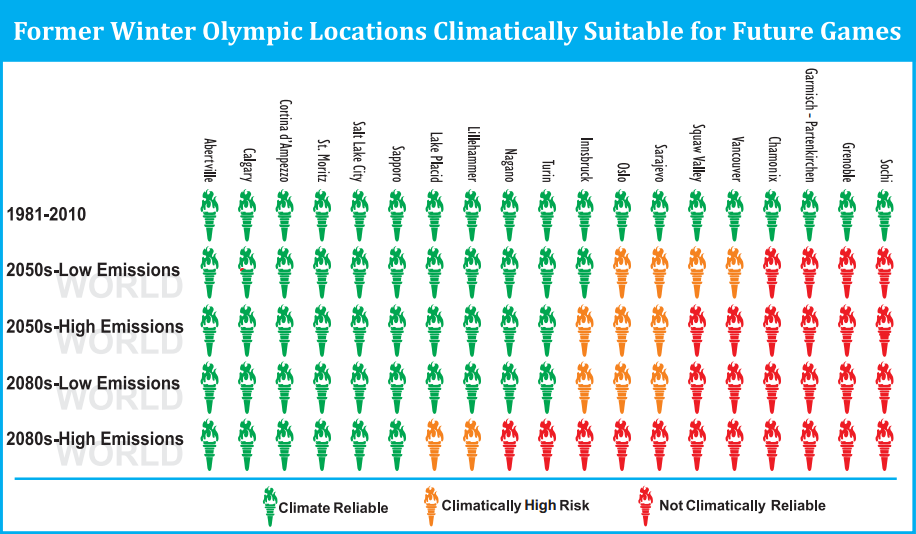
Uri Friedman passes alongs the above graphic from a report (pdf) on global warming and Sochi:

By mid-century, according to pessimistic projections, only 10 of these cities will be climatically suitable to host the Games. By the end of the century, the field will be winnowed down to just Albertville, Calgary, Cortina d’Ampezzo, St. Moritz, Salt Lake City, and Sapporo.

Note also that Sochi is listed as cold enough for the Games right now, meaning the International Olympic Committee didn’t necessarily make a mistake in awarding this year’s Olympics to the subtropical, Black Sea city. In fact, the authors suggest that new technologies like artificial snowmaking have made the IOC more willing to choose warmer host cities (the IOC explicitly states that it considers how countries that submit bids plan to adapt to global warming). But the researchers are suggesting that Sochi 2054 probably won’t be happening.

Brian Merchant covers the heat wave in Sochi:

“The fact is that this is part of a larger pattern,” climatologist Michael Mann writes me in an email about Sochi’s heat, “one in which we are breaking records for all time warmth at nearly three times the rate we would expect from chance alone so far this decade.”

Indeed, according to Russian climate data for the region stored at Climatebase.ru, the average temperature during the period from 1940-1960 was 14˚C. Since 2000, that’s risen to 14.3˚C. According to a temperature record that goes back to 1898, the average temperature in February was 6˚C, or 42˚ F. Today, the mercury is in the low 60s.

The Dignity Of Work

Drum cautions liberals against denigrating it:

Even people who hate their jobs take satisfaction in the knowledge that they’re paying their way and providing for their families. People who lose their jobs usually report intense stress and feelings of inadequacy even if money per se isn’t an imminent problem (perhaps because a spouse works, perhaps because they’re drawing an unemployment check). Most people want to work, and most people also want to believe that their fellow citizens are working. It’s part of the social contract. As corrosive as inequality can be, a sense of other people living off the dole can be equally corrosive.

Ryan Avent asks what happens when there are no jobs available:

In that case, the dignity of work may cease to be a particularly useful social concept, and something will be needed to replace it. Society will have to come up with new means to set useful incentives for people in a world in which we do not allocate purchasing power through market wages. We might talk instead about the dignity of endeavour for its own sake, or the dignity of contribution to society. Such phrases may seem to have the makings of a social infrastructure for socialism. Indeed they do, for a world in which machines can do much of the work will need to become more socialistic if it is not to become intolerably unequal.

The Rise Of The Tech Villain? Ctd

When the emcee of your own awards ceremony gives you a dressing down, it’s time to take notice. Here’s John Oliver at this week’s Crunchie Awards:

You already have almost all the money in the world. Why do you need awards as well after that? It is absolutely ridiculous. You’re no longer the underdogs; it’s very important that you realize that. You’re not the scrappy people that people get behind. It used to be that people who worked in the tech industry were emotional shut-ins who you could root for. Now those days are gone. You’re pissing off an entire city – not just with what you do at work, but how you get to work.

Oliver also suggested that a modern-day Wolf of Wall Street would be set on the West Coast, with “all the money, all the opulence, and about 10 percent of the sex.” And that was inside the party; outside, protesters hosted an alternative “Crappies” ceremony, with categories such as the “tax evader award.” Bill Wasik urges the industry to take the critics seriously:

Unlike any other industry, tech relies on not merely trust but faith that a leap into the unknown will be rewarded. That’s why the recent arrogance of Silicon Valley honchos has been not just poisonous but deluded. … The entire business models of Google and Facebook are built not on a physical product or even a service but on monetizing data that users freely supply. Were either company to lose the trust and optimism of its customers, it wouldn’t just be akin to ExxonMobil failing to sell oil or Dow Chemical to sell plastic; it would be like failing to drill oil, to make plastic.

When William Gibson envisioned cyberspace as a “consensual hallucination,” he was right. Unsettle the consensus about the social web and you don’t just risk slowing its growth or depopulating it slightly. You risk ending it, as mistrust of corporate motives festers into cynicism about the entire project.

Previous Dish on the escalating image problem of Silicon Valley here.

Dick Cheney Has No Regrets, Ctd

A reader writes:

Arthur Machen wrote, “A man may be infinitely and horribly wicked, and never suspect it.” Cheney illustrates that to a T.  A friend of mine work for him during the second administration. He felt that Cheney was the nicest, sweetest man he’d ever met. There’s an amazing dichotomy on display here. Your reference to Nietzsche could not be more apt, but this is a case where the appearance of self-possession masks a veritable black hole of self-deception.

I wonder if all evil isn’t like that. Arendt’s point was not that evil was banal as such, but that it could be committed by individuals who simply did not think much about it. They made no anguished decision; they were unaware of any moral constraints; they just did it, and never began to absorb what it meant. The most penetrating recent investigation into this is Errol Morris’s brilliant documentary about Don Rumsfeld. With Rumsfeld, as with Cheney, you have the same refusal even to conceive of immorality in government. It’s all semantics. The grin almost never wavers. You get the impression that this is a morally unserious person, or someone who cannot even begin to believe that there were consequences to his own actions for which he might bear some resp0nsibility.

So in the critical scene when Morris links Rumsfeld’s authorization of torture techniques to the exact same torture techniques used at Abu Ghraib, Rumsfeld simply says that no report of any kind had ever reached such a conclusion. Nothing that happened at Abu Ghraib or anywhere in the American gulag of torture camps had anything to do with him at all. He submitted his resignation after Abu Ghraib came to light not because he was in any way responsible for it in fact, but merely because he was responsible for the war in general. There’s a glibness and absolute certainty to Rumsfeld’s answer.

But Morris has done his homework – unlike so many “journalists” who have interviewed Rumsfeld on this question over the years.

He recites a passage from exactly one of the reports that Rumsfeld said had exonerated him – and it plainly concludes that the torture tactics at Abu Ghraib had indeed “migrated” from Rumsfeld’s waiving of Geneva and authorization of torture at Gitmo. What does Rumsfeld say in response? Nothing. He smiles nervously. He seems to get the brink of facing up to his own responsibility for evil and then decides to go get a cup of coffee. He never confronts his past. He just shrugs it off. He has obviously never even considered the question of his own moral responsibility for anything.

Similarly, look at the video in the first post and note how stumped Cheney is when asked to name his biggest fault. He simply has never thought of such a thing. In fact, he seems to regard any self-reflection as an irritating thing only liberals engage in – not manly, decisive men like him. In both these men, you see a kind of moral autism. Evil is defined a priori as something that others do. It is simply inconceivable to Cheney and Rumsfeld that they could ever commit evil themselves. Even when confronted by direct evidence, they simply blink as if they cannot see.

I think such an attitude is terrifying. But integral to all the great acts of evil in human history.

Ask Reza Aslan Anything: So Jesus Goes To Mass …

In our first video from the author of Zealot: The Life and Times of Jesus of Nazareth, he explains how he thinks the historical Jesus would react to present day Catholicism:

Reza’s answers, of course, presuppose that Jesus was/is not the Son of God. In the light of faith, however, the question our reader posed is a bizarre one: Jesus is already at the Mass, in the Eucharist. He’s there every time it is celebrated. And that’s what is so frustrating about Aslan’s book: its dismissal of any radical claims Jesus made for saving the entire world makes Jesus a much smaller figure, one who would never have had the enormous impact he had on human consciousness and civilization. Which makes me think I should ask Reza for a podcast conversation soon. After he has had his say in dialogue with you.

Reza is an Iranian-American writer and scholar of religions. He is the author of No god but God: The Origins, Evolution, and Future of Islam and, most recently, Zealot, which offers an interpretation of the life and mission of the historical Jesus. Previous Dish on Zealot herehere and here, as well as Fox News’ treatment of Reza here and here.

Our full Ask Anything archive is here.

The Guardian Now Shares “Values” With Unilever

Much of the media isn’t covering the grotesque transformation of journalism into corporate public relations – well, they’re all in on it, aren’t they? – but the latest example is really rich. The Guardian – that lefty, anti-corporate, “comment-is-free” trans-Atlantic behemoth – is now merging with Unilever to produce “content”. What does that mean exactly? Well, follow the newspeak:

Guardian News and Media has signed a seven-figure deal to provide content about sustainability under the brand of household goods giant Unilever. It is the first deal for the new Guardian Labs division – which describes itself as a “branded content and innovation agency which offers brands bold and compelling new ways to tell their stories and engage with influential Guardian audiences”.

Guardian Labs employ some 133 staff including designers, video producers, writers and strategists who will work with The Guardian’s editorial, marketing and digital development teams.

A “content and innovation” agency. Helping “brands … tell their stories.” This is called public relations, guys. There’s nothing new or innovative about it whatsoever. What’s new is the deliberate attempt to merge this industry with journalism itself and to disguise the difference with bullshit. Smell the ordure:

The Guardian partnership with Unilever is said to be “centred on the shared values of sustainable living and open storytelling”.

Who knew that the giant manufacturer of such products as Axe Body Spray, Vaseline and Ben and Jerry’s has long been committed to “open story-telling,” whatever the fuck that means? Then check this out:

Anna Watkins, managing director, Guardian Labs said: “Our partnership with Unilever is a fantastic example of collaboration based on our shared values. Right from the start we brainstormed ideas, working across the whole of the Guardian, and built the campaign together. It represents a truly original way of working.”

So the entire paper is to be filled with a p.r. campaign disguised as journalism, in order to promote Unilever’s image as a green company. That’s called corporate propaganda. The key to all this is the old and simple trick of deceiving readers into thinking they are reading journalism when they are actually reading p.r. – especially when a single page can travel alone through the Interwebs and seem to most readers to be a Guardian article. And the end of all this will be the growing gnawing sense among Guardian readers that, unless they are very careful, they will have a very tough time telling the difference.

Breaking: Obamacare Meets A Target

obamacare

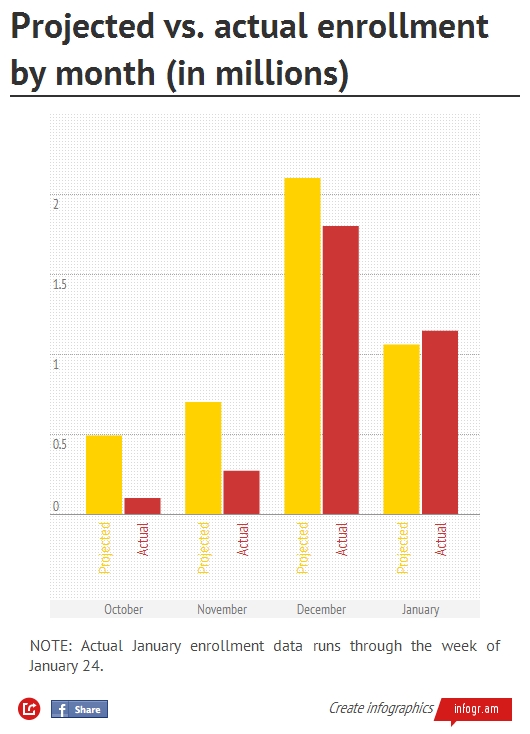
In fact, January sign-ups exceeded expectations:

The latest enrollment data from the Obama administration show that 3.3 million people have signed up for private health insurance through federal and state insurance exchanges created under the Affordable Care Act. This figure represents all enrollment from Oct. 1 through Feb. 1. It includes both people who have and have not paid their first month’s premium. Of those people, 1,146,100 selected their health insurance plans in January, meaning there was a 53 percent increase enrollment last month alone.

This makes January the first month that the Obama administration has beaten an enrollment target. Back in September, way before HealthCare.gov’s botched launch, the Centers for Medicare and Medicaid Services projected that 1,059,900 people would sign up for private health insurance in January. However, the Obama administration still falls short of projected, cumulative enrollment by 1 million people, largely due to the anemic sign-ups in October and November.

Benen sees the numbers as evidence that the system is stabilizing. Sprung worries that only those who qualify for subsidies seem to be signing up:

Fully 82% of the 3.3 million people who have selected a marketplace plan are eligible for subsidies. That would be 2.49 million.  Overall, 7.27 million people have been determined eligible to enroll in a marketplace plan.  Of those, 4.16 million, or 57%, are eligible for subsidies. 60% of them (2.49 out of 4.16) have pulled the trigger and selected a plan Of the 3.11 million who have completed applications and been found ineligible for subsidies, just 594,000 — again, 19% — have enrolled in plans.

The low signup rate thus far for the subsidy-ineligible is perhaps unsurprising. Unsubsidized insurance on the exchanges is expensive. In New Jersey, a single 27 year-old earning a bit over $32,000 will pay $249 per month for the cheapest silver plan; two 60 year-olds earning $63,000 will pay $1,346 per month.  Perhaps many of the unsubsidized will sign up near the deadline; perhaps a significant percentage have bought insurance off the exchanges.

Cohn looks at the big picture:

We don’t know how many of these people have paid premiums. We don’t know how the demographics compare to what insurers had expected. And we don’t know how many of these people had insurance previously. Those are some pretty big unknowns.

But on that last point, at least, we have one more, very small hint that the law is making real progress. It comes from Gallup, which regularly polls on the question of whether people have insurance. According to its latest round of polling, which includes 19,000 survey responses between January 2 and February 2, the proportion of Americans without health insurance has fallen to 16 percent—lower than it was in the first quarter of 2013 and lower than its been anytime since Obama first took office.

Sargent talks to Kaiser’s Larry Levitt about those Gallup numbers:

“It’s an early possible sign of success,” Levitt told me. “There’s been a lot of uncertainty about the affect the ACA is having on the number who are uninsured. Clearly people are signing up, and clearly Medicaid coverage is expanding. But many had their policies canceled. This is the first sign that the net of all that is still likely a decrease in the number of uninsured — it may be moving in the right direction.”

Still, Levitt added: ”I would emphasize that it’s noisy.”

Philip Klein points out the huge discrepancies in enrollment from state to state:

In 11 states including Connecticut, Rhode IslandNew YorkMaine and New Hampshire, signups are more than 100 percent of projected enrollments. On the other hand, in 13 states signups are tracking at less than 50 percent of original targets.

Though supporters of the health care law have tried to point fingers at Republican states for trying to sabotage enrollment efforts, the worst-performing states were among those that were most gung-ho about implementing the law, including Massachusetts, OregonMaryland and the District of Columbia.

If these numbers hold up, the could lead to some interesting decisions for insurers, who may try to back away from exchanges in states that haven’t proved viable, while increasing the number of carriers offered in other states.

Matthew Herper thinks the ACA is looking less and less repealable:

The point is that even with all the law’s problems, there may be a substantial number of people who come to depend on it before there is any political chance of repealing it — before the midterm elections. A more likely outcome than repeal, [Austin] Frakt believes, will be that Republicans, or the government as a whole, will eventually find a way to give more freedom to the states to change some of the parameters of the ACA, bringing states that have resisted marketing their own exchanges or enrolling patients in Medicaid into the fold. Says Frakt: “It may be a conservative means to a progressive ends.”

Even Obamacare critic Avik Roy admits there won’t be a “death spiral” at this rate:

In some quarters, there has been a kind of intellectual laziness, a belief that there’s no need for critics to come up with better reforms, because Obamacare will “collapse under its own weight,” relieving them of that responsibility.

Obamacare isn’t good for the country. But it’s not going to collapse.