The Aftershocks Of Windsor

Yesterday in Kentucky, US District Judge John G. Heyburn II ruled that the state was constitutionally obligated to recognize same-sex marriages performed in other states, citing Windsor and other new laws and rulings that have struck down state bans in recent months:

Although the judge said he was bound by precedent in his judicial region (the federal Sixth Circuit) to apply only the easiest-to-meet constitutional standard — that is, “rational basis” review — he said that Kentucky’s refusal to give equal treatment to validly married same-sex Kentuckians could not satisfy even that low-level test.  He canvassed all of the arguments made for treating same-sex married couples differently, and found none of them to have merit.

A noteworthy part of Judge Heyburn’s opinion was a studied effort to explain to those who would be offended by his ruling, especially on the basis of their religious or cultural beliefs, why he was led to his decision as a constitutional matter.  That section of the ruling read very much like a basic civics lesson about the way that the Constitution’s protection of individual rights may sometimes override traditional moral and political preferences, and even trump the expressed wishes of a political majority.

Mark Joseph Stern points out that Antonin Scalia’s premonitions about Windsor were absolutely right:

Now, for the second time in two months, a federal judge has taken Scalia at his word and struck down state-level anti-gay laws. This time, the unlikely state is Kentucky, and the judge is John G. Heyburn, a George H.W. Bush appointee recommended by Republican Sen. Mitch McConnell. Heyburn’s opinion mostly follows the emerging pattern of these kinds of rulings: He wavers on the scrutiny question, finds that the law was driven by anti-gay animus, and strikes it on Equal Protection grounds. The ruling itself is narrow; Heyburn was only asked to invalidate the portion of Kentucky’s law that bans recognition of out-of-state gay marriages. But the judge added that should the entire ban be challenged, “there is no doubt that Windsor and this court’s analysis” would likely hold it unconstitutional.

The path to a final resolution of this seems shorter by the day. That’s not because of judicial tyranny, but because of the logic of seeing gay citizens as equal under the law.

(Photo: Justin Sullivan/Getty)

Why The GOP Needs Immigration Reform

Last week, Pete Wehner warned that “the challenges facing the Republican Party, at least at the presidential level, are significant and fairly fundamental.” Among the facts he marshals to make that argument:

In 2016, if there is not a dramatic reduction in African-American turnout, a Republican presidential candidate will need to get 60 percent of the white vote, plus a record-high share among each portion of the non-white vote (African-Americans, Asians, Hispanics, and others) to win a bare 50.1 percent of the vote.

In response, Trende pooh-poohs the importance of Hispanic voters:

If the GOP reduces the Democrats’ share of the Hispanic vote to 67 percent, Florida goes Republican. At 56 percent, New Mexico flips. Nevada and Colorado flip at 51 percent and 50 percent, respectively. Incidentally, Mitt Romney is still losing the Electoral College, 283 to 255. It isn’t until the Republicans win 63 percent of the Hispanic vote that Pennsylvania finally flips, handing Romney the presidency.

There are very good reasons to pursue the Hispanic vote from both moral and policy perspectives, and of course every vote does help. But from a cold electoral calculus, the Democrats’ gains among Hispanics at this point yield very little fruit.

Chait counters Trende by focusing on Florida:

Last July, Nate Cohn wrote a definitive piece explaining why Florida should terrify Republicans. Cohn is hardly a Democratic Pollyanna – he’s also made the bracing case that Texas is not going to turn blue or even purple for a long, long time, if ever. The white share of the vote is rapidly collapsing in Florida, having fallen from 72 percent of the vote in 2004 to under 66 percent in 2012, and is projected to keep dropping fast. Only a precipitous spike in white support for Republicans, probably in keeping with the general white southern reaction against Barack Obama, has kept the state even close; as Cohn explains, if the next Democrat could merely replicate John Kerry’s performance among white voters, he (or she) would win the state by nine points.

Republicans may not have the luxury of building their entire comeback strategy around regaining Florida. As Trende implies, flipping the state alone wouldn’t have given Mitt Romney enough electoral votes to win in 2012. But winning the presidency without Florida is nearly unimaginable for Republicans.

Dick Cheney Has No Regrets

The trailer for R.J. Cutler’s The World According To Dick Cheney, which premiered last March:


What has long struck me about Dick Cheney was not his decision to weigh the moral cost of torture against what he believed was the terrible potential cost of forgoing torture. That kind of horrible moral choice is something one can in many ways respect. If Cheney had ever said that he knows torture is a horrifying and evil thing, that he wrestled with the choice, and decided to torture, I’d respect him, even as I’d disagree with him. But what’s staggering about Cheney is that he denies that any such weighing of moral costs and benefits is necessary. Torture was, in his fateful phrase, a “no-brainer.”

Think about that for a moment. A no-brainer. Abandoning a core precept of George Washington’s view of the American military, trashing laws of warfare that have been taught for centuries at West Point, using the word “honor” as if it had no meaning at all: this is the man who effectively ran the country for years after 9/11, until he was eventually sidelined in the second Bush term. Here is the true Nietzschean figure – beyond good and evil, motivated solely by his own will to power and hatred of those who might thwart him. Here is the politician Carl Schmitt believed in: one for whom all morality is subordinate to the exercise of power, and whose favorite form of power is overwhelming physical violence. The other word for this is sociopath.

Mark Danner, in his latest examination of this profoundly evil figure in American history,  considers the former vice president’s legacy:

Asked by Cutler whether he considers “a prolonged period of creating the sensation of drowning”—waterboarding—to be torture, Cheney’s response comes fast and certain:

I don’t. Tell me what terrorist attacks that you would have let go forward because you didn’t want to be a mean and nasty fellow. Are you gonna trade the lives of a number of people because you want to preserve your, your honor, or are you going to do your job, do what’s required first and foremost, your responsibility to safeguard the United States of America and the lives of its citizens. Now given a choice between doing what we did or backing off and saying, “We know you know their next attack against the United States but we’re not gonna force you to tell us what is is because it might create a bad image for us.” That’s not a close call for me.

Quite apart from the large factual questions blithely begged, there is a kind of stark amoral grandeur to this answer that takes one’s breath away. Just as he was likely the most important and influential American official in making the decision to withhold the protection of the Geneva Conventions from detainees, Cheney was likely the most important and influential American when it came to imposing an official government policy of torture. It is quite clear he simply cannot, or will not, acknowledge that such a policy raises any serious moral or legal questions at all. Those who do acknowledge such questions, he appears to believe, are poseurs, acting out some highfalutin and affected pretense based on—there is a barely suppressed sneer here—“preserving your honor.” What does he think of those—and their number includes the current attorney general of the United States and the president himself—who believe and have declared publicly that waterboarding is torture and thus plainly illegal? For Cheney the question is not only “not a close call.” It is not even a question.

It’s rare to see such arrogance combined with such indifference to evil. Cheney would have made a great leader of Russia. America? We will live for ever with the acrid taint of his evil.

Christianists On The Left? Ctd

A reader writes:

I think you and Dreher are missing something here. You are assuming that the Moral Mondays people are just now deciding to take a Christian message into politics, but that’s not what is happening. Their religion has always been in their politics. These liberal Christians are just adjusting their language for a Christian audience.

I grew up in Lynchburg, Virginia as a Christian, though I was not a member of Jerry Falwell’s church. For years I tried to argue with people you would call Christianists about one issue or another using secular sources: scientific studies, statistical analyses, the Constitution, whatever. What I did not realize was that only source that matters to Christianists is the Bible. Their obsession with the Bible (or at least approved translations of the Bible) borders on idolatry.

Eventually I figured out that if I wanted to make a point, I needed to be working from the same source material.

For example, if I wanted to convince Christianists that women were equal to men, I had to point to Deborah, Phoebe, and Junia, not to Thatcher and Palin (though mentioning those two doesn’t hurt). The best way to convince a Christianist that climate change is a problem is to remind her that God gave humanity dominion over Earth and to frame her responsibility for the environment as a Christian duty given to her by God.

You and Dreher assume that liberal Christians have not already brought religion into politics. You are wrong. Liberal Christians have always brought their religious beliefs into politics. Recently though, they have just been making their arguments for their beliefs in secular language, which is important for court battles, but it is not the language Christianists speak. If liberal Christians only use secular terms to make an argument, there is a sizable portion of the population that they will never reach because we will be dismissed out of hand.

Religion is, and always has been, a part of politics for both sides. Remember when Obama referenced being our brother’s keeper in his 2004 convention speech? What about abolition? That was all about what the Bible said, and both sides used the Bible as a source of support for their arguments. These liberal Christians are just using different source material to back up their assertions in order to reach a different audience. If your definition of Christianist is now so broad as to include anyone who cites the Bible as a source in making a political argument, we are, and always have been, a majority Christianist nation.

Yes, we have been. I don’t deny that. And in an entirely Christian context, debating whether this or that verse of the Bible requires this or that response is something no one would object to. But Moral Mondays do not exist in a purely Christian context; they exist in a secular context. And they do so because discussion about policy and politics in America in 2014 takes place within a multi-faith and multi-cultural country. And when you start making political arguments from explicitly religious fiats, you are leaving the entire premise of secular politics behind. You treat non-Christian citizens as if they do not exist. You attempt to persuade them by citing verses of a Holy Book they may well regard as a fairy tale. You are, in fact, legitimizing the very basis for the Christianist right – and their conflation of religion and politics.

If that’s your intent, you are both undermining your ability to make your case to non-Christians or to Christians who do not share the premises of Christianism; and you are fighting on a battlefield where fanatics and extremists will almost always win. The battle between Christianist right and Christianist left is not, after all, evenly matched. The Christianist right would crush their opponents in any fight you can name.

My view remains that all public policy and political arguments should remain in secular terms, appealing to citizens qua citizens as opposed to members of any religious grouping. Yes, of course those of us who are Christians will reach our varied political positions after filtering them through the prism of our faith. But we have a moral duty to translate those positions into wholly secular public arguments. Or risk turning our democracy into a sectarian screaming match. I’d leave that to the Middle East.

More from readers here.

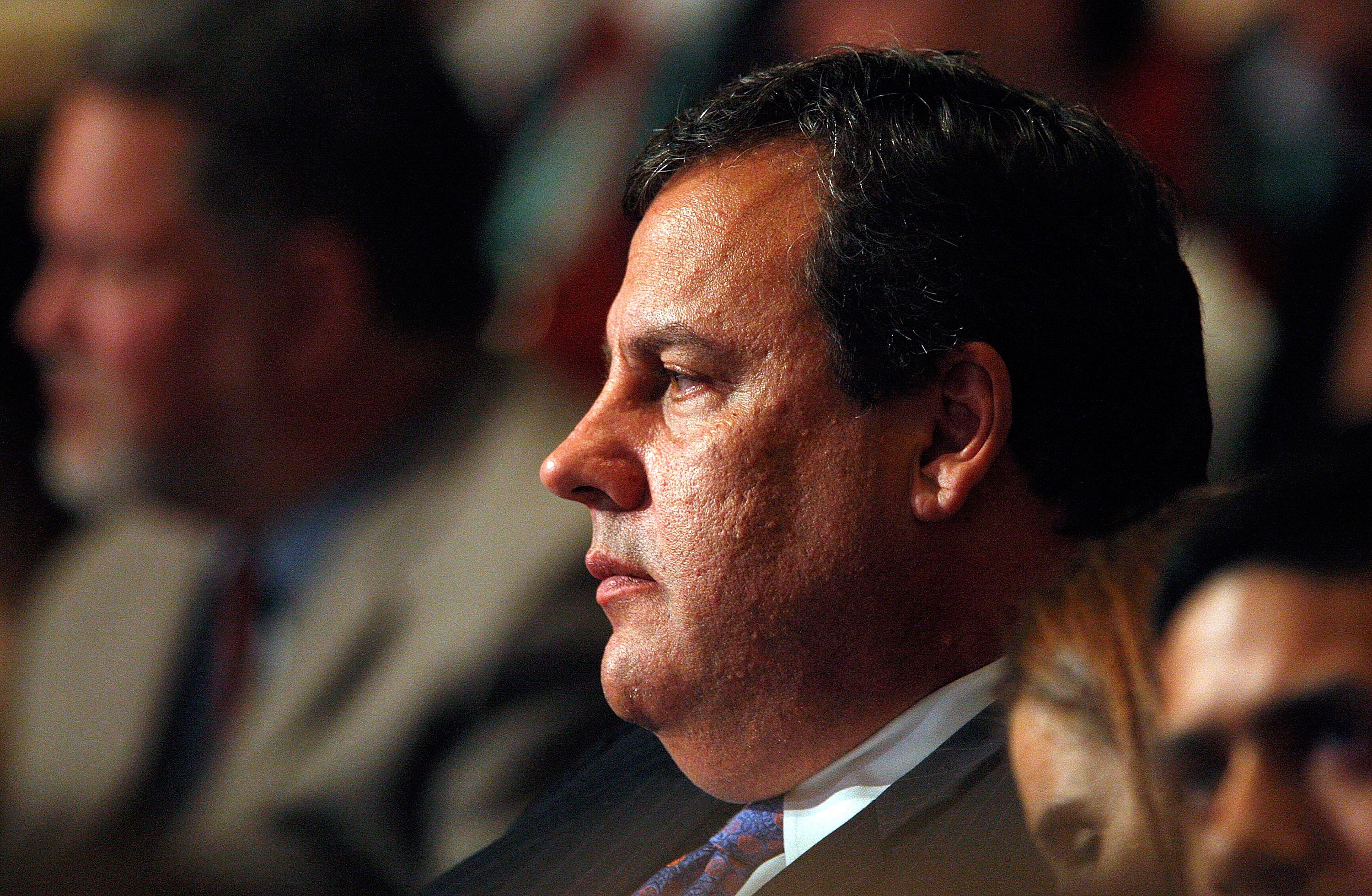
Chris Christie’s House Of Cards

Republican Presidential Candidates Debate On Economy In New Hampshire

Alec MacGillis has a terrific, granular and vivid take on Christie’s entire career in New Jersey, and Beau Willimon might take a look at it for a new drama series. It proffers an answer to the key question floating around in my head since Bridgegate: if that kind of petty politicking was Christie’s mojo, why did we not see that scandal coming? Where are all the other incidents of palm-greasing, threats, and payback? If Christie were that tawdry a public official, why did he have such a great rep for targeting corrupt pols?

MacGillis’ answer is pretty simple: Christie targeted lots of petty corruption, removing large numbers of small-time bosses for various shenanigans, while leaving the big bosses intact. And those big bosses in New Jersey’s rich panoply of appointees, commissions, and government grants helped him govern the state. So he both targeted petty corruption and chummed it up with those with the big sticks and greatest leverage over the state (almost all of whom were and are Democrats). He wasn’t a Robespierre targeting every machine pol; he was a Machiavelli targeting the least powerful bosses by aligning with the much more serious ones:

The problem with Christie isn’t merely that he is a bully. It’s that his political career is built on a rotten foundation. Christie owes his rise to some of the most toxic forces in his state—powerful bosses who ensure that his vow to clean up New Jersey will never come to pass. He has allowed them to escape scrutiny, rewarded them for their support, and punished their enemies. All along, even as it looked like Christie was attacking the machine, he was really just mastering it.

The piece draws on MacGillis’ deep knowledge of New Jersey politics. And it has some wonderful vignettes of the various bosses in Christie’s empire – chief among them, George Norcross:

In the early 2000s, several New Jersey attorneys general investigated whether [Norcross] had pressured a Palmyra councilman to fire a city solicitor, Ted Rosenberg, who wasn’t cooperating with the machine. Wiretaps offered a rare glimpse of a man completely convinced of his power. “[Rosenberg] is history and he is done, and anything I can do to crush his ass, I wanna do cause I think he’s just a, just an evil fuck,” Norcross said. In another conversation, referring to then-top Jersey Democrats, he declared, “I’m not going to tell you this to insult you, but in the end, the McGreeveys, the Corzines, they’re all going to be with me. Not because they like me, but because they have no choice.” While discussing plans to remove a rival, he exclaimed: “Make him a fucking judge, and get rid of him!”

Some of Christie’s tactics were truly brilliant, Francis Underwood maneuvers. By the end of the piece, I both better understood why the Romney campaign decided not to go there and also began to appreciate the kind of bare-knuckled politicking that enabled Christie to get shit done in the Garden State. Which is to say that MacGillis’ piece both explained why Christie would be a corrupt and impossible president, but also perhaps a brutally effective one.

(Photo: Scott Eells-Pool/Getty Images)

“A Man’s-Man Game” Ctd

A reader writes:

If Michael Sam is drafted by a well-coached/managed team, and if he can sack quarterbacks and hard-hit running backs, he’ll be just fine.  Remember the handwringing of conservatives when Don’t Ask Don’t Tell ended in 2011?  OMG the showers, the showers, the showers – straight guys atremble at the thought of a gay guy ogling their schlongs. Crickets.

Dave Cullen, who is writing his next book on two gay Army officers under DADT, makes that connection as well:

The old men of the NFL are trotting out the same tired arguments the codgers in the Pentagon got away with for years. The military fretted about “unit cohesion.” This week, the charge sounds comically pettier: They keep referring to telling the truth as a “distraction.” Both old guards feign horror at nakedness in the showers—as if most straight men in America haven’t pulled their dicks out at a urinal beside a gay guy in the last week.

[Sportswriter Rob] Rang copped to the comparison: “There remains a bit of a don’t-ask-don’t-tell policy” in the NFL he wrote. A bit? That’s precisely the unwritten policy every gay player has adhered to in the history of the NFL. You can be gay, as long as you lie about it. … I’ve spent years following a handful of gay soldiers, and the lengths they went to hide the truth—big and especially small—were mind-boggling.

They start with de-gaying the house. A lieutenant colonel described rushing home to de-gay before hosting his unit’s Christmas party: Hide pictures with gay friends and any iffy music or magazines. An Ani DiFranco or Tori Amos can be neutralized with a hefty country section or heavy metal. “Lighting and bathroom products—those were the biggest tells,” the officer said. “Not too many lamps—too much dim lighting screamed lady friend!”  No more than two or three hair “products.” Bonus points for Pert Plus or Vaseline Intensive Care; no rejuvenating lotion or eye cream, and never ever anything labeled Clinique.

Football is actually less uber-macho than the army, and Michael Sam probably could have gotten away with a Clinique bottle, especially if he balanced it with enough NASCAR and Bud Light. But he had a boyfriend. That gets really tough, especially once the guy moves in. “Roommate” is the obvious alibi, but that introduces surprisingly-complex new lies.

Read all of the Dish’s coverage of Michael Sam here. One more reader:

Did I miss something or has nobody commented on the exquisite timing of Michael Sam’s announcement coming right after the opening of Sochi/Putin’s Anti-Gay Winter Olympics?

Chart Of The Day

Cancer Chart

Chris Kirk passes along an interactive graphic (screenshot above) that shows the prevalence and mortality rates for different types of cancer:

As the chart reflects, breast and prostate cancers are the most common, with 235,000 and 239,000 new cases last year respectively. Fortunately, they are relatively survivable cancers, though their mortality rates more than double by the 20-year mark. Pancreatic cancer is the most deadly, killing 96 percent of patients within five years. That’s partly because pancreatic cancer typically does not cause symptoms until it’s at a late stage of progression. For the same reason, liver cancer is the second-deadliest cancer, killing 93 percent of patients within five years.

The original graphic comes from David Taylor, who runs a data-visualization blog. Interactive version here.

What Should We Expect From Immigrants?

Responses are pouring in to the permanent resident from India who wrote, “I fail to understand why amnesty for illegal immigrants is assumed to be a force for the good. Why should we reward people for breaking the law? And why is it so unacceptable to ask immigrants to learn English?” One reader:

While I understand the Indian immigrant’s very justified frustration, his arguments against amnesty based on the rule of law miss an important point. The immigrants in question paid to travel from their places of origin to the United States because there was work to be had. And who provided that work? It was us, as a society. We were willing to look the other way when our farms hired migrant workers to bring in the harvest; when our landscapers hired day laborers without green cards; when our hotels and restaurants and meatpacking plants and retailers hired workers who they knew would do more work for less money and who had a strong disincentive against complaint if conditions were bad.

If we would punish those who came to fill the demand we placed as a society, shouldn’t we punish those responsible for that demand? And if we are unwilling or unable to punish those who willingly exploited this failure in the name of profit, why should we punish those who were exploited?

Another writes:

I think these types of questions have a flawed premise. Rather than asking “Why can’t they just learn English?”, we should be asking “On what moral and ethical basis can we exclude anyone from migrating to our country?” As long as the people in question are acting in good faith, and want to come to America with the intention of working and securing a better future for their family, what right do we have to refuse them?

Another:

Many years in this country apparently did not teach your reader the finer points. I am from India as well. I came here for school, and when a company offered a job, I stayed. It’s been about 17 years now. Somewhere along the way, I applied for the green card, and then citizenship, all like clockwork. All went through, at considerable costs. These are not cheap or easy processes, especially if you go through a lawyer. And that gave me perspective.

For many from Mexico or Central America, these costs can hardly be borne without breaking their meager savings. They trekked across and made this dangerous journey, all for a better life. Not for mansions, just to work at a mansion. Not for enjoying the finest cuisines, but to work in the kitchen. They have higher goals, I am sure, and I wish them the very best to get there. The person from India thinks nothing of speaking English, or a few other languages. This is just not possible for an average immigrant who crossed the Rio Grande in desperation.

I wish the reader would learn what America means truly to a lot of people before he gets naturalized – and I promise, it is not “I came here in a plane with papers, and you did not!” or “I speak English, and so should you!”

On that note:

We are not lowering the bar by failing to mandate English; we would in effect be dramatically raising the bar beyond anything we have required of previous generations. First-generation travelers from Europe and Asia were just as likely to establish conclaves built around their former homelands’ cultures and languages as modern-day arrivals do. Why do you think we have sections of major metropolitan cities and states referred to as Little China or Little Italy or Pennsylvania Dutch Country? Why are those areas considered fantastic islands of preserved culture and a core part of the Americana, while Little Havana or Little Haiti are disparaged as as problems of failed assimilation?

Another adds:

This has been true since 1753, when Ben Franklin wrote of German-speaking immigrants:

Few of their children in the country learn English. … The signs in our streets have inscriptions in both languages, and in some cases only German. … Unless the stream of their importation could be turned from this to other colonies, as you very judiciously propose, they will soon so outnumber us [so] that all the advantages we have will, in my opinion, be not able to preserve our language, and even our government will become precarious.

But an American abroad argues that a language requirement would be “pro-immigrant, in that it should reduce the risk of social isolation, victimization, or helplessness in dangerous situations”:

I’m am American living in Italy, which within the past few years has instituted a language test requirement for all who apply for long-duration residency. The test itself was much easier than I anticipated: present tense only, checking one’s ability to comprehend brief written and verbal passages on topics like grocery shopping, job openings (as if they exist here), and the weather – things one needs to understand to function anywhere. Then you had to write a brief “postcard” to a friend describing your new “job.” Based on the names on the roster, many of them started life with a different alphabet, either Arabic or Cyrillic. Of the 47 other testees in my group, only one failed.

Without any demonstrable language skills, one is far more likely to be taken advantage of, if not outright exploited. People need to be able to call the police or ambulance, understand job terms, navigate basic transactions, speak with a doctor. You don’t need fluency or an advanced vocabulary, but you do need to be able to connect in some elementary way with the people around you for a sense of social inclusion as well.

Mitt’s Missing Mormonism

After watching the Netflix documentary Mitt (seen above), Batya Ungar-Sargon notices that the film barely covers the candidate’s religious life:

It’s no wonder Romney appeared wooden to voters; he had to hide a major part of what motivates him. Yet even here in the hearth of the Romney clan, while glimpses of religion are central to [filmmaker Greg] Whiteley’s portrayal, the family’s Mormonism is hardly on display. It’s surprising how the documentary, whose creator, Whitely, is himself a Mormon, casts a sanitized gloss on the religious moments, all of which are themselves highly unspecific. One could watch this film and never know that Romney is a Mormon (except when he calls himself “the flipping Mormon”), which suggests that even in a film purporting to be an intimate portrait of Romney, some things are still off-limits, and get edited out.

But why?

Did Whiteley fear that the film’s largely sympathetic portrayal of Romney would be compromised by overtly Mormon scenes? How much of this narrative decision was informed by Whiteley’s own Mormon background? Would the intimacy viewers feel watching this lovely portrait of a close-knit family potentially have been disabled by the specifics of the Romney’s Mormon faith? Unfortunately, because Mitt doesn’t deliver on this front, we’ll never know.

In Whiteley’s words:

My initial attraction to Mitt was his Mormonism. I’m Mormon and I remember my dad telling me the story of [Mitt’s father] George Romney when I was a little kid. I remember being very surprised to learn that there was an actual presidential candidate — and not just any presidential candidate, but someone that was actually a legitimate contender, a front-runner…

The documentary prompted Alex Beam to speculate that Mormon leaders might have been relieved that Romney didn’t win, since a victory would have brought “another order of exposure entirely” to the church:

While it is true that many wealthy Mormons, such as the Marriott family, or JetBlue founder David Neeleman, donated lots of time or money to Romney’s campaign, the church remained neutral. The church, which takes stands on some political issues, for example, on same-sex marriage, says it doesn’t endorse political candidates, and Romney was no exception.

“No one would ever come out and say it, but I suspect what you are thinking is probably true,” says Matthew Bowman, a Mormon professor of religion and author of “The Mormon People.” “The whole Romney campaign was a shock to the system for a church that generally wants to move very slowly and is used to hashing out things out internally over a long period of time.”

Speaking of Mormon history, Doug Gibson reviews Some Savage Tribe: Race, Legal Violence and the Mormon War of 1838, a new article by T. Ward Frampton in The Journal of Mormon History. Previous Dish on Mitt here and here.