A Flood Story Older Than Noah

A recently deciphered Mesopotamian tablet offers yet another alternative telling of the flood story – and at 3,750 years, it predates the Genesis version we know so well. Mark Esposito is enthused:

The find is important because it points up the similarities in the ways ancient cultures viewed the world and coped with its unpredictable circumstances. Seeing themselves as pawns before angry gods and survivors of catastrophes beyond their control empowered these civilizations and brought disparate tribes together. Indeed, some scholars have opined that a function of ancient religion was to galvanize groups of humans with a common ancestry and belief system regardless of the effects of geography or political culture. The flood story seems have served that function many times over as it spread throughout the Fertile Crescent into Egypt and North Africa and beyond. You can read about flood stories around the world here. There are hundreds.

British Museum curator Irving Finkel, author of the forthcoming The Ark Before Noahexplains what makes this new story unlike the others:

When the gods decided to wipe out mankind with a flood, the god Enki, who had a sense of humor, leaked the news to a man called Atra-hasis, the ‘Babylonian Noah,’ who was to build the Ark. Atra-hasis’s Ark, however, was round. To my knowledge, no one has ever thought of that possibility. The new tablet also describes the materials and the measurements to build it: quantities of palm-fiber rope, wooden ribs and bathfuls of hot bitumen to waterproof the finished vessel. The result was a traditional coracle, but the largest the world had ever dreamed of, with an area of 3,600 square meters (equivalent to two-thirds the area of a football pitch), and six-meter high walls. The amount of rope prescribed, stretched out in a line, would reach from London to Edinburgh!

To anyone who has the typical image learnt from children’s toys and book illustrations in mind, a round Ark is bizarre at first, but, on reflection, the idea makes sense. A waterproofed coracle would never sink,and being round isn’t a problem – it never had to go anywhere: all it had to do was float and keep the contents safe: a cosmic lifeboat. Palm-and-pitch coracles had been seen on the Euphrates and Tigris rivers since time immemorial: they were still a common sight on Iraq’s great waterways in the 1950s.


The Brief Wondrous Life Of “Flappy Bird”

Leonid Bershidsky chronicles the rise and fall of the touchscreen sensation:

[Dong] Nguyen, who claimed he was making $50,000 a day from in-game ads, appears to have taken the game down for ethical reasons. On Feb. 10, the 29-year-old developer explained what exactly it was he “couldn’t take” to a Forbes reporter in Hanoi who spoke to him in Vietnamese. He was smoking nervously and had to put off the interview because of a meeting with a deputy prime minister.

“Flappy Bird was designed to play in a few minutes when you are relaxed,” Nguyen said. “But it happened to become an addictive product. I think it has become a problem.”

The American Psychiatric Association has so far declined to include computer game addiction to its Diagnostic and Statistical Manual of Mental Disorders. Still, some studies have shown that game addiction and substance dependence may share the same neurobiological mechanism. In effect, Nguyen felt he was selling the equivalent of drugs, and that bothered him. Some people appear to have reacted adversely to withdrawal: When Nguyen took the game down, he started receiving death threats that looked only half-facetious.

Yannick LeJacq explores the murky concept of videogame addiction:

“Addiction” might not be a physiological phenomenon in video games the same way it is for coffee, cigarettes, or heroin. But the word, perhaps for want of a better descriptor, has a special meaning for many game developers.

While talented and charismatic entrepreneurs like King’s Tommy Palm don’t exactly go around encouraging people to mainline Candy Crush, they speak openly and enthusiastically about the most artless sounding parts of their games—user acquisition, retention, and spending—all with the focus of how to increase those values.

And that’s fine. But there’s another camp of people who think that people like Tommy Palm are out to destroy video games as an art form. We’re finally able to create majestic, cinematic works like Journey and The Last of Us, the reasoning goes, but now smartphone games are trying to plunge games as we know them back into the muck and mire of slot machines.

Suddenly, artistic concerns become ethical ones.

Of course, the Flappy Bird clones have already arrived, including some that scam players:

According to researchers at Trend Micro, Android-based Flappy Bird clones are “especially rampant in app markets in Russia and Vietnam,” and look exactly like the original. The scam they run is pretty straightforward: the new apps require permission to send text messages—something the real Flappy Bird didn’t require—and use that newfound power to send texts to premium numbers that charge the subscriber a fee.

Bronze Isn’t So Bad

Silver is worse:

Research suggests that in the Olympics, those who finish third are likely to be a lot happier than those who finish second. The reason is that much of our thinking is based on counterfactuals. We like to ask: What else could have happened?

If you finish second, you tend to think that with a little good luck, or maybe a bit of extra effort or skill, you might have gotten the prize of a lifetime: Olympic gold. But if you finish third, you tend to think that with a little bad luck, or without that extra effort or skill, you wouldn’t have gotten the prize of a lifetime: an Olympic medal.

Update from a reader:

Did you ever hear Jerry Seinfeld’s take on this? Very funny:

The Best Of The Dish Today

Winter Storm Affects Large Swath Of Southern States

One of the weird privileges of mass intimacy is that you can be deeply moved by the lives of people you’ve never met. That’s what the Dish has been for me for the near decade and a half I’ve been writing and editing it. I almost feel I know people from their email addresses, from countless little virtual exchanges that, over the years, accumulate into a person. And so you can imagine the stream of emotions that was prompted by this one:

I’m sitting here in the airport, about to get on a plane for the first time in over a decade and I wanted to take this moment (flight delayed) to renew my subscription and send along a note of gratitude. As an undocumented immigrant, my American partner and I Greencard yayhave struggled to build a life together over the last 22 years, navigating the myriad legal, social and practical challenges that thousands of other bi-national same sex couples in similar situations have endured.

In recent years, during my more self-pitying moments, when we thought we might never get out of this bind, it was your blog that helped steel my resolve (that and my guy’s preternatural optimism). Your unrelenting, clear-throated accounting of each and every way marriage inequality directly and indirectly impacts gay peoples’ lives has helped me focus, and more clearly see my own circumstances in the greater context. I know, it’s called perspective, but that can be a distant shore when your struggling to stay afloat.

So now, with the fall of DOMA and our subsequent marriage, my husband and I finally come blinking into the light, clutching that small green card, and the first thing I wanted to do was thank you. I owe you a debt of gratitude for helping me get to the airport. Know hope indeed.

Yes, that’s exactly it: you clutch that small green card. And I can remember when I first did.

Today, I absorbed the life-story so far of Michael Sam, and a reader seconded. The case for adopting an abused dog can be found here in some photographs. This bouncy, psychedelic animation feels like your iTunes visualizer just did some crystal meth. I can’t believe they banned the women’s ski jump because of danger to the ovaries … but they did. I surveyed the new social media news landscape, and praised the literary hatchet job (done right).

The most popular posts of the day were both about the struggles of Michael Sam.

See you in the morning.

(Photo: Crape myrtle berries are covered in ice after a rare winter ice storm swept across the South February 12, 2014 in Summerville, South Carolina. More than 400,000 customers have lost power across the Southeast and at least 13 deaths caused by the storm. By Richard Ellis/Getty Images.)

What The Hell Is Happening In Bosnia?

Merdijana Sadović summarizes the latest:

What started earlier last week as peaceful demonstrations by unemployed workers in the town of Tuzla – one of the main industrial hubs in pre-war Bosnia – turned into the worst violence this country has seen since the end of the conflict. Within a few days, the unrest had spread to other cities in the Federation, the larger of Bosnia’s two administrative entities, which is populated mainly by Bosniaks and Croats. The other entity created by the 1995 Dayton Peace Agreement which ended the war is the Serb-majority Republika Srpska (RS), which largely escaped the protests.

While most Bosnians sympathized with the protesters’ fury about unemployment and rampant corruption, as well as their demands for local officials to resign, they were taken aback by the violence, as government buildings in Tuzla, Sarajevo, Zenica and Mostar were set ablaze. Dozens of people were injured, most of them police officers protecting these buildings.

Harriet Salem sheds some light on the reasons for the unrest:

Ostensibly, the protests can be linked to widespread public discontent over Bosnia’s rampant unemployment and beleaguered economy. Nationwide, joblessness stands at 44.5 percent; it is a staggering 60 percent in the 15-to-24-year-old age bracket. The average wage is around $545 per month – one of the lowest in Europe.

But these economic woes are fueled by a much more deep-seated problem: a political system mired in corruption and nepotism.

In the aftermath of the Bosnian War, dodgy backroom deals to dole out businesses nationalized during the socialist era – including the Tuzla factories – were some of the first examples of the long list of dubious tactics deployed by the political elite to line their own pockets. Often sold under favorable conditions to the cronies of politicians, the businesses had new bosses who were frequently either incompetent or outright crooked. The resulting combination of inefficient management, skimming, and the state turning a blind eye to it all drove several vitally important local industries to the point of collapse

Joshua Keating adds, “the political paralysis that led to the current crisis is certainly related to the compromise that ended the war”:

[T]he political paralysis that led to the current crisis is certainly related to the compromise that ended the war. The Dayton Accords, which ended the war in 1995, were designed to divide power among the Bosniaks, Croats, and Serbs. In practice, as a 2011 Reuters feature put it, the deal “split the country into two autonomous, ethnically based regions so decentralized and unwieldy that Bosnia barely functions at the state level.” …

The Dayton Accords may have been the best deal available at the time, and negotiators including the late U.S. diplomat Richard Holbrooke certainly deserve credit for helping to end the bloodshed. But in the name of stopping the fighting, the agreement put off questions of how the cobbled-together nation was supposed to function as a state. Twenty years later, those chickens seem to be coming home to roost.

The Question Rubio Won’t Answer, Ctd

Saletan bashes the young Senator for refusing to confirm or deny that he ever smoked marijuana:

When you tell a child that it’s bad or unwise to do something, and the child asks you whether you’ve done it, the most important thing isn’t to persuade the child that you’re clean. The most important thing is to tell the truth. … Kids aren’t stupid. When they ask whether you’ve smoked pot, and you evade the question, they don’t conclude that it’s bad to smoke pot. They conclude that you think it’s OK to hide the truth from your kids. What they’re learning from you is deceit.

A reader sounds off:

I’m by no means a fan of Marco Rubio, but I’m not particularly upset that he won’t answer the questions. Politicians make a practice of not answering questions if they can avoid it, and certainly not questions the answers to which could potentially alienate voters. I should say that I think his refusal to answer is kind of stupid, which is par for the course with Rubio. Hardly anyone would refuse to vote for him if they knew he had smoked some pot back in the day and, in fact, his weaselly refusal to answer could lose him some votes.

But the answer that he should have given is: “None of your business”. Whether he had ever smoked pot has absolutely no bearing on his qualifications to be President. And while journalists are certainly entitled to ask him this question, I disagree with you and believe that we aren’t entitled to an answer from him. In my view, this is a purely private matter.

Update from another:

The reader you quoted is wrong. Marijuana prohibition is a matter of public policy. If a politician supports said prohibition, as we must assume Rubio does, then the public has a right to know whether or not he has smoked before. We’re not talking about Rubio’s sex life here, where privacy would be expected – and where no laws prohibit him from doing whatever he chooses in the bedroom.

Toe Tapping Among The Goose Steps, Ctd

Remembering the 1940s swing group The Harlem Kiddies – an Afro-Jewish ensemble that improbably made it big in WWII-era Denmark – Anne Dvinge examines how jazz flourished in Nazi Europe:

In the occupied territories, jazz continued to exist and even thrive. In Norway, a ban on radio jazz transmissions meant an increase in live performances, both public and underground, and in Paris the popularity of Romani jazz guitarist Django Reinhardt allowed him to avoid both racial and artistic persecution. And the war years became one of the most fruitful periods for Danish jazz. For one thing, the nightlife in Copenhagen boomed during the German occupation. Clubs and dance restaurants featured live jazz performances on a regular basis and big swing cavalcades drew audiences of up to 8,000, according to an old news clipping. … So jazz, in Denmark and in other occupied territories, became a music of resistance. It was the music of the Allied forces, a music despised by the Nazis, and a music of joy and syncopation in a time of fear and regulation. The symbolic significance of jazz during the occupation resulted in a huge rise in audiences.

Previous Dish on jazz in Nazi-occupied Europe here.

Ambassadorships For Sale

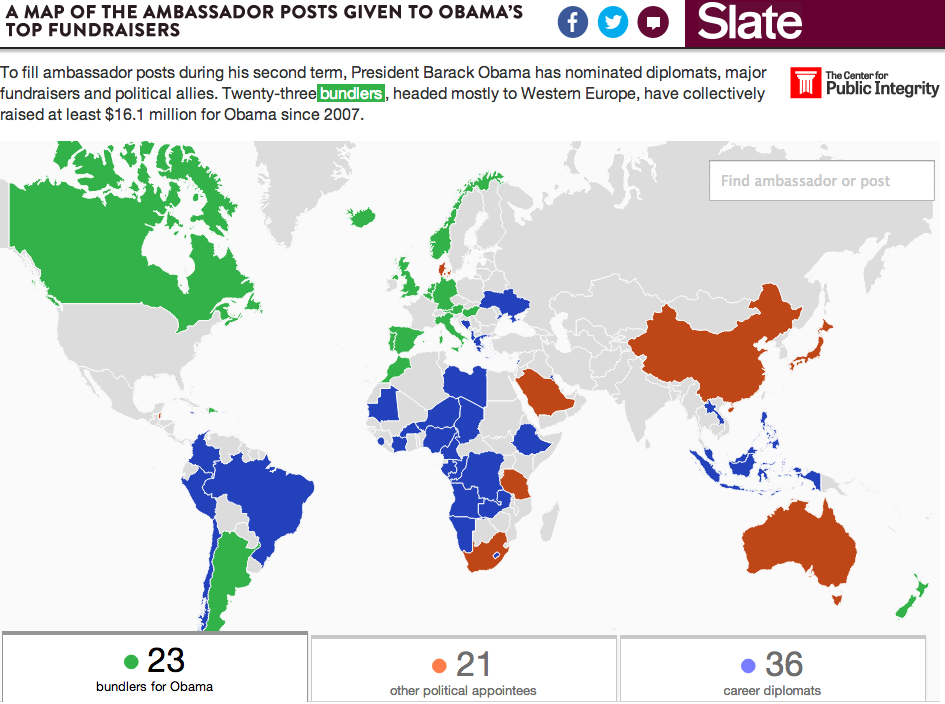
ambassadors-map

James Bruno laments that the US still hands out ambassadorial appointments as political prizes:

When hotel magnate George Tsunis, Obama’s nominee for Oslo, met with the Senate last month, he made clear that he didn’t know that Norway was a constitutional monarchy and wrongly stated that one of the ruling coalition political parties was a hate-spewing “fringe element.” Another of the president’s picks, Colleen Bell, who is headed to Budapest, could not answer questions about the United States’ strategic interests in Hungary. But could the president really expect that she’d be an expert on the region? Her previous gig was as a producer for the TV soap opera The Bold and the Beautiful. She stumbled through responses to Senator John McCain (R-Ariz.) like, well, a soap opera star, expounding on world peace. When the whole awkward exchange concluded, the senator grinned. “I have no more questions for this incredibly highly qualified group of nominees,” McCain said sarcastically. …

The reason a hotelier and a television producer, for instance, might be appealing choices is blindingly obvious: money. Bell raised $2,101,635 for President Obama’s re-election efforts. Tsunis, who flipped his affiliation from Republican to Democrat in 2009, embraced his new party with gusto, raising $988,550 for the president’s 2012 bid.

Henri J. Barkey takes Obama to task for what he calls “a disservice to diplomacy”:

The Obama administration’s appointments suggest that the president isn’t being honest when he says that diplomacy is important to him. Yet the administration clearly values diplomacy — officials, including the president, have emphasized that the ongoing negotiations with Iran are the way to resolve the nuclear impasse. Would Obama consider making Tsunis our negotiator? Of course not. Yet it’s illogical, and insulting, to presume that Norwegians are such wonderful and civilized people — and hence unlikely to cause any problems with Washington — that we can afford to send someone on a taxpayer-funded three-year junket to enjoy the fjords.

But Fisher, who passes along the above map from Slatesees a silver lining:

There may be an upshot to all this. Career diplomats are probably, in most circumstances, also going to be the best diplomats. They’re competing against campaign bundlers for assignments, though, and they seem to lose out for assignments like Belgium or Italy. Countries like Egypt and Russia are probably important enough that no administration would send a bundler there. But there’s a category of countries that are not Egypt-level difficult to demand a technocratic assignment, nor Portugal-level fun that a campaign bundler gets it.

You have to wonder if some number of really talented diplomats, who in a universe without campaign bundlers would get sent to Austria or Italy, are instead getting sent to countries like Malaysia or Peru. Countries they would otherwise be too experienced or talented to be sent to. And maybe, as a result, the United States has unusually good diplomatic representation in a lot of the blue countries in this map. That could maybe have helped a little bit in sub-Saharan Africa, where, as G. Pascal Zachary argued in The Atlantic, the United States has seen significant diplomatic gains.

Rand Paul vs The NSA

Rand Paul is suing the government over the NSA’s bulk data collection program, on behalf of every American with a phone:

The complaint charges Obama, as well as Director of National Intelligence James Clapper, National Security Agency Director Keith Alexander and FBI Director James Comey, with violating the Fourth Amendment to the U.S. Constitution by collecting and storing Americans’ phone data on a massive scale. … Joined by the conservative and libertarian non-profit FreedomWorks and former Attorney General of Virginia Ken Cuccinelli, Paul submitted the complaint to the U.S. District Court for the District of Columbia Wednesday morning.

Serwer explains the significance of a class action suit:

“A class action would be Rand Paul, not just suing on his own behalf, but on behalf all people, known and unknown, who are similarly situated,” said Stephen Vladeck, a law professor at American University. “Ostensibly, he could be suing on behalf of all Americans, or all Americans hypothetically affected by these court orders.”

By making his challenge to the NSA’s metadata program a class-action suit, Paul is reiterating his point that the metadata program amounts to a “general warrant,” or the government giving itself permission to search any person at any time without individual suspicion or evidence of a crime, in violation of Americans’ constitutional rights.

But Adi Robertson says the suit is “doomed” for that very reason:

Paul says he expects the case to quickly rise to the Supreme Court and that “the American people will win.” Unfortunately for the American people, he’s almost certainly wrong. So far, damages and injury from NSA data-gathering have been hard to establish even on an individual basis. Several groups have brought lawsuits against the administration by saying a particular individual organization or person has suffered because of surveillance. But even for Verizon customers, who have a leaked court order to back them up, there’s no definitive way to tell whether the NSA actually collected metadata from them, and the claim is too hypothetical for many judges. If Paul wants to go forward with the suit, he’ll need to calculate and prove similar damages for every single member of his class.

None of which, of course, have stopped Paul from trying to recruit 10 million people to “join the class action lawsuit” by sending their name, email address, and zip code. In theory, this shows that a large number of people have suffered similar harm and lets people opt into the suit, although nobody joining will be able to provide any information on whether they’ve been spied upon (and therefore qualify.) In practice, the charitable interpretation is that it’s essentially a petition of protest. The uncharitable interpretation is that it’s a fundraising and campaigning effort.

Allahpundit thinks it’s a smart political move:

Whether a Fourth Amendment suit will prevail depends on which judge they draw. Remember, within 12 days of each other in December, a federal district court judge appointed by Bush found the NSA’s data-mining program unconstitutional while another judge appointed by Clinton upheld it. Assuming both rulings are affirmed on appeal, it’s a cinch that this will end up in the Supreme Court. Paul’s shrewdly getting on board now, before it takes off, so that he’s in the middle of things as it moves up the legal food chain.

Massimo Calabresi, however, sees a big risk:

The risk for Paul is not so much the legal outcome as a potential change in the politics of the underlying issue. Where the law can be slow to develop and harden, political change can be rapid and unpredictable. Paul risks getting on the wrong side of an issue that is still playing out in the public mind. … For now, Paul’s play may work all the better for having mainstream Republican and Democratic opposition. But public opinion is fickle and it doesn’t take much to imagine a turn of events that could leave Paul exposed to charges he put politics ahead of national security.

Read the full complaint here.