Forget The Whiskey And Drugs

Riffing on the life and work of Ingmar Bergman, Dorth Nors argues that great artists need solitude most of all:

Solitude, I think, heightens artistic receptivity in a way that can be challenging and painful. When you sit there, alone and working, you get thrown back on yourself. Your life and your emotions, what you think and what you feel, are constantly being thrown back on you. And then the “too much humanity” feeling is even stronger: you can’t run away from yourself. You can’t run away from your emotions and your memory and the material you’re working on. Artistic solitude is a decision to turn and face these feelings, to sit with them for long periods of time.

It takes the courage to be there. You run into your own pettiness. Your own cowardice. You run into all kinds of ugly sides of yourself. But the things that you’ve experienced in your life become the writing that you do. And there’s no easy way to get to it, if you want to write literary fiction. And that’s what Bergman and other Swedish writers have taught me—to stay in that painful zone, discipline myself through it to get where I want.

Scotland vs Britain, Round II

800px-The_Battle_of_Culloden

Massie thinks that September’s referendum on Scottish independence might pass:

Real Scots vote ‘yes’; timid Scots vote ‘no’ — and doubtless, in time, will fill a coward’s grave. This might seem a form of emotional blackmail, but it is a mightily effective one…

At the same time, Salmond argues that very little will change. The nationalist campaign might be subtitled ‘Project Reassurance’. Nevertheless, despite presenting his case as a question of fiscal accountancy and common sense, the true appeal of independence is still emotional. What kind of country, Salmond and his colleagues will ask, rejects the chance to govern itself? It is a good question. The answer, of course, is a country that rejects as false the choice between two identities. You can be a Highlander, Scottish and British — just as you can be Cornish, English and British. Even so, Salmond articulates a vision of a better, purely Scottish future in ways that no unionist politician has yet matched.

I saw the inexorable logic of this as far back as 1999:

Blair has allowed the Scottish Parliament the leeway to lower or raise the British rate of income tax by only 3 percentage points. But the direction is clear enough. Blair clearly believed that by devolving some power to Scotland he would defuse the independence movement. Instead, the opposite could happen. The latest polls suggest that in the new Edinburgh Parliament the largest single party may well be the Scottish Nationalists, who see the new Parliament as a way station to full independence. Of the dozens of conversations I had in London about the future of the United Kingdom, literally no one I spoke with believed that Scotland would be a part of Britain in 10 years’ time.

And since then, as Alex notes, the momentum has been pretty steady and, with a few setbacks, in a pretty clear direction. You see the impact of this in England too, where the flag of Saint George is far more popular now than the old Union Jack. And when Scotland competes in international rugby, it takes part in the Six Nations Cup – those six nations being England, France, Wales, Scotland, Ireland and Italy.

Party politics has only made the Unionist case less potent:

The Tories, bashful as ever, are reluctant to campaign vigorously for the Union lest their unpopularity in Scotland weaken the overall case for unionism. Labour are reluctant to be seen within spitting distance of any Tory. Moreover, the unionist alliance allows the SNP to argue that there is no functional difference between the Labour and Conservative parties. Only the SNP will stand up for Scotland’s interests by putting Scotland first.

Larison likewise argues that opponents of independence are defeating their own cause:

[I]f the unionists mainly rely on painting a gloomy picture of what post-independence Scotland will be like, enough people may conclude that there is no positive unionist case to be made and will decide to vote for the referendum whose advocates at least pretend to have a clear idea of where they want to take their country. I still doubt that Scotland will vote for independence in the end, but it is a lot more likely than it was just a few months ago.

Yglesias declares himself “favorably disposed” to Scottish independence:

The main reason is that it seems to me that in the European context where everyone is a stable democracy with a mixed-market economy, the small countries (Netherlands, Denmark, Finland, etc.) are generally a lot better run than the bigger ones. For one thing, smaller countries have simpler institutional arrangements since you’re not trying to accommodate size by embedding complicated federalism mechanisms into the already complicated framework of the European Union. But for another thing, I think the debate over welfare state design gets more sensible when you’re talking about a small jurisdiction. A place like Scotland is a sufficiently small share of the United Kingdom that it makes sense for a Scottish political activist to be more focused on “how much money does this program bring to Scotland?” than on “how good is this program at generating social benefits in a cost-effective way?” An independent Scotland—like an independent Wallonia or other possible new European mini-states—would have politics that I think would ultimately be more constructive.

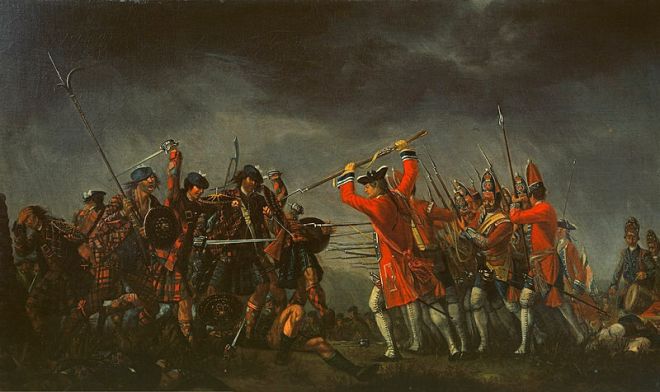
(Painting: The Battle of Culloden (1746) by David Morier, oil on canvas. It was the last real battle between the forces of the Crown and Scottish insurgents.)

Face Of The Day

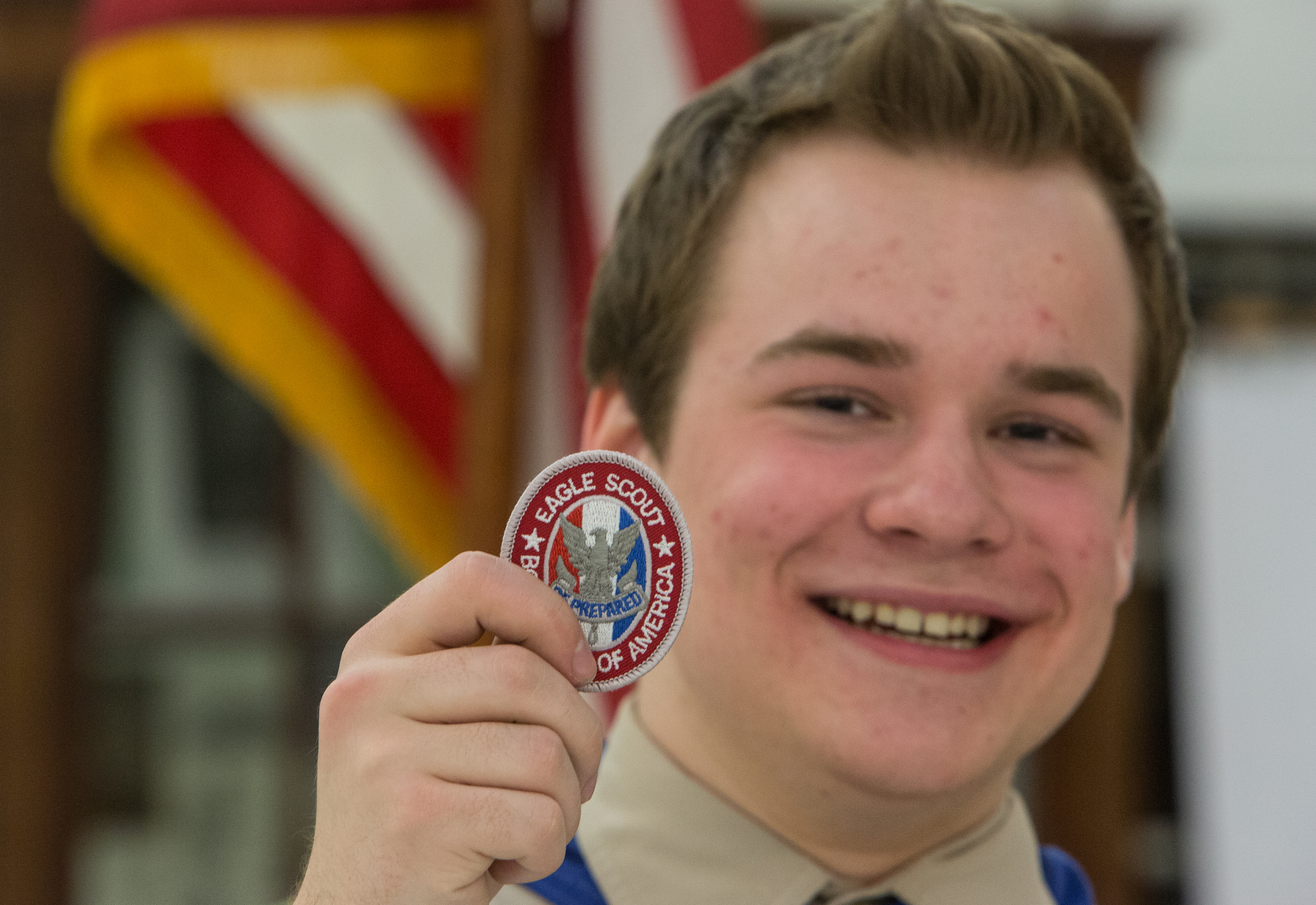
Pascal Tessier a gay scout receives Eagle scout badge

Pascal Tessier receives his Eagle scout badge at his weekly troop meeting, at the All Saints Church in Chevy Chase. Tessier will be one of the first openly gay Eagle scouts. In the past he would have been asked to leave or be booted from scouting, but BSA ruled that it would accept gay scouts but not gay scout leaders. By Evelyn Hockstein/For The Washington Post via Getty Images. Update from a reader:

Great to see you featured Pascal Tessier receiving his Eagle scout badge. I sat on his Eagle Scout Board of Review, and he’s a remarkable young man. He helped change policy in a huge organization, and moved history along a little in so doing. Our two oldest boys also made Eagle Scout the same night – there were 7 candidates from the region. Very proud of them all.

Clinton’s Achilles Heels, Ctd

Masket doubts that Hillary’s thin record will prevent her from winning the White House:

As Barack Obama demonstrated, a lack of legislative accomplishments will prevent you neither from becoming president nor from accruing impressive legislative accomplishments once you’re there. And voters don’t really care much about rationale, probably aware that every presidential candidate’s true rationale is, “I’d like to be president and I think I’d do a pretty good job.” These are mainly issues that political journalists stew over, and not without cause! Writing about the same person in the same way for a quarter century is extremely tedious, particularly when that person is sitting on a large lead and her strategy is to say as few risky things as possible.

But voters, we know from a long line of research (PDF), don’t really focus on these things when deciding on their next president.

Their main concerns are the status of the economy, the presence or absence of war, and the perceived moderation of the candidates. If the economy is growing reasonably well in 2016, if we are not engaged in a massive bloody war, and if Clinton is not perceived as excessively ideological (relative to her Republican opponent), she’ll have a very good shot of winning the general election. A recession that year would likely doom her or any other Democratic presidential candidate.

Nevertheless, PM Carpenter is dreading the Clinton campaign:

The other day someone chastised me on this site for being ignorantly unenthused by another Clinton candidacy, since the alternative could only be–egads–a Republican president. On that point, I’m in full accord with the chastiser. Anyone is preferable to a Huckabee or a Paul or God forbid another Bush. To my mind, that goes without saying. But I guess, duly criticized, I should be saying that a lot, as we proceed to the presidential sweepstakes: Hillary is better than the ghastly alternatives.

That’s quite the rallying cry.

Heh.

What If The Russian Economy Runs Out Of Gas?

In the Dish’s latest podcast, Masha Gessen discusses how Putin’s control of the media prevents accurate polling on his popularity. But Daniel Treisman finds that “Putin’s popularity remains highly vulnerable to a further deterioration in the economy”:

Russia’s growth rate has sunk steadily from 4.8 percent in the first quarter of 2012 to 1.2 percent in the third quarter of 2013. This has not yet affected incomes and employment in a way that would undermine public assessments of the economy. But if it does, the political effects may be pronounced.

Christianists On The Left?

After attending the massive Moral Mondays protest in Raleigh this weekend, Dahlia Lithwick considers the role of the faithful in the liberal coalition:

Progressives are not used to so much religion in their politics. I met someone who planned to avoid Saturday’s protest because of the God talk, and it’s clear that for many liberals, it’s easier to speak openly about one’s relationship with a sexual partner than a relationship with God or spirituality. But there are a lot of liberals who live on the seam between faith and politics. And one of the core messages of Moral Mondays is that ceding all talk of faith and morality to the political right in this country has been disastrous for the left. …

As discomfiting as it may be to hear the Bible quoted alongside the Federalist Papers, the truth remains that for most people of most faiths, kicking the poorest and most vulnerable citizens when they are down is sinful. Stealing food and medical care from the weakest Americans is ethically corrupt. And the decades long political wisdom that only Republicans get to define sin and morality is not just tactically wrong for Democrats. It’s also just wrong. This is a lesson progressives are slowly learning from nuns and the new pope. When we talk of cutting food stamps or gutting education for our poorest citizens, we shouldn’t just call it greed. We should call it what it is: a sin.

The question begging here is about that “we”. And it’s not as simple as Dahlia would have it. As Christians, it seems to me, our faith may inform our politics, but not dictate its contents or permit us to use theological claims in civil debate. So, for example, there is no disputing Jesus’ teachings about the poor. But Jesus had no teachings about government‘s relationship to the poor, no collective admonitions for a better polity. On the countless occasions he was asked about such issues, he was remarkably consistent: do not confuse Caesar with your own soul.

Now Catholic social teaching may look at a society and see grotesque inequalities and injustices, but it does not have a pre-made, uniform prescription for them.

What the Church can and must do is draw our attention to, say, soaring inequality or long-term unemployment or resilient poverty and challenge us to see if these evils can be prevented or ameliorated. What it should not do, it seems to me, is grant any political movement – let alone a political party – to represent in policy or political terms what our actual response should be. For that we need civil debate over political and policy ends – and Christians may well take different prudential positions in that debate and draw different conclusions.

It seems to me you can resist the politicization of religion by the right without committing the same category error on the left. In fact, it seems to me vital for the restoration of a living Christianity that it not be drawn into these political struggles. But if you do want to conflate Christianity with leftist politics, as Rod Dreher notes, you may come to regret it:

OK, fine. I don’t have a problem with using that kind of rhetoric in principle. But if you’re going to go that route, you lose your right to complain about religion interfering in politics.

No more griping about how conservative Christians are trying to impose their morality on the rest of us. That’s exactly what the progressive religious leaders in North Carolina are trying to do. And more power to them, sort of. I mean, I don’t know much about what’s going on in NC, and chances are I oppose most of what the Moral Mondays coalition is after. But I think they are doing the right thing in bringing their religious convictions to the public square to influence the political debate.

But let the Left be on notice: if you endorse this kind of thing, don’t ever open your mouth to complain about conservatives doing it. You can’t complain about the Religious Right bringing their faith to the public square when you don’t like their politics, and praise the Religious Left for doing the same thing when it suits your goals.

Switzerland Tightens Its Borders

On Sunday, Swiss voters narrowly approved a referendum to place a cap on immigration. What this means for its relationship with the European Union:

Switzerland is not an E.U. member, but it has a bilateral agreement on free movement with E.U. countries. European citizens can freely move and work in Switzerland, as can Swiss citizens in the E.U. The immigration cap is clearly incompatible with this agreement, and as all the agreements between the E.U. and Switzerland are tied together by a so-called “guillotine clause”, the E.U. could potentially revoke all of them, including crucial agreements on banking and taxation.

The vote’s outcome has severe economic consequences for the Swiss economy even aside from its relationship with the E.U. Switzerland is has one of the highest share of immigrants relative to all E.U. countries: 23 percent of the population does not have Swiss citizenship, and 63 percent of these residents come from E.U. or European Economic Area countries. Immigration from E.U. countries, particularly from Germany and Portugal, has played a large role in sustaining domestic demand in recent years.

Walter Russell Mead calls the vote irrational but understandable:

No other country benefits economically as handsomely from its migrant population as Switzerland does, but it would be misleading to try to view the vote in overly rational terms.

It is better understood as a primal scream rather than a calculated policy. The Swiss voted with their guts, not with their heads, and in so doing they followed a deeper instinct felt by many of their European peers. As German Finance Minister Wolfgang Schäuble perceptively commented on the outcome of the referendum: “Of course it shows that in this globalized world, people are increasingly uneasy about unrestricted movement. I think that’s something we must all take very seriously.”

Ryan Avent thinks it may have something to do with Switzerland’s expanding welfare state:

I’m more interested in, and perhaps worried by, the (possible) interaction of the Swiss immigration vote with a fledgling movement within Switzerland for a universal basic income.

The basic income plan is anything but a sure thing, and residence does not equal citizenship. But at a time at which economic conditions—like stagnant wages, falling employment rates, and declining labour share of income—make extension of the safety net look reasonable, a large foreign-born population may come to look like an obstacle to such extensions: either because making the safety net available to migrants is socially and financially impractical or because the idea of a second class of poor migrants is unappealing.

Cowen wonders if there is an upper limit to immigration levels:

In my view immigration has gone well for Switzerland, both economically and culturally, and I am sorry to see this happen, even apart from the fact that it may cause a crisis in their relations with the European Union.  That said, you can take 27% as a kind of benchmark for the limits of immigration in most or all of today’s wealthy countries.  I believe that as you approach a number in that range, you get a backlash.

Bryan Caplan draws the opposite conclusion:

Swiss anti-immigration voting was highest in the places with the least immigrants!  This is no fluke.  In the U.S., anti-immigration sentiment is highest in the states with the least immigration – even if you assume that 100% of immigrants are pro-immigration. The natural inference to draw, then, is the opposite of Tyler’s: The main hurdle to further immigration is insufficient immigration. If countries could just get over the hump of status quo bias, anti-immigration attitudes would become as socially unacceptable as domestic racism.

A big question is whether the referendum will embolden opponents of open borders elsewhere in Europe:

Other governments, including Norway, have suggested removing themselves from the Schengen Area, and there’s been widespread opposition to allowing recent EU members Bulgaria and Romanian to join.  EU leaders reportedly discussed scrapping Schengen and reimposing border controls in the event of Greece deciding to exit the eurozone—which for the time being appears to be a remote possibility.

The depth of anti-immigrant sentiment in Switzerland is a bit puzzling, given that with a quarter of its residents being foreign-born, it has the lowest unemployment rate in Europe at 4 percent and its economy is among the strongest. If a law like this can pass there, it seems like the dominoes could fall pretty fast for the rest of the continent and the days of passport-free borders might be numbered.

Putin Goes Both Ways, Ctd

A reader adds to juxtaposition of Putin and gay Tchaikovsky:

And let us not forget that Sochi’s opening ceremonies also featured the reunion of Russian pop duo t.A.T.u. – you know, the musical act whose name is shorthand for “this girl loves that girl”, who were marketed as lesbians, who frequently performed holding hands and were often photographed … doing other things, and whose video for “All the Things She Said” [seen above] would unquestionably be classified as textbook “homosexual propaganda” nowadays. And to top it all off, Yulia Volkova and Lena Katina are well-known supporters of LGBT rights. (I wonder if they still are, or if someone “got them” after all.)