Another Obamacare Tweak

Yesterday the Obama administration announced that the employer mandate – the requirement that larger employers provide health insurance to all their full-time staff or pay a penalty – will be delayed for another year for companies with 50-99 employees. Cohn ponders what motivated the decision:

What’s the primary rationale? It’s impossible to say. The official explanation is the same as before—the move will give companies a little extra time and flexibility, easing the transition to the newly reformed health care system. That makes perfect sense. On the other hand, administration officials might also have other goals in mind. For example, they might be anxious about employers taking certain actions—like limiting the hours of workers, in order to avoid giving those workers health insurance. Administration economists have said they don’t see evidence this is happening on a large scale and the Congressional Budget Office just last week came to the exact same conclusion. But anecdotes of such decisions have been all over the media. (Jed Graham of Investor’s Business Daily has been tracking them.) Whether or not the problem is real, it might appear real.

Kate Pickert points out that the employer mandate “is not considered a central tenet of the law’s plan to expand health coverage”:

The vast majority of large employers already offer insurance and the mandate was mostly meant to shore up this system into the future. Still, every time more employers are exempted from the mandate for another year, the cost of the reform law increases. Before the mandate was originally delayed, budget experts had predicted the requirement would generate some $10 billion in revenue in 2014, in part, from penalties paid by employers opting not to provider insurance to workers. In addition, some workers who may have received health insurance through work in 2014 and 2015 will now instead be eligible for federal subsidies to buy coverage independently through the the law’s state-based insurance exchanges.

Kliff looks at Massachusetts’s example:

Massachusetts’ universal coverage law has an employer mandate–and, since it passed seven years ago, employer-sponsored coverage has been pretty much stagnant. Delays to the employer mandate can matter politically. But as for what they mean for who Obamacare covers, this delay will likely amount to a relatively small, if non-existent, change.

Avik Roy says “we should simply repeal the employer mandate”:

It’s a huge drag on hiring, because the mandate increases the cost of hiring someone (because on top of wages, you now have to pay for his costly, government-approved insurance plan). The House of Representatives has already proposed a bill to repeal the provision, and it would be quite easy for the Senate to do so as well.

But the Obama administration doesn’t want to do things the old-fashioned way, by actually passing a law through Congress. The President fears that by opening the Affordable Care Act to legislative changes, many more aspects of the law could get repealed or changed by Congress. So, instead he simply chooses to ignore the law. It’s up to the public to hold him accountable.

The way the administration is going about making these changes also bothers Philip Klein:

If Obama believes the employer mandate is a bad idea that needs to be repealed or severely changed, he should propose permanent changes rather than erratic piecemeal fixes. But for Obama, it isn’t acceptable for opponents of the health care law to seek changes through the constitutional legislative process. That’s sabotage. The only way to make changes to Obamacare is for him to do so unilaterally, no matter what the text of the law actually says.

Bob Laszewski argues that the piecemeal approach affects the law’s functionality:

No one has been more critical of the various requirements in Obamacare that I have. But to make an insurance system work you have to have a set of consistent and consistently applied rules. You can’t have some people choosing to be out today and in tomorrow. You can’t have a system where insurers price products based upon one set of conditions and then you keep backing off on the conditions consumers and employers have to follow.

Yuval Levin sees this as an outrageously expansive interpretation of executive powers:

We have here a written statute that levies a fine on large employers who fail to provide insurance coverage as a benefit to their employees. It defines a large employer as “an employer who employed an average of at least 50 full-time employees on business days during the preceding calendar year,” provides a relatively detailed set of criteria for applying that definition, and states that the provision “shall apply to months beginning after December 31, 2013.” We have already seen that latter date pushed back by a year without obvious legal authority, and now we see it pushed back by another year for some affected employers while the requirement is loosened for others. If this kind of selective enforcement of a public law is legitimate, then how exactly would the president describe the limits of his ability to engage in such selection? Is he bound in some definable way to the particulars of statutes as written and passed by Congress, or does he merely take them as suggestions for how he might proceed?

Gobry warns Obama’s supporters that if they are OK with this type of executive legislation now, they’ll have no standing to cry foul when a Republican president does it:

What’s striking here is that liberals have gone along with these moves from the White House. And it makes intuitive sense: they have so much invested in Obamacare’s success that, just like the Administration, they’re pretty much willing to do anything to get the law to work, no matter how far-fetched or, well, illegal.

The problem with this is that, of course, if it becomes accepted American Constitutional tradition that the President can apply whatever laws she wants, well, that tradition applies to Republicans as well as Democrats.

What Rescheduling Marijuana Would Change

A Medical Marijuana Operation In Colorado Run By Kristi Kelly, Co-Founder Of Good Meds Network

Sullum considers it:

Rescheduling marijuana would not affect the legal status of state-licensed cannabusinesses in states such as Colorado and Washington, which would still be criminal enterprises in the eyes of the federal government. But [Dale] Gieringer [of the National Organization for the Reform of Marijuana Laws] notes that rescheduling could remove one of the major financial challenges facing state-legal marijuana suppliers: Section 280E of the Internal Revenue Code prohibits the deduction of business expenses related to “trafficking in controlled substances,” but only for drugs on Schedule I or II. If marijuana were moved to, say, Schedule III, that prohibition would no longer apply.

Schedule III, which is supposed to be for medically useful drugs that can be taken safely and have a lower abuse potential than drugs on Schedules I and II, arguably is appropriate for marijuana because that is where the DEA put Marinol (a.k.a. dronabinol), a synthetic version of THC, marijuana’s main active ingredient. The DEA also has said naturally occurring THC used in generic versions of Marinol belongs on Schedule III.

Recent Dish on marijuana rescheduling here.

(Photo: Matthew Staver/The Washington Post via Getty Images)

Can Philosophy Go Viral?

That’s the hope of recent poseur alert recipient Alain de Botton, whose new group blog is modeled after the Daily Mail:

Journalists used to believe that good, clear, interesting writing was enough to make otherwise dull news stories interesting to the masses. And that was probably true a few decades ago, when most families took at least one daily newspaper, and far more people than today read general-interest magazines. It’s not as true anymore. Readers need more of a hook, de Botton believes. And so The Philosophers’ Mail gives us headlines such as “Kristen Stewart’s socks provide lesson in friendship,” “Taylor Swift’s legs beat Arctic melt,” and “Interview with the Soul of Angela Merkel.” …

After spending some time on The Philosophers’ Mail, it becomes clear that the point isn’t to deny or ignore all that garbage – or even to make fun of it  –  but rather to transcend it. “We begin,” de Botton told me, “by being very sympathetic to what [Daily] Mail readers like: beauty, glamor, murder, disaster. But rather than ending it there, we try to move the reader on to deeper themes. We see the flotsam and jetsam of the day’s news as an opportunity to sneak some big ideas across. We’re very interested in sugaring, or at least flavoring the pill.”

A sample post, “Important News: Anne Hathaway Takes Her Chocolate Labrador Esmeralda For A Walk!”, offers a defense of “Stars! They’re just like us!”-style reporting:

The doubts we might feel about looking at pictures of Anne Hathaway walking her dog are largely caused by accidental snobbery. We are liable to look down on an activity which, if it were presented to us in a museum, we might take very seriously. And yet what we’re doing here – looking at a pleasant person talking a walk – is not fundamentally different from the pleasures available in an art gallery. If we went on a special trip to Giverny to see Monet’s paintings we’d hardly think we were doing something a bit low-brow or pointless. Yet when we look at his lovely Wild Poppies Near Argenteuil we are – in many respects – doing exactly the same as when we look at Anne and her dog. …

Monet was a great artist in part because he wanted to draw our attention to times when nothing important seems to be going on. In the Wild Poppies picture, it’s just an ordinary day; they’ve probably gone on the walk hundreds of times. Monet is telling us that in just looking at someone going for a walk we are doing something worth taking seriously.

If the task of the news is to tell us important things, then we shouldn’t define importance too narrowly. Part of what we need is to stay hopeful about the human project. Hope is an achievement and we find it in these sort of scenes – scenes where no one is dying or suffering, where things are attractive, where there is an absence of sickness and in which everyday, quiet, ordinary contentment is glimpsed.

Previous Dish on merging philosophy and celebrity here.

Chart Of The Day

Obamacare Coverage

Jonathan Cohn puts Obamacare’s partial coverage of the uninsured in perspective:

Liberals settled on something like Obamacare, which they realize will reach only about half of the uninsured for now, because they had literally spent decades trying to do something more ambitious—only to fail, thanks in no small part to conservative opposition. And while conservatives like to say they have better ideas for reforming health care, their proposals inevitably result in many fewer people getting coverage—or those getting coverage getting significantly less financial protection.

Recent Dish on who Obamacare does and doesn’t cover here.

Correction Of The Day

“An earlier version of this story incorrectly stated [that Christie chief spokesman Michael] Drewniak referred to the Port Authority’s executive director as a “piece of crap.” While Drewniak did call him a “piece of excrement,” it was David Wildstein who referred to the executive director as a “piece of crap,”” – The Star-Ledger.

Why A Gay NFL Player Matters

This chart from Derek Thompson helps explain why Michael Sam coming out is so significant:

NFL Audience

Marc Tracy wonders who will draft Sam:

If you are an optimist … you believe that the 32 NFL franchises will be making their decision on Sam the same way they would any other player: analyzing his merits (his college play, his “measurables” at the upcoming combine, what their research says about his character) and then deciding how good a “system fit” he is for their rosters and defensive schemes. “I think that sports, at its best and purest, acts as a meritocracy,” NFL historian Michael MacCambridge emailed me Sunday night. “And what we’re seeing is simply another chapter in the realization that if someone can help you win, it doesn’t matter if that person is black or white… and ultimately, it won’t matter if the person is straight or gay.” …

“Much is made about football’s macho culture,” MacCambridge argued, “but you also have to remember that virtually every player in the NFL spent at least three years on a college campus, with the accompanying socialization and exposure to different lifestyles.” He added, “That heterogeneous college experience tends to supply people with lessons about diversity and tolerance, whether they’re conscious of it or not.”

Earlier thoughts from readers here. Nancy Goldstein tries to understand the squeamishness of NFL executives:

So what’s up with the tut-tutting from the NFL’s front office? It may be that the big difference between their panic and the NCAA College Football’s maturity is money—particularly the big money that corporate sponsors and advertisers bring to the NFL and don’t bring to the NCAA. When an anonymous official in Sports Illustrated says, “the league isn’t ready for this,” it’s likely code for “We’re afraid that having an openly gay player on board means that ticket sales will drop, or male viewers will be turned off, or that Bud Light and Marriott and Pepsi and GMC won’t want to pay top dollar to advertise with us.” In short, members of the NFL’s front office may be afraid that Sam will compromise their brand.

Lt. Col. Robert Bateman dismisses such concerns:

Really? Seriously? It has now been years — not weeks, not months, years — since gay men and lesbian women have openly laid down their lives for our nation in combat. And you, Mr. NFL executive who does not even have the slightest whiff of moral courage to even use your name, say that America is not ready for gay NFL players? Really? You think that the nation is cool with gay men dying in combat, in service to our nation, in desperate distant places, but you don’t think the country is cool with them playing in your game?

Are you on crack?

Kavitha Davidson joins the conversation:

As we saw with Branch Rickey and Jackie Robinson and baseball’s integration, management might be reluctant to progress, but eventually somebody will stop spitting in its face to open up a new pool of talent. Sam doesn’t need to be a Hall of Famer; he just needs to attract the eye of a team in need of a solid tackler and to work on translating his game from college to the pros. In the past decades, the conversation around homosexual athletes has shifted from whether gays can play sports in the first place to the slightly more palatable question of whether gays can be accepted in sports. Sam and his predecessors have already addressed the former — he just needs management to give him a chance to prove that the latter is no longer an issue.

Scott Shackford’s bottom line:

[A]ll eyes are on Sam because this is the final doorway in America for cultural acceptance. It marks the end of certain silly ideas about how masculinity informs sexuality that have had lasting impacts on the psyches of straights and gays alike for decades. It’s a huge deal, though the impact may not be fully grasped except in retrospect years from now.

Earlier Dish on Sam here and here.

Catholics, Contraceptives, And Their Church

A Univision poll (pdf) of 12,000 Catholics in 12 countries found that big majorities reject the logic of Humanae Vitae:

Screen Shot 2014-02-11 at 12.31.13 PM

The contraceptive question stands out to me. On other issues, there is a more equal division in the pews, or more support for the hierarchy’s position (two-thirds oppose civil marriage equality, for example), or huge differences between the developing and the developed world. But on contraception, massive majorities in Europe and Latin America and the US oppose the Vatican’s position.

And in some ways, contraception is the core issue, as Pope Paul VI recognized in his unilateral rejection of his own commission’s recommendation on the subject. If sex can be licit without procreation, the arguments shift tectonically on a whole host of other matters. Such a change would open the question of sex as purely expressive of love rather than instrumental for procreation, of whether gay sex can be licit, of pre-marital sex, of a whole universe of possibilities – and areas for moral thinking. That’s why Paul VI shut the debate down prematurely – he saw the potential consequences.

But he didn’t succeed and the hierarchy has ever since abjectly failed to make the case for its thirteenth century version of natural law. At some point, the church will have to stop preaching this or give up credibility in the Americas and Europe in favor of Africa and the Philippines, or remain resigned to promoting a core set of morals simply ignored by the vast majority of its members.

I think they should stop preaching this and begin thinking seriously about a new sexual ethic that is actually informed by science and by the experience of countless millions of lives. It’s also striking to me that the question of married priests – which Pope Benedict XVI dismissed as inconceivable (except when it meant snagging a few reactionary Anglicans) – so evenly divides the faithful.

It’s pretty close to 50-50. Unlike contraception, it requires no deeper shift in doctrine – and could well do more to revive the church in the West than any other single reform. It’s the lowest-hanging fruit for Francis to pluck, if he has a mind to. But check out the question of women priests as well. I would have expected a solid majority against, but in fact, the church is evenly divided on that as well: 45 – 51.

As for abortion, I agree with Morrissey, who thinks the top-line numbers are misleading:

[T]he striking figure here is the low number of Catholics who think abortion should be unrestricted. If, as the question suggests, abortion was restricted to only issues of the mother’s health and rape and incest, there may be considerable support for having just those limited options available as compared to the abortion-on-demand environment which currently dominates the US. Only 10% of American Catholics, and 20% of those in Europe, favor abortion on demand.

The questions of human sexuality are rightly deemed less grave than the termination of human life.

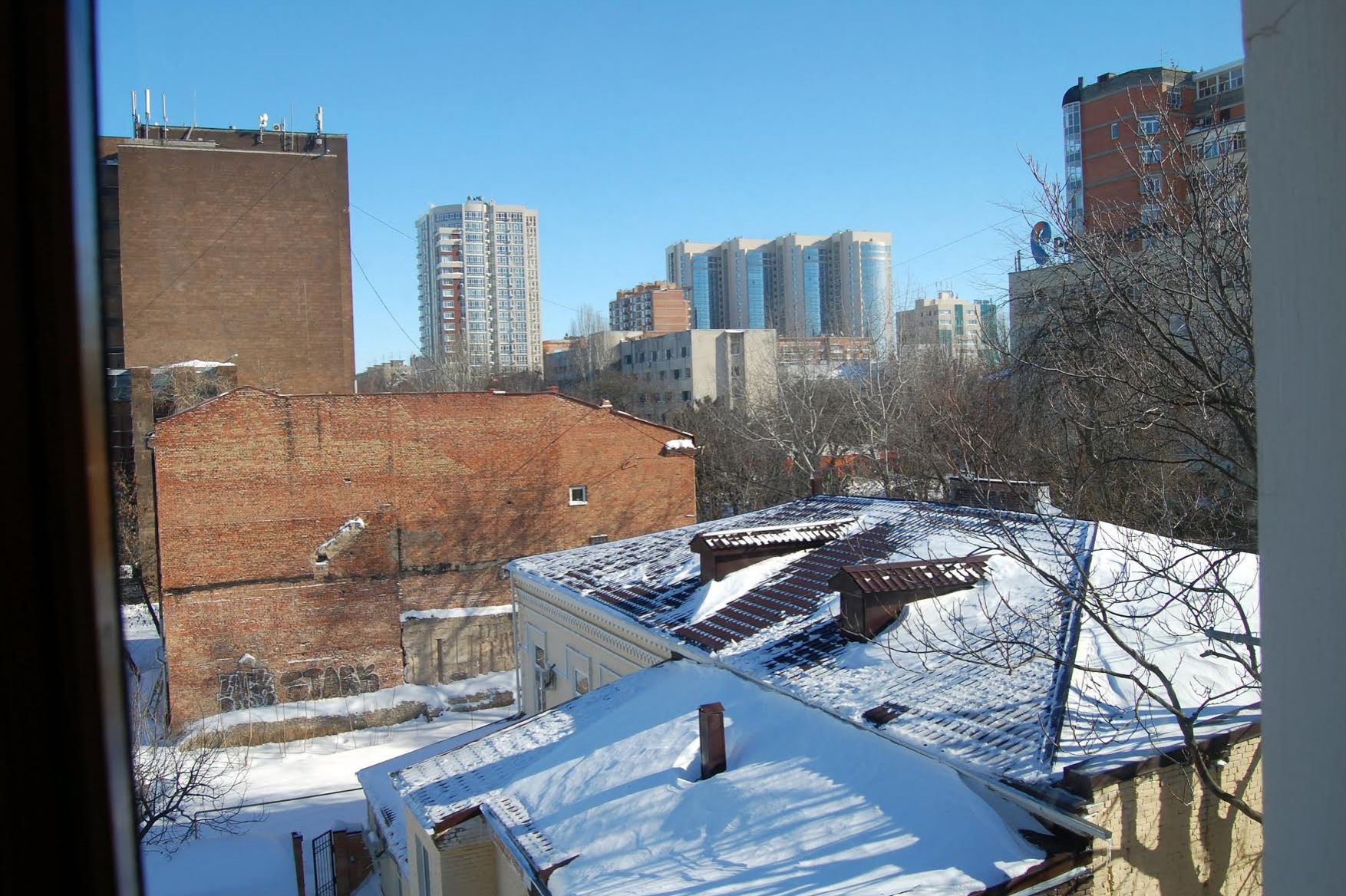
The View From Your Window Contest: Winner #191

vfyw_2-8

A reader describes the scene:

High-rise condos, barren trees, snow everywhere, a run-down brick building with graffiti on it. It could be any of the North Jersey bedroom communities across the Hudson from New York. I’m going with Fort Lee because it’s been in the news so much recently.

The window is themed on a recent news story, but not Bridge-gate. Another reader:

West Berlin, Germany. The graffiti: (“stark” = strong, mighty). Neighborhood: Lubensdorf. 9th floor, Rechenberger apartments …

Game of Thrones fan weighs in:

WINTERFELL, SEVEN KINGDOMS. Graffiti (“Stark”) gives it away, obviously.

Based on the relatively low number of entries this week, this reader wasn’t alone:

Oh my lord. How can anyone win this contest?? And then you have those damn tree branches covering that sign on top of the building!

Another:

That logo at the right looks soooo familiar, but my darned middle-aged memory won’t help identify it. So let’s call this the untouristed Basel, outside the center but near the Rhine.

Another:

The Bronx, no thonx. Although I know it intimately, I have never seen that sign on the right nor that hi-rise cantilevered structure in four parts. But to a native, it’s the first thought that comes to mind – and it seems impossible that it can be anywhere else on Earth.

Another:

Obviously, the key to this one is figuring out the logo obscured by the trees off to the right. Turns out, a LOT of companies have logos with stylized “P”s (or is that a rho?). Probably North America, far enough north for snow (so not Florida) and in a city with a lot of recent-vintage construction. The crisp blandness of the highrises screams Belltown, Seattle, to me, though I cannot pin down the exact location. Most likely because I’m wrong. But after all those P logos I just can’t bring myself to slog through Google images of “boring high rise condo buildings”.

Another gets the right country:

Well, I’m making a guess that’s a 180 from my original thoughts. At first glance it looks like my neighborhood on Chicago’s north side; the snow cover is just about right but the buildings are not 5familiar, and what is that logo on the building to the right? Perhaps another North American city, in Canada perhaps?

But I finally identified the logo using Google search: it’s from Rostelecom, the Russian long-distance service. It would be too predictable for it to be Sochi (it probably doesn’t have snow anyway) so I’ll go with a nice Baltic town like St Petersburg. But then where are the Soviet era buildings and why the American style grafitti? Still looks a lot like Chicago.

Another is more definitive about Russia:

Moscow. I’m not watching the Sochi Olympics but I’m sure anyone who is has seen that Cyrillic letter P everywhere. It an interpretation of an ear and belongs to Rostelecom, Russia’s leading long-distance phone company. I have scoured the web for images of the buildings in the distance in Russia with no luck.

Another nails the correct city:

For several months I’ve just given up without trying (there wouldn’t be enough to go on in a given view to justify the head banging that would accompany the futile search), but this week’s view offered a couple of clues that tempted me back in:

Rostov-na-Don

A quartet of distinctive glass skyscrapers together with a sign, obscured by a tree but just legible enough to indicate it was probably Cyrillic. Thus probably Russia, but probably not Sochi, because it’s not your style to be so obvious. Anyway, a quick couple of Google image searches for similar building in Russia bore fruit: about 360 miles north of Sochi in the port city of Rostov-na-Don.

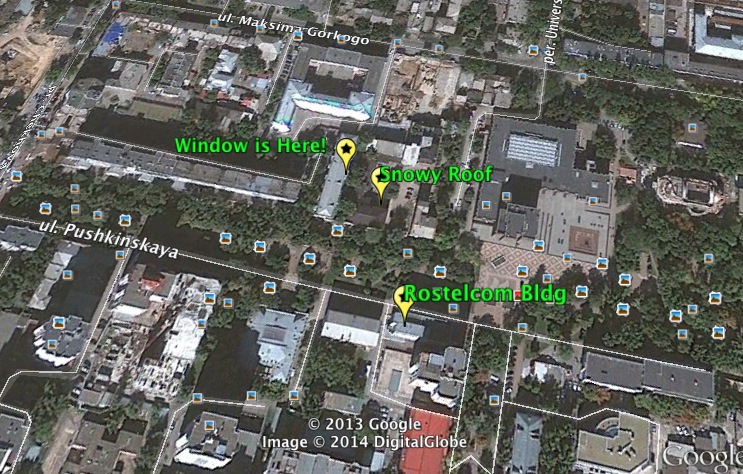
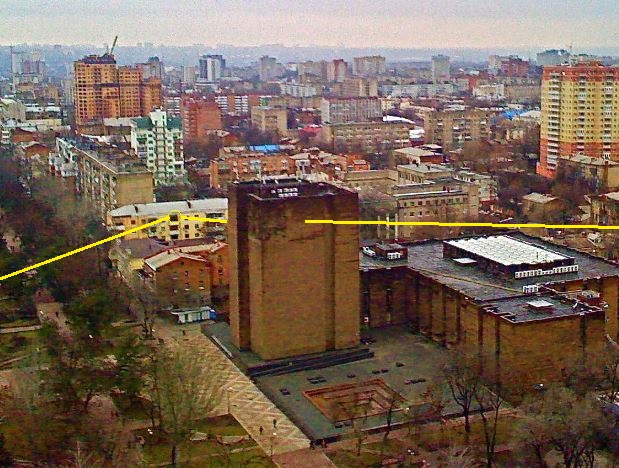
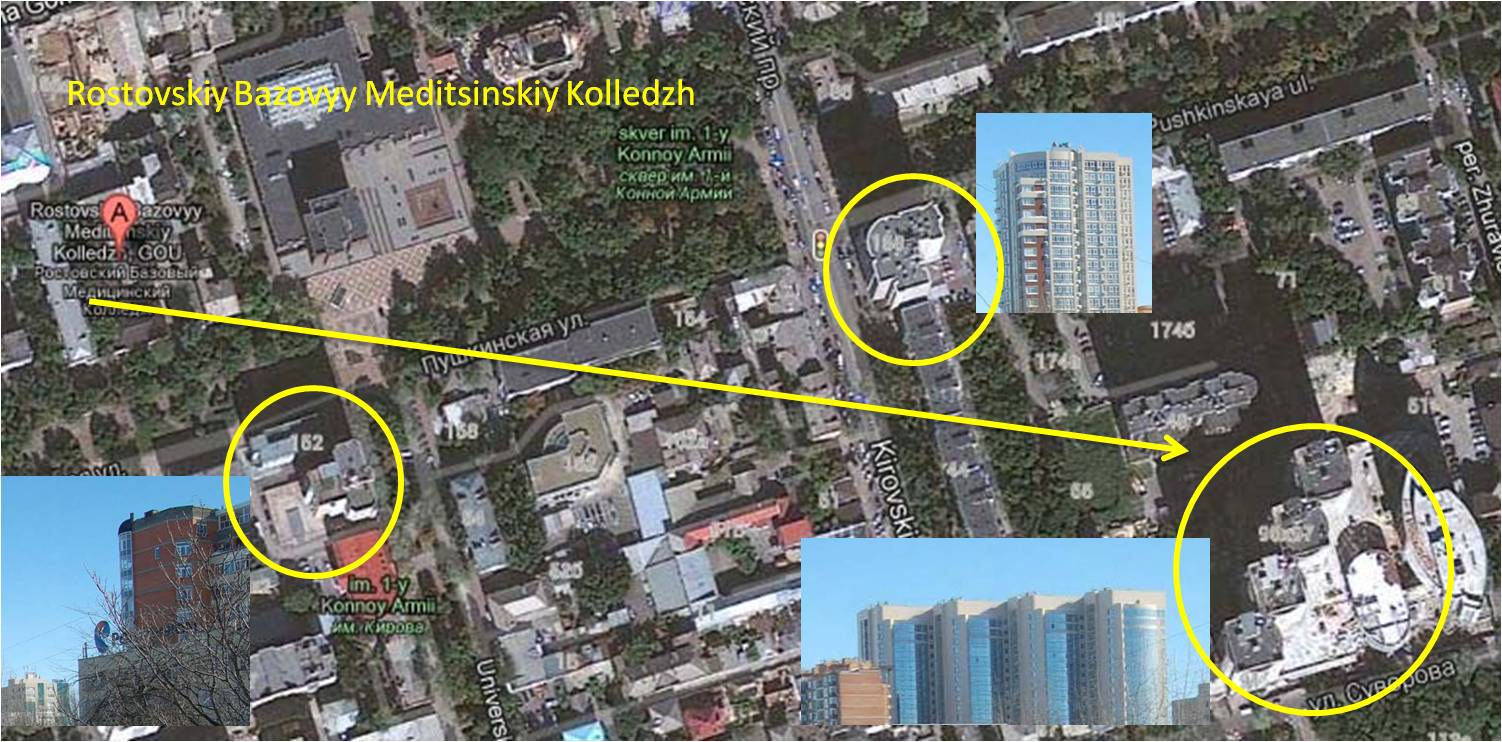
I then spent a pleasant hour or so touring the locale and nailing down the quasi-exact address, which is on Pushkinskaya (maybe 173b or nextdoor), seemingly on the campus of Ростовский базовый медицинский колледж (Rostov Medical College). It’s just southwest of the public library (the brick monolith to the left in the view), across Pushkinskaya from Rostelecom (the building with the blue sign to the right), and about a block and a half northwest of the Rostov City Towers (the glass buildings in the background). Thankfully, having won once already on contest #143, I don’t feel the need to drill any deeper to get this specific window. But it was fun to be back in the game.

Another imagines an Olympics tie-in:

I am guessing the person who sent this in was a ski jumper, injured in his warm-ups for the Sochi games and airlifted to Rostov-na-Donau for treatment. Specifically: Rostovskiy Bazovyy Meditsinskiy Kolledzh. Rostov-na-Donu, Pushkinskaya ul., 173b:

VFYW-Rostov-on-Don

I’m going to go with the fourth floor. I could not find a picture of the clinic, and it probably only has three floors.

Another Rostov-na-Don entry:

I wanted to tell you that since winning my very own VFYW book a couple years ago (back when the competition wasn’t quite as fierce), I’ve taken to posting the weekly contest photo on my Facebook wall to let my friends have a go at it. There is a small but determined group of us who tackle the contest each week, and I announce the winner, same as you, only among a smaller pool of brilliant people. One of my friends won your contest about two months ago.

Another regular player was stumped until turning on the TV:

I ignored my family all day Saturday with little to show for it, ultimately narrowing it down to Canada, England, China, Philadelphia, Belgium, Bosnia and Herzegovina, Poland, or Austria. Maybe the Netherlands or South Korea, or Japan. The vast majority of companies I could find that ended in ‘-kom’ were in Eastern European countries. Then, watching the Olympics and considering how Sochi is spelled in Russian: Cyrillic alphabet. I found Rostelecom. Maniacal laugh: Rostov-on-Don, Russia. I’m going to guess the picture was taken from this window:

Rostov_lib_view

The smaller yellow building in front of it is part of a medical school, the website listing it as at 173-б (letter between A and B in the Russian alphabet). Google Maps includes the pic site as part of the college.

So after all this, Russia during the Sochi Olympics, huh?

Another hears our own maniacal laugh:

So I was expecting an easy one this week after a tough one last week. But no. You had to be especially evil and pick a view not from the obvious Sochi, but from a city just 250 miles away. The view this week comes from Rostov-on-Don, Russia, specifically the Rostov Medical College.

P_logoI identified the country fairly fast by figuring out what the sign above the building across the street said. I couldn’t read it through the trees other than P______KOM, but the logo was distinctive enough. Making a mock-up of the logo (attached), a Google image search identified it as belonging to Rostelecom, a Russian phone company. While they have offices outside of Russia, the sign was clearly written in Cyrillic, so I knew the country then.

I expected identifying the city would be easy. and I figured all I had to do was find the correct Rostelecom office building. Sochi was my first guess, but no, that wasn’t it. It wasn’t Moscow, Saint Petersburg or a dozen other major cities either. So then I had to turn to other clues in the picture.

The next big clue was the graffiti on the brick building in the foreground. It clearly says STARK, which I don’t think is Russian. It is the German word for strong though. This led me to research cities in Russia with large German populations (thanks to Wikipedia), but I still couldn’t find the right one.

Looking at a map then, I noticed Volgograd (one of the German cities) was fairly close to Sochi, so this put me on the “Andrew is being evil” track. Looking at nearby cities, I checked out Rostov-on-Don and bingo, that’s where the Rostelecom building was. Identifying other landmarks in the view was easy after that. Across the street from Rostelecom is the Medical School. All the street views are obscured by trees, but the satellite view makes it clear where the window is. The view is just south of due east and I’m guessing it’s on the 4th floor:

vfyw_140208-1

Another gets the exact address:

Unfortunately, Street View does not provide enough information for me to certify its exact address. It looks like the yellow brick building is #173 Pushkin St. (a medical college). But the building behind it, #171, frustratingly lacks description on Google Maps. However, a search of the Cyrillic address “171 пушкинская улица Ростов-на-дону” brings up a host of residential advertisements for this location. This website says that this building has 5 floors and 40 apartments. So, I’ll guess 3rd floor. No idea about apartment number, though.

The winner this week is the only Correct Guesser (of a previous difficult contest) to guess the right floor:

Cold in the winter (snow), hot in the summer (window air conditioners).  The P sign didn’t look like the Latin alphabet, and guessing it could be Cyrillic in a nod to the Olympic Games in Russia, I Googled and found a list of companies in Russia on Wikipedia, which led to Rostelecom.  Googling Rostelecom’s regional branch office locations, I picked the southeast one in Rostov, which is close-ish to Sochi (a guess, as a nod to the Olympics, but also the southeast area would be a place with cold winters and hot summers).

The Google Map for Rostelecom in Rostov led me to the right place, confirmed the tall building and group of four in the background, but the limited Street View and abundance of trees made it difficult to narrow down the correct window where the photo was taken.  The little dormer windows on the roof next door leads me to guess 171 Pushkinskaya St, Rosotov, Russia.  Northeast side of the building.

Which floor?  Well, the Rostelecom building is 7 stories high, and the view is not as high up as that (the view doesn’t rise over tree height and the building isn’t seen over the treetops in Google Street View), but it’s higher than the 2+ story building next door with the dormers.  The gray building directly ahead has 6 floors, and the view looks to be at eye level with the fourth floor.  I’m going to guess 4th floor, third window back.

Two hours later she amended her guess:

Oh wait! I just found a photo on Panoramio of the building next door, showing a sliver of the likely window.  The building has shorter stories, so I’d like to amend my guess to a window on the 5th (top) floor.  I also think it could be the first window back from the street.

From the photo submitter:

The address the picture was taken from is 171 Pushkinskaia ulitsa. The apartment number is 20. The apartment is on the fifth (top) floor. The latitude and longitude are 47 13 36 north, 39 43 24 E.

(Archive)

The Question Rubio Won’t Answer

This embed is invalid


He’s from the younger Latino generation but belongs to a party whose center of gravity is with the white elderly. Maybe that explains it. But let’s deconstruct his answer to the question: “Have you ever smoked pot?”:

“I’ll tell you why I never answer that question. If I tell you that I haven’t, you won’t believe me.”

‘Tis true. But if you told us you had, we’d believe you. And that is simply a function of the rank dishonesty in this debate. So why not challenge that dishonesty, simply tell the truth, grapple with the details of the argument, pro and con, and take a position informed by your own life and experience? That’s what elected representatives are supposed to do. So why are you refusing to do your job?

“And if I tell you that I did, then kids will look up to me and say, ‘well, I can smoke marijuana because look how he made it.’”

Well, duh. So – again – why the avoidance of the truth? Because you prefer propaganda to truth? Because your own life would illuminate one aspect of the debate? So for fuck’s sake, tell us if you did or didn’t. It’s not that hard. No one will be offended either way – and at least people will give you points for candor. After all, politicians have been asked that question regularly since Bill Clinton.

The last three presidents all smoked weed before they became president. And the truth is: smoking marijuana does not ruin the lives of the vast majority of those who smoke it. If you know that to be true (and it’s undeniable), why are you still dodging the question?

“I know I’m sounding like a 42-year-old dad, but here’s the problem. You can make mistakes at 17 that will be with you the rest of your life, OK? … People won’t get hired because of that stuff.”

But the only reason people don’t get hired is because of the Prohibition we’re discussing. So this is completely circular. As is completely obvious.

The one thing that has struck me most forcefully these past few months as the marijuana debate has finally really gone mainstream is how desperately unprepared the politicians are to grapple with it, and how transparently weak the arguments of the Prohibitionists are. Rubio just confirms what we already knew. He refuses to answer relevant questions about his own life, refuses to take a stand even on a clear ballot initiative in his home state, and reverts almost instinctively to a circular argument when forced into the open. He has essentially abdicated being an elected representative because his political interests – pandering to the white elderly – require him to sustain any number of untruths. I’m sorry, but I don’t have sympathy for him. Just contempt.

How Can An All-Powerful, Benevolent God Allow Suffering?

One possible answer:

I suppose your thinking is that it is suffering and sin that make this world less than perfect. But then your question makes sense only if the best possible worlds contain no sin or suffering. And is that true? Maybe the best worlds contain free creatures some of 41zQwuhenYLwhom sometimes do what is wrong. Indeed, maybe the best worlds contain a scenario very like the Christian story.

Think about it: The first being of the universe, perfect in goodness, power and knowledge, creates free creatures. These free creatures turn their backs on him, rebel against him and get involved in sin and evil. Rather than treat them as some ancient potentate might — e.g., having them boiled in oil — God responds by sending his son into the world to suffer and die so that human beings might once more be in a right relationship to God. God himself undergoes the enormous suffering involved in seeing his son mocked, ridiculed, beaten and crucified. And all this for the sake of these sinful creatures.

I’d say a world in which this story is true would be a truly magnificent possible world. It would be so good that no world could be appreciably better. But then the best worlds contain sin and suffering.

The entire dialogue is well worth a read. It’s between Gary Gutting and Alvin Plantinga, an emeritus professor of philosophy at the University of Notre Dame, a former president of both the Society of Christian Philosophers and the American Philosophical Association, and the author of Where the Conflict Really Lies: Science, Religion, and Naturalism.