Face Of The Day

Screen shot 2014-01-31 at 11.43.33 AM

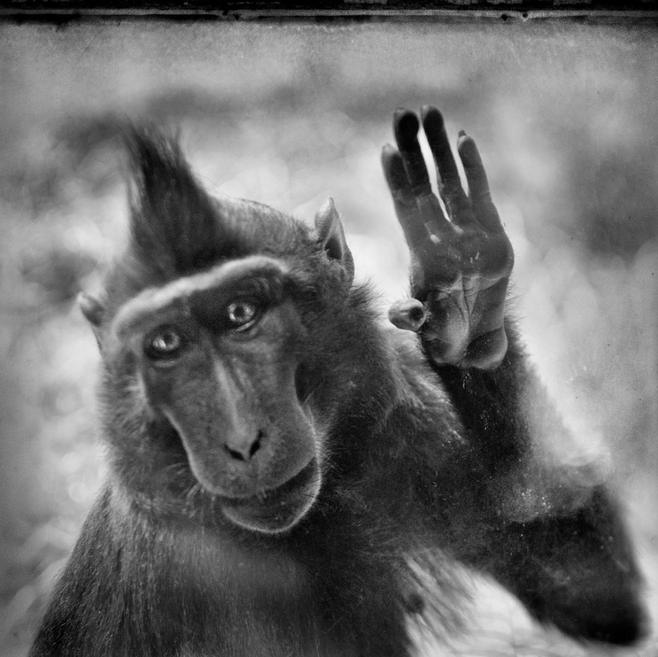
For her series “Behind Glass,” Anne Berry photographs primates through the glass separation barrier:

“They’re looking at us like we’re looking at them,” Berry said.

Her title not only means the obvious, that the animals are behind enclosure windows, but also draws a metaphor to how humans separate themselves from nature. People like to observe the natural world but want to segregate wild animals in contained preservations or zoos.

“I want people to say, what are we doing to the habitats?” Berry said.

More images from the series here.

(Photograph by Anne Berry)

Quote For The Day

“For quite a few people, there is something upsetting about the 100%-with-no-exceptions forgiveness that Jesus talked about. It is a feature that upsets conservatives. But it also upsets liberals. There is something in it to offend everybody. Except the person who needs it at the time.

What proves hard to swallow is the absolute character of it. Christ’s forgiveness includes the worst offenders you can think of, but it also includes the pussycats of life – there aren’t many pussycats, but there are a few – who have done nothing wrong or worthy of blame. It is a blanket forgiveness that puts a straight red line through the past. I write ‘red line’ because the Old Story says that Christ’s blood was shed in place of my blood. Dylan captured this on his 2012 album ‘Tempest’: ‘I pay in blood/But not my own.’ It seems obvious that this is unfair. It seems to put ‘The Good, the Bad and the Ugly’ (1966) all under the same protection. There is no distinction.

A familiar rationalization for Christ’s universal forgiveness goes like this: ‘Well, yes, it is for everybody, but you have to ask for it. The offender can’t receive it until he or she asks for it. Each person, good, bad, or a little bit of both, has to do his part. It won’t do you any good if you don’t first come forward and take it.’ That is a rationalization in service of explaining away the ‘full-service’, 24/7 gas station that Christ’s message actually is for all the cars on the road.

Can anyone really rationalize what Christ was saying when he said that people should be forgiven 490 times per action per person?” – Paul F.M. Zahl, in PZ’s Panopticon: An Off-the-Wall Guide To World Religion.

The Joy Of Blasphemy

Simon Price explains why he “blaspheme[s] freely, with relish and glee”:

Objections to my fondness for blasphemy usually fall into three categories. First is the accusation of hypocrisy. “If you’re an atheist,” comes the question, “why do you even use those words?” My answer is that I was reared in an Anglican culture, which instilled in me uncountable hang-ups, false hopes and arbitrary feelings of guilt. Blaspheming, for anyone who had their young mind mangled by religion, is not merely a right – it’s a solemn duty.

The second, especially in these post-Fatwa, post-Danish-cartoon times, is the insinuation of cowardice. Why, I’m asked, do I not speak profanities pertaining to other religions? Firstly because it would sound desperately put on and contrived, like Basil Fawlty muttering, “Oh, Buddha”. Secondly, Christianity programmed me with its “language”, a rich set of cultural references in which I’m fluent. We all speak, for example, of the “road to Damascus moment”, or predict that “so-and-so will get crucified”. These phrases belong to the unbeliever as much as the believer. …

The third is the charge of impoliteness. I’m told I must always consider the sensitivities of the faithful, who shudder at sacrilegious speech. I disagree. Those who were indoctrinated alongside me, but bought into it for life, have made their choice about what to do with all that baggage. And I’ve made mine.

The Divine Comedy, Without The Divine?

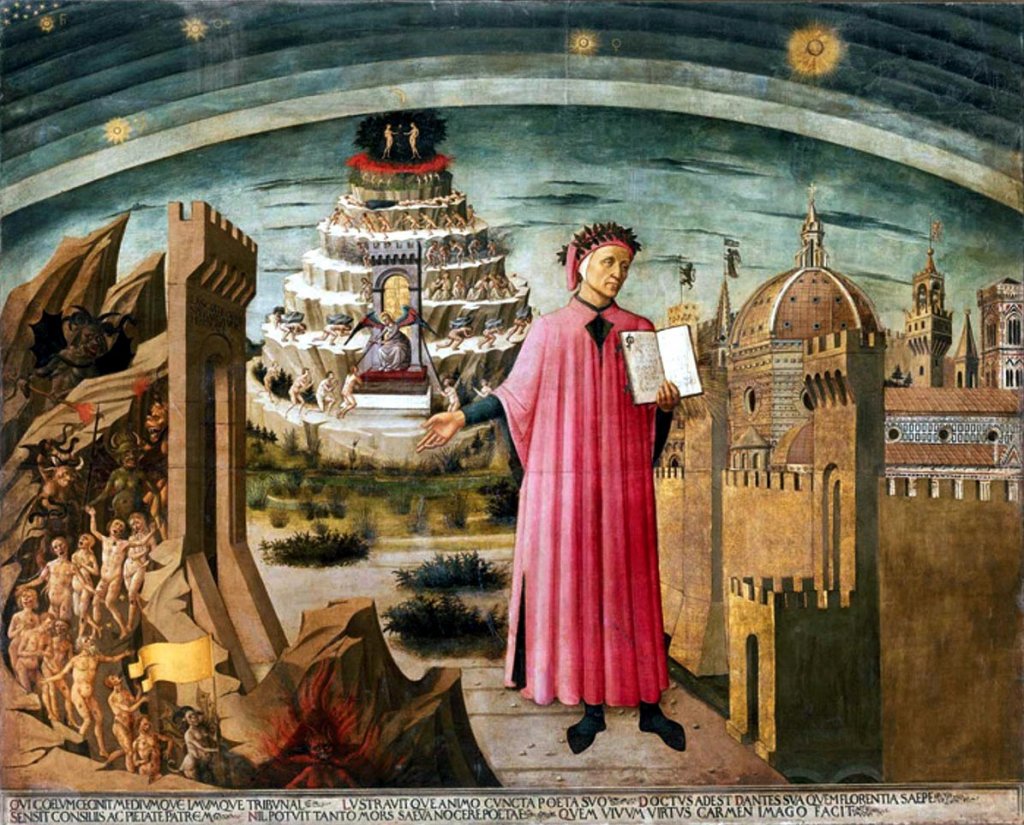
Dante Large

Dreher wonders if atheists can “really get” Dante:

Without question many people read it and understand it deeply without converting to Christianity, but as I read Paradiso, with Inferno and Purgatorio behind me, I found myself genuinely mystified by what an atheist or agnostic reader would make of its illumination of the workings of divine love.  Paradiso is not a work of theology, strictly speaking, but if you do not accept the existence of God, and a God who is Love at that, the poem loses much of its power, or so it seems to me.

I know how defensive atheists and agnostics can get over claims like this, so let me hasten to say that the Iliad and the Odyssey remain imaginative works of staggering genius, even though none of us believe in the pantheon of Greek gods. You do not have to accept Greek religion to understand and be profoundly moved by these epic poems (though it is interesting to imagine how those who first heard the poems, as believers in those gods, experienced it).

Paradiso is different. It is utterly saturated with theology. In my personal experience, I do not think the Commedia would have worked its magic on me had I not believed that the God of Whom Dante wrote really exists, and that His love, as Dante characterizes it, is a real thing. The Commedia was a means of transformative grace for me, and a theophany, the likes of which I had not experienced since I was 17, and wandered unawares into Chartres cathedral – but I doubt it would have been had I not believed that such grace actually exists. What I don’t know is the extent to which that is a statement about my own subjectivity.

(Image of Dante and the Divine Comedy by Domenico di Michelino, 1465, via Wikimedia Commons)

Peering Into The Evangelical Mind

Reviewing Molly Worthen’s Apostles of Reason: The Crisis of Authority in American Evangelicalism, John Turner explores evangelicals’ complicated approach to the life of the mind:

In Molly Worthen’s witty and erudite retelling, evangelicalism is always on the verge of an intellectual meltdown. Fundamentalists-turned-neo-evangelicals traded in the presuppositions of strict inerrancy for the presuppositions of a [Reformed] Christian world view. Having once pretended that biblical authority alone could suffice as a guide for faith and action, they now pretend that Christians should be able to agree on what that world view looks like. Ultimately, evangelicals cannot live in the world of free inquiry and [secular] reason, so they curtail precisely those traits that would finally gain them the intellectual respect of non-evangelicals. “These habits of mind,” writes Worthen, “have crippled evangelicals in their pursuit of what secular thinkers take to be the aims of intellectual life: the tasks of discovering new knowledge, creating original and provocative art, and puzzling out the path toward a more humane civilization.” Of course, as Worthen herself notes, pursuing those tasks have never been evangelicals’ foremost goal. Instead, they want to win the world to Christ, and many of them fear that intellectual pursuits (even on evangelical rather than secular terms) will endanger that higher purpose.

In a review of the book last month, Michael Robbins zoomed out:

The key to understanding the anxieties that led conservative evangelicalism to such frantic action lies in [theologian Carl] Henry’s phrase “world-life view,” an awkward translation of Weltanschauung, a word that, in Worthen’s telling, obsessed the neo-evangelicals: “They intoned it whenever they wrote of the decline of Christendom, the decoupling of faith and reason, and the needful pinprick of the gospel in every corner of thought and action.” They picked up the term not from Kant but from Reformed theologians, and it came to represent a set of shared premises and guidelines that, once discovered and articulated, would reknit the dispersed body of faithful into a new Church Militant.

Apostles of Reason, then, is a chapter in the broader history of secularization, and as such it makes an interesting companion to Charles Taylor’s A Secular Age, which I happened to be reading alongside it. “It’s a commonplace that something that deserves” the title of secularization “has taken place in our civilization,” Taylor writes. “The problem is defining exactly what it is that has happened.” (The vulgar popular version has it that science in some sense proved religion to be false; this is simply another way of saying that scientism is the faith proper to late capitalism.) Regardless of the precise content of secularization, Worthen’s neo-evangelicals saw that a coherent picture of the world, a shared presumption of the truth of the Christian religion, had disappeared. And they set about trying to figure out how to restore it.

Recent Dish on Worthen’s work here.
The Language Of Certainty In Atheism

Certainty Words

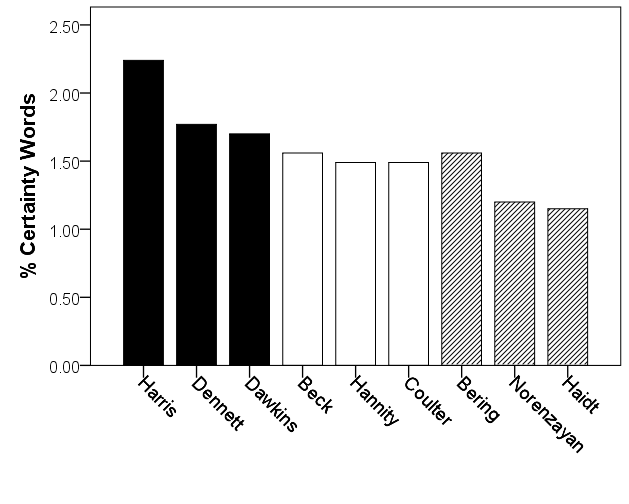
While reading Sam Harris and his fellow New Atheists, Jonathan Haidt noticed that their books “used rhetorical structures suggesting certainty far more often than I was used to in scientific writing – words such as ‘always’ and ‘never,’ as well as phrases such as ‘there is no doubt that…’ and ‘clearly we must…'” So he decided to do a little experiment:

I took the full text of the three most important New Atheist books—Richard Dawkins’ The God Delusion, Sam Harris’s The End of Faith, and Daniel Dennett’s Breaking the Spell and I ran the files through a widely used text analysis program that counts words that have been shown to indicate certainty, including “always,” “never,” “certainly,” “every,” and “undeniable.” To provide a close standard of comparison, I also analyzed three recent books by other scientists who write about religion but are not considered New Atheists: Jesse Bering’s The Belief Instinct, Ara Norenzayan’s Big Gods, and my own book The Righteous Mind. (More details about the analysis can be found here.)

To provide an additional standard of comparison, I also analyzed books by three right wing radio and television stars whose reasoning style is not generally regarded as scientific. I analyzed Glenn Beck’s Common Sense, Sean Hannity’s Deliver Us from Evil, and Anne Coulter’s Treason. (I chose the book for each author that had received the most comments on Amazon.) As you can see in the graph, the New Atheists win the “certainty” competition. Of the 75,000 words in The End of Faith, 2.24% of them connote or are associated with certainty.

The Human Difference

Wray Herbert reviews Thomas Suddendorf’s The Gap: The Science of What Separates Us from Other AnimalsThe most important distinction between man and beast:

Suddendorf’s main idea is that we humans are capable of cognitive feats to which no other animal—not even our impressive cousin the ape—comes close. We are able to imagine endless situations, to create scenarios and narratives about distant places, including the past and future. And, equally important, we have an insatiable drive to share those imaginings with other scenario-building minds. Our uniqueness, the author argues, rests on these two fundamental traits, but plays out in various domains of the human mind.

Language is one of those domains. A lot has been written about the abilities of other species to communicate, and those skills are indeed impressive. Bees signal the whereabouts of food, and birds have elaborate courtship dances. My dog clearly (and effectively) signals that it’s dinnertime by staring. But none of this adds up to language—not as I illustrated it above. Even humpback whales, with their very large brains, show only a narrow repertoire of communication skills, devoid of the flexibility and generative power that allow us to utter and comprehend novel expressions. Suddendorf systematically dismantles the claims of other species on language, arguing that even the great apes—the ones we have spent years trying to teach our language—fall far short of full-fledged language. What’s lacking, in the end, is the motivation to create symbols and grammar to share what’s on their minds.

The Creativity Of Copycats

Commenting on Duke: A Life of Duke Ellington, Popova considers the composer’s tendency to plagiarize from soloists in his orchestra “without credit, creative or financial, to the originators”:

[Music writer and historian Stanley] Dance called him “the greatest innovator in his field, and yet paradoxically a conservative, one who built new things on the best of the old.” It was, no doubt, a compliment on the mastery with which Ellington built on the legacy of jazz, not a dig on his unabashed creative borrowing that bled into plagiarism. And therein lies another eternal human paradox that Ellington embodied: Is it possible to be both a plagiarist and an innovator? Ellington lived the answer with remarkable aplomb.

But the real question, of course, isn’t whether creativity is combinatorial and based on the assemblage of existing materials — it is. What Ellington did was simply follow the fundamental impetus of the creative spirit to combine and recombine old ideas into new ones. How he did it, however, was a failure of creative integrity. Attribution matters, however high up the genius food chain one may be.

Previous Dish on Ellington here and here.

Turning To Tricks

In an excerpt from Cut Me Loose: Sin and Salvation After My Ultra-Orthodox Girlhood, Leah Vincent describes her decision to become a prostitute:

The choice I made that morning felt inevitable. Girls who left Yeshivish life always became sluts and whores. This had been taught to me all of my life. I could never turn into a healthy irreligious woman. I now saw that this was not because of some divine punishment— no. It was because the journey out of the cloistered community I had been raised in was too difficult. The distance from modest girl to free woman could not be traversed. I would never have the confidence of a woman who’d received parental love regardless of her lifestyle choices. I would never relate to men the way a woman who had safely explored her sexuality in high school or college could. I would be stranded in black space between the world I came from and the world I wanted to enter, always falling short, always hurt, always failing. I might as well give up clawing away in the direction of a future that would never be mine. I might as well embrace my brokenness. I might as well wield it like a sword. I would not fall into the prophecy of doom; I would jump into it, feet first. I would be a smashing success at being bad.

Having rejected the laws of my upbringing, I had adopted few new morals. Sex was not sacred to me. And most importantly, I was good at it. My curves grabbed men’s attention, their interest fueled my confidence, and in the act, my desperation to please left my lovers more than satisfied. I was clueless at relationships but fantastic at attracting eager men and thrilling them that first, magical time. I might as well pursue my strength, I figured. I did not pause over the dangers of prostitution. I did not worry about disease. The [pelvic inflammatory disease] had probably left my insides dead. I felt I had nothing to lose.