A Primer On “Impossible Music”

Robert Berry describes Black Midi, which is known “for the incredible density of notes crammed onto [songs’] scores”:

Artists use cheap software like Synthesia, intended as a vaguely Guitar Hero-ish piano tuition aid, as a means of visualising their pieces for YouTube consumption. Notes rain down on the piano keyboard like a tropical storm with some pieces averaging more than 60,000 notes a second, note counts in the millions – even billions – over the course of a few minutes. At moments of the most extreme densities, the system’s ability to represent the information it is being fed breaks down and the sound erupts into a scree of digital distortion. There is a reason why so many ‘blackers’ refer to their tunes as “impossible music”.

When I described the Black Midi stuff I’d heard to [electronic artist] Holly Herndon, she was apt to liken it to the early twentieth century cluster chords of Charles Ives, or to think of it as a kind of absurdist critique – whether deliberate or not – of the extremes of virtuosity demanded by the ‘new complexity’ music of composers like Brian Ferneyhough. … As I plunged through the online rabbit hole of Black Midi wikis and YouTube channels, with their frenzied cover versions of classic video game soundtracks, their hyperbolic boasts of lavish cpu- busting note densities; I heard something at once comfortingly alien and peculiarly childlike.

(Video: “Bad Apple” by TheSuperMarioBros2)

The Secrets Of Online Dating

Just in time for Valentine’s Day, Wired analyzed data from OKCupid and Match.com to help online daters create the most appealing possible profiles. Their suggestions in a nutshell?

Learn to surf, listen to Radiohead, mind your grammar, use Tinder, OkCupid, Match, and Grindr on Sunday, watch Homeland, stop listing your eyes as your best feature (nobody cares), and please, please make eye contact with the camera and smile with teeth in your profile picture.

Amanda Hess notes that Wired‘s number-crunchers “found that both men and women gain popularity on the site when they play against gender stereotypes”:

On OkCupid, men who mention “my children” are rated as highly attractive, while women who discuss their kids are not. It’s good for women to talk about electronics and for men to talk about crafting, but not the other way around. It’s much better for women to mention The Matrix than it is for men to mention The Matrix, better for men to mention weddings than it is for women to mention weddings, and better for women to mention war than it is for men to mention war. The lowest-rated women talk about Twilight, poetry, and “chick flicks”; bottom-ranked men discuss zombies and C++. (More fun facts: The most popular women on the site call themselves “girls,” while the most popular men call women “women.” And it’s really hot for guys to use the word “whom.”)

Daisy Buchanan insists that profile pictures trump self-descriptions, however finely-tuned:

[T]he fact remains that a picture paints a thousand words and, as long as you look good in your photograph, you can fill the “about you” section with an extended essay about your passion for the works of cinematic auteur Michael Bay, and still get plenty of messages. This might be why image-based dating apps like Grindr and Tinder are so popular, with the latter increasing its user base by 25% a week at the last count.

Putting the image-first hypothesis to the test, comedy writer Alli Reed created a fake profile using pictures of a model-actress friend accompanied by text that indicated “she’s not just a bad person, she wants to ruin your life”:

Q: So you created a profile for a girl named AaronCarter’sFan who likes to party and knock over homeless people, or at least their cups, and she’s a racist, gold digging, fake pregnant-getting, 25 year old girl, white girl. How’d you do?

A: AaronCarterFan did very well. In the first 24 hours she got 150 messages. I had the profile up for two or three weeks, and she got close to 1000 men message her. … [A]fter so many messages started rolling in, the optimist in me decided that these men had just seen the pretty photo and had not read her profile. So my goal at that point became to convince them that she is just awful. That she is the worst woman on earth. If they asked what I was doing I said I was pretending to be a 14 year old on Facebook so I could bully my sister’s friends. I would threaten to pull out their teeth. With a lot of guys I could just, I wrote gibberish, just pounded on keyboard for a minute and sent it and the vast majority of them responded with that sounds great, what are you doing on Friday?
Where Happy Hour Hits The Pocketbook Hardest

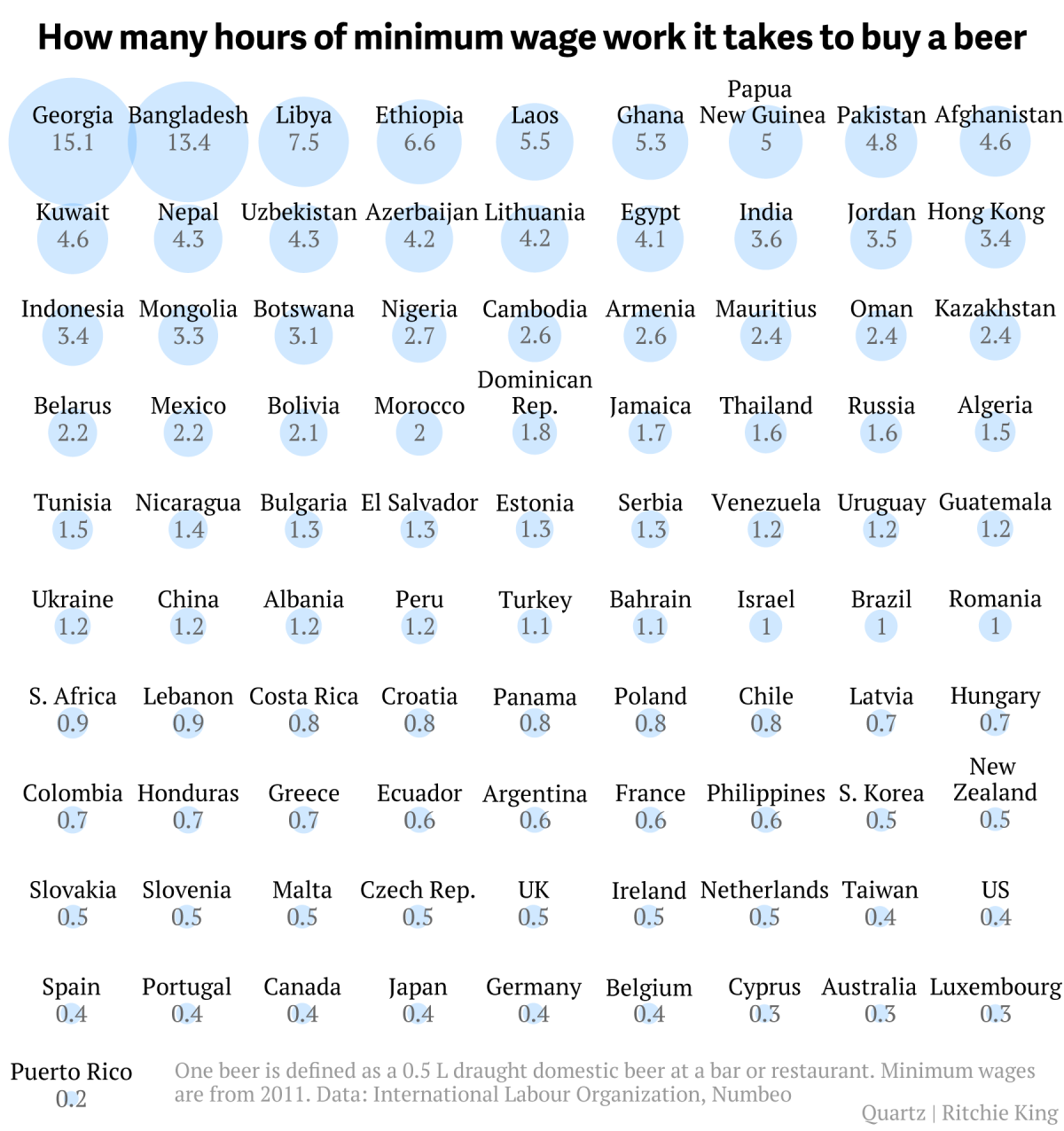
dish_beerchart

Roberto A. Ferdman and Ritchie King describe how they created the above Beer Index:

Numbeo, a crowd-sourced database of the price of goods around the world, maintains a comprehensive list of the average price of a domestic draft beer in different countries. And the International Labor Organization (ILO) maintains a vast library of minimum monthly wage data. So we combined the two—into a beer indicator, of sorts.

By dividing the average price a local has to pay to get a beer by the hourly minimum wage (assuming a 40-hour work week) a person makes in each country, we were able to approximate how long it takes someone making the minimum wage to earn enough to buy a brew at a local bar. The Economist did something similar back in 2012, but used countries’ median wages, and only included 27 countries. This one is a bit more comprehensive (and a bit more about the people who make the least.)

Taverns For Teetotalers

The Economist notes the surprising rise of “dry bars” in Britain, with three operating in London, Liverpool, and Nottingham and two more set to open soon:

Unlike many cafés, they stay open late. They emulate bars in other ways, with live music, comedy acts and films to pull in punters. When the lights go down and the DJ plays at Sobar, which opened in Nottingham in January, it looks like any city bar, hopes Alex Gillmore, the manager. Redemption misses the hefty profits made on alcohol, but temperance brings its own benefits. Business remains steady throughout the week rather than spiking at the weekend, says Catherine Salway, its founder. The absence of drunken, obstreperous patrons means that bouncers are unnecessary.

Sobar, like the Brink in Liverpool, is linked to a do-gooding drug and alcohol charity. But ordinary drinking dens are becoming a little drier, too, out of business sense rather than temperance principle. Pubs can make almost as much selling food as drink – and more are serving it. Both in pubs and at home, less boozy drinks are becoming popular. Total sales of beer by volume dropped slightly in the year to January, but those of the weaker kinds, with just 1.3-3.3 percent alcohol by volume, jumped 32 percent, according to Kantar Worldpanel, a market-research firm.

Maturing With Middlemarch

In My Life in Middlemarch, Rebecca Mead interweaves memoir and literary criticism, illustrating how George Eliot’s classic has affected her throughout her life.  In a review of the book, Hannah Rosefield describes why the novel endures:

Mead first read the novel aged 17, living in the southwest of England and preparing for university examinations, and she has read it every five years or so since. Middlemarch is, of course, not the only novel that changes with the age of its reader, but it does attract a particular kind of rereading. Writers, academics and non-specialist readers alike talk about a distancing from Dorothea as they grow older, a realization of the irony in Eliot’s portrayal of the girl who wishes she could have married Milton or any other great man “whose odd habits it would have been glorious piety to endure.” They discover their sympathy, especially if they are academics, for Dorothea’s elderly husband Casaubon, the scholar fixated on a project that he has neither the will nor the intellect to complete. To the young, Middlemarch is about the young; to the middle-aged, it’s about middle age.

Pamela Erens elaborates:

[Protagonist] Dorothea feels an inchoate longing to do or become something that the provinces don’t provide a ready picture of. Mead experienced this, too, although she had a better image of what might lie in the big world outside, and opportunities to reach for it.

The “it” in Mead’s case was Oxford University and a life of literature and journalism. But in Dorothea, Eliot was not writing simply about a woman born too soon for a career. Her portrait of youthful longing is more complex than that.

As Virginia Woolf put it, Dorothea and other Eliot heroines experience “a demand for something  —they scarcely know what — for something that is perhaps incompatible with the facts of human existence.” The book speaks, writes Mead, to the part of girlhood that asks:

How on earth might one contain one’s intolerable, overpowering, private yearnings? Where is a woman to put her energies? How is she to express her longings? What can she do to exercise her potential and affect the lives of others? What, in the end, is a young woman to do with herself?

In this sense, Eliot is a poet of youthful longing (not merely in women but also in men) — of what it feels like to suffer “the burthen of larger wants than others seemed to feel,” as Eliot writes of Maggie Tulliver in her earlier novel The Mill on the Floss — and one can see why Middlemarch has hypnotized sensitive, introspective, ambitious young women for many generations.

Face Of The Day

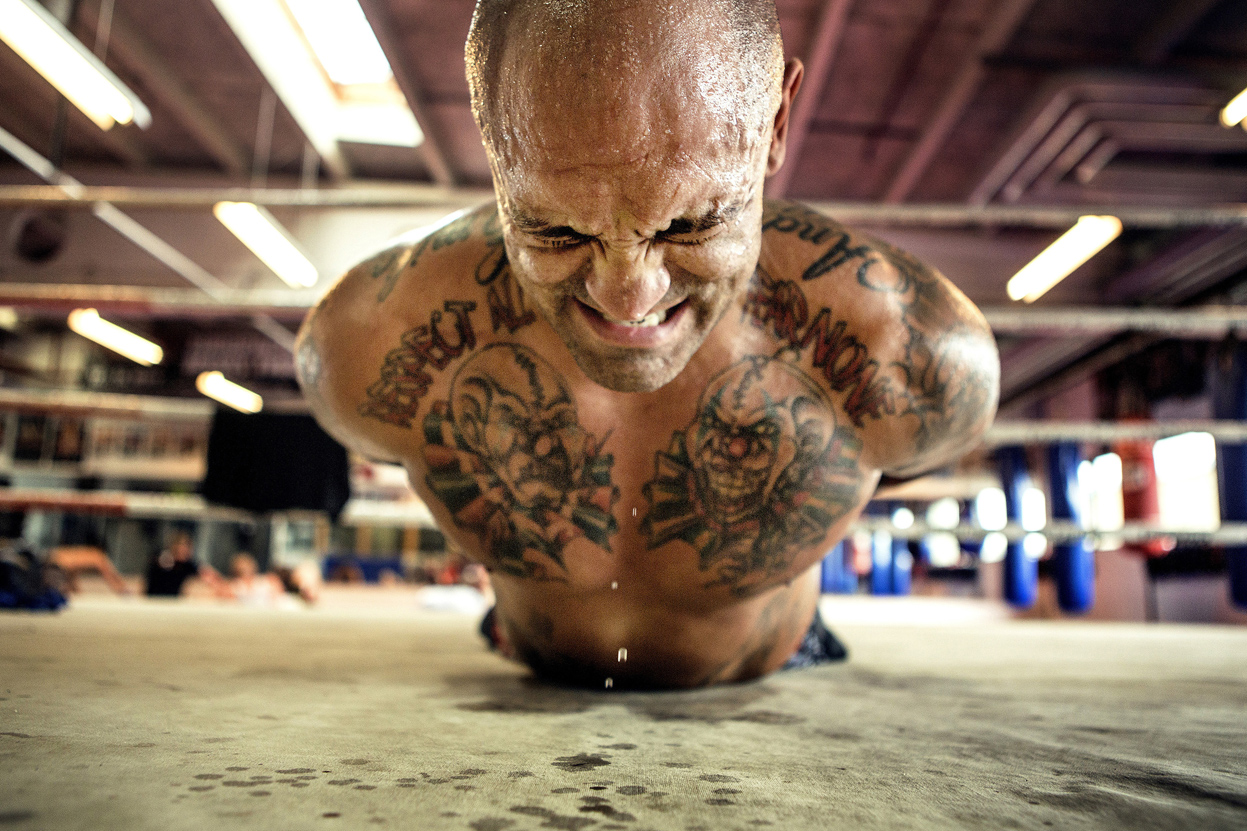
The Fighter, The Father by Nikolai Linares

UMMA fighter Jorge Herrera prepares for an upcoming fight in a photo from Nikolai Linares’ series The Fighter, The Fatherwhich originally ran in the Danish newspaper Berlingske. Nikolai’s blog is here. The photo has been shortlisted for the 2014 Sony World Photography Awards. Alan Taylor compiled a gallery of many of the contending images:

The Sony World Photography Awards, an annual competition hosted by the World Photography Organisation, has recently announced its shortlist of winners. This year’s contest attracted more than 140,000 entries from 166 countries. … Winners are scheduled to be announced in March and April.

Samuel Beckett, Motivational Speaker

Mark O’Connell investigates how a line from Beckett’s Worstward Ho – “Ever tried. Ever failed. No matter. Try again. Fail again. Fail better” – has entered a “strange afterlife as a motivational meme” for the Silicon Valley set:

The entrepreneurial class has adopted the phrase with particular enthusiasm, as a battle cry for a startup culture in which failure has come to be fetishized, even valorized. Sir Richard Branson, that affable old sage of private enterprise and bikini-based publicity shoots, has advocated from on high the benefits of Failing Better. He breaks out the quote near the end of an article about the future of his multinational venture capital conglomerate, telling us with characteristic self-assurance that it comes “from the playwright, Samuel Beckett, but it could just as easily come from the mouth of yours truly.” …

Fail Better, with its TEDishly counterintuitive feel, is the literary takeaway par excellence; it’s usefully suggestive, too, of the corporate propaganda of productivity, with its appeals to “think different” or “work smarter” or “just do it.” And the fact is that these six telegraphic bursts of exhortation actually work pretty well as a personal motto, once that sanding and smoothing has been completed. They are also—and this is crucial, though obviously not something Beckett would have had in mind—eminently tweetable; the whole thing comes in at just 69 characters, which leaves people plenty of room for whatever commentary or show of approval they might want to append.

Connecting Across Time

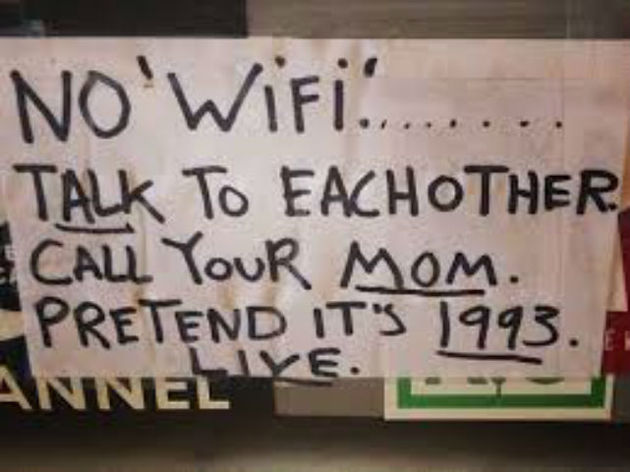
A viral image urging people to unplug:

Wifi 1993

Rachel Baron Singer challenges “the writer’s questionable sense of nostalgia.” Looking back past the 90s to the Jazz Age parties of F. Scott Fitzgerald’s day, she suggests that meaningful human connection was no easier when people met only face-to-face instead of on Facebook:

[A]part from the wild parties, [artists and socialites] Gerald and Sara Murphy are also famous for being the inspiration behind Dick and Nicole Diver, the alluring but emotionally insolvent protagonists of F. Scott Fitzgerald’s Tender is the Night, a novel that is, if nothing else, a tale of detachment and marital loneliness. The book is rife with comments about how alone Dick and Nicole feel in one another’s company (and with friends and lovers, to boot). In one scene, in which the pair sits in frosty silence, Fitzgerald notes how Dick “often felt lonely with [Nicole],” and in another, he describes Nicole as “leading a lonely life, owning Dick, who did not want to be owned.” Most poignantly, in Chapter 12, Fitzgerald writes: ” . . . they sat with the children on the Moorish roof and watched the fireworks of two casinos, far apart, far down on the shore. It was lonely and sad to be so empty-hearted toward each other.”

How much of this sentiment is based upon impressions of the Murphys versus Fitzgerald’s own fractured relationship with [his wife] Zelda is difficult to say, but the point still stands that in the literary imagination of the Jazz Age, people who engage in the most public, grandiose acts of socialization (what our sign writer might consider to be living), are the ones who are the most isolated from real human interaction. This is certainly a prevalent theme in The Great Gatsby, where lavish, glamorous parties — undoubtedly influenced to some degree by those thrown by the Murphys — are portrayed as the ultimate symbol of social disengagement. Gatsby is as alone at his parties as he is in death, and that goes for anyone and everyone else.

A Short Story For Saturday

The opening lines of Chris Offutt’s “Mr. Cartoon“:

We got one channel that came over the mountains from West Virginia, and bad weather just about ruined that. On stormy winter nights Papaw went outside to turn the antenna while my big brother, Wendell, stayed in front of the TV, watching for the picture to get better. I stood in the doorway and yelled back and forth between them.

Papaw twisted the pole and hollered, “What now?”

“What now?” I said to Wendell.

“Nothing yet,” Wendell said.

“Nothing,” I yelled to Papaw.

He moved the antenna some more. When the picture got good, Wendell said, “Stop!” and I said, “Stop!” but usually Papaw was done past the stopping place and the picture went bad again.

Read the rest here. For more, check out Offutt’s collection Out of the Woods: Stories.