The Best of The Dish Today

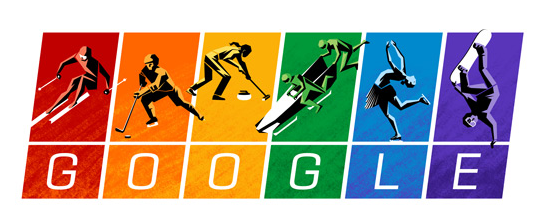
Screen Shot 2014-02-06 at 9.15.52 PM

Nice move there, Google – celebrating the Olympics with the rainbow flag. That’s the Russian search-page. Here’s the one in Jamaica – another country riddled with pathological homophobia. And the Ugandan and Nigerian versions. If you think I’m over-reading some simple coloring, the quote on each page makes the intent clear:

“The practice of sport is a human right. Every individual must have the possibility of practicing sport, without discrimination of any kind and in the Olympic spirit, which requires mutual understanding with a spirit of friendship, solidarity and fair play.” –Olympic Charter

Well played.

Today I wondered if Clinton fatigue could worsen; mused if the pursuit of wealth through work is now in conflict with the deeper American principle of the pursuit of happiness; and mourned an epic beard.

I also appreciated the defense of French as integral to a proper education. It was the one foreign language I actually mastered. It enabled me to read Camus, Mauriac, Baudelaire, Constant, Flaubert, Tocqueville, de Maupassant, and above all, Pascal and Montaigne in the original. It’s up there with my Oxford entrance-level Latin as a foundation for my entire intellectual life – even though it could be described as useless as a practical endeavor. But the life of the mind is not a practical endeavor; and one good sign of the value of the truly great things in life is their “uselessness”.

The most popular post of the day was Clinton Fatigue? Next up: Sarah Palin’s baked Alaska.

Our renewal revenue is now 106 percent of the original revenue this time last year. 106 percent.

See you in the morning.

Rebuilding With Robots

Glenn Thrush covers the revival of Pittsburgh:

The irony that a city built on an industrial working class has reclaimed part of its past industrial glory by developing machines designed, in some cases, to replace human workers is lost on exactly no one. Carnegie Robotics, a new CMU startup generating a lot of buzz, makes a machine that sorts strawberries and can do the work of 800 people; Aethon, a medical robotics company founded in 2002, automates much of hospitals’ tangled internal logistics chains. “We create jobs, we don’t take them away,” growls Whittaker, whose own firm, RedZone Robotics, which he founded while keeping his university research post, builds robots that inspect small sewer lines. “If you want to dig through shit for a living that’s your business. But a robot can get into a tiny pipe, and a person can’t do that, so I’m not taking anyone’s job away.”

This story of Pittsburgh’s reinvention, then, is very much about not only the new politics of urban renewal—but also about the future shape of an American economy that may well be smarter, faster and more innovative, but without the sheer number of good, stable middle-class jobs that powered the great postwar American boom.

Of course, it’s still not clear whether the widespread automation of repetitive tasks—the kinds of things a machine can do as well or better than a human—is responsible for the anemic pace of American job creation since 2000. Since the dawn of the Industrial Revolution, productivity and overall employment have generally risen together, with advances in technology spurring a virtuous cycle of re-investment and job creation. In the last decade or so, they have diverged—leading some economists to conclude that robots and smart software are elbowing humans out of the workforce. Two MIT researchers, Erik Brynjolfsson and Andrew McAfee, theorize that rapid technological advances have created a “great decoupling” of productivity and employment, which partially explains the malaise. Other researchers fiercely question that conclusion, and argue that the employment stall has as much to do with globalization and the accelerating boom-bust cycle of recent financial crises. “No one knows the cause” of the recent jobs slowdown,” economist David Autor told MIT’s Technology Review. “[It’s] a big puzzle… but there’s not a lot of evidence it’s linked to computers.”

Recent Dish on robots here.

Why Is Liberal A Dirty Word?

Beinart passes along a theory:

[T]here’s reason to believe that today, many Americans eschew the term not because they associate it with any particular unpopular attitudes or issue positions, but merely because they’ve only heard it discussed negatively. In a thought-provoking 2013 paper, Christopher Claassen, Patrick Tucker, and Steven S. Smith of Washington University in St. Louis note that although most Americans prefer the term “conservative,” those same Americans are “remarkably consistent” in telling researchers that they prefer liberal policies. How come? One reason may be that “conservative” has positive “extra-political” associations. To many Americans, it connotes “caution, restraint and respect for traditional values,” positive attributes irrespective of one’s views on specific policies.

But even more important, Claassen, Tucker, and Smith suggest, may be the negative way in which “liberal” is publicly discussed. “When certain labels are emphasized or favored by political and media elites,” they write, “the public is more likely to identify with them than others. Public framing often promotes the term ‘conservative,’ while the term ‘liberal’ is used with much less frequency and has long had a more negative connotation.” Part of the reason Americans consider liberal an epithet, in other words, is because they mostly hear it used as an epithet.

The Paradox Of De-Extinction

An excellent primer on the various ways scientists are trying to bring back extinct species:

Gregory E. Kaebnick wonders how to square de-extinction with the very concept of “nature”:

Defending nature is difficult, and not only because it seems to be giving way on so many fronts, but because the very idea of nature has been under assault. One criticism is that we are often wrong about it. Environmental phenomena thought to be entirely natural are in fact artificial to at least some degree. The Great Plains of North America, for example, were actively maintained as plains through regular burning carried out by the people who lived there. A second criticism is that, according to some thinkers, the idea of nature is just incoherent. The belief that nature must be protected from human activity suggests (hold these critics) that nature is a pristine, pure realm from which humans are excluded – that human activity is somehow unnatural. That seems bizarre. Yet if humans are part of nature, then what is unnatural, exactly, about the human activity that supposedly threatens nature, and why try to protect nature as something apart from humans?

This is the foundational challenge posed by de-extinction. It plays into criticism of the very idea of nature. To preserve nature has mostly meant to restrain or limit human interference with it. But with de-extinction, preservation is interference with nature. Indeed, de-extinction can look like an attempted coup, in which technology overtakes nature and preservation as usually understood is eliminated. Preserve creation? We can recreate it.

Faces Of The Day

Westminster Kennel Club Hosts Masters Agility Championship

Hailey, a Boston Terrier Beagle, kisses her owner Karen Profenna ahead of the 138th Westminster Kennel Club Dog Show at Madison Square Garden on February 6, 2014. The Mixed Breed category brings non-purebred dogs to the event for the first time since the earliest days of the show. This is the first year for the Masters Agility Championship at Westminster, which will be held this Saturday at Pier 94 in New York, ahead of the big event – the annual Westminster Dog Show. By John Moore/Getty Images.

How The Left Failed Black Americans

Tanner Colby regrets that “there is rarely any thoughtful critique of the left when it comes to race.” He kicks off a multi-part series on the subject by criticizing the effort to integrate schools in the post-Brown south:

Not all black parents believed in integration. Those who did wanted a say in how it played out for their children. Some busing programs were voluntary, but by and large black children had to bus where [the Department of Health, Education, and Welfare] told them to bus. Mandatory racial-balance requirements insisted on it. With Jim Crow, black America lived under an onerous, top-down system that told them where their children could and could not go to school. Now, with busing, black America lived under … an onerous, top-down system that told them where their children could and could not go to school. A 1972 Gallup poll showed that 77 percent of whites were against busing. The same poll showed 47 percent of blacks were against it as well. Many black Americans did believe in the school bus and the access it provided, and busing might have been a viable tool for those families had it been smartly and surgically applied. It wasn’t. It was presented in a sweeping fashion that denied many blacks the agency they sought.

Bouie supports Colby’s broader point but thinks it’s unfair to discount the political circumstances:

“You have to realize that busing had been used for decades to promote segregation,” [Virginia Commonwealth University history professor Brian Daugherity said, pointing to one Virginia county that, for example, bused black students to the black school and white students to the white one. “For liberal policymakers in the 1960s, it wasn’t a stretch to say ‘You’ve been using busing to promote segregation, we want to use it to promote integration instead.’” …

I should say that I don’t disagree with Colby about the efficacy of busing. But one thing is clear to me: If you’re going to criticize the political approach of anyone, you need to consider the context in which they were working. If busing was a key part of the integrationist arsenal, it was because it was a key part of the segregationist one as well. And if liberals lost the war on segregation, it’s because there wasn’t—and isn’t—the will to win.

What’s The Point Of Learning French? Ctd

A reader goes beyond the utility of the language:

In my opinion, one doesn’t learn French for practical reasons (although one of your readers did make a case along those lines). Rather, one learns French because it is beautiful. Some of the most adventurously intellectual, rigorously philosophical, and inventive, artistic, and creative minds just happen to have been shaped by the French language. To mention only a few examples: the poets Baudelaire, Verlaine, Rimbaud, Mallarmé, Apollinaire, Jacob, Valéry, Artaud, et. al. The list of French philosophers is even longer: Abelard, Montaigne, Descartes, Voltaire, Diderot, Comte, Bergson, Sartre, de Beauvoir, Barthes, Foucault, and the rest.

I could go on listing French composers, playwrights, novelists, scientists, and the like. But to my mind the best defense for the French language is an Irishman:

Samuel Beckett wrote some of his most important works in French, including his masterpiece Waiting for Godot and the trio of novels Molloy, Malone Dies, and The Unnamable. Beckett consciously chose to write in French, because it freed him creatively and allowed him to develop a style that he would not have developed otherwise.

Language both shapes culture and is a reflection of culture. To rate languages accordingly to how “useful” they are, as McWhorter does, is peculiarly vulgar and offensive. It also indicates an oblivious attitude toward the beauties and mysteries of all languages, not only French.

Another reader:

As a French major, I can say that studying la langue was great. But not for Molière or Rimbaud. (Yes, for Paris …) Rather, it’s the way one’s brain stretches and re-forms when confronted with alternate cultural architecture for seeing, sorting, and comprehending the world around you. To discover, for instance, that the French language has no word for “wilderness” – for a kid from the West, that was a mind-blower. “My cultural foundation does not exist in your worldview.” That is why language is such a powerful thing to study.

American children need more opportunities to be shocked out of their America-centric universe, and to see that meaning is fleeting and culture-dependent. If the temptation of croissants and a sweet tooth for Orangina gets a kid to study French, bravo. Whatever the language, the better a child (or adult) will be for it.

Why CVS Is Quitting Tobacco

Daniel Gross applauds CVS for its decision to stop selling tobacco products by October 1:

Yes, CVS is a massive operator of bricks-and-mortar stores that contain pharmacies and sell cosmetics and other items. But that’s not all CVS does. Not by a long shot. In fact, the corporate parent is known as CVS Caremark. Why? In 2007, CVS merged with Caremark RX, a huge pharmacy benefits manager (PBM). PMBs, as their name implies, manage the prescription drug components of Medicare and other public and private insurance programs. And that’s a huge and growing business.

Jonathan Cohn points out that CVS is abandoning one industry in favor of another:

For the past few years, pharmacy chains have been providing the care that more traditional medical practices cannot.

In the next few years, the chains hope to provide a lot more of it. On a conference call Wednesday morning, Troyen Brennan, MD, chief medical officer for CVS, said the company already has 800 clinics in operation and plans to expand to 1500. That seems roughly consistent with the national trend. A recent study from Accenture suggested the number of clinics would double between 2012 and 2015.

This growth is what prompted CVS to stop tobacco sales, according to company officials: “We are retooling ourselves as a company,” Brennan said. “How can you continue to sell tobacco when you are part of the health care system?”

Kliff agrees:

CVS has increasingly moved beyond its traditional role as a pharmacy in recent years, expanding its reach as a health-care provider. Its MinuteClinics services have allowed the company to increasingly enter into contracts with hospitals and health plans, often providing primary care services on the weekends and evenings, when doctors’ offices tend to be closed.

CVS chief medical officer Troyen A. Brennan estimates that the company has between 30 and 40 partnerships with health-care systems across the country and is in talks with a similar number about starting additional arrangements. He said the decision to halt tobacco sales will make it easier to strike such deals, particularly those that include financial rewards for CVS if they can help patients stop smoking and reduce their medical bills.

Olga Khazan looks at how this decision might affect CVS’s competitors:

CVS is far from the only player in the retail-clinic space: Walgreens, Target, and Walmart all have their own versions. And as more and more big-box stores become homes for primary care, they may face identity crises because they sell the vice-oriented products that make consumers feel good alongside the services that make them well. Even as CVS stops offering cigarettes within 20 feet of a physician assistant’s practice, its competitors might continue to do so. And beyond tobacco, Walmart might encounter PR issues over the fact that it sells, say, Jack Daniels and cirrhosis treatments under one roof, or shot guns and wound care. Some states have even considered legislation that would prevent retail clinics from operating in stores that sell tobacco or alcohol.

Yglesias wonders if the pharmacy chain will remove other unhealthy items from its shelves:

[T]he cigarettes issue seems to me to mostly raise the question of how far CVS can really go down this road. After all, I was in CVS just yesterday to buy myself some Diet Coke. The Diet Coke sits next to the sugary sodas. And they’re across the aisle from the potato chips. Up front where you cash out there are lots of M&M’s and Snickers bars.

There is, to be sure, also some medicine for sale in your typical “drugstore.” But junk food is a massive product line. I’m not sure how junk food sales compare to tobacco sales, but much more square footage of the stores is dedicated to chips and sodas than to smokes. To really make the pivot CVS is talking about, it seems to me they’d have to change their business pretty drastically.

Jonathan Weil notes that the company will lose money on the move but clearly believes it’s worth it:

In dollar terms the move is a blip. CVS said the decision would cut annual revenue by about $2 billion, which is less than 2 percent of its $123 billion of 2012 sales. The socially responsible investing crowd will be thrilled. President Barack Obama praised the move. A certain majority owner of Bloomberg LP no doubt will be pleased, too. Walgreen Co.’s directors had better be ready to answer questions about why their company hasn’t decided to stop selling cigarettes, too.

Kilgore considers the broader cultural shift against tobacco:

The relatively mild backlash to the cumulative wave of anti-smoking laws, ordinances and private bans (would anyone light a cigarette in someone else’s home without explicit encouragement?), not to mention sanctioned discrimination by health insurers and employers and heavy legal settlements against the tobacco industry, probably means actual Prohibition will at some point become feasible. And the trouble to which tobacco addicts must increasingly go to indulge their habits—even as cannabis smoking becomes more acceptable—has to be having an impact on anyone wanting to live a normal life.

The CVS ban, particularly if it leads to similar bans by competitors, is another step towards the day when purchasing of tobacco products will happen in the equivalent of “head shops” where it’s available at all. And popular culture will follow, at least after Mad Men’s final season concludes.
Better Late Than Never?

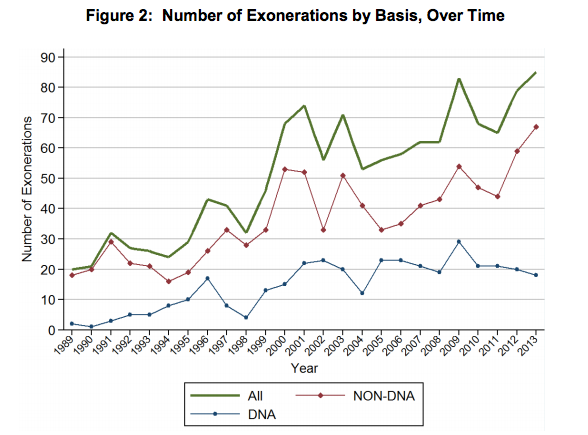
Screen Shot 2014-02-05 at 4.54.58 PM

A record-breaking 87 prisoners were exonerated in the US last year:

Today’s report from the National Registry of Exonerations counts more than 1,300 exonerations in the past 25 years. Among the long term trends they discuss:

* Twenty-seven (27) of the 87 known exonerations that occurred in 2013 — almost one-third of the total number for the year — were in cases in which no crime in fact occurred, a record number.

* Fifteen (15) known exonerations in 2013 — 17 percent — occurred in cases in which the defendants were convicted after pleading guilty, also a record number. The rate of exonerations after a guilty plea has doubled since 2008 and the number continues to grow. …

Last year, 40 people convicted of murder were exonerated, including one person who’d been sentenced to death. Murder and sexual assault convictions make up the majority of exonerations. The report points out that that may be largely because the meager resources available to review old cases tend to focus on the crimes with the most severe penalties. That would indicate that there may be a whole universe of innocent prisoners convicted of lesser crimes who simply don’t have anyone to fight for them.

Balko has a more upbeat view:

The fact that we just had a record year for exonerations – and more than a decade after the introduction of modern DNA testing – is a good sign. If nothing else, that we’re exonerating more people means there are more resources being devoted to looking for these cases. It means that courts are more open to reconsidering old cases. It’s also a testament to the fact that, in some parts of the country, police and prosecutors are actively participating in task forces charged with seeking out the wrongly convicted.

Andrew Cohen thinks there are “two relevant facts worth noting that are not synthesized into the exoneration report’s analysis”:

The first is that not all states are equal when it comes to prioritizing exonerations. Some simply care less about justice for the wrongfully convicted than others. Some are spending money on programs designed to ferret out inaccurate trial results while others are not. The registry that has given us this report may be national, in other words, but the remedies in place surely are not. Congress could help rectify that. So could the Supreme Court. So could the executive branch. Maybe this year.

The second point that needs to be made in the shadow of the report is that some states today are moving against the flow. Lawmakers in at least two states, Alabama and Tennessee, are seriously considering measures that would tighten appellate deadlines in capital cases, making exonerations harder to achieve.

(Graph via The National Registry of Exonerations’ “Exonerations in 2013”)

Quote For The Day

“It is fair to wonder if Hillary Clinton learned the lesson of the health-care disaster too well, whether she has so embraced caution and Hillary Clinton Addresses National Automobile Dealers Association Conventioncompromise that she can no longer judge what merits taking political risks. It is hard to square the brashly confident leader of health-care reform—willing to act on her deepest beliefs, intent on changing the political climate and not merely exploiting it—with the senator who recently went along with the vote to make flag-burning a crime. Today Clinton offers no big ideas, no crusading causes—by her own tacit admission, no evidence of bravery in the service of a larger ideal. Instead, her Senate record is an assemblage of many, many small gains.

Her real accomplishment in the Senate has been to rehabilitate the image and political career of Hillary Rodham Clinton. Impressive though that has been in its particulars, it makes for a rather thin claim on the presidency. Senator Clinton has plenty to talk about, but she doesn’t have much to say,” – Josh Green, Atlantic, 2006.