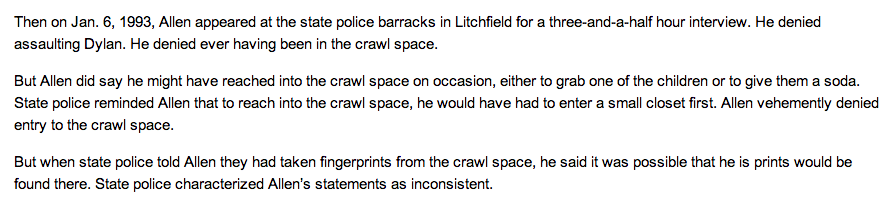
Jon Lovett is tweeting up a storm. And if you haven’t read this analysis of the strange investigation into the allegations two decades ago, you should. Just because Allen wasn’t charged doesn’t mean he was exonerated.
Jon Lovett is tweeting up a storm. And if you haven’t read this analysis of the strange investigation into the allegations two decades ago, you should. Just because Allen wasn’t charged doesn’t mean he was exonerated.
Well, maybe here is the case to be made for Hillary:
The authors describe her State Department leadership as strong but not dazzling: a “workmanlike
enhancement of diplomacy and development” with “deliverables” that were real but not high-profile — no “marquee peace deal,” for example. But she elevated the stature of State, which lost influence to the CIA and Pentagon during the years when two wars dominated the foreign policy landscape. She worked to win over her employees, fighting for budget increases and going to bat for Foggy Bottom bike commuters. As a member of the Cabinet, she brought star power and a venerable understanding of Washington’s “levers of power.”
MichiKak puts it this way:
“To the disappointment of even some of her most ardent supporters,” Ms. Parnes and Mr. Allen write, “Hillary’s legacy is not one of negotiating marquee peace deals or a new doctrine defining American foreign policy. Instead, it is in the workmanlike enhancement of diplomacy and development, alongside defense, in the exertion of American power, and it is in competent leadership of a massive government bureaucracy.”
That’s the pitch: competent leadership of the federal government, unrivaled work ethic, and experience in the ways of Washington. That’s how she both represents a continuation of Obama’s legacy, but with more schmoozing/bullshitting/politicking experience. Plus Bill.
Elias Groll pushes back against the analogy:
Sadly, the initial reports out of Sochi indicate that Olympic Games are going to be covered in utterly predictable fashion: as a confirmation of everything terrible the West thinks about Russia. The toilets don’t have doors! The water can’t be consumed! The people are impossible!
The shoddy accommodations, in particular, are sure to feature heavily in every Sochi story you will read from now until the Olympics’ end. They play on an old notion of Russia in the Western imagination: a land filled with Potemkin villages. The comparison is appearing in the media, and it certainly won’t go away anytime soon. Is there some truth to the notion that Sochi was largely constructed as a vanity project – and, yes, a Potemkin village – to please Tsar Putin? Certainly. But the metaphor will be deployed with such laziness as to be meaningless.
Julia Ioffe makes related points:
There’s a fine line between fair criticism and schadenfreude, and the Western press has been largely well on the side of the latter. I’d also argue that there’s something chauvinistic, even Russophobic in it. The Europeans may not be ready for their Olympics, but, okay, we’ll give them the benefit of the doubt and hope for the best. The Chinese prepare for theirs ruthlessly, but we don’t understand them so whatever. We railed on Romney for daring to criticize the preparedness of our British friends, and we wrote in muted tones about Athens not being ready in time for their Olympics, but with the Russians, we gloat: Look at these stupid savages, they can’t do anything right.
Anne Applebaum reports that Bashar Assad is starving his own people to death:
Nowadays, “death by forced starvation” sounds like something from an old newsreel. But it is not. Right now, in the 21st century, the Syrian dictator Bashar al-Assad is once again making use of it. While the international community is haggling over his chemical weapons, the stuff of modern nightmares, he is following the example of his medieval and his 20th-century predecessors and deliberately starving thousands of people to death.
Because he says he doesn’t want to feed armed rebels, trucks filled with food aid now sit outside the besieged city of Homs, where an unknown number of civilians have had no supplies for many weeks. The effects are the same as they were in the Łódź ghetto. A Dutch priest who has remained inside the city has described people literally going mad from hunger: “Infants are suffering the most. Nursing mothers can’t feed their babies as they are too weak from hunger. We search everywhere for milk, and when we find it we mix it with water.”

Nathan Yau pulled data from a running app to map common routes:
If there’s one quick (and expected) takeaway, it’s that people like to run by the water and in parks, probably to get away from cars and the scenery. In the smaller inland cities, there seem to be a few high-traffic roads with less running elsewhere.
The map for London is above. Other major cities here.
In a follow-up to his earlier post, Freddie continues to argue that online education is little help for disadvantaged students:
I keep pointing out: the record for educational technologies making an actual impact on educational outcomes is dismal. And that’s before we talk about the fact that these technologies are specifically endorsed as a method to spread education to marginal students from demographic categories with poor educational outcomes. As Alan Jacobs– the opposite of a technophobe– pointed out, the research we have suggests that it’s exactly the students who least need the affordability offered by online education who do best in online classes. Getting anything out of online classes takes great self-discipline and motivation; these are qualities that students who struggle typically lack.
When people talk about using online education to “scale up” education, that is necessarily saying that they are going to be giving students far less individual attention than they receive– despite the fact that individual attention, class time, and teacher investment are precisely what students need most to succeed.
This is an area where the media is particularly vulnerable to its demographic biases. So, so many people in our elite media have never been exposed to actual educational failure in any way, shape, or form. They come up through affluent suburban public school districts where all of the students come from stable and financially secure households. They go on to attend elite private high schools where the worst students are systematically excluded by test scores and an inability to pay. They attend Ivy League universities where all students were in the top five in their class and everybody was in the top 5% on the SAT. They then go to work at newspapers and magazines where everybody else is exactly like them. Of course, they think education can be fixed with apps or buzzwords or good ol’ American gumption. They literally don’t know what educational failure looks like.
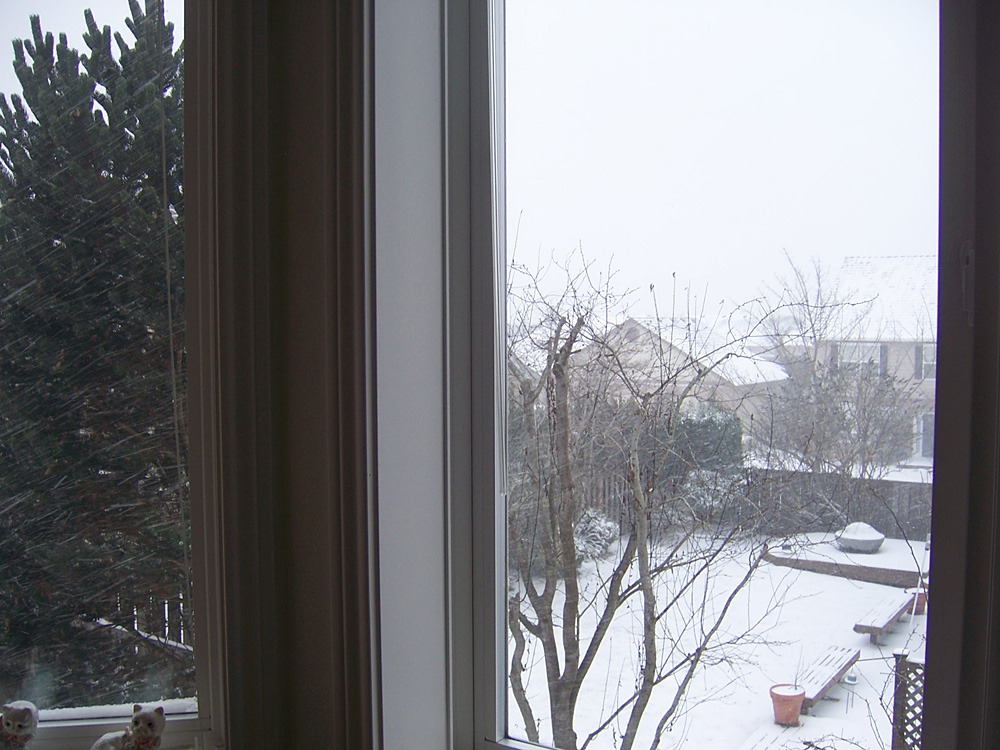
Portland, Oregon, 4.10 pm
Stacia Brown is unsettled that the public may have learned of Phillip Seymour Hoffman’s overdose before his family did:
By the time the Wall Street Journal posted its first brief, the New York Times had also begun to report facts in the case. The most disturbing of these was the mention that an official had requested anonymity as he gave sensitive details to the press – including that Hoffman passed of an apparent overdose – “because he was not certain the actor’s family had been informed of the death.” …
Though the idea of that chills me to the bone, Philips Media Training founder Brad Phillips asserts that it’s not unusual. Though print journalists once voluntarily withheld names of victims until next of kin were notified, in the age of the Internet, where photos of a crime scene can be tweeted by passersby long before the first reporters reach the site, there’s no longer a hard and fast consensus around withholding names. “Would releasing the news on an official channel even without family notification – help clear up confusion and offer confirmation instead of allowing unconfirmed speculation to fester?” Philips wonders. “And couldn’t it be argued that that would be more respectful of the families?”
These are challenging questions, ones that should be evaluated on a case-by-case basis. Perhaps there are valid arguments to be made for releasing victims’ names before their families have been notified. But in the case of Philip Seymour Hoffman, the swift release felt unseemly and unnecessary. A celebrity’s overdose isn’t so time-sensitive that we can’t afford to respect the children of the deceased by waiting to confirm that they have been notified before the public has.

Now that S&P has downgraded its bonds to junk status, Salmon expects Puerto Rico to default soon. But he notes that “there’s no chapter of the US bankruptcy code which encompasses Puerto Rico”:
My advice to the Puerto Rican government, then, is this: start having quiet conversations in Washington about a piece of legislation which would give the island the legal freedom and ability to restructure its debts in a clean, one-and-done manner. Such a law would not be a bailout: it would involve no money flowing from DC to PR. But it would allow Puerto Rico to default on its debt and come out the other side, without the risk of years of legal chaos. While bondholders would squeal, at least they would get certainty. And Puerto Rico would get something much more valuable still — an opportunity to finally drag itself out of its horrible recession.
Roberto Ferdman comments on the situation:
Puerto Rico is in a pretty precarious spot. But it’s hardly something that happened overnight. The island has been crawling its way toward today’s economic mess for quite some time. “If you look at the numbers, the economy has shrunk by something like 15% over the past six or seven years,” economist José J. Villamil told Quartz. Puerto Rico’s economy has been getting smaller for almost eight years, as the chart [above] shows.
The Economist worried about default back in October:
For decades Puerto Rico has been sustained by federal subsidies. Its people, far poorer than the American average, get lots of transfers, from pensions to food stamps. Until 2006 the economy was buoyed by tax incentives for American firms that manufactured there. As drug companies took advantage, the territory became a vast medicinalmaquiladora.
This tax break disappeared in 2006, and Puerto Rico’s economy has shrunk virtually every year since. It has been able to keep on borrowing, thanks to another subsidy: interest on Puerto Rican debt is exempt from state, local and federal taxes in America, making it artificially attractive to investors.
Jacob T. Levy points out what the obsession with combating welfare and food stamp fraud leads to:
[P]oor people will be subjected to another set of forms, another set of inspections, another set of surveillance and monitoring, another set of insults, another risk of false findings of guilt, for trivial financial savings. Someone gets to posture as having zero tolerance for some unacceptable outcome; that’s what the zero tolerance policies are for. And life for a sixth of the country’s population gets worse, more unfree, more subject to the burdens and intrusions of micromanaging regulation.
This kind of thing is, famously, among Milton Friedman’s reasons for advocating a negative income tax in place of the complex array of partial-coverage welfare policies in America. (It’s also among the reasons called upon today by supporters of basic income guarantees.) I think Friedman understood, not only that regulations are administratively expensive to enforce, but that they’re also sources of unfreedom for the many people who don’t violate them. And the effort to make sure that income support only ever goes to the deserving poor however conceived, to regulate their behavior to stop them from doing whatever it is the undeserving do, is regulation, and requires the same costs, sacrifices, and burdens regulation always requires.