Is Obamacare Really Universal Healthcare?

The CBO report (pdf) estimates (p. 107) that, as of 2024, that 25 million non-elderly Americans will get health insurance thanks to Obamacare. But about 31 million, or one in nine, non-elderly residents of the US will remain without insurance in 2024. Of these, 30 percent are undocumented immigrants, 20 percent are eligible for Medicaid but will choose not to enroll, 5 percent will be ineligible for Medicaid because their state has chosen not to expand coverage, and 45 percent will choose not to purchase insurance through their employer or on the individual market.

Lanhee Chen thinks a narrow goal of covering more people is misguided and that health care reform should focus instead on lowering costs:

This is where the Republican alternatives have a distinct advantage. Analysts across the political spectrum recognize that the existing (essentially unlimited) tax preference for employer-sponsored health insurance drives up health-care utilization and costs. It also creates a cost disadvantage for anyone seeking to purchase health insurance independent of an employer. By and large, people aren’t buying health insurance today; they’re buying pre-paid health care with relatively few limits on the services they can obtain.

Reform of the existing tax treatment of health insurance is an important step toward reducing costs and avoiding the rationing and service limits that afflict the health-care systems of many other countries. The Affordable Care Act does little to address the tax treatment of health insurance and other dynamics that push up health-care costs.

Meanwhile, Byron York casts doubt on the number of people Obamacare claims to have insured:

This week, the health consulting firm Avalere found that only 1 to 2 million of the 6.3 million who signed up for Medicaid were new enrollees brought into the program by Obamacare. The rest were people who were eligible and would have signed up for Medicaid irrespective of Obamacare, in addition to people who were already on Medicaid but were renewing their status.

The Game Putin Is Playing

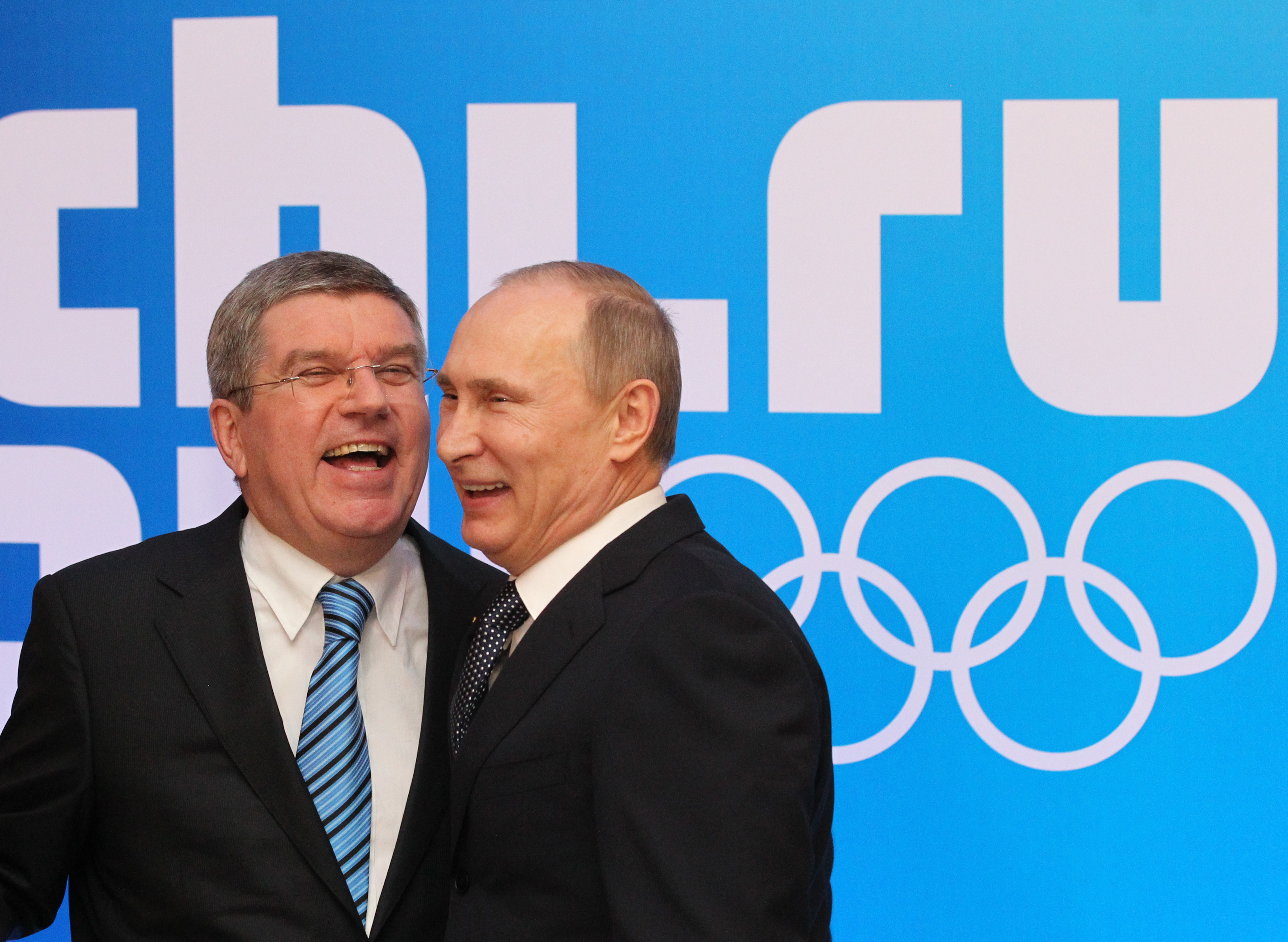
Putin Greets IOC Members In Sochi

Remnick explains Putin’s Olympic motivations:

The theme of these Games is simple: this is Putin’s pop-culture reassertion of Russia, a worldwide media-saturated insistence on its modern power and capacities, all done with a flash and a reach that no diplomatic summit could ever match. Dissident Russian voices such as Alexei Navalny, Masha Gessen, and the members of Pussy Riot all call these “Putin’s Games”; they talk of a pharaoh intent on building, and displaying, his pyramids. In fact, minus the tone of derision, when you talk to Russian officials close to Putin, the explanation for his motives is not so different. The level of risk may be greater than anyone quite imagined in 2007, but Putin wants to show that his country is capable of doing more than sucking oil and gas out of the ground and building a new Dubai in Russia. Putin, obviously, is no democrat. Not remotely. He is not interested in the contemporary requirements of human rights. He is not interested in empowering a real legislature or ceding true independence to the courts. Democracy is not his interest. Stability and development—those are his themes, first and last.

Amy Bass thinks it’s impossible to avoid politics at the Olympics:

Inherently contradictory, the Olympics get to transcend everything until they don’t. It is naive to think that sport is above politics, that any kind of level playing field exists, or that sport allows the world to put its problems on hold. The narrative of peaceful competition is disrupted time and again, because the Olympics are inherently political, in ways that are overt, such as the black power protest by Americans Tommie Smith and John Carlos in Mexico City in 1968, and nuanced, such as Czech gymnast Vera Cáslavská lowering her gaze when the Soviet anthem played during her medal ceremonies at the same Games.

(Photo: International Olympic Committee President Thomas Bach (L) is greeted by Russian President Vladimir Putin at a welcoming event for IOC members ahead of the 2014 Winter Olympics at the Rus Hotel on February 4, 2014 in Sochi, Russia. Putin has arrived in Sochi to participate in the openings of the Winter Olympics. (Photo by Sasha Mordovets/Getty Images)

Is Boehner Backpedaling On Immigration Reform?

Cillizza analyzes Boehner’s statement yesterday that “There’s widespread doubt about whether this administration can be trusted to enforce our laws”:

Making President Obama the issue is never a bad thing for a Republican Speaker who wants to keep his job. If the narrow window to pass immigration reform closes entirely sometime between now and November, Boehner has now created a perfect political scapegoat on which to blame things. Look, President Obama never was willing to build the relationships with my members I told him he needed to, Boehner will now be able to tell both his conference and conservative Republican activists across the country. And, those folks are already more than willing to believe that narrative.

Immigration reform isn’t dead — yet. But Boehner’s assessment of its chances on Thursday are what sharp political minds have known all along: It’s a triple bank shot (or a Triple Lindy). Possible, but far from likely.

Weigel chides the media for making too much of the statement. Allahpundit thinks it makes more sense for the speaker to pursue reform after the elections:

Here’s the question: If he could get more of a Republican buy-in next year, why shouldn’t he wait? Matt Lewis argued the other day that amnesty opponents will always gin up some sort of excuse related to the timing to keep kicking the immigration-reform can down the road, but I simply can’t believe party leaders and their business backers will send the GOP nominee into battle in 2016 without arming him with some sort of amnesty to show Latino voters. It might be a limited one like DREAM, but something’s going to happen. Even Raul Labrador, who said this week that pushing immigration now could cost Boehner his gavel, says immigration is “one of the first things we should do” in 2015 once it controls the Senate again.

Sargent’s view:

[T]here’s just no reason to assume reform will be any easier for Republicans next year than it is right now, and there are multiple scenarios in which it could be harder next year. And if it doesn’t get done in 2015, Republicans will be heading into the next presidential election having failed to embrace reform yet again — after yet another contentious debate marked by who knows what sort of rhetoric — making relations with Latinos still worse, as demographic reality marches on.

Jay Newton-Small thinks immigration reform will stall. Among her reasons:

Most Republicans want to wait to pass immigration reform until next year, after the midterm elections. The problem with that scenario is that the 2016 presidential race will heat up the minute the midterms are over. And while Democrats have every incentive to push for a deal now, they could lose a powerful wedge issue at the polls in 2016 if they pass a deal next year. Sure, Obama probably would like to see something get done to burnish his legacy. But Democrats may argue that they could get a better deal in 2017, especially if they lose the Senate in November.

Larison sees a lose-lose scenario for Republicans:

Republicans stand to gain nothing if they help Obama achieve one of his legislative goals. Meanwhile, their “compromise” position of favoring legalization without citizenship so reeks of cynicism that it won’t be appealing to anyone outside the party. Indeed, favoring legalization without the possibility of citizenship is in some respects the most insulting position one can take, since it provides amnesty for those here illegally while keeping them as a non-citizen underclass that will continue to compete with American labor.

Another Ugly Jobs Report

Seasonal Adjustment

Benen summarizes the bad news:

The new report from Bureau of Labor Statistics shows the U.S. economy added 113,000 jobs in January, well below economists’ expectations. The unemployment rate dropped to 6.6% – its lowest point since October 2008 – but that’s cold comfort given the overall data, and is likely affected by congressional Republicans’ decision to cut off jobless benefits for the long-term unemployed. As is often the case, there was also a sizable gap between the public and private sectors – in January, businesses added 142,000 jobs, while spending cuts forced 29,000 government job losses.

Felix Salmon uses the chart above, which is from Betsey Stevenson, to cast doubt on the numbers:

[J]ust look at how we got to that 113,000 figure. We took January’s workforce, of 135,396,000 people, and then subtracted December’s workforce, of 138,266,000 people — for a total decrease of 2,870,000 jobs. But we know that the number of jobs in America always decreases in January — even when the economy is surging. It’s cold out, making outdoor jobs very difficult to do, and the Christmas seasonal jobs are all in the past. So the BLS institutes some seasonal adjustments. In this case, it subtracted 880,000 jobs from the December number, and it added 2,103,000 jobs to the January figure.

All of which means that the 113,000 headline figure is, in fact, 135,396,000 + 2,103,000 – 138,266,000 – 880,000. You want to trade on that being 70,000 jobs lower than you thought it would be?

Cassidy largely blames the numbers on bad weather:

The cold snap does bear part of the blame for this dramatic dropoff. When it’s freezing cold, consumers tend to stay indoors, spending falls, and firms tend to put off hiring new workers. The figures that the Labor Department publishes have already been adjusted to take account of normal seasonal variations. But we’ve been experiencing abnormal variations, which must have had some effect.

Jeffrey Sparshott disagrees:

“Weather was a clear drag on December, but this actually reversed in January,” said Morgan Stanley economist Ted Wieseman.

Indeed, nationwide the weather wasn’t that bad. While December registered the coldest temperatures for the month since 2009, the National Weather Service isn’t expecting a dramatically cold January relative to records from the last 120 years. It was warm in the Rocky Mountains and West, balancing conditions in East, a spokeswoman said.

Ylan Mui also doubts that the weather is playing a big role:

So if it’s not the weather, what is it? Why is the labor market still so weak? There are no easy answers to that question. Without weather as a scapegoat, it raises the uncomfortable prospect that the economy’s potential for growth is lower than we would like it to be.

Alan Pyke notes the continued disconnect between public and private sector jobs:

State, local, and federal government payrolls shrank by 29,000 jobs in January, according to the Bureau of Labor Statistics data released Friday, continuing a damaging and historically unusual trend that has undermined the economic recovery throughout the past five years.

Despite spiking briefly during the 2010 Census, the public-sector workforce nationwide isnearly three-quarters of a million jobs smaller than it was when President Obama took office. In that same time, the private sector has added 3.5 million jobs on net, even after accounting for the millions of jobs lost in the economic free fall five years ago

Barry Ritholtz calls the report “mostly meaningless”:

To me, the most fascinating aspect of the employment report is the hoopla leading up to it. It is merely a single monthly data point in an ongoing series, one that 90 percent of the time is almost insignificant.

The Job Losses Republicans Ignore

Ezra spotlights a massive contradiction:

In context, the freakout over the CBO estimate is perverse. Is it really the Republican position that we should do nothing – – in fact, cut aid — for the millions of long-term unemployed, but express shock and terror that employed people will, in a few years, cut back their hours or leave the labor force by choice? Shouldn’t we be more concerned about people desperate to join the workforce, who can’t, than about people voluntarily leaving the workforce, who can?

Some Republicans will say, of course, that they don’t oppose helping the jobless. They just oppose increasing the deficit or increasing taxes to do so. But repealing Obamacare raises the deficit, too! So rather than increasing the deficit to help people who want jobs get them, we would be increasing the deficit to make sure people who want to leave their jobs can’t. That’s insane.

It’s not insanity. It’s just the result of a party that defines itself solely by being against whatever the president believes. It’s nihilism.

Never Mind, Says AIPAC

They’re now against the poison pill bill to scuttle negotiations with Iran:

AIPAC has completely reversed course on the issue. For months, the group had been lobbying lawmakers hard to push the Iran sanctions bill, even launching an attack on one of its biggest allies, Rep. Debbie Wasserman Schultz (D-Fla.), for not supporting it. Only in recent weeks has AIPAC begun backing off in the face of resistance from the White House and key Democratic lawmakers, including Reid.

Just savor the moment. AIPAC toadies like Bob Menendez are on a limb that just got cut off. They’ll be back, of course. Is Bill De Blasio available? It is his job, afer all, to defend AIPAC whenever they place a call. But the night flower, as usual, withered once a little light was shone upon it. Now let’s make it a klieg-light.

An Acid Test For Francis

Pope Francis Attends Celebration Of The Lord's Passion in the Vatican Basilica

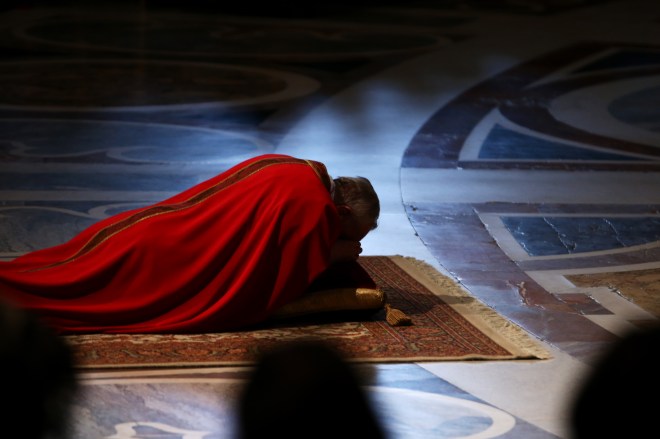
The UN Report on the Vatican’s role as a global conspiracy to enable, abet and cover up crimes against humanity is a vital reminder of just how hideous the Catholic Church has been in violating the souls and bodies of so many innocents. Sometimes, the sheer scale of the abuse renders one mute. But it shouldn’t. Nor should the emergence of a truly Christian – as opposed to Christianist – Pope blind us to the taint that still corrupts Catholicism.

The scale of the criminality is important to keep in mind:

Last month, the Vatican acknowledged that close to 400 priests left the priesthood in 2011 and 2012 because of accusations that they had sexually abused children.

The number of victims is in the tens of thousands. And their agony never ends. Now it should be said that the Church has made some serious changes to prevent child abuse in the future, and Benedict deserves some credit for that. But the institution itself has never held itself fully accountable. And the crimes it presided over were legion and horrifying. Only today, for example, we read of the apology issued by the Legion of Christ – a neo-fascist, theocon cult – for the grotesque abuses of its founder, protected for years by Pope John Paul II:

The Legionaries of Christ, which former members said was run like a secretive cult, accused the founder, the Rev. Marcial Maciel Degollado, who died in 2008, of “reprehensible and objectively immoral behavior” as head of the order from its founding in 1941 until Pope Benedict XVI removed him in 2006.

The Dish’s long coverage of this scandal – well before the hierarchy began finally to take it seriously – can be found here. And when you absorb just how evil this cult was, just how depraved its leader was, and the psychic and spiritual toll it took on so many human beings, you come to one conclusion: there is no way this organization should still exist. The Vatican should shut it down. Period. Instead we have the former cronies and favorites of Maciel still calling the shots:

The order’s newly elected general director, the Rev. Eduardo Robles Gil, has a long history with the group himself. According to its website, he helped establish the Legion in Brazil, and in 2011 he was named to a commission created to work with the victims of Father Maciel. The Rev. John Stegnicki, a former Legion priest now working in the archdiocese of Brasília, was quoted by The Associated Press as saying that the outcome of the election was “disappointing” but predictable, given that the priests voting were by and large Maciel confidants or their protégés. “Who else could they choose from?” he said. “All of them are entrenched in Legion-think.”

So why does the church tolerate the continuation of such an organization? And yet it does. Similarly, why on earth is the Pope who presided over the sex abuse crisis – and protected Maciel to his death – even faintly considered for sainthood, far sooner than has ever been the case before? Sanctifying a Pope who presided over such crimes against humanity is an obscenity.

And why do we have to struggle to discover that more than 400 priests have been defrocked because of child rape in the last couple of years alone? Why aren’t their dismissals announced proudly by the Vatican? And why, for Pete’s sake, does the Vatican not enforce a simple rule: all accusations of child abuse should be referred immediately to secular law enforcement?

Francis has an opportunity here – perhaps the only opportunity the church will ever get – to turn a new page, to insist on complete transparency, to be fully accountable to law enforcement, and to atone and recant for the legacy of the past. There needs to be a purge not just of abusing priests but of every church official who played any part in the cover-up. Why, for example, has Cardinal Bernard Law not been defrocked and publicly shamed – instead of enjoying a cushy sinecure in Rome?

Francis has made some steps toward a reckoning with the past. But not nearly enough so far. He’s been adept at symbols, gestures, simple acts that speak more loudly than words. But no symbol and no gesture would do more to restore some measure of integrity to the institution than following most of the UN Report’s recommendations. The truth is that the Catholic Church has committed a crime against humanity. Until every person implicated in that crime is removed, defrocked and disgraced, the entire moral credibility of the church will remain irreparably damaged.
The Competition To Compete

How to boost your chances of becoming an Olympian:

Peter Spiro wants to allow for Olympic free agents:

A club sports model would hardly eliminate the correlation between country of origin and country of competition. All things being equal, most athletes will want to play for the country they call home. For big-time athletes in the marquee competitions, getting wrapped up in their national flag is an important part of the performance—no amount of money is going to get Michael Phelps to swim for Qatar. At the same time, a free-agent Olympics would expand opportunities for lesser-known athletes and those in the lower-profile sports, who often struggle even as members of major-country delegations. The threat of player-raiding at that level could spur national Olympic committees and home-country corporations to higher levels of sponsorship.

To the extent that players take the highest bids, fans will learn to adjust, just as Ryan Howard’s St. Louis origins are a nonissue for Phillies fans. And if they do compete under the flag of a different nation, athletes shouldn’t have to swear phony allegiance to a new sovereign. The uniform the player wears should suffice to establish sporting loyalties, for players and fans alike.

The Unrepentant Israelis

As they get slowly cornered into a real peace process, the Israeli government – surprise! – steps up destruction of Palestinian homes:

A statement by 25 aid organisations said the number of demolitions increased by almost half and the displacement of Palestinians by nearly three-quarters between July 2013, when the talks began, and the end of the year, compared to the same period in 2012.

One the more remarkable aspects of this is that Israel would never negotiate with a partner that was doing something equivalent. Take the Iran negotiations, which Israel wants to scuttle. Do you think the Israelis would consent to a negotiation without a freeze on Iran’s nuclear development while the talks are underway? And they’d be right to object. When you’re negotiating, it’s completely destructive of the process if one side actually keeps advancing its relevant objectives while the talks are going on.

So why did Israel refuse to freeze its settlement activities on the West Bank while negotiations with the Palestinians took place? Why is it even now stepping up demolition of Palestinian homes as talks stagger on? Are there any established norms that Israel demands from others that it will ever apply to itself?

Hathos Alert

An epic ad for a lawyer – and major hathos material. Deadspin puts it this way:

This is without a doubt the most metal commercial for a personal injury lawyer of all time. Oh, the ambulance chaser in your town has some iMovie effects and a nice suit? Jamie Casino’s got murder, vengeance, and a flaming sledgehammer. Welcome to Casino’s Law, hold on to your fucking dicks.