The Beautiful Creations Of Disturbed Minds

On Sunday, I argued that Woody Allen’s “art and his craft is so extraordinary in its range and scope and creative integrity that it escapes the twisted psyche that gave birth to it.” Gracy Olmstead disagrees:

There are many artists, it is true, who lived with little to no morals. But there seems to me an important difference between the person whose sins are voluntarily indulged in, and the person who takes advantage of the young, the vulnerable, and the voiceless. This seems to be too horrific to ignore. Perhaps I am too sensitive. But I do not want to douse my mind in the artistic thought of a man with such inexcusable inclinations and actions. … Art changes us: it affects our perceptions and our world views. Can we really trust ourselves—our minds, eyes, and ears—to Allen’s hands?

Eric Sasson wants journalists to stop assuming that Allen is guilty of molestation:

Woody Allen’s defenders point out that he was never charged with molesting Farrow, and a team of child-abuse specialists concluded that she hadn’t been molested. His detractors note that a state attorney at the time said there was “probable cause” to charge Allen, but that he chose not to prosecute the case to avoid traumatizing the young girl. There are plenty of reasons to doubt both sides. For journalists to “react” to Farrow’s letter without acknowledging those doubts does the public a disservice, and for them to question the morals of those who remain in doubt does journalism itself a disservice.

Rebecca Buckwalter-Poza, on the other hand, considers why the rich and famous often get away with these types of crimes:

Celebrities are particularly effective at discouraging victims and witnesses from cooperating with law enforcement and prosecutors in cases involving sex crimes against underage victims. Their testimony is critical to securing a conviction, but the alleged victims and their families are understandably reluctant to weather public scrutiny and a high-profile trial indefinitely and at uncertain cost for an unknown outcome.
Earlier Dish on Allen here and here.

Clinton’s Achilles Heels, Ctd

Drum agrees with me that Hillary’s achievements are underwhelming. He spots another possible weakness:

[B]y 2016 she will have been in the public eye for 24 years. That’s unprecedented. In the modern era, Richard Nixon holds the record for longest time in the public eye—about 20 years—before being elected president. The sweet spot is a little less than a decade. Longer than that and people just get tired of you. They want a fresh face. That’s largely what happened to Hillary in 2008, and it could happen again in 2016.

Carpenter’s misgivings:

I’m less concerned with Hillary’s rationale for running than I am for my own sanity.

For the next three years she’ll play it safe on the ever-Clintonian middle ground, which for the last three years has been exhaustively played out by Obama. The reasons for the latter are many, and some are valid. My complaint about Hillary is that the exciting promise of new and aggressive management will be lacking.

Linker fears we’ll have a match-up between Jeb Bush and Clinton:

 Since 1980, when I was 11 years old, a Bush or a Clinton has run for president or vice president in eight out of nine contests (with Obama’s 2012 re-election campaign being the only exception). Unless Hillary Clinton surprises everyone, 2016 is guaranteed to make it nine out of 10, which is bad enough. But the idea of the Republicans running a third Bush against her — it’s almost too much to bear.

Or rather, it’s almost enough to make me wonder why we don’t just scrap the pretense of the United States being a democracy at all and instead embrace the truth — that, at least when it comes to the nation’s highest office, we’re now a nepotistic oligarchy.

It’s a national embarrassment.

Executive Power Politics

Executive Orders

Noam Scheiber worries that Obama’s executive action agenda could backfire politically:

[These unilateral maneuvers’] only real value is signaling that Obama believes he can exert his will on the economy without Congress and is working really hard to do that. But if that’s the effect, then they only exacerbate Obama’s dilemma by further persuading voters he has influence over the economy we just agreed he doesn’t have.

Now maybe the economy will improve on its own, in which case no foul. As I said earlier, the chances that it will are reasonably good. But if the economy doesn’t improve, or god forbid it worsens, the new approach will be a disaster. It will stick Obama with an even larger share of the blame than he’d otherwise come in for. Since the point of a political strategy is to shape voters’ perceptions of events in a way that makes them look more favorable to you, not less, this doesn’t strike me as a step forward.

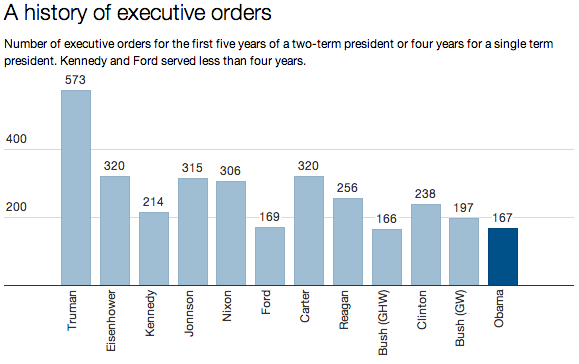
From a historical perspective, Posner argues, Obama’s embrace of executive power is neither unusual nor worrisome:

The president is kept in check by elections, the party system, the press, popular opinion, courts, a political culture that is deeply suspicious of his motives, term limits, and the sheer vastness of the bureaucracy which he can only barely control. He does not always do the right thing, of course, but presidents generally govern from the middle of the political spectrum.

Obama’s assertion of unilateral executive authority is just routine stuff. He follows in the footsteps of his predecessors on a path set out by Congress. And well should he. If you want a functioning government—one that protects citizens from criminals, terrorists, the climatic effects of greenhouse gas emissions, poor health, financial manias, and the like—then you want a government led by the president.

Also, as Jonathan Bernstein noted last week, the functions of the three branches of government have never been clear-cut: 

Congress does things that look an awful lot like executing the laws (think oversight, and the Senate’s role in the nomination process) and even in some cases judging; the courts do things that look an awful lot like making and executing the laws; and, yes, the executive branch does things that look an awful lot like legislating and judging. In other words, separated institutions — president, legislature, courts — sharing the powers of legislating, executing the laws, and judging.

Those aren’t newfangled modern ideas; they’re really inherent in the way the Constitution is written, and they took root early in the republic as politicians learned to work according to the rule book that James Madison and others gave them. “Separation of powers” has always been just a very misleading description of how the U.S. political system is designed.

(Chart from The Fix.)

Cannabis And Schizophrenia, Ctd

In a review of A New Leaf: The End of Cannabis Prohibition, Jerome Groopman questions the alleged link:

Perhaps the most controversial and important concern around cannabinoids is whether they increase the risk of psychoses like schizophrenia. This question is most germane for adolescents and young adults. A number of studies reviewed the health records of young people in Sweden, New Zealand, and Holland who reported cannabis use, as compared to the records of those who did not. A combined or metaanalysis of results from nearly three dozen such studies linked cannabis use to later development of schizophrenia and other psychosis.

The limitation of such observational studies is that they may suggest an association but in no way prove a causal link. Indeed, the medical literature is littered with observational studies that were taken as meaningful but later overturned when randomized placebo-controlled trials were conducted. Here the Women’s Health Initiative comes to mind. This was a randomized study, using placebos as controls, that reversed some four decades of thinking about the alleged benefits of hormonal replacement therapy among postmenopausal women in preventing dementia and heart disease. No one is likely to conduct a randomized controlled trial of thousands of teenagers, assigning one group to smoke or ingest cannabis and the other group to receive placebos. The issue of marijuana as a cofactor in the development of schizophrenia and other psychosis will therefore remain unresolved.

My take on the subject is here.

Karzai Goes Rogue

The revelation (NYT) that Afghan President Hamid Karzai has been secretly negotiating with the Taliban behind our backs helps explain his erratic behavior of late:

The reports confirm suspicions that Karzai’s recently-increased antipathy towards the U.S. is fueled by a desire to appeal to Taliban leaders. Last month Karzai went so far as to claim that suicide and other attacks, which the Taliban had already taken responsibility for, were actually orchestrated by the U.S. The insistence that Washington was behind the attack makes more sense as an attempt to justify a failing Taliban negotiation than an actual complaint against the U.S. government.

The kicker for Chotiner is that Karzai making no progress:

These actions have enraged American officials, as has the idea that Karzai would reach out to groups that are killing Afghans and American soldiers. But what’s truly embarrassing and maddening about Karzai’s unilateral initiative is that it is, er, absolutely pointless. As the Times reports: “The clandestine contacts with the Taliban have borne little fruit, according to people who have been told about them. But they have helped undermine the remaining confidence between the United States and Mr. Karzai, making the already messy endgame of the Afghan conflict even more volatile.”

Noah Feldman, however, thinks we should let him try:

Karzai’s efforts have a potential upside that the U.S. negotiations lack. For Karzai’s life to be spared and his presence to be tolerated would be a powerful signal to Afghans who allied themselves with the U.S. that Taliban rule will not come with vicious retaliation. The Taliban right now must be asking themselves whether to engage in de-Americanization in a post-conflict Afghanistan. A glance at U.S. efforts to de-Ba’athify Iraq, which led to bloodshed and chaos, may be all it takes for them to conclude that the benefits are not worth the costs. Why resort to a reign of terror if the people are already willing to accept your rule?

Jim White suggests a way to move things along:

If the US truly cared about bringing peace to Afghanistan, an interesting new bargaining position would be to threaten both Karzai and the Taliban that they intend to stay in Afghanistan beyond the end of the year even if Karzai doesn’t sign the [bilateral security agreement (BSA)], but that if a peace agreement is reached, the US would leave and provide a portion of the funding that the US now dangles as incentive for signing the BSA. Such a position by the US would allow the Taliban and Karzai to unite behind their one common goal–the removal of all US troops. With public opinion of the US effort in Afghanistan at an all-time low, promoting a full withdrawal would be a welcome development in the US.

Can An Anti-War Republican Win?

Senators Gather To Caucus Over Hagel Nomination

It’s the $64,000 question of the next GOP primary cycle. First up: let’s note a fascinating new development. Republican views of the wars in Afghanistan and Iraq have shifted quite dramatically. In the latest Pew poll (pdf), only 36 percent of Republicans now believe that the US achieved its goals in Iraq – basically the same as Democrats and Independents. Only 39 percent believe we succeeded in Afghanistan. So hefty majorities of Republicans now believe that both wars were failures. They haven’t yet fully absorbed the cost of those failures. But surely the fiscal blow will have some traction with Tea Partiers.

Larison, ever hopeful, believes that Rand Paul’s “greatest advantage over other Republican politicians is that he has reliably been an early and vocal opponent of unnecessary wars”:

Unlike every other Republican in elected office today, Paul was on record as an opponent of the Iraq war from the beginning. Today even most Republicans acknowledge that the war was a failure, and there is clearly no appetite for anything like that again. While other Republicans were berating Obama for intervening in Libya too slowly, Paul was opposed to the war, and he was likewise an early critic of attacking Syria and arming the opposition. This has put him on the right side of public opinion and distinguished him from the Obama administration on a few high-profile issues.

But Colin Dueck sees Paul’s foreign policy views as a liability:

A whopping 73 percent of Republicans believe Iran is “not serious” about addressing concerns about its nuclear weapons program. Some 80 percent of Republicans believe the United States is “less respected” than it was a decade ago. (It is unlikely that those Republicans view this as a good thing.) The highest foreign policy priority listed for Republicans was “protecting U.S. from terrorism.” Moreover, the December Pew poll found that 51 percent of all Americans view Obama as “not tough enough” on foreign policy and national security, 37 percent view him as “about right,” and only five percent view him as “too tough.” It is more than likely that the proportion of Republicans, specifically, who view Obama as “not tough enough” is well above 51 percent.

These findings are consistent with similar foreign policy polls by Pew, Gallup, and numerous other organizations. Over 70 percent of Republicans support drone strikes against suspected terrorists (Wall Street Journal, June 5, 2013); favor airstrikes against Iran rather than allowing that country to develop nuclear weapons (Haaretz, March 19, 2013); believe that U.S. military spending today is either about right or too low (Gallup, February 21, 2013); and think the “best way to ensure peace is through military strength” (Pew Center, June 4, 2012).

Last week, Paul is announced that he is against the Iran sanctions bill. Allahpundit wonders whether this will come back to haunt him:

It’s bound to figure in the debates next year, maybe prominently. If negotiations break down, it’s a cinch that the field’s more hawkish candidates will use his wait-and-see approach to bludgeon him for his dovish naivete. Paul will have defenses to that — he voted for Iran sanctions in the past, and he says here that he’d prefer to keep existing sanctions in effect until there’s proof that Iran’s complying with the Geneva terms (although Iran never would have agreed to that) — but no one knows if they’ll work. The whole thrust of his opponents’ criticism on foreign policy will be that he’s too much like his father to be trusted to defend the country robustly. They’re looking around for data points to support that thesis; if negotiations collapse, this’ll be seized eagerly.

(Photo: Alex Wong/Getty)

Why Do We Procrastinate?

It might be because we see our future selves as separate from our current selves:

Using fMRI, [researcher Hal] Hershfield and colleagues studied brain activity changes when people imagine their future and consider their present. They homed in on two areas of the brain called the medial prefrontal cortex and the rostral anterior cingulate cortex, which are more active when a subject thinks about himself than when he thinks of someone else. They found these same areas were more strongly activated when subjects thought of themselves today, than of themselves in the future. Their future self “felt” like somebody else. In fact, their neural activity when they described themselves in a decade was similar to that when they described Matt Damon or Natalie Portman. And subjects whose brain activity changed the most when they spoke about their future selves were the least likely to favor large long-term financial gains over small immediate ones.

Walking In A Circle Of Hell

Morgan Meis interprets the philosophy of the Coen brothers through their latest film, Inside Llewyn Davis, which he likens to “a light brush with evil, a stroll through the outermost circle of hell”:

The problem of having nowhere to be is actually the problem of evil. That sounds extreme, but it is something the Coen Brothers have always understood. The plot structure of Inside Llewyn Davis is the structure of an endless loop. Davis sings “Oh Hang Me” in the first scene of the movie. He is back singing the same song in the same place at the end of the movie. The same thing happens to him each time. His life is repeating itself. It is not hard to understand why. Llewyn Davis is trying to connect space and time in ways that don’t fit. He is trying to fit old wine into new wineskins. There is no traction. And so his life spins on its own axis. …

The theologian Stanley Hauerwas once wrote about Augustine and the problem of evil. Hauerwas wrote that, in his Confessions:

Augustine finally came to understand, paradoxical though it may sound, that evil does not exist because “existence” names all that is created and everything created is good. He observes that there are separate parts of God’s creation, which we think of as evil because they are at variance with other things.

The idea is that evil is not a force in and of itself, but a side effect of disconnection, of things being put together in a way that doesn’t fit. Evil isn’t some thing that opposes another thing: the good. Evil is when good things are rubbed up against one another in such a way that they produce nothing. Evil is reduction for the sake of reduction, nothing for the sake of nothing. It is thus hard to get your arms around evil, to understand it or even to see it for what it is.

A Scandal Without An Off-Ramp

Jeffrey Toobin suspects Bridgegate “will take longer than anyone expects to resolve”:

Ultimately, [U.S. attorney Paul] Fishman will probably give immunity to Kelly and Stepien, meaning that they will testify before a grand jury. At that point, they will be called before the legislative committee, because they won’t be able to take the Fifth anymore. By then, it will probably be summer at the earliest. If there are indictments, they probably will not be issued until fall—and trials, if any, would be held in 2015.

In short (or rather, long), Chris Christie can look forward to many months of investigations. News leaks will abound. Like most U.S. Attorney operations, Fishman’s investigation has been largely invisible to the public, but the legislators, especially the Democrats, live to embarrass the governor. And this is really the best-case scenario for Christie, one in which the investigators do not find anything that would seriously implicate him. Events are now firmly out of his control. All Christie wants to do is put this whole matter behind him. It will be increasingly apparent that he has a long road ahead of him.

Beutler bets that it will only get worse for Christie:

[T]he slowly effluviating nature of the scandal suggests that more and more stink will accrete around him over the coming weeks in the form of more bad actors for him to alienate. And he’s alienating former allies at such a rapid pace that he could easily end up having several more strange stories to tell about why all the people in his inner circle were obvious liabilities from the start.