“What is above us in the atmosphere is daily simplified into one or another of those icons beloved of weather forecasters, which, in their naive reductiveness, stand in relation to the subtleties of the sky rather as news reports stand in relation to the complexities of existence,” – Alain de Botton, in his new book The News: A User’s Manual. Flagged by Claire Carusillo in a list of the book’s “11 most Alain de Botton sentences.”
Author: Andrew Sullivan
The View From Your Window

Bronx, New York, 8.25 am
The Plight Of The Egyptian Press
Joshua Hersh details it:
For foreign journalists, who were tolerated under the Brotherhood but have never been viewed with great affection in Cairo, the steep decline in working conditions hit bottom in December, when the police busted down the door of an upscale hotel suite that served as the offices for Al Jazeera’s English-language channel and dragged away the staff. The detained reporters, including the Egyptian-Canadian bureau chief, Mohamed Fahmy, and Peter Greste, an Australian correspondent, were swiftly dubbed “the Marriott terror cell”—a moniker adopted by both the state and private media, which have overwhelmingly supported the military since Morsi’s overthrow. The sweeping litany of charges against the Al Jazeera employees—“disturbing public peace, instilling terror, harming the general interests of the country, possessing broadcast equipment without permit, possessing and disseminating images contrary to the truth”—leave the impression that just about any act of journalism, particularly if it involves speaking to members of the Brotherhood, could be considered a crime.
Dan Murphy fears this could be the beginning of a larger crackdown:
Egypt’s State Information Service (SIS) sent an explanatory note to the foreign press last week that claimed freedom of expression is guaranteed in Egypt, but the note is littered with caveats and get-out clauses. It reads, “Egyptian law ensures (press) freedoms completely and does not penalize for thought and opinion unless this thought turns really to a materialistic behavior that the Egyptian Penal code forbids. And this falls within the crimes that threaten the country’s national security and its benefits.”
Everything that follows “unless” in that sentence means that press freedoms aren’t guaranteed at all. …
The government may be leading the charge against reporters, but the effort for now is a popular one. Minor assaults of reporters, once unthinkable there, have become frequent occurrences when covering protests. Although Al Jazeera is a particular target for the government since the network is owned by Qatar, a supporter of the Brotherhood, that’s no guarantee that spurious charges of “false news” won’t be used to target other reporters.
The Best Of The Dish Today
The specter of a long-ago alleged sexual assault on a minor hovered over the Dish today. My musings on debating Woody Allen on Superbowl Sunday were complemented by a batch of readers casting doubt on Dylan Farrow’s claims, and then by readers whose memories and feelings about childhood molestation made Dylan’s anguished letter more credible.
We tried to muster hard data on the anti-gay violence in Russia, sanctioned by Vladimir Putin and the Orthodox hierarchy. Pussy Riot had their say, via Remnick. Is Syria backsliding on its WMD commitment? Is Boehner nuts for pushing immigration reform?
Contraception – surprise! – has helped bring abortion rates down to their level when Roe became the law of the land. And there’s more to the sand between your toes than you may previously had recognized. The most popular post of the day was my take on Woody Allen. Next up: Russia’s Gay-Bashing Culture.
For those of you whose subscriptions expire on February 4 – a year after the new Dish site launched – you have just 24 hours to renew and see no interruption at all in your reading experience.
Renew here! Renew now! Or subscribe here if it’s your first time. And the gifting link is here is you want to spread the Dish to others.
And see you in the morning.
A Conflicted Conflict Photographer
DL Cade captions the above video:
Don McCullin is a household name in the photographic community, but as far as he is concerned, it’s for all the wrong reasons. In this incredibly poignant and thought-provoking interview, he shares his thoughts about an illustrious career that was spent photographing atrocities, and left him somewhat haunted.
In a profile from last year, McCullin described the inspiration for his work:
“In my photography I always lean towards the underprivileged because that’s where I came from,” says McCullin. “When I went to the wars I attempted to go and stand by those who were being trodden on. By that I mean people like the Palestinians. When I go to India I see really the poorest people and I tend to be drawn to them. You could say they are life’s losers but it’s society that has categorised them as such and made them be lost.”
How We Speak Of The Dead
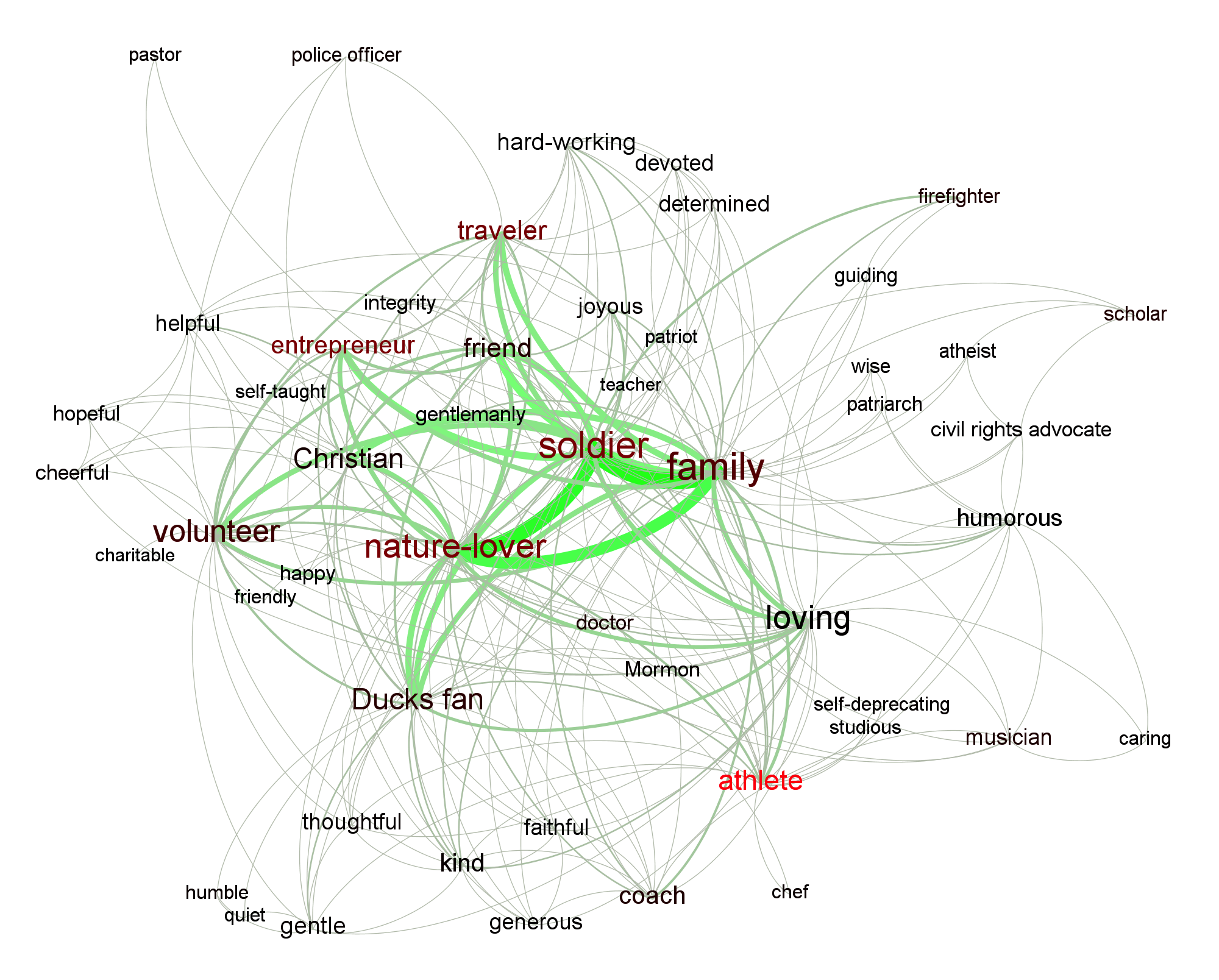
Philosopher Mark Alfano gets a sense of the gender divide:
As a first pass, I read through a month’s worth of obituaries from my local paper, the Eugene [Oregon] Register-Guard, and noted all of the agent-level descriptions and evaluations of the deceased. In other words, I ignored what was said about hospice workers (not that their work is unimportant – quite the contrary) and single actions of the deceased, recording only the words used to describe him or her as a whole person.
One thing I immediately noticed was that there were systematic differences in how the men and the women were described. Unsurprisingly, a huge proportion of the men had fought in World War II, and thus were described as soldiers. The women – not so much. This suggested that there might be other, more subtle, systematic differences. Andrew [Higgins, of the University of Illinois at Urbana-Champaign] took this initial batch of data and created semantic maps of the things said about the men and the women. [Above is] the one for men.
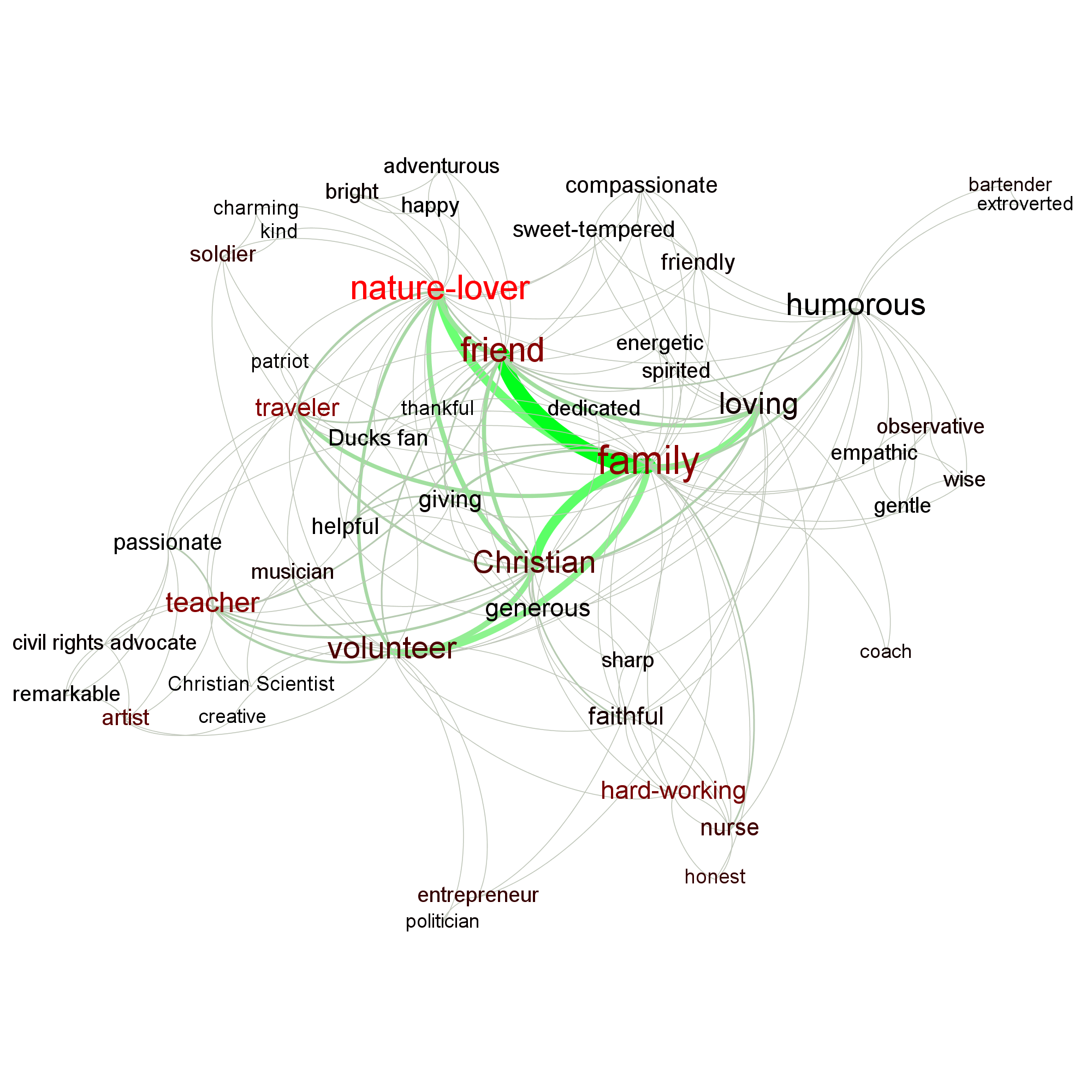
Women, on the other hand, were recalled as “humorous” more often than men – sorry Hitch:
What Makes Someone A Coward?
Linda Besner suggests that the idea of “‘cowardice’ … holds less water as our society becomes more considerate of the psychological factors—like anxiety—that compound our behaviour.” She contemplates the meaning of bravery in a society in which “we’ve come to celebrate admissions of fear”:
In a 2010 article in Psychology Today entitled “The Meaning of Courage,” psychologist Dr. Richard Zinbarg wrote of his patients, “I am constantly inspired by their courageous confrontation of their fears and anxieties.” Zinbarg argues that fear is a prerequisite for bravery; if a man runs into a burning house to save someone without feeling any fear, he writes, it’s not really a brave thing to do. His hypothetical man’s name is Jim, and in explaining Jim’s behaviour, Zinbarg writes: “Two possibilities that come to mind are either that Jim exhibited a lack of intelligence or that he didn’t perceive danger in this situation.” Not only is it not brave not to be afraid, it may actually mean that you’re dumb.
The new formulation—bravery consists in admitting to one’s fears—makes it possible for all of us to consider ourselves heroes. … But without a moral category of cowardice, are we really entitled to a category of bravery? The argument that Fear is Courage sounds unsettlingly Orwellian, and paves the way for the simple admission of fear to replace overcoming it. The emotional risks of facing one’s feelings matter; but an inward-looking process focussed on self-actualization is different from a sense of duty to the wider world. If cowardice consists in failing the collective, bravery may be said to inhere in taking personal risks for the greater good.
Faces Of The Day

Justin Crowe sets the scene:
Photographer Jedediah Johnson has a phobia of making out. In a similar way that a person may confront a fear of heights by skydiving, Johnson is confronting his fear by making out with lots of people and leaving brightly colored lipstick behind as evidence.
To prep each subject for their portrait Johnson applies bright pink lipstick to his lips and places his hand gently on their neck; he then shares a strange but intimate moment kissing them. A photo is snapped following the makeout session and the evidence of the mysterious moment is documented for viewers to imagine for themselves what the actual kiss was like. Johnson explains, “The kisses vary in length and intimacy. My subjects are all aware of what I’m going to do ahead of time, but in the moment of the kiss anything can happen. The lipstick mark I leave on my subjects invites viewers to imagine the circumstances surrounding the kiss.”
A less ominous portrait after the jump:

More of Johnson’s work here.
Kerry’s Mideast Peace Plan
Judis outlines it:
The agreement would permit between 75 and 80 percent of Israeli settlers in the West Bank through land swaps. What settlements would remain, and what Israel would cede was not discussed in the briefings, but it’s likely that large settlements like Maale Adumim, where the controversial Soda Stream is produced, will become part of Israel under the agreement. …
Palestinian refugees would receive some kind of compensation, but so would Jewish refugees who fled, and in many cases were forced to flee, places like Iraq Syria, and Egypt after 1947. (Estimates are that about 500,000 of these refugees settled in Israel between 1947 and 1972.) That provision, one of the Jewish leaders commented, was meant as a “sweetener” to the Israelis. The Palestinians would recognize Israel as the nation of the Jewish people, and the Israelis would recognize Palestine as the nation of the Palestinian people. But one critical issue was left vague and unresolved. The framework will not propose a way of dealing with the future of Jerusalem as the capital of Israel and Palestine. “That’s the biggie,” one person involved in the calls commented.
Adam Garfinkle doubts this effort will produce an agreement:
I hope this works, but I’m skeptical. My sense is that the sides are still about as far apart as ever on all the key issues. I’m disappointed to hear that Kerry buys into the recent Israeli demand that the Palestinians recognize Israel as a Jewish state, which strikes me as a gratuitous and costly addition to the negotiating burden. I’m happy in theory that the Palestinian side has apparently agreed to allow discussion of compensation for Jews who left Arab countries after 1947-48, but in practice this is liable to raise an enormous can of worms given the diversity of the historical cases, and, like the “Jewish” state business, raise the cost to Israel in other ways of getting a deal that is sound on security grounds.
Stephen Cook expects the settlement issue to get in the way:
Based on Judis’ reporting, 75 percent of the settlers would remain under Israeli sovereignty in the West Bank through land swaps along with a residual military presence in the Jordan Valley for anywhere from 3 to 10 years and a host of other security guarantees. What will become of the remaining settlers is left open to question. Still, that is a lot of people no matter what method is used to count the settlers. The Palestinians would be hard-pressed to like this deal, but their views do not actually matter much. The Israelis hold virtually every card, and given the configuration of Israeli politics where the right has brought down successive prime ministers, it is highly unlikely that the issue of continued settlements will hinge on whether Scarlett Johansson is hawking SodaStream or not.
Bob Dreyfuss doubts AIPAC has the strength to fight the plan:
First, the American Israel Public Affairs Committee tried, and utterly failed, to destroy President Obama’s critical diplomatic dialogue with Iran by pushing for a new economic sanctions bill that would have ended the US-Iran talks. Now, AIPAC will have to face a real, existential challenge, namely, the about-to-be-released “framework agreement” for the Israel-Palestine conflict, a framework developed by Secretary of State John Kerry over months of shuttle diplomacy into the region. If AIPAC hadn’t confronted the White House over Iran—and lost—it might have more muscle now to fight the Obama-Kerry plan for Israel-Palestine. Instead, AIPAC has alienated the White House and, no doubt, lost credibility with some members of Congress, especially in the Democratic Party, who’ve traditionally followed AIPAC’s lead on the Middle East.
Hassan Barari sees it as a lose-lose for Abbas:
Now, it is obvious that the Palestinian leader is in a dilemma. If he accepts that framework, he will face enormous Palestinian opposition and he will go down to history as a “sell out.” Nevertheless, if he turns down the framework deal, he will be blamed for the failure of Kerry’s effort. What makes matter worse for the Palestinian side is that even accepting the framework deal will not automatically lead to an independent Palestinian state with East Jerusalem as its capital. It can only be a means for extracting enormous concessions from the Palestinians without real quid pro quo. Long time observers of the Arab-Israeli conflict argue that the framework can only keep the negotiations on for yet another year without real success.
What’s The Point Of Learning French?
McWhorter urges Americans to drop their French classes and learn a more practical language:
One learns French to communicate with … who, exactly? Some will yearn to read Sartre and Molière; more power to them. But what about languages like Spanish and Chinese, which are useful to learn because we encounter them in everyday life? I have seen medical professionals just miss getting plum jobs in New York because a competitor happened to speak Spanish, and Chinese will be increasingly important in the business world. Arabic skills, meanwhile, are achingly needed on the geopolitical scene. It’s swell that knowing French allows you to ignore subtitles in the occasional art house film, but unclear why this would be considered a priority of childrearing.
 The Dish