Clinton’s Achilles Heels

US-POLITICS-CLINTON

Ben Smith has a real scoop here – getting Obama political aides to measure up Hillary Clinton’s 2016 campaign. In many ways, she’s astonishingly ascendant, as John Heilemann and I chew over in a new Deep Dish podcast – more ascendant than in 2007 – when she also seemed inevitable. But in other ways, her campaign now – relying again on massive support from Democratic constituencies and donors – is uncannily close to the campaign she ran last time. It relies on her name, her stature, and her gender. And it’s perfectly possible that she could run and win by the George W Bush model in 2000 – by simple and early overwhelming of the field.

But there are big liabilities to being the overwhelming front-runner in any primary race:

“The further out front the effort to elect Sec. Clinton is three years before election day, the greater the incentive is for the press, prospective opponents, and adversarial groups to scrutinize and attack her every move,” said Ben LaBolt, the national press secretary for the 2012 Obama campaign. “Even if it is a well-known candidate — sometimes more so — activists, donors, and voters like to see candidates fighting for every vote. If they start to feel like their power and influence is diminished it could have unforeseen consequences — we learned that lesson the hard way during the New Hampshire primary in 2008.”

Who knows? As John notes, almost all her potential rivals have effectively deferred to her. But nonetheless, there are, it seems to me, two weaknesses at the heart of her candidacy.

What are her defining issues? Will she run on Obamacare – ensuring its success? Will she run on climate change? Or protection of entitlements? How would her foreign policy differ from Obama’s? Until we get a sense of where she is headed as far as policy is concerned, she runs the risk of appearing as some kind of large juggernaut that simply has to be elected, well, just because. Maybe being the first woman president would render all these other issues moot. But at some point, she will have to enter the fray. I’m not sure she’s actually fully prepped for that. Her campaigning and speaking skills are not as impressive as Obama’s.

But more importantly for me is the inability of her supporters to answer a simple question. I was having dinner with a real Clinton fan the other night, and I actually stumped him (and he’s not easily stumped). What have been Hillary Clinton’s major, signature accomplishments in her long career in public life? What did she achieve in her eight years as First Lady exactly? What stamp did she put on national policy in her time as Senator from New York? What were her defining and singular achievements as secretary-of-state?

Maybe readers can answer those questions. I’m a little stumped. But more important: Clinton herself must have a ready answer to that question – an answer that can unify various elements of her career and make a coherent whole. My concern is that her name, history and gender have pushed that core question to one side. And her fiercely loyal coterie may be too much in the tank to see that these are questions non-groupies want answers to. But at some point, she better have a stronger answer than her supporters can currently provide.

(Photo: This February 6, 2013 photo illustration shows a woman viewing the new website of Hillary Clinton in Washington, DC. According to news reports, the website was registered on Thursday, just 24 hours before Clinton stepped down as America’s top diplomat, handing the baton to John Kerry.  By Karen Bleier/AFP/Getty Images)
The Other Side Of Rouhani

He hangs poets from a scaffold. Update from a reader, who cautions:

This is based on a report by a known fabricator named Amir Taheri, the guy who wrote the infamous story about Iran requiring Jews to wear yellow stars.

I don’t know if the hanging story is true or not, but my guess is Rouhani didn’t have much to do with this. One account from a rights group I found said the intel ministry carried it out, which would be under the Supreme Leader’s purview, not Rouhani’s. That doesn’t excuse the act, of course, or Rouhani’s place in that system, but that’s not the same as him “ordering” it.

Another reader:

I am an Iranian-Canadian graduate student and this is the first time I’m e-mailing the Dish. I think it is important to note that the President of Iran (Rouhani) does not order executions. That is in the domain of the Judiciary branch of government (run by Sadeq Larijani under the supervision of Ayatollah Khomeini). The correct title for this post should have been “The Other Side of The Islamic Republic”, as there is still a lot of human rights violations in Iran and the President has very little say in preventing them. To blame these vicious executions on Rouhani is naive as it ignores the internal power dynamics within the country. I’m not saying Rouhani has no responsibility for trying to stop or reduce these cases, but to outright blame him for ordering the executions is not fair.

The Debt Ceiling Ransom

What Republicans are asking for this time:

Several House members told The Washington Post on Monday that Republican leaders have narrowed their list of possible debt-limit strategies to two options: trading a one-year extension for approval of the Keystone XL pipeline, or trading a one-year extension for repeal of the Affordable Care Act’s risk corridors.

Chait puts these demands in perspective:

[R]ather than abandoning their hostage-taking methods altogether in the face of obvious failure, Republicans instead just keep lowering the price.

Three years ago, they were demanding trillions of dollars in budget cuts. Now they want either a pipeline that will probably get approved anyway or to take a random whack at insurance companies. Their new demands are both a massive retreat from their grandiose government-slashing ambitions of yore and at the same time obviously unachievable. Next year they’ll be demanding a football helmet filled with cottage cheese and naked photos of Bea Arthur.

Jia Lynn Yang explains why this debt-ceiling showdown could be worse than last year’s:

Because it’s tax filing season, cash flows will be more volatile over the coming weeks as the government likely pays out more in refunds than it’s getting in income. That means less breathing room for Treasury as it tries to come up with solutions to stave off default …When will the clock run out exactly? The timing with the tax season makes it hard to pin down an exact date. In its latest analysis, the Bipartisan Policy Center estimates that the government will not be able to meet all of its obligations sometime between Feb. 28 and March 25. The BPC says default will mostly likely occur “on or in the days before March 14.”

A Conversation With John Heilemann

The State Funeral Of Former South African President Nelson Mandela

In the craziness of our first renewal push, we put projects for Deep Dish on hold – in part because the workload was already overwhelming and in part because we did not know if we would have the revenue to keep it going this year. The good news is: we are confident enough that we can begin to add content again to our long-form, subscribers-only essays and podcasts. We still don’t have the budget to plan ahead much – help us get there by renewing here or subscribing here for just $1.99 a month or $19.99 a year – but we can definitely start creating content deep-dish-buttonfor it again.

We’ve made one change: we’re not going to create Deep Dish every month in one big content-dump. I realized I’d adopted a classic magazine model for long-form – because that was what I had been used to in legacy journalism. But on the web, we don’t need to have one monthly deadline, and you don’t need to read or listen to the essays and podcasts in one intimidating lump.

So we’re adding Deep Dish items as we go along in more digestible portions. First up: some crack for all you political junkies. It’s a chat with my old friend John Heilemann, New York magazine writer, co-author of two of the best campaign books out there, Game Change and Double Down, and one of the sharpest political minds out there. We cover the gamut of topics, from weed to steroids to the 2012 race and the web. One major focus is the Hillary Clinton campaign – someone John has covered for many years. Here’s a short clip from our discussion of the Clinton juggernaut now rumbling down the track toward us:


And here’s a snippet from our discussion of Obama’s potential legacy as president:


It’s not a TV interview; it’s not a book-plug. It’s just a conversation you’d never be able to have on radio or TV.

Check it out on Deep Dish here. If you’re a Founding Member, and haven’t gotten around to renewing yet, this is, for many of you, the last day you’ll have access to Deep Dish (subscriptions that began February 4, 2013, expire today). So take this as an opportunity – okay, another nudge – for renewing and ensuring you are never shut out of content you’ve already helped to finance.

Renew here! Renew now! Or subscribe here if it’s your first time. It takes just two minutes and can give you full and complete access to the Dish, including Deep Dish, from here on out.

(Photo: Getty Images)

I Would Like To “Share” With You This Book Of Jesus Christ

Shira Telushkin reports on the Mormon church’s recent embrace of the Internet as a proselytizing tool:

On June 23, 2013, Elder L. Tom Perry, 91, a member of the Twelve Apostles, the ruling council of the church, announced in a public web broadcast that all Mormon missionaries would begin phasing in social media and Internet use in the coming year. The reactions to Elder Perry’s announcement were overwhelmingly positive, if startled. While the occasional article about a specific test mission had been published in Deseret News, a Mormon-operated newspaper, very few people were aware that social media was being tested and considered. “This change is huge,” said Lon Nally, President of the Missionary Training Center (MTC) in Provo, Utah, as we went on a tour together of the building. “Traditionally they’re knocking on doors, and now with these hand-held devices the methods of work will change.” …

“I think my jaw dropped for about 10 minutes after the announcement was made,” said Elder Drew Brown, 19, at the Missionary Training Center in Provo, Utah, where he was in language training before heading to serve in Taiwan. Brown worried that he was “going to spend more time inside a room rather than face to face” teaching people, like his father’s mission.

Will Upworthy Go Down?

Upworthy Facebook

Salmon expects Facebook to crack down on the site:

Facebook assumes that people click on exactly the material that they want to click on, and that if it serves up a lot of clickbaity curiosity-gap headlines, then it’s giving its users what they want. Whereas in reality, those headlines are annoying. … It’s basically a way of hacking real-world friendships for profit, and there’s no way Facebook is going to allow it to continue indefinitely.

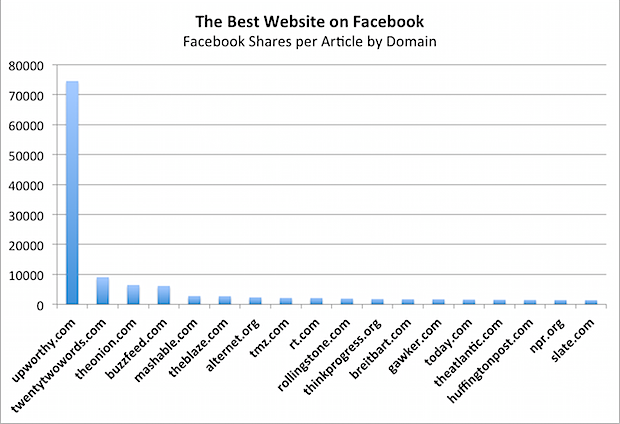
All of which is to say that the massive advantage which Upworthy has, as seen in the chart at the top of this post, is certain to go away. It’s a temporary phenomenon, a function of the fact that Upworthy is better than anybody else at turbocharging virality by using artificially-optimized curiosity-gap headlines as a way of sending a (false) message to Facebook that those headlines are the stories its users really want to read. Upworthy’s formula will work until it doesn’t. Which is why I think that Dennis Mortenson is going to win his bet against James Gross.

(Chart from Derek Thompson)

If A Track Drops On Spotify And Nobody Is Around To Hear It …

Thor Benson profiles Lane Jordan and Nate Gagnon, co-founders of Forgotify:

Jordan discovered that 20 percent of Spotify’s library had never been heard—not even once. He brought on his friends J. Hausmann and Nate Gagnon to help with a project that would put a spotlight on those unsung heroes of music. Forgotify scans Spotify’s API for songs that have never received a single play and puts them in the library to be heard. The rest is up to curious listeners. … The temporal beauty of Forgotify is its fleeting existence. “If it’s successful, it shuts itself down,” Gagnon said. “We heard somewhere that it would take 200,000 people listening for an average of an hour to knock out all the songs—which makes it sound more attainable than we thought.”

Katie Collins tried it out:

Wired.co.uk has taken Forgotify for a whirl to see if it unearths any buried treasures. Among various Bollywood songs and cuckoo noises from a sound effects album, we came across a bearable country-style track The Crazies by folk rock ensemble New Mongrels. Obviously there is a very good reason some of the songs on Spotify have never been played, but we also discovered some Mozart and Bach in the mix, which just goes to show that reputation doesn’t guarantee you anything these days.

To use Forgotify, you have to be signed into Spotify and head to the website, which uses an embedded player that provides you with randomly generated unplayed songs. It will try its hardest to mix up genres, so you’re not listening to similar stuff back to back. But while it makes for a diverse listening experience that will certainly expose you to things you never knew existed, it’s unlikely to hit the spot in the same way as your own carefully curated playlists.

In Defense Of Duplicating Art

After getting over his modernist hangups, Malcolm Jones writes, “I understood more about Vermeer by painting my own Vermeer … than I had ever learned by simply staring at his paintings”:

When I was little kid, I didn’t learn much from all those teachers urging me to express myself –  frankly, I don’t think I, or most people for that matter, have much to express, certainly not when 485985-72888fd8f769c6e50a99b68860cc51dathey’re six. I learned to draw and paint on my own, and I did it by copying. I started with Mickey Mouse, and I kept at it until my Mickey looked like the one in the cartoons and the comic books. Along the way, I got an education in shading, depth, perspective, and all the other basics of drawing. The real takeaway, though, was that not just anyone can be a great artist, but anyone can learn to draw. You just need a pencil and paper and a lot of time.

Copying, like rote memorization, is no longer in fashion. … Modernism blew the doors open with its insistence on constant change that now permeate – and rules – every corner of the creative world (Ezra Pound’s dictum, “Make it new!” might as well have an “Or else!” tacked on). And that’s fine if you are a true artist. Alas, most of us aren’t, so when our puny efforts at creativity fall short, we feel like failures and quit before we’re out of grade school. Ever thereafter, we regard art as some mysterious, gated territory where we cannot go. Somehow, I don’t think that’s what our teachers intended.

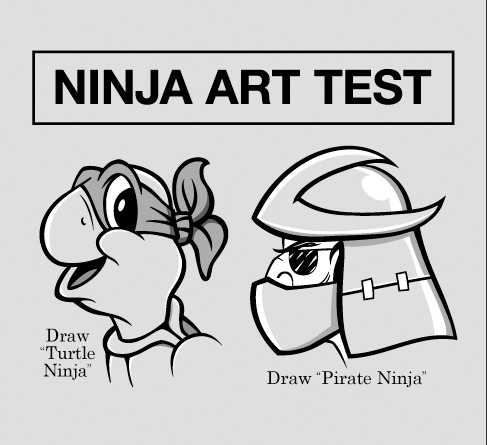
(Image of the Threadless T-shirt design “Free Ninja Art Test” based on those old drawing tests from the Art Instruction Schools)

Exposing The TSA

Ex-agent Jason Edward Harrington turns the tables:

Just as the long-suffering American public waiting on those security lines suspected, jokes about the passengers ran rampant among my TSA colleagues: Many of the images we gawked at were of overweight people, their every fold and dimple on full awful display. Piercings of every kind were visible. Women who’d had mastectomies were easy to discern—their chests showed up on our screens as dull, pixelated regions. Hernias appeared as bulging, blistery growths in the crotch area. Passengers were often caught off-guard by the X-Ray scan and so materialized on-screen in ridiculous, blurred poses—mouths agape, à la Edvard Munch. One of us in the [Image Operator] room would occasionally identify a passenger as female, only to have the officers out on the checkpoint floor radio back that it was actually a man. All the old, crass stereotypes about race and genitalia size thrived on our secure government radio channels.

(Hat tip: Dan Savage)

Selfie Reflection

Jerry Saltz tours the history of the digital self-portrait and predicts its future:

Whatever the selfie represents, it’s safe to say it’s in its Neolithic phase. In fact, the genre has already mutated at least once. Artist John Monteith has saved thousands of anonymous images from the selfie’s early digital era, what Monteith calls the “Wild West days” of selfies. These are self-portraits taken with crude early webcams, showing weird coloration, hot spots, bizarre resolution. Posted online starting around 1999, they have mostly evaporated into the ethersphere.

The “aesthetic” of these early selfie calling cards and come-ons is noticeably different from today’s, because the cameras were deskbound. Settings are more private, poses more furtive, sexual. Tics crop up: women showing new tongue piercings, shirtless men with nunchucks. They seem as ancient as photographs of nineteenth-century Paris.

It’s easy to project that, with only small changes in technology and other platforms, we will one day see amazing masters of the form. We’ll see selfies of ordeal, adventure, family history, sickness, and death. There will be full-size lifelike animated holographic selfies (can’t wait to see what porn does with that!), pedagogical and short-story selfies. There could be a selfie-Kafka. We will likely make great selfies—but not until we get rid of the stupid-sounding, juvenile, treacly name. It rankles and grates every time one reads, hears, or even thinks it. We can’t have a Rembrandt of selfies with a word like selfie.