“Strategic Entertainment”

Chipotle has produced a miniseries about factory farming:

Farmed and Dangerous, which premieres on Hulu on Feb. 17, focuses on a fictional industrial agriculture company that devises a money-saving scheme to feed cows petroleum-based animal pellets. Lots of hijinks with exploding cattle and a nefarious PR spokesman ensue. The show exposes issues in the agriculture industry that Chipotle has publicly denounced, such as dependence on fossil fuels and overuse of antibiotics on animals. But instead of hearing about these points from the restaurant directly, viewers will learn about them by laughing at Twin Peaks star Ray Wise and a wide cast of other characters.

Could this be the future of advertising?

This is not advertising, exactly, but it’s not regular video programming either. Daniel Rosenberg, a partner at Piro, calls it “strategic entertainment.” The goal, he says, is “adding value to people’s lives rather than interrupting it with traditional advertising.” …

“I could produce an award winning ad for a restaurant. You wouldn’t be affected by the ad. You’d go to Yelp,” explains Neal Burns, a professor of advertising at the University of Texas. The Chipotle show, on the other hand, may enhance brand affinity by promoting the company’s beliefs rather than the company’s name. “It’s appropriate for our times,” Burns says. “It’s going to help establish a sense of fondness and [that] eating there is the right thing for me to do.”

Eliza Williams thinks the series might break new ground:

The term ‘branded content’ has been bandied around adland for years now, but there have been few projects that have really managed to pull off the delicate balance between creating something entertaining that also makes sense for a brand. From the trailer, this series looks promising, and it is clear that the team at Piro was fully aware of the dangers that can befall this kind of project. “When brands overextend into the story, it is a let down for everyone,” says Rosenberg. “But when they inspire storytelling everyone appreciates it.

“In truth, advertising creative is typically quite different from storytelling creative,” he continues. “It’s a different creative muscle. While ads usually focus on a single, central proposition, stories focus on broader elements like character arcs, turning points and conflict to propel action and move the story forward. Chipotle’s internal creatives collaborated with Piro and TV and film writers in writers’ rooms to create the right balance between message and entertainment. Entertainment quality was the final measure of what stayed or went, but brand strategy, values and messaging were always at the forefront.”

I don’t have any problem with brands creating innovative advertising online. In fact, more, please! But as these kinds of things proliferate, it seems to me to be even more important that journalistic outlets retain a clear editorial-advertizing distinction. When more and more content is actually advertizing, the distinction between “sponsored content” and “branded content” will be ever tougher to decipher. And magazines or websites will be increasingly confused with pure advertizing. In my view, that’s the end of a distinct Fourth Estate – and a collapse in the notion of any non-commercial speech online.

A Legislator’s Legislator

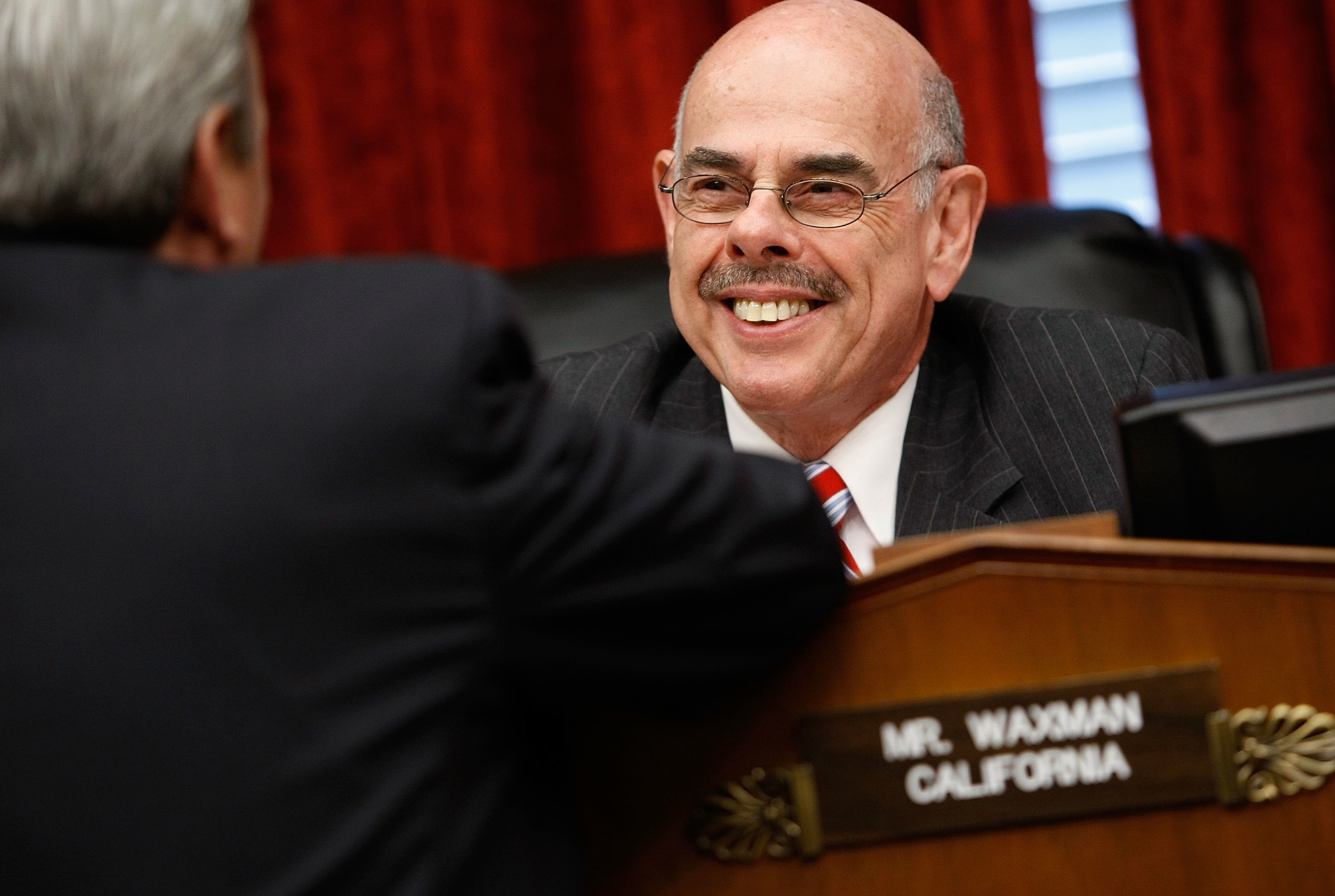
Cabinet Members And Top CEO's Testify On Clean Energy Security Act

Kilgore will miss Henry Waxman, who is retiring from Congress after 40 years as a Democratic party stalwart:

As a legislative craftsman, Waxman was sort of a rumpled, uncharismatic 5-foot-5-inch version of Ted Kennedy, and the comparison might actually slight (no pun intended) the Californian. There’s hardly any significant health or environmental legislation enacted during his long tenure in the House that doesn’t have his fingerprints all over it. But personally, I’ll always identify Waxman with his long, heroic effort to turn the twisted and inadequate federal-state Medicaid program into something that actually served as a safety net, particularly for kids. I’m sure the Affordable Care Act, and particularly its Medicaid expansion, were especially sweet accomplishments for Waxman.

Although he was a staunch liberal, Joshua Green points out that most of Waxman’s legislative achievements were bipartisan:

That Waxman’s most productive years occurred while the White House was controlled by the opposing party makes his example all the more notable today. It’s astonishing that Republicans don’t study him and emulate his methods.

Those methods are essentially the opposite of the ones that lawmakers such as Ted Cruz have employed—the refusal to compromise, the sweeping attempt to impose an entire agenda immediately through force. “You have to be willing to be at it, look for compromises, build coalitions, and get public opinion behind you so you can finally get to the point when legislation can be passed,” Waxman said.

Harold Meyerson recalls the congressman’s distinctive style:

Getting things done the Waxman way didn’t involve the bonhomie that politicians characteristically employ. He didn’t persuade his fellow congressmen by schmoozing. “Henry never entertains his colleagues,” his longtime aide Howard Ellison told me when I wrote a profile of Waxman for the Los Angeles Times Sunday Magazine in 1995. “He does no sports. His staff would say, ‘You should play golf with John Dingell [then chair of Waxman’s committee].’ Fat chance.”

Rather, as I wrote at the time, Waxman “persuades by argument, not by humor or force of personality. Where Ralph Nader unleashes a torrent of indignation, Barney Frank stings with wit and Tom Hayden still taps into a vein of adolescent anger, Waxman simply makes his case point by point. He is not liberalism’s man for all seasons. He is only its legislative genius.”

Masket highlights his role in building the Democratic power base in West LA:

To some, at least, the Waxman-[Howard] Berman machine would represent a form of political corruption. That is, they used money, influence, and technical skills to limit voters choices in elections and advance issues they felt were important. And they could certainly be competitive and cutthroat in their approaches, doing as much to hurt their opponents as help their friends. But it’s hard to find much evidence of graft or pettiness in their efforts. As much for his other accomplishments, Waxman deserves to be praised for building a serious political organization that affected dozens of political careers and literally millions of constituents.

Ben Adler explores Waxman’s environmental legacy:

Environmental advocates point to one major legislative accomplishment in particular: his role in writing the powerful 1990 amendments to the Clean Air Act. As the Times explains, “He is also credited with laying the foundation for many of the executive actions that Mr. Obama, during his State of the Union address on Tuesday, pledged to pursue. One involves the Clean Air Act, which Mr. Waxman helped write and which gives the Environmental Protection Agency the authority it is now exercising to regulate power plant emissions of greenhouse gases. Mr. Waxman saw to it that the bill would allow the president, on his own, to order improvements in automobile fuel efficiency and other energy saving efforts.”

Reflecting on Waxman and George Miller, who both entered the legislature as young men, Bernstein considers what a geezer Congress we have today:

There’s nothing wrong with people coming to politics, and Congress, later in life. But if we don’t get 30-somethings (and some 20-somethings) in the mix, we are going to have an overly geriatric legislature. That is increasingly the case.

I’m not sure exactly why it’s happening. It could be because more individual wealth is needed for House campaigns these days. It could be, in part, because the field of candidates has opened up to include women, and maybe others who were excluded in the past and take a little longer to stake their political claim. So there may be good and bad reasons. Still, we could use a few more House careers like those of George Miller and Henry Waxman.

And Sam Baker notes that Waxman’s retirement is just the latest in an exodus of Obamacare architects and Democratic health care experts from Congress:

Including Waxman, four of the five committee chairmen who helped write the law are gone or leaving. Democratic leaders and committed liberals can and will still defend Obamacare politically, along with the basic idea of universal coverage. But there aren’t many Democrats left who—like Waxman and some of his departing Congressional colleagues—are truly invested in the ins and outs of the Affordable Care Act as well as other nitty-gritty health care issues. (Waxman, along with Republican Sen. Orrin Hatch, essentially created the generic-drug industry.)

(Photo: House Energy and Commerce Committee Chairman Henry Waxman (D-CA) prepares to hear testimony from Obama Administration cabinet members on Capitol Hill April 22, 2009. By Chip Somodevilla/Getty Images)

Finding, Ctd

A reader takes the thread in another direction:

What I’m really wondering is when (or whether) we’ll have an animated Disney film with two Prince Charmings. If as a young child I had ever been shown that such a relationship was even thinkable, let alone gloried in Disney-style apotheosis, it could easily have set the groundwork for my teenage decade to be a “normal” one of healthy self-discovery instead of one filled with angst, duplicity and shame. Sometimes I have to explain to people why I didn’t come out much earlier, since neither I nor my family was religious, and the way I usually express it is: it’s not so much people disapproved, it mostly just never occurred to anyone as a serious possibility.

Passing The Buck On Rescheduling Pot

In his latest evolution on drug policy, Obama suggests that he wouldn’t oppose changing marijuana’s Schedule 1 designation – but he’s leaving that to Congress:

“First of all, what is and isn’t a Schedule I narcotic is a job for Congress,” Obama said. … The DEA is required to make determinations, Obama said, but based on laws passed by Congress. A spokesman for the White House Office of National Drug Control Policy tweeted Wednesday that the attorney general can reclassify marijuana after a scientific review, but that it was “not likely given current science.” But Obama said he would support congressional action to remove the schedule I classification for marijuana.

Sullum calls out Obama for acting like he doesn’t have to power to make that change himself:

While Congress can amend the Controlled Substances Act (CSA) to increase or reduce restrictions on particular drugs, the statute also gives that power to the attorney general, who has delegated it to the Drug Enforcement Administration (a division of the Justice Department). In fact, the DEA has repeatedly rejected petitions to reschedule marijuana, most recently in 2011. I forget: Who was president then?

Apparently Obama forgot too. Obama often speaks as if he is an outside observer of his own administration—condemning excessively long prison sentences while hardly ever using his clemency power to shorten them, sounding the alarm about his own abuses of executive power in the name of fighting terrorism, worrying about the threat to privacy posed by surveillance programs he authorized. Now here he is, trying to distance himself from his own administration’s refusal to reclassify marijuana.

Nicole Flatow points out that the state of “current science” on marijuana is subject to a catch-22, courtesy of the federal government:

[T]here have been many peer-reviewed studies, but very few of sufficient size and scope to satisfy the government, particularly about the drug’s medical benefits. Ironically, this dearth of research is perpetuated by the federal government’s position on marijuana. Federal funding, the lifeblood of academic research, is severely curtailed for large-scale studies of pot, particularly those that aim to study the plant’s potential benefits rather than its potential for abuse, because of the drug’s Schedule I designation. Perhaps even more significantly, the legal access to a supply of marijuana for conducting this research is controlled by one federal agency with a mission to combat drug abuse. And the panel that controls access to the marijuana has delayed and rejected academics’ FDA-approved requests to research some of the most pressing medical marijuana issues, including treatment for post-traumatic stress disorder.

An Extreme Rx

“Bioprospectors” are exploring deep-sea trenches, acid lakes, and other extreme environments in the hunt for tomorrow’s antibiotics:

Lechuguilla_Cave_Pearlsian_GulfThe organisms that flourish in the comfort zone of Earth’s biosphere make up only a fraction of life on our planet. Outside what we consider the habitable regions – in the desiccated soils of deserts or buried beneath thick ice or rock – creatures not only survive, but thrive, at extremes of temperature, salinity and darkness. … It wasn’t until a few years ago that we began to realize that these adaptations could also be turned against some of our nastiest medical foes. Fungi discovered in the acidic lakes of Lechuguilla Cave in Carlsbad, California – whose metal-infused waters should have stymied all life – tipped us off (see diagram). One hardy strain of Penicillium produces a compound that inhibits the growth of lung cancer cells. Another compound, berkelic acid, isolated from fungus and bacteria found living in the toxic water of an open-pit mine, slowed ovarian cancer cell growth by 50 per cent. The hunt was on to unearth more of nature’s extreme medicines.

(Photo of Lechuguilla Cave by Dave Bunnell)

Boehner’s Opening Bid On Immigration

At the House Republicans’ annual retreat on Thursday, John Boehner released the much anticipated draft (pdf) of the party’s immigration reform “standards,” outlining what reforms the GOP leadership would be willing to enact, and under what conditions. Molly Ball examines the core issue raised in the one-page document:

There’s a lot of important nuance here surrounding the controversial citizenship question. Undocumented immigrants, their families, and their advocates have two basic and related priorities. First, can they stay in the country without fear of deportation? The language here suggests Republicans want most of them to be able to do that, though the “triggers” part gives people pause. (Border enforcement is already at record levels, and the Senate bill would devote still more resources to it.)

Second, can they eventually become U.S. citizens? The language here suggests Republicans would let them do that too, by getting in the same “line” as all the foreign residents who have applied to enter the U.S. legally. That’s the difference between “no pathway” and “no special pathway”: The former would, in advocates’ view, create a permanent second class of resident non-citizens, while the latter would merely mean a very long wait.

Beutler also sees the “pathways” issue as the biggest stumbling block:

Nebulous wording and wiggle room is where a lot of politics happen, and its totally possible that this all comes down to framing a picayune technical dispute over how and when the 11 million end up becoming citizens as the difference between amnesty and not amnesty.

But it’s also possible that Republicans will make legalization precluding citizenship, or making citizenship effectively unattainable, their final offer. And I’m not sure Democrats and advocates have adequately grappled with the bind that would place them in. Obviously it would be a major negotiating failure for reformers to entertain an idea like this publicly. And it would be a genuinely unjust outcome in the sense that the 11 million would be treated secondarily to the rest of their fellow taxpayers under the law. And it would be a sub-optimal political outcome for the Democrats’ demographic politics.

For all these reasons, reformers have typically refused to go there.

On the other hand, Byron York thinks the enforcement triggers are “the key to the whole thing”:

It is not an exaggeration to say that the future of immigration reform in Congress depends on whether Republican leaders mean what they say in that single sentence.

If they do, and the GOP insists on actual border security measures being in place — not just passed, not just contemplated, but actually in place — before illegal immigrants are allowed to register for legal status, then there will likely be significant Republican support for such a bill. (It might well be a deal-killer for most Democrats, but that is another story.) If, on the other hand, GOP lawmakers wiggle around the clear meaning of the principles’ last sentence to allow legalization to begin before security measures have been implemented, then the party will be back to the same divisions and animosities that have plagued Republicans since the terrible fights over immigration reform in 2006 and 2007.

Considering the long odds of a total overhaul in the current political climate, Ed Krayewski advocates “a smaller, more focused bill that deals with the human cost of poor immigration policy”:

Concerns about illegal immigrants seeking to abuse the welfare system are largely unfounded, but could be alleviated by offering expedited legal status for illegal immigrants willing to forgo access to the welfare system. Every illegal immigrant I know (quite a few) has said something along those lines; they want to be legal in this country and couldn’t care less about getting welfare. They want to work, and ought to be allowed to.  To that end, immigration reform should make it easier for employers to hire the employees they want without having to worry about running afoul of immigration law. If this kind of narrower immigration reform couldn’t garner the support it needs to pass, reform supporters ought to consider a concession that could dampen opposition: making it easier to deport illegal immigrants convicted of violent crimes, and perhaps even banning such immigrants from ever returning to the US. Again, most illegal immigrants would be ok with this: they are law-abiding people just as upset by illegal immigrants who drink and drive and hit and run as legal immigrants and US citizens are.

The statement omits another major angle of the debate:

One point these principles don’t mention is that a working legal immigration system is essential to resolving unauthorized immigration. The solution to America’s problem with unauthorized immigration does not lie with more restrictions, less lawful immigration, and more restrictions on the freedom of Americans.  The solution lies with deregulating our immigration system, allowing more immigrants to come lawful on green cards and guest worker visas, and minimizing the government’s role in picking immigrant winners and losers.  The market can do that far more effectively than a government agency, regardless of all the shiny new fences, border drones, and invasive government databases they command.

Allahpundit considers Boehner’s political calculations:

Sean Trende of RealClearPolitics started tweeting in total mystification after the statement was released as to why the GOP would be pushing amnesty now, of all moments. If they were dead set on doing this before the midterms, he reasoned, why not do it last year, to give conservative anger more time to cool before the big vote? Failing that, why not wait until next year, after the midterms, since no one expects the Latino vote to be decisive this fall? I have no answers to the first question but you know my answer to the second. I think Boehner’s afraid that if they wait another year, until the GOP holds the Senate as well, conservative expectations for a “tough” Republican-written law will be so high that the backlash when they fail to come through will be even more bitter than it’ll be if they do it this year.

In a follow-up post, Beutler notes another reason the GOP is wary of reform:

If Republican leaders were serious about doing immigration reform anyhow, the sensible thing to do would be to ditch the vindictive crap and just pass something like the Senate bill. But the elephant in the room here is that even pragmatic Republicans are nervous about the prospect of creating millions of new voters, the majority of which would probably be Democrats. And that augurs poorly for Republicans passing anything this year at all.

For that reason, Waldman doubts anything will come of this:

Now it’s true that in the wake of the government shutdown and the various debt ceiling crises, House conservatives have slightly less power to force the rest of the GOP to bend to their will. But only slightly. One thing hasn’t changed: the average House Republican still comes from a safe district where the only real threat to his job is a primary challenge from the right. He knows that his primary voters are people who watch Fox News and listen to conservative talk radio, where they hear things like Laura Ingraham telling them that jingoistic Mexicans are trying to take over America, which is why “your language [that’d be English] is gone,” while Rush Limbaugh rails at the Republican immigration principles as the wolf of “amnesty” in sheep’s clothing. Today’s Drudge Report featured a graphic of John Boehner in a sombrero, and it wasn’t a compliment. As one Southern Republican member of Congress told Buzzfeed, “If you go to town halls people say things like, ‘These people have different cultural customs than we do.’ And that’s code for race.”
A Flaccid Drama

As the wieners just won’t quit on Game Of Thrones, Justin Moyer has a long, hard look at Looking:

[W]hen the HBO series Looking concludes in six weeks, viewers of the most ambitious television show starring gay men ever produced will almost certainly not have seen the essence of (gay) male sexuality: the erect penis.

This is inexcusable. While it’s possible that Looking’s lack of rigid man meat is part of executive producer Andrew Haigh’s understated personal aesthetic, history suggests that the real blame lies with the network.

While ostensibly breaking barriers by producing a gay show for a general audience, HBO’s failure to spotlight members at attention shows the network is bowing to censorious TV convention—and perpetuating a disturbing fear of queer people.

This dick-shyness is not, as you might expect, a legal necessity. A 2012 Supreme Court decision suggested that the Federal Communications Commission’s ability to police broadcast television may be legally shaky, but regardless, cable networks were already liberated. That’s right: Though it can bluster about it, the FCC has no real say in what HBO, Showtime, Cinemax, et al. put on the air. Yet, even as a faux load of jism splattered a cast member of Girls last year, the flesh cannon that shot it inexplicably remains a TV taboo. Why?

Will Jeb Run?

Sean Sullivan calls that the biggest unanswered question about the 2016 GOP race:

There are two simple reasons why. 1) No other top tier Republican has the potential to alter the landscape of the primary as broadly as the former Florida governor. 2) No other top tier Republican has broadcast as much genuine uncertainty about his plans.

Hollande Visits Britain

Sometimes, you just miss home:

Monsieur le President est un cookie smart. Donc, il used le plus vieux trick dans le livre: il began par droning on pour ages et ages about les choses incroyablement boring, par exemple l’économie, et les projets d’infrastructure, et la France. Tres clever! Les journalistes anglais would soon être fast asleep!

But, non!

Mais then, désastre – dans le forme d’un journaliste du Télégraph, Monsieur Christopher Hope. “Est-ce que vrai que votre rumpy-pumpy a made la France un laughing-stock?” a dit cet rogue impertinent. “Est-ce que vous still having une affaire avec Julie Gayet, et do vous wish elle était ici maintenant?”

Monsieur Hollande wrinkled son nez, as if un fly a landed sur it.