Reality Check

Obamacare Unfavorable

Suderman parses Kaiser’s latest numbers:

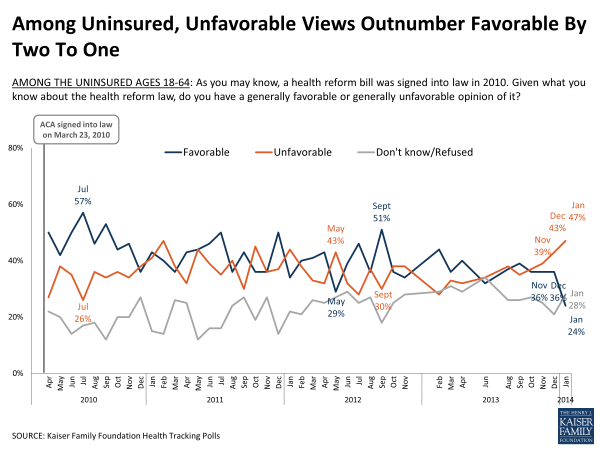
[T]he [above] latest monthly tracking poll from the Kaiser Family Foundation finds that opposition to the law amongst the uninsured has actually increased since December … This is the group of people the law was, in theory, supposed to benefit most. And yet even as the most prominent benefits start to kick in, their support is dropping. It’s possible, of course, that this could turn around at any time. But it’s not a very good sign for the future popularity of the law.

I too was gobsmacked by this result. But then you look and ask what the respondents actually think Obamacare is. And you get this result:

Roughly four in ten adults overall, and about half of the uninsured, are not aware that the law provides financial help to low- and moderate-income Americans to help them purchase coverage, gives states the options of expanding their Medicaid programs, and prohibits insurance companies from denying coverage based on pre-existing conditions.

That is such a massive indictment of the president’s messaging it beggars belief. Half of the uninsured have no idea that Obamacare offers them money to buy health insurance! WTF? No wonder the popularity of the law remains mired.

Look: the cognitive dissonance is real. But so is the ignorance. Obama’s approach to selling the ACA has been that of a classic defensive-crouch liberal. He sees the low popularity and decides not to tout the law so much. And by failing to tout the law effectively, relentlessly, persistently and clearly, he simply enables the ignorance-based opposition to grow.

Kliff notes how the media have also simply responded to this mood, rather than explaining the fuller story:

For many Americans – particularly the 68 percent who get coverage through their work, Medicare and Medicaid — the launch of the exchanges probably doesn’t affect their coverage situation. … So what’s driving the negative opinions of Obamacare? The Kaiser survey does point to one potential culprit: negative news coverage. More Americans say they’ve seen stories about people having bad experiences with the Affordable Care Act than good ones.

Waldman puts these numbers in perspective:

We spend so much time talking about politics that it’s easy to forget that politics are not an end in themselves, they’re a means to an end. Liberals advocated for comprehensive health insurance reform for so many decades not because it was politically advantageous (at some times it was, and at other times the voters didn’t seem to care), but because it was right. The fact that so many millions of Americans had no health security up until now was a moral obscenity. The ACA is beginning to fix things—slower and less completely than we might like, but it is a beginning. And if it never becomes the political boon you were hoping for, it was still the right thing to do.

Drum’s analysis:

27 percent now say that Obamacare has “negatively affected” someone in their family. That’s crazy. Even if you subtract the baseline of 18-19 percent who have been saying this all along, that’s an increase of nearly ten points over the course of 2013. Unless you take an absurdly expansive view of “affected,” this is all but impossible. Obamacare simply doesn’t have that kind of reach.

But we’ve been though a recent period in which every co-pay increase, every premium increase, and every narrowing of benefits has been blamed on Obamacare. These things have happened every year like clockwork for the past couple of decades, but this year it was convenient to blame them on Obamacare. Combine that with the PR disaster from the website rollout, and a whole lot of people now believe that Obamacare is hurting them.

Sticky Status

Economist Gregory Clark’s book The Son Also Rises traces social mobility rates over hundreds of years using surnames and concludes that government interventions aimed at increasing mobility have little effect. In an interview, Clark suggests that, because socioeconomic status is so hard to change, it may make more sense to focus on raising the minimum standard of living instead:

We already live in societies of massive social intervention in terms of the provision of education and health care. Yet we have not been able to raise social mobility rates above those of the pre-industrial era. Even the most interventionist societies such as Sweden have such low social mobility rates.

But if we’re learning that we can predict the majority of people’s outcomes at conception, that should lead us to reexamine our assumption that whatever income distribution comes out in society is fine. Because if it’s the case that a lot of this is determined before someone enters the game, it weakens the case for letting the market determine the distribution.

You’d be much more likely to favor a society with much less inequality. And that’s where Sweden’s system does provide advantages over the U.S.’s. They haven’t changed mobility rates, but they’ve changed the consequences, strongly, of ending up at various points in the distribution. It’s a much better place for people who end up at the bottom of the distribution.

Yglesias makes related points, arguing that the bipartisan obsession with equal opportunity “makes no sense whatsoever as a social objective”:

[W]hether the focus groups like it or not, an opportunity to climb is no real answer for people at the bottom. A perfectly fair race is, in at least one important way, the same as a rigged race: Both have a first-place finisher and a last-place finisher. The question of what happens to the person at the bottom genuinely matters. Whether you want to phrase that in terms of the gap between the bottom and the top—inequality, as such—or simply look at the absolute condition of the people at the bottom, you can’t escape the conclusion that outcomes matter, and not just in terms of procedural fairness. Today, even poor people are able to take advantage of things like electricity and antibiotics that were rare or nonexistent 100 years ago. That’s the kind of opportunity that matters—the opportunity for everyone to enjoy a better life. But over the past generation, progress has been slow for the nonrich. And over the past 10 years, it’s been essentially absent.

Wait: Hillary Can’t Give Bill A Job?

Yesterday, I wrote:

If Hillary wins, Bill should be secretary of state. A formal role on the world stage is far preferable to an informal role on the inside fucking everything up.

Carpenter wishes this were possible:

[Hillary] probably would [appoint Bill], were it not for the Federal Anti-Nepotism statute of 1967, which bans such eminently sensible acts as a chief executive appointing whomever he or she deems best suited for the executive’s trust and convenience.

From the text of the law in question:

A public official may not appoint, employ, promote, advance, or advocate for appointment, employment, promotion, or advancement, in or to a civilian position in the agency in which he is serving or over which he exercises jurisdiction or control any individual who is a relative of the public official.

So we have a uniquely nepotistic and dynastic democracy in fact, but a law forbidding its being made explicit, and thereby formally accountable. Yep: sounds like America.

Republicans Endorse Obamacare Lite, Ctd

Here’s something quite striking about the Republican alternative to Obamacare:

A preliminary (non-C.B.O.) score shows that it insures slightly more people than Obamacare and reduces the deficit, relative to current law, by $1.4 trillion over the next ten years… How does it accomplish this feat, you ask? Well — it pushes people buying on the individual market toward cheaper insurance plans with much narrower physician networks, and it reduces the tax subsidy for employer-provided insurance more substantially than Obamacare’s Cadillac tax would do.

Which is why I think such alternatives can and should be explored (and might even have had a chance of making it into the bill if the GOP TO GO WITH AFP STORY By Otto Bakano -- Thadn’t had a psychic meltdown almost as soon as Obama took office). But, of course, this means that many more people may have to switch doctors under Obamacare Lite than under Obamacare Classic. It also means that businesses will be hit hard with more taxes once their cushy subsidy, unavailable to those in the individual market, expires. Now I’m quite sympathetic to both ideas. If we’re going to cut costs, something like the former is vital; if we’re going to create a more viable individual market, then corporate taxes will have to go up. But haven’t Republicans been trashing Obamacare on precisely those grounds – that you have less choice over your doctor and that there’s a hidden tax increase in all of this?

Donald H Taylor has a must-read on all this. Money quote:

Narrow network plans don’t bother me one bit (I thought everyone wanted to reduce costs!), but the ad machine that is trying to give the Republicans the Senate in 2014 is demagoguing something that is a feature and not a bug of the plan put forth by Republican Sens. Burr, Coburn, Hatch.

Indeed. Because the GOP has not been a conservative party these past five years, but a raging, irrational id, it has opposed Obamacare on any grounds, including liberal ones. They hate it because it may restrict some patient choice, but they hate it because it allegedly spends too roadrunner-midairmuch money. My advice: pick one. And the one to pick is the maximal extended coverage with the maximal cost controls. Burr-Coburn-Hatch tries to do this – and may fall between two stools, merely proving Obama right. But the Republicans cannot run on repealing Obamacare when they are effectively proposing to fine-tune it. And they cannot run both on maximal patient choice and lower costs.

They have to choose. Finally, as with immigration, they are being forced to admit that their most practical vision is not that far apart from what Obama has already enacted or proposed. Their bluff is finally being called as they have to present themselves as an alternative governing party and not just a cable entertainment company.

Yes, I’ll go there. Meep meep.

The Money In Wealth

Earlier this month, Ryan Avent examined Thomas Piketty’s new book, Capital in the Twenty-First Century, which Tom Edsall unpacked this week:

What Mr Piketty conveys most powerfully, in my opinion, is the fact that economics was once  centrally concerned with the question of distribution. It was impossible to ignore in the 19th century! Not least because economists of a market-oriented disposition and those more sympathetic to Marx both wondered whether capitalism was capable of generating a sustainable distribution of the gains from growth. We are all used to sneering at communism because of its manifest failure to deliver the sustained rates of growth managed by market economies. But Marx’s original critique of capitalism was not that it made for lousy growth rates. It was that a rising concentration of wealth couldn’t be sustained politically.

In a follow-up, he responded to Piketty’s critics who point out that inequality is shrinking globally. Yglesias added:

It’s true that it would be a mistake to get excessively hung up on any particular summary statistic of inequality. But the broad facts that stagnating living standards in rich countries are coinciding with a falling share of national income going to the bottom 80 percent or so of the population aren’t in serious dispute and they’re not “compensated for” in any policy-relevant sense by the success of Chinese development policy.

Drum’s suspects that taxes are going to rise on the rich:

My view is that the second half of the 21st century—assuming we manage not to blow each other up or fry the planet to a cinder—is likely to be an era of fantastically high growth thanks to robotics and artificial intelligence. That also produces problems related to the distribution of income, but they’re rather different from Piketty’s.

But in one sense it doesn’t matter. Piketty’s solution to the problem of this mismatch between growth and capital returns—which he considers an inevitable consequence of capitalism—is redistribution and plenty of it: “The only way to halt this process, he argues, is to impose a global progressive tax on wealth….an annual graduated tax on stocks and bonds, property and other assets that are customarily not taxed until they are sold.” That’s probably the eventual answer to the robotics revolution too. So regardless of which fork we take in the future, higher taxes on the rich seem pretty likely.

Millman wonders how such a tax work since “the incentives for a given state to cheat are simply too large – any state that had a lower tax on wealth than the cartel would attract enormous inflows of capital.”

Quote For The Day

“OMG, you would rather have had a COMMUNIST MUSLIM in charge of your va*ina? Lady (and I use the term lightly), you ain’t seen NOTHIN’ yet until that muslim YOU put back into office AGAIN completes his task of destroying this nation, the muslims take control and YOU, Ms. Female voter, LOSE all the freedoms you now enjoy, including the female’s right to VOTE! Sheesh, what low-information voters have done to this country…” – a commenter at Breitbart.

I usually avoid crazy commenters but this one had a certain kick to it.

Calculating The Coup Odds

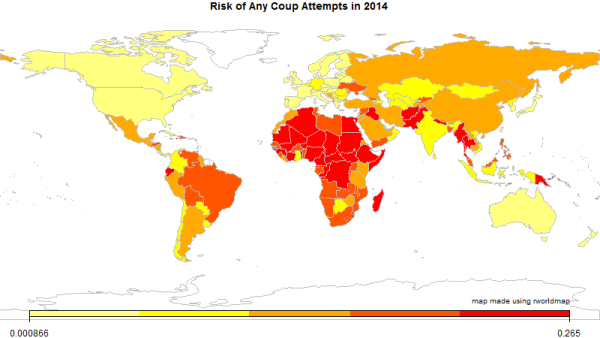
forecast-heatmap-2014

Opening with the caveat that “Coup attempts rarely occur, so the predicted probabilities are all on the low side, and most are approximately zero,” Ulfelder maps where they’re most likely to happen this year:

From cross-validation in the historical data, we can expect nearly 80 percent of the countries with coup attempts this year to be somewhere in that top fifth. So, if there are four countries with coup attempts in 2014, three of them are probably in dark red on that map, and the other one is probably dark orange.

Fisher takes a minute to “appreciate the luxury many countries have of not worrying about coups”:

A lot of democratic as well as authoritarian states, rich as well as poor, have strong enough rule of law and institutional norms that they don’t have to worry about coups. Ulfelder’s model predicts only a 0.15 percent chance in the United States; many Western democracies show similar scores. So do some countries experiencing political turmoil, such as Greece and Cuba (0.14 and 0.21 percent risk, respectively). Iran, for all its problems and political infighting, only rates a 1.43 percent chance of a coup. That’s probably great news for the United States: even if we don’t like the Iranian government, it’s preferable to chaos, and a government that can negotiate without worrying about a military coup has a freer hand to accept any U.S. nuclear deal.