There Goes Christie’s Electability Argument

NJ Governor Chris Christie Holds Town Hall Meeting

Christie numbers have taken a beating:

His net favorability has dropped 27 points in a month from +12 at 43/31 to now -15 at 31/46. He’s gone from having the best numbers of the potential Republican candidates to the worst in the span of a month. Christie had been popular because of his unusual amount of appeal to Democrats and independents. But now he’s become deeply unpopular with both of those groups, dropping from 38/36 to 20/58 with the former and from 46/28 to 29/44 with the latter.

Last month Christie led Clinton in a head to head, 45/42. Now Clinton has the upper hand on him at 45/43. That’s similar to the small leads Clinton holds over the rest of her potential Republican opponents- she’s up 45/43 on Bush, 46/44 on Ryan, 46/43 on Huckabee and Paul, and 47/41 on Cruz.

Christie, it seems to me, had a couple of very strong arguments to make not so long ago. The first was his personality: brusque, no-nonsense, a bull-in-a-china-shop who’d be a natural response to the professorial, no-drama POTUS we currently have. Now, that personality is easily viewed through the prism of a Tony Soprano style politics – with more petty vindictiveness and bullying. His second argument was that he could appeal to Independents and Democrats. In fact, that appeal was behind the absurdly maximalist re-election campaign as governor. Maybe he’ll recover some of that bipartisan mojo – but the bloom is way off that rose. Ramesh looks on the bright side:

Christie’s chances of winning the nomination seem better than those of anyone else. And his recent troubles may help him insofar as they cause him to discard a risky strategy.

Before the last few weeks, he may have thought that after winning the nomination his sheer charisma would lead him to a general-election victory. Many Republicans think that it was Romney’s lack of charisma that lost him the presidency in 2012. That’s a mistake: The actual electoral difficulties of the Republican Party run much deeper than that.

The traffic scandal makes it less likely that Christie will go down this blind alley. It has made the downside of his personality loom larger, and so will force him to base his campaign on something else.

Kilgore talks up Huckabee, whose numbers rose as Christie’s fell:

The guy who might have the ideal combination of genuine support from hard-core conservatives without being toxic to non-Republicans is actually Huck. As you may recall, in 2008 Huck benefitted from the same sort of dynamic until he ran out of money. He won Iowa thanks to support from serious Christian Right types, but at the same time, had a positive image in the MSM thanks to his sunny disposition (you know, jokiness plus bass playing) and his refusal to pretend the W. economy was just aces.

(Photo: Getty.)
Yglesias Award Nominee

“Part of it, I think — and I hate to say this, because these are my people — but I hate to say it, but it’s racial. If you go to town halls people say things like, ‘These people have different cultural customs than we do.’ And that’s code for race,” – a “Southern Republican lawmaker“, on opposition to immigration reform.

An Update From The Cannabis Closet

A reader writes:

Like many readers, I satisfyingly came out in the second edition of The Cannabis Closet, although I got a smackdown for talking about my two-year-old daughter’s help in the garden. I have since tripled the size of my grow and quit my teaching job. By now my children are bored by my “plants,” and I don’t let them help me.

I work part-time at a hydroponics store in Western Massachusetts, where the first medical marijuana dispensaries are set to open next month. As the laws evolve rapidly, there is a cracking open of the closet that is beautiful to watch. Middle-aged couples come in to the shop to learn about their first grow, and you can sense their relief and excitement that I’m cheerily (and vaguely) helping them grow something that was once hardly spoken of outside of criminal associations. Although some chronic smokers in the scene clearly need to take a month to clear the pot fog from their brains, the vibe is of a positive, mature, and healthy community wanting to make the world a better place.

I want the Dish community movers and shakers to know that we have fears that our grassroots capitalism, entrepreneurship, and peace-loving culture may be squashed by the over-the-top regulation of the industry and the inevitable hoop-jumping abilities of big money firms who can follow the regulations despite the investment cost. The culture has been thriving economically in the free (black) market for decades, and it would be deeply disappointing to “Walmart-ize” that away from the very beginning.

In the meantime, I do what I love, I raise and feed my family like all the other dads on my block, and I occasionally smoke a little pot to calm my nerves after a hard day of farming organic herbal medicine for my community. Wish I could send you all out a free sample.

I Blog Therefore I Am

Last week, Wilkinson reflected on blogging as an extension of the self:

There’s nothing wrong with blogging for money, but the terms of social exchange are queered a little by the cash nexus. A personal blog, a blog that is really your own, and not a channel of the The Daily Beast or Forbes or The Washington Post or what have you, is an iterated game with the purity of non-commercial social intercourse. The difference between hanging out and getting paid to hang out. Anyway, in old-school blogging, you put things out there, broadcast bits of your mind. You just give it away and in return maybe you get some attention, which is nice, and some gratitude, which is even nicer. The real return, though, is in the conclusions people draw about you based on what you have said, about what what you have said says about you, about what it means relative to what you used to say. People form expectations about you. They start to imagine a character of you, start to write a little story about you. Some of this is validating, some is irritating, and some is downright hateful. In any case it all contributes to self-definition, helps the blogger locate and comprehend himself as a node in the social world. We all lost something when the first-gen blogs and bloggers got bought up. Or, at any rate, those bloggers lost something. I’m proud of us all, but there’s also something ruinous about our success, such as it is.

The Epicurean Dealmaker responds:

Whether the creation of an online persona is a primary motivation for personal blogging, as Mr. Wilkinson maintains, or simply a (hopefully) beneficial side product thereof is not really my concern. But everybody does it.

Some of the motivations behind this character creation are the same or similar for everyone who blogs: we want our online persona to appear smarter, funnier, wiser, better-read, and more articulate than we are in real life. Some of them are more unique to my own situation and adopted persona: I want to appear richer, more powerful, better connected, more successful, more handsome, and more wicked here than I am in actuality. In any event, these exaggerations or deceptions add up—we hope—to create an online “self” that is more compelling and admirable than our own and in whose reflected glory we can bask our gratified egos. We tell ourselves that yes, my online self is the real me, me as I want others to see me, minus all those embarrassing, incidental flaws and imperfections which do not define me as I would be seen. As I want to be. As I really am.

Freddie contrasts blogging with social media:

The advantage of old-school blogs lay in the greater degree for self-ownership than social media. You controlled everything with your own space, and as a blog post was far slower and far more considered than your average Facebook status update, there was more of a sense of weight and finality to what you had to say. Twitter is never fully your space, even when looking at you’re own timeline. That’s what people like about it, but it has consequences. Sure, there was intense social conditioning involved with blogs, but it was slower and more disparate. On Tumblr and Facebook, the system of reward and punishment is so immediate, and your ownership so much less total than it was on blogs, that the speed and intensity of social conditioning are dramatically increased. It’s a wonder that the average internet obsessive has much of a differentiated self left to be affirmed or denied by others.

Where The Good Book Gets Read

Bible minded

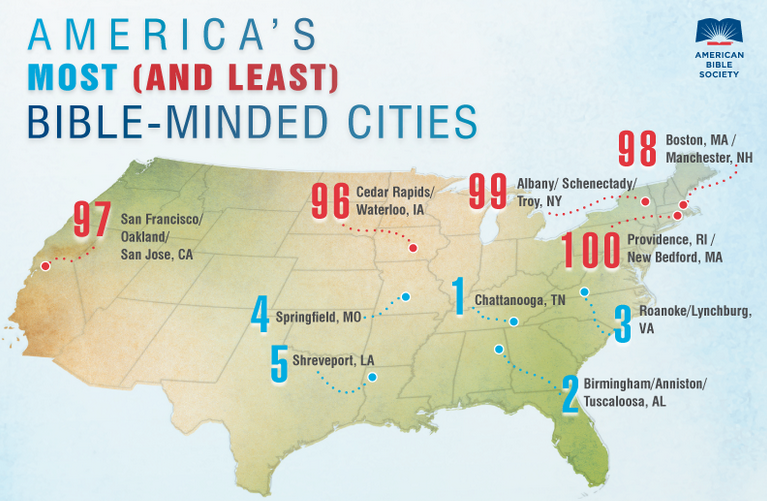
The American Bible Society has deemed Chattanooga the most “bible-minded city” in America:

Along with ranking the most and least Bible-minded cities, the study also found that an inverse relationship exists between population size and Bible friendliness. Of the top 25 Bible-minded markets, only three have a population of greater than 1 million households: Charlotte, N.C.; Nashville, Tenn.; and Dallas.

But Religion Dispatches’ S. Brent Plate takes issue with the concept of ”bible-mindedness”:

The first sentence of the Barna article explains that the poll was about “the role of the Bible in U.S. Society.” The fine print in the survey suggests something slightly different: “Respondents who report reading the Bible within the past seven days and who agree strongly in the accuracy of the Bible are classified as ‘Bible-minded.’” No suggestions are given that someone might act anything scriptural out, put the Bible to use, or otherwise engage it in real life. What we are left with is the idea that people read the Bible and call it accurate, and thus we know something about society.

The logical leaps here are vast. In reality, the survey is not telling us about any “role” of the Bible. It’s all just a mind game. The assumptions of the pollsters betray a larger misconception concerning who religious people are and what they do. Questionnaires are still mired in the mostly-Protestant notion that religious people read holy books and have “beliefs” in their heads. It makes for good fodder on the religion news circuits but necessarily leaves out the lived realities of religious existence.

Will Hillary Hatred Be The GOP’s Undoing?

Paul Waldman thinks so:

There are few things more fundamental to smart political strategy than the understanding that other people may not share your beliefs, and may not have the same emotional reactions you do to certain people and events. That understanding is what allows you to make thoughtful decisions about how to persuade the number of people you need to achieve your political goals, whether it’s passing a piece of legislation or winning an election. This is something Republicans often struggle with, but when it comes to the Clintons, they’re absolutely blinded by hate. To take just one example, if Hillary runs, we’re going to be hearing a lot about Benghazi, because Republicans are not only sure she did something scandalous, they’re also sure that if they just hammer away at it long enough, everybody else will become convinced, too. But just like with Bill’s impeachment, exactly the opposite is likely to happen: the more they talk about it, the more voters will become convinced that they’ve taken leave of their senses.

And that, more than anything else, may be what gives Hillary Clinton such a good chance of winning in 2016. When they’re looking at her, her opponents just can’t see straight.

The Second Amendment In Black America

Nicholas Johnson, the author of Negroes And The Gun, explains what motivated him to write the book:

The black tradition of arms has been submerged because it seems hard to reconcile with the dominant narrative of nonviolence in the modern civil-rights movement. But that superficial tension is resolved by the long-standing distinction that was vividly evoked by movement stalwart Fannie Lou Hamer. Hamer’s approach to segregationists who dominated Mississippi politics was, “Baby you just got to love ’em. Hating just makes you sick and weak.” But, asked how she survived the threats from midnight terrorists, Hamer responded, “I’ll tell you why. I keep a shotgun in every corner of my bedroom and the first cracker even look like he wants to throw some dynamite on my porch won’t write his mama again.”

Like Hartman Turnbow, Fannie Lou Hamer embraced private self-defense and political nonviolence without any sense of contradiction. In this she channeled a more-than-century-old practice and philosophy that evolved through every generation, sharpened by icons like Ida B. Wells, W. E. B. Du Bois and Daisy Bates, pressed by the burgeoning NAACP, and crystalized by Martin Luther King Jr.

Roving Against The Dying Of The Light, Ctd

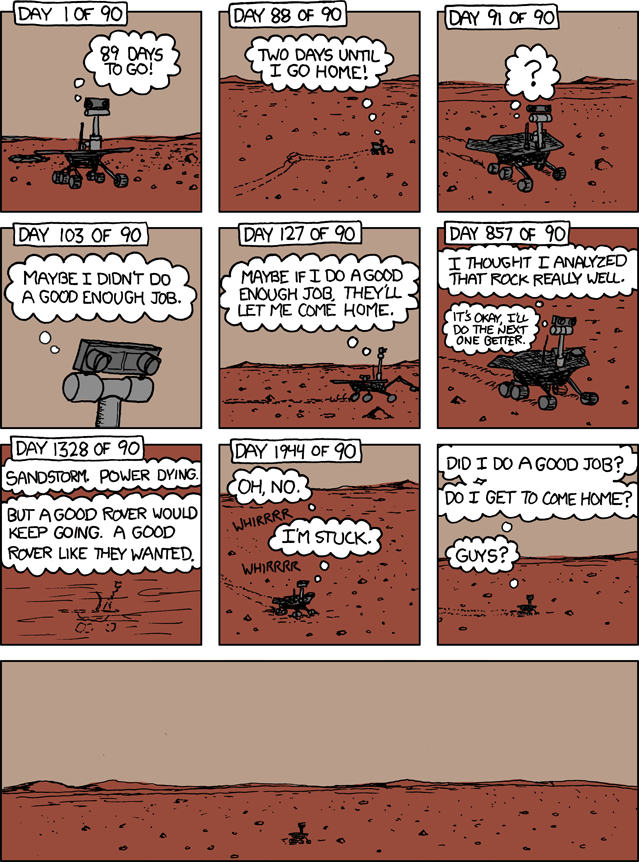
A reader sends the above cartoon:

Your post about the Jade Rabbit rover and the comment at the end about Curiosity on Mars made me think of this strip by xkcd. I know it’s just human projection, but somehow, these amazing machines take on their own personality in our minds. How can we not feel affection for them, and sadness at their ultimate fate? Maybe we recognize a bit of our own story in them. Go rovers!

Others offer some love for a veteran explorer:

If you think the Curiosity rover is awesome, I would like to remind you of a little rover named Opportunity.

Opportunity landed on Mars on January 25, 2004. It initially had a mission duration of 90 (Mars) days, and is still exploring Mars today.  You should check out the launch patch on Wikipedia [seen right]; it Nasa_mer_daffyhas Duck Dodgers and the words “Red Planet Gladiators.”

What’s even worse for Jade Rabbit’s is that the technical difficulties were announced on January 25, 2014, the tenth (Earth years) anniversary of Opportunity’s arrival on Mars.

Now I don’t view this as an “America, fuck yeah” moment because I think that any rover that manages to land successfully has exceptional scientific value and hopefully has a long operating life.  I feel the loss of Jade Rabbit is a loss for science which is more important than any amount of nationalism.

But I do agree with the idea that NASA is awesome.

Opportunity celebrated its 10th anniversary by taking a selfie. Meanwhile, another reader chides us for going all “America fuck yeah”:

You were comparing apples to oranges when comparing the different unmanned probes. Mars has an atmosphere and has no dust like the moon dust, which gets into everything and clings there with sharp edges.

Another nods:

“Abrasive lunar dust” is redundant. Unlike dust on Earth and Mars, where there are erosion processes to wear the particles somewhat smooth, on the moon the dust retains its knife’s-edge sharpness forever. By the third day on Apollo 17, astronauts Cernan and Schmitt were having a lot of trouble with the abrasive dust getting into the zippers and joint seals on their space suits. Moon dust will mess you up, man.

Do Writers Change?

Contemplating the question, novelist Tim Parks points to examples:

[S]ome writers do change their stories and their style quite decisively: Dickens shifted abruptly from optimism to pessimism, T.S. Eliot from a grumbling gloom to something approaching serenity, Joyce from relative simplicity to unspeakable complexity, Beckett from baroque English to the sparest French, Hardy from novels to poetry, or indeed, in the case of one of my favorite writers, Henry Green, from regular writing to silence.

In each case, if one examines the life of the author, it becomes clear that the earlier approach no longer “worked” for the writer, no longer contained the tensions that need to be contained in order to go on living in a certain way. Some other story was necessary. Or alternatively, change had happened, had been achieved, for better or worse, and the previous story was simply no longer appropriate, because no longer required.

I recall in this regard a recent conversation with a young novelist who was in some distress about his private life, in particular his obviously conflicted behavior with women. I encouraged him to see an analyst and hopefully sort things out. He said he had thought about this but was concerned that a successful analysis would alter the way he wrote, his ability to write tense, distraught stories about conflicted behavior with women, etc. I laughed. When despair brings home the bacon and self-esteem with it, it’s hard to let it go.