Interviewed To Death

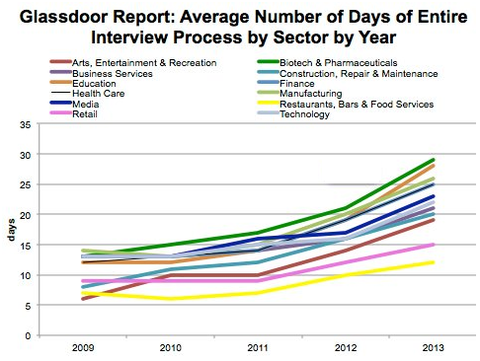
economix-24interviewprocessbysector-blog480-v2

Catherine Rampell wonders why employers’ hiring processes are getting longer and longer:

Some economists have argued that there is a growing “skills gap” between what workers have and what employees need. If that were true, though, we’d expect to see wages being bid up, and so far wages have remained relatively stagnant across the economy.

Another theory is that in an uncertain economy, companies are really, really worried about making a mistake and do not feel pressure to fill openings right away so long as they can still dump more work onto their existing staff members. As a result, employers exercise more exhaustive screening and vetting processes until they’re confident they’ve found their “purple squirrel,” H.R. jargon for an impossibly perfect, overqualified candidate usually willing to work for peanuts. Meanwhile, the costs that companies incur by making the hiring process more involved remain relatively hidden.

The Dish, Year 2: Update

[Re-posted from earlier today]

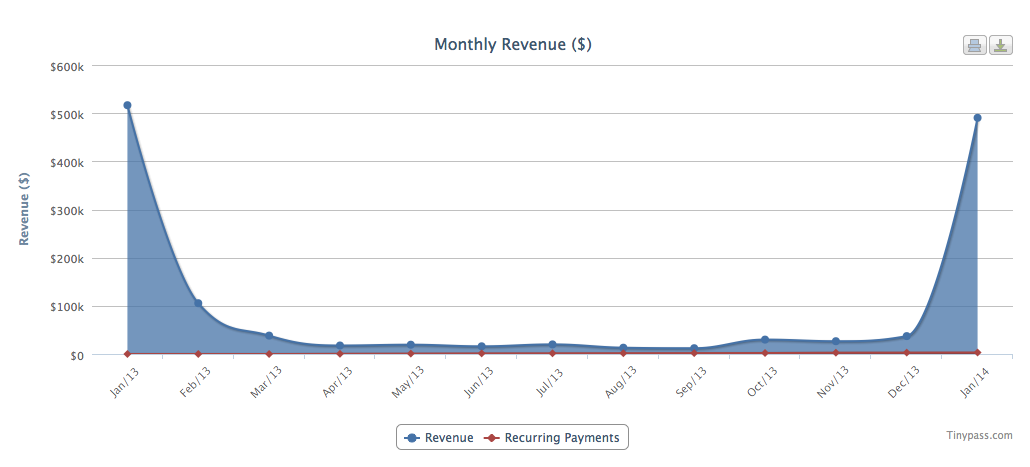
The latest numbers on renewals:
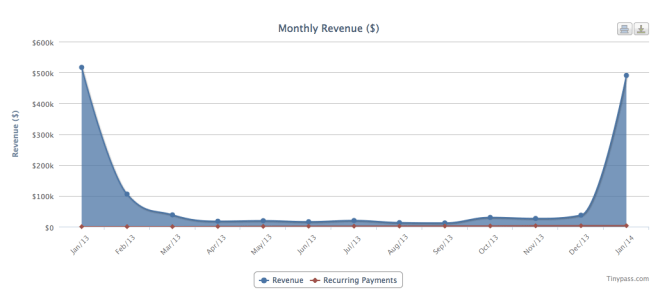
Screen Shot 2014-01-29 at 12.19.04 PM

There are two and a half days left in January – and revenue is almost equal to last year’s first month. In two weeks this January, we’ve gotten $490,000 in revenue. In all of last January, new subscription revenue was $516,000. Can we match it? I think this is now a real Rubicon for reader-supported content online. If we can prove that subscribers won’t just pay for content, but that they’ll pay consistently over time, we’ll be helping to prove that the web doesn’t have to be a blizzard of ads, gimmicks, slide-shows, sponsored content, and Upworthy headlines. It can actually have a much higher signal-to-noise ratio; it can be visually uncluttered; it can be intelligent and not crammed with flaming comments; it can begin to generate a business model that can invest in quality journalism, as we hope to do by expanding Deep Dish.

You’ve made this happen. And many of you still can. Renew here! Renew now! Or if you’ve always intended to subscribe and have never gotten around to it, subscribe for the first time here (for just $1.99 a month or $19.99 a year) and help us change the future of online journalism. Update from a reader, who adds a new price point to ones such as $4.20 and double chai:

So far the Dish is as significant in my Internet diet as Facebook, and I am kind of addicted to Facebook, so you can see I am milking every cent of my first year $19.99 subscription. This year I was planning to increase my subscription to $25, but I took the Euler number as an inspiration. This number is 2.718 … but I had a short circuit in my brain so I invested $23.18 (instead of my planned $27.18, I guess I’ll upgrade to $217.8 the day I have a real salary, but right now I am a graduate student, sigh).

Anyway, I googled 23.18 and I found the following Bible verse: Proverbs 23,18 “There is surely a future hope for you, and your hope will not be cut off.”
When Faithlessness Leaves Family Behind

Chris at Ordinary Times reveals how becoming an atheist alienated his devout Christian parents:

It should come as no surprise … that my leaving has caused them a great deal of distress and anxiety.  Nor should it come as a surprise to anyone who is familiar with either Christians or parents that they, again my mother in particular, have made their distress and anxiety abundantly clear to me on many occasions. And here enters a concept, and feeling, wholly alien I imagine to the native atheist, that of atheist guilt. I love my parents very much, so the knowledge that I am causing them pain is deeply disturbing to me. Yet what am I to do? Am I to lie to them and pretend that I have come back home? No, I respect them too much to deceive them. Am I to indulge them in their attempts to bring me back into the fold, with all of the praying and Bible verses and invitations to church when I visit? Nothing can come of such things, and I worry that false hopes inevitably dashed will only increase their suffering.

So my guilt is a dilemma, and the more I think on the dilemma, the more I am aware of being powerless to overcome it. Powerlessness in the face of guilt all but guarantees dysfunction in interpersonal relationships, and my relationship with my parents is no exception. I tip toe over many of the insensitive things they say, things that reveal how little respect they have for my world view while they, at the same time, are deeply intolerant of any perceived disrespect for theirs, and my doing so results in resentment — likely mutual at times — that occasionally spills over in the form of anger.

A Jewish commenter responds:

Judaism does not have the concept of hell that Christianity developed. Our version of “hell” is still supposed to be more peaceful than life on earth because life on earth is full of pain and misery. So an atheist child does not produce the amount of distress that seems to happen in Christian families. Furthermore, Judaism does not believe that not being Jewish means a life of damnation. My parents are atheist but raised me Jewish for cultural and ethnic reasons. I’ve never wrestled with whether there is a God or not.

Vaccination Is Neither Red Nor Blue

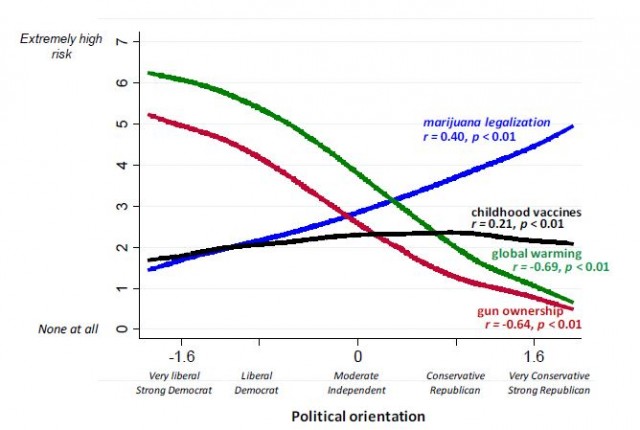
dish_vaccine

The erroneous belief that vaccines cause autism has little basis in partisan politics:

Yes, there may be a parent at your kid’s organic vegan locally sourced small-batch co-op nursery school who thinks it’s true, and dangerous lunatic Jenny McCarthy, the nation’s most prominent propagator of this theory, is a Hollywood celebrity and many Hollywood celebrities are liberals, but that doesn’t mean that liberals in general are more likely to believe in the fictional vaccine-autism link.

So here is some empirical data, from Dan Kahan of Yale Law School and the Cultural Cognition Project. Kahan did a study that included a survey and some experiments testing both what people believe about the topic and how they react to different kinds of information about it. And it turns out that not only do very few people believe that childhood vaccines pose a danger, liberals are no more likely to believe that than conservatives; in fact, they’re slightly less likely to believe it.

Ria Misra focuses on another finding from the study, that “vaccination rates and public acceptance of it are extremely high”:

But reports on both the science and the safety of vaccination don’t convince anti-vaxxers, and may even polarize them more.  So what should we be doing instead? Kahan says that the best way to promote vaccination may be to report on the already existing high vaccination rates, creating a kind of peer-pressure to vaccinate as a public good

Previous Dish on vaccines here, here, and here.

Face Of The Day

President Obama Delivers Economic Address At A Maryland Costco

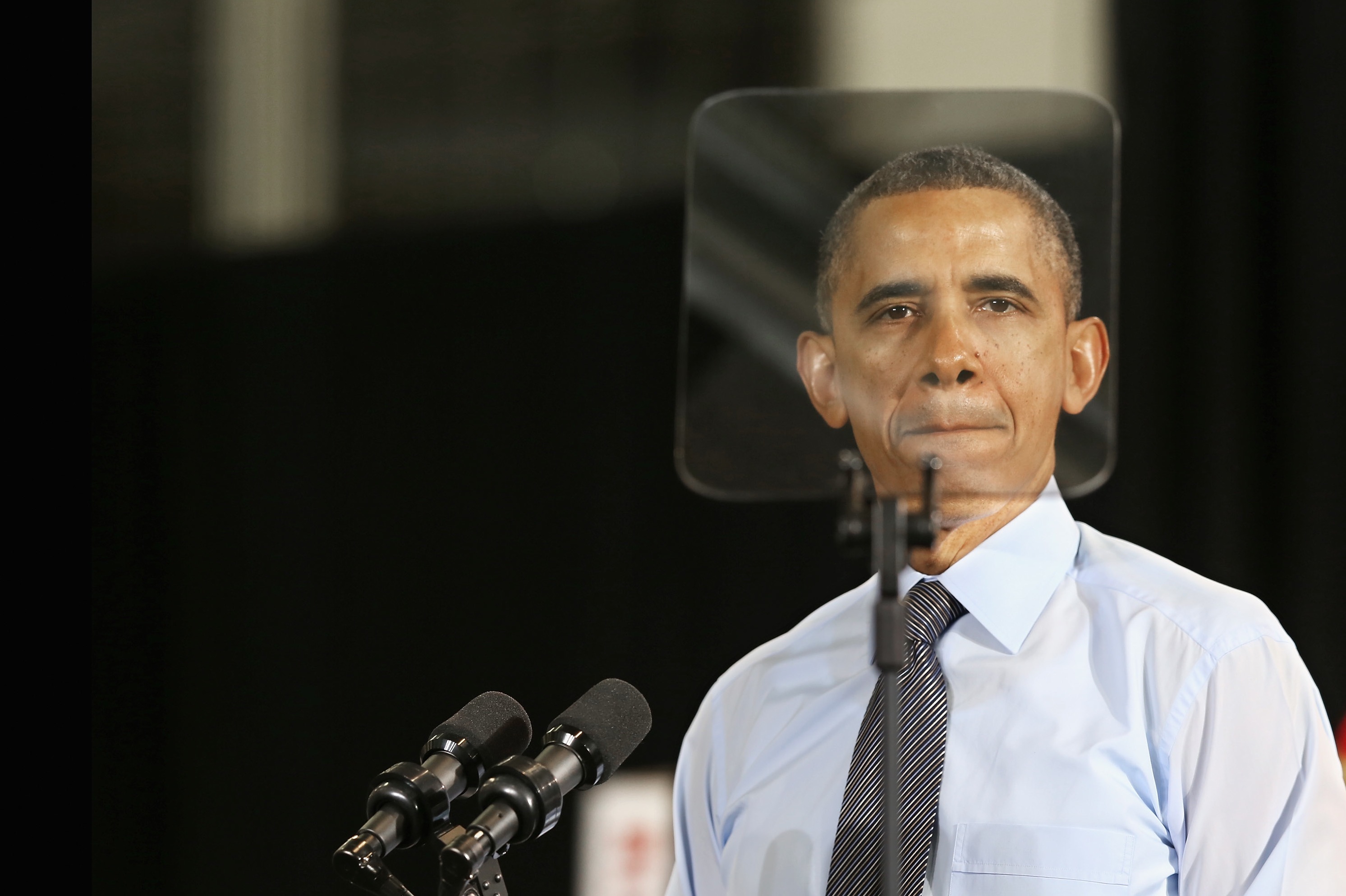
U.S. President Barack Obama is framed by his teleprompter while delivering remarks at the Costco wholesale store, repeating some of the same policy proposals from his State of the Union speech the night before January 29, 2014 in Lanham, Maryland. Obama is beginning a two-day, four-state tour to promote a raise in the minimum wage, immigration reform and other other policy ideas. By Chip Somodevilla/Getty Images.

The Bagel-And-Schmear Campaign

Bill de Blasio may have failed the pizza-eating test, but at least his taste in bagels passes muster. L.V. Anderson explores the role the humble Jewish bread has played in New York mayoral politics:

So why do we—both journalists and New Yorkers in general—care about whether our mayors have good taste in bagels? Having a good answer to the bagel question is meant, in part, to demonstrate a politician’s appreciation for Jewish culture and, by extension, Jewish voters. But inquiring about our mayors’ bagels preferences also stems from the same culinary chauvinism that spawned Pizzagate. Bagels, like pizza, are an affordable food brought over by early NYC immigrants, and thus are seen to confer a kind of working-class credibility on those politicians who properly enjoy them. Plus, it’s easier to judge a mayor’s taste in breadstuffs than it is to evaluate his or her policies—particularly for the pundits in the press, who are sometimes loath to wade into the minutiae of, say, city tax rates.

Two Thumbs Up For Life Itself

Owen Gleiberman describes the new documentary about Roger Ebert as “deeply enthralling”:

Here are some of the things I didn’t know about Ebert that I learned from Life Itself. I’d always assumed that his rock-steady gaze and toweringly brash, domineering personality grew out of his status as America’s most influential celebrity movie critic — but, in fact, those things were fully there when he was in college, editing the school newspaper with a fearsome, cocky-beyond-his-years arrogance that made him a campus legend. I knew that countless filmmakers were indebted to him, but I didn’t know that Martin Scorsese, crawling out of his heavy addiction period, credited Ebert (and Siskel) with bringing him back from the dead through the tribute they organized at the Toronto Film Festival in the early 1980s. And though the movie should have done more digging into how Ebert first hooked up with Russ Meyer (it presents his penning of the script for Beyond the Valley of the Dolls as a fait accompli — and neglects to mention that he wrote several other, far more tawdry screenplays for Meyer), it’s pretty up front about Ebert’s involvement, for years, with reckless and unstable women. I bring this up only because it gets to Ebert’s dual nature: He was a tubby, ink-stained Midwestern geek who walked on the wild side.

In an interview, Chaz Ebert describes her amazement at the number of people who still approach her with a personal story about her late husband:

I think it’s because he was sincere. When he reached out to people, there were no cameras. People weren’t going to write stories about it. He did it because he really felt that way and he really liked communicating with other people and reaching out to them. He liked mentoring, and so he would answer letters and take time to talk to people who sincerely wanted to learn about journalism.

And he also sincerely was curious about what it was like to be another person. He liked getting inside the head of another person and inside the heart of another person. He said we are constrained in this box of life, but to get to know what it feels like to be a person of another age or race or gender is just a gift. If you’re curious and just reach out, you’ll find out.

The Dish noted Ebert’s passing here. Browse our archive for the critic’s influence here.

(Video: Martin Scorsese talks about Ebert and Life Itself)

Impoverished By Prison

Michael Gerson argues that drugs “damage and undermine families and communities and ultimately deprive the nation of competent, self-governing citizens.” Balko sees prohibition as the larger problem:

In 2012, the economist David Henderson wrote a piece for the right-leaning Hoover Institution about the “bottom one percent.”

By that, he was referring to the incarcerated, who of course have little to no annual income. There are currently well over a half million people in prison for non-violent drug offenses. There are about a million more on probation or parole. According to a study by Students for Sensible Drug Policy, about 200,000 young people have lost access to financial aid due to some sort of drug offense, although since that figure was from 2006, it’s probably much larger today.  In 2012 alone, 1.5 million people were arrested for some sort of consensual drug crime. Of those, 1.2 million were arrested for possession, not distribution. On average, taxpayers pay $25,000 per year to house each prisoner. In some states, the figure can approach $50,000. As Henderson writes, we’re paying that money “so that the government can put poor people in prison and keep them poor,” and to “put non-poor people in prison and make them poor.”

If conservatives like Gerson and Frum are truly concerned about income inequality, income immobility, social disorder, erosion of the rule of law, disrespect for for public institutions, and the dissolution of the family, it seems they should at least address the drug war’s contribution to these problems. Instead, when contemplating solutions to these problems, reforming or ending the drug war is usually the first option they take off the table.

Not-So-Strangelove

Fifty years after the release of Dr. Strangelove, Eric Schlosser reflects, “In retrospect, Kubrick’s black comedy provided a far more accurate description of the dangers inherent in nuclear command-and-control systems than the ones that the American people got from the White House, the Pentagon, and the mainstream media”:

The most unlikely and absurd plot element in “Strangelove” is the existence of a Soviet “Doomsday Machine.” The device would trigger itself, automatically, if the Soviet Union were attacked with nuclear weapons. It was meant to be the ultimate deterrent, a threat to destroy the world in order to prevent an American nuclear strike. But the failure of the Soviets to tell the United States about the contraption defeats its purpose and, at the end of the film, inadvertently causes a nuclear Armageddon. “The whole point of the Doomsday Machine is lost,” Dr. Strangelove, the President’s science adviser, explains to the Soviet Ambassador, “if you keep it a secret!”

A decade after the release of “Strangelove,” the Soviet Union began work on the Perimeter system—-a network of sensors and computers that could allow junior military officials to launch missiles without oversight from the Soviet leadership. Perhaps nobody at the Kremlin had seen the film. Completed in 1985, the system was known as the Dead Hand. Once it was activated, Perimeter would order the launch of long-range missiles at the United States if it detected nuclear detonations on Soviet soil and Soviet leaders couldn’t be reached. Like the Doomsday Machine in “Strangelove,” Perimeter was kept secret from the United States; its existence was not revealed until years after the Cold War ended.

Previous Dish on other nuclear close-calls here and here.