When Pot Is A Problem

Leah Allen movingly recalls how her father’s pot habit negatively impacted her and her family:

I don’t know when my dad started to smoke. I do know that before he smokes a joint he can get antsy, angry. His temper is fast and sharp. He hit my mom when she was pregnant and that’s when she left him. I was three. I also know that after he smokes, my dad is relaxed, soothed, likely to go off on dreamy tangents about colors and pictures. He was great with us when we were kids, an adventurer ready to play on our level. It’s hard to deny that pot has made him a happier person.

During the few weeks my brother, sister, and I spent with my dad every summer, he took us to reggae festivals. Pot circles sprung up as the sun went down. One year, feeling bold, we children pooled our money together and bought a “ganja brownie” from the walking vendor.

That was the same year my dad forgot us. He always had a spotty memory, a well-documented side-effect of marijuana. Pick-up times were regularly missed by several hours. Dinners—half-cooked, half eaten—were left in the microwave or on the stovetop. Birthdays brushed by unnoticed. Once he remembered my birthday two years in a row and sent the same CD both times.

After rattling off many other ill effects, she concludes:

I can’t be angry. I understand the appeal of marijuana: its soothing properties, its potential to help chronic pain sufferers, its medical implications. I also believe it should be legalized. In a world where alcohol and nicotine can be purchased at most corner shops, the argument against bringing pot sales out into the open is a weak one.

Yet I can be sad. So very little is understood about how marijuana impacts families. I can’t help but thinking that the cool, carefree users of today will be the parents of tomorrow. My dad will never stop smoking pot. Sometimes I wonder about the man he might have been, and the lives we all might have had, if he’d never started.
Spraying The Crops, Ctd

A reader discusses his own experience using human pee as fertilizer:

I was a Peace Corps volunteer in Mali, and urine fertilizer was a popular practice for environment/agricultural volunteers such as myself to pass on to our communities. Normally, we would get these ubiquitous 20-liter yellow plastic water drums affectionately referred to as Jibitans (in Bambara, ji means water and bitan means container) and, well, fill ’em up. You had to cap them so as not to let the nitrates leak out or evaporate.

At first, it raised an eyebrow when I introduced it to the communities I worked with, but not much more than that.  Then again, most of them already thought I and every other American was batshit crazy, so maybe that’s why they weren’t all that surprised.

To get to the point, though: It worked! Quite well, as a matter of fact. It saved communities, families, and individuals money and it spared a little chemical fertilizer use. Until reading your post, I never really even stopped to think about its application in the West or sanitary issues or “ick factors.” I guess when you spend two years using your left hand as toilet paper, you won’t even think twice about pissing in a container and putting it on your garden.

Another notes that commercial fertilizer carries its own “ick factor”:

One of the chemicals that’s long been used in chemical fertilizers for agriculture is named ‘urea.’  I’ll leave it to you to figure out why chemists first named it that.

California’s Endless Summer

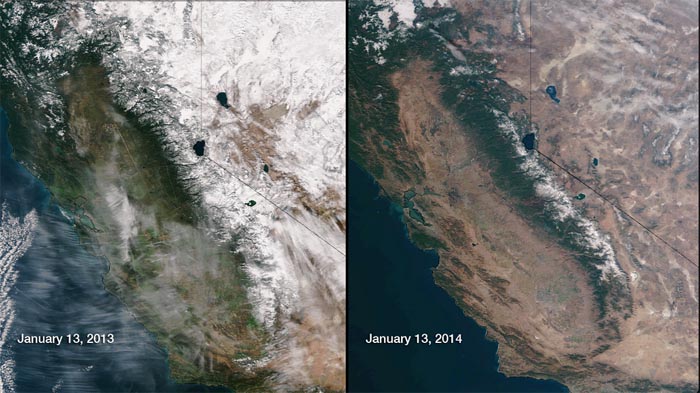
CA Snow

Last week California declared a drought emergency. Amelia Urry catches us up:

In the past two weeks, the percentage of the state experiencing extreme drought conditions shot from 28 percent up to a vertigo-inducing 63 percent, according to the U.S. Drought Monitor. Snowpack in the Sierra Nevada Mountains is at a perilously low 17 percent of its usual level this time of year [as seen above]. Since as much as 65 percent of Cali’s water comes from this virtual water cooler, and much of that goes toward the state’s multibillion-dollar agricultural industry, the effects of a catastrophic water shortage may be widely felt in the year to come.

Though droughts are not uncommon in the region’s Mediterranean climate, the pattern of the past few years points to a slow-mo climate crisis crashing into the West Coast. 2013 was California’s driest year on record, with about two thirds of the state experiencing severe water shortage and fire danger.

Christopher C. Burt details the agricultural impacts:

A major drought in California would have nation-wide implications.

California is the number one state in cash farm receipts with 11.3 percent of the U.S. total. The state accounts for 15 percent of national receipts for crops and 7.1 percent of the U.S. revenue for livestock and livestock products. California’s agricultural abundance includes more than 400 commodities. The state produces nearly half of U.S.-grown fruits, nuts and vegetables. Across the nation, U.S. consumers regularly purchase several crops produced solely in California. The state is also the nation’s largest agricultural exporter.

Chris Mooney examines the region’s fire potential:

Hotter, drier conditions favor wildfires. Indeed, California has already seen several significant fires since the October 31 end of the traditional fire season, including December’s Big Sur fire and the ongoing Colby Fire in the Los Angeles area. That’s a bad sign. So is the fact that in just the first 11 days of January, the state saw 154 fires that burned 598 acres. That’s way above the five-year average for this time of year.

For California, seven of the 10 largest fires in state history have occurred since the year 2000. And if these dry conditions persist throughout 2014, another new fire may be added to that list.

And the future looks drier and drier:

Over the longer term, climate projections suggest that this [drought] risk will continue or increase. According to the draft National Climate Assessment, the US Southwest—which includes California and five other states—can expect less precipitation, hotter temperatures, and drier soils in the future, meaning that by 2060, there could be as much as a 35-percent increase in water demand. Along with that comes a 25- to 50-percent increased risk of water shortages.

(Image: NOAA/NASA)

A Good Death

Julie Myerson calls her mother-in-law’s passing “as good as I can imagine a 21st-century death to be.” She urges others to share their positive experiences:

Helen’s death felt oddly like the labor of birth: exhausting and devastating, yes, but natural too and, in some strange way, productive. More crucially, and reassuringly, the nurses understood this far better than we did. As the moment drew near and, inevitably distressed on Helen’s behalf, we requested pain relief, these nurses explained, with real gentleness and compassion, that it would be far better for her if they did not intervene. And they were right. Her final moments were peaceful. And to be allowed to be there with her as they ticked on past – it’s not something I can put into words. …

I’ve thought often about whether or not to write about this, especially when I read yet another newspaper account of how the medicalization of death, the obsession with intervention and saving at all costs, is robbing us all of our right to die in peace. But I’ve always hesitated. Partly because death, any death, is such an intensely intimate experience and seeking to describe it may be, for lots of reasons, a step too far. And partly, of course, because this particular death belongs at least as much to the others who were present as it does to me. All you have here is a purely subjective description from someone who loved her children’s grandmother very much.

And yet. It seems to me that what we all experienced on the 11th floor of St Thomas’ Hospital on that April evening was something that ought to be known about, appreciated, celebrated even. We surely can’t be the only family who’ve had such an experience? So I hope that Helen – whose love and friendship I feel moved to have known – would forgive me. Because how can we possibly debate these issues with any honesty if we don’t seek to share our most positive experiences of intensely private moments?

Ukraine Reignites

Protests have popped up again in Kiev after the Ukrainian parliament passed a new law that essentially bans demonstrations:

The relatively quiet spell was broken last Thursday, when the Ukrainian parliament passed a series of new laws that seriously limit the scope for protests. The laws were rushed through by President Yanukovych’s supporters, with a show of hands and no time for discussion. Not for the first time, a brawl broke out in parliament. But the voting procedure was clearly fine with Yanukovych, and the next day he signed the laws.

The laws, summarized in English on this infographic, clearly limit Ukrainians’ freedom of assembly. They introduce penalties for wearing helmets at demos, setting up tents and public stages and distributing “extremist” materials, among other activities. People driving cars in columns of more than five could have their licenses and vehicles confiscated (presumably a response to the increasingly popular “automaidan” initiatives). Foreign observers are particularly dismayed at the law—which could have been copy and pasted from Vladimir Putin’s Russia—that labels NGOs receiving money from abroad “foreign agents.”

Timothy Snyder declares that, “On paper, Ukraine is now a dictatorship”:

In practice, will Ukraine become a dictatorship? Ukrainians have powerful reasons to resist. These laws, now signed by the president, end the Ukrainian republic as they have known it. They also much reduce the possibility of future European integration, something which is yearned for throughout the country, and for that matter among elites and the political class. No one in Brussels or European capitals is going to lobby for a trade deal with a leadership that has explicitly chosen authoritarianism. If these laws are allowed to stand, the future of Ukraine will thus be with Belarus and Russia, for lack of another option. This makes no economic sense, since Europe’s market is bigger and more important. The only kind of sense it makes is political, for a president who knows he is too weak in his own society to win another democratic election.

Hannah Thoburn looks at the fractures within the country:

A large percentage of Ukrainians hold [Ukrainian president Viktor] Yanukovych personally responsible for solving the current political crisis,but his choosing one side over the other will polarize this already divided country more than it has been before. Yanukovych’s political base is in eastern Ukraine, where the majority speak Russian and identify strongly with Russia. Only 17 percent of eastern Ukrainians approve of the protest movement and would be only too happy to see their president quash it in whatever manner he deems necessary. Meanwhile, 80 percent of citizens in the western and more European-leaning part of the country approve of the protest movement and disapprove of the president’s recent decisions. They did not vote for him and will not support him.

While rounding-up videos of the protests, Fisher flags the clip above:

This is important: Most protesters are not violent, and what’s happening in Kiev is not, despite some government assertions to the contrary, a “mass riot.” Still, there’s been violence, with some protesters throwing flares at the vast rows of security forces. This video shows what it looks like from the police’s perspective …

The Myth Of American Generosity?

This is news to me:

For a start, it isn’t clear why the rest of us get credit for the fact that the Gateses and Warren Buffett gave away the bulk of their fortunes. But as importantly, it simply isn’t true. Private development assistance in the United States equals 0.2 percent of gross national income—the same as government development assistance. Private development assistance in the United Kingdom also equals 0.2 percent of gross national income—while government assistance equaled 0.6 percent in 2011. Add the two together, and the United States is one-half as generous as Great Britain — and two-fifths as generous as Sweden.

The Lonely Listener

8940839074_1487a6fd8c_o

Stan Alcorn investigates why Internet users almost never share audio the way they share, say, pet videos:

“Audio never goes viral,” writes radio and podcast producer Nate DiMeo. “If you posted the most incredible story – literally, the most incredible story that has ever been told since people have had the ability to tell stories, it will never, ever get as many hits as a video of a cat with a moustache.” It’s hardly a fair fight, audio vs. cat video, but it’s the one that’s fought on Facebook every day. DiMeo’s glum conclusion is an exaggeration of what [viral video-maker Bianca] Giaever reads as the moral of her own story: “People will watch a bad video more than [they will listen to] good audio,” she says.

Those in the Internet audio business tend to give two explanations for this disparity.

“The greatest reason is structural,” says Jesse Thorn, who hosts a public radio show called “Bullseye” and runs a podcast network called Maximum Fun. “Audio usage takes place while you’re doing something else.” You can listen while you drive or do the dishes, an insuperable competitive advantage over text or video, which transforms into a disadvantage when it comes to sharing the listening experience with anyone out of earshot. “When you’re driving a car, you’re not going to share anything,” says Thorn.

The second explanation is that you can’t skim sound. An instant of video is a still, a window into the action that you can drag through time at will. An instant of audio, on the other hand, is nothing. “If I send someone an article, if they see the headline and read a few things, they know what I want them to know,” a sound artist and radio producer told me. “If I send someone audio, they have to, like… listen to it.” It’s a lot to ask of an Internet audience.

For some radio makers, social media incompatibility is a sign of countercultural vitality. Thorn has called his own work “anti-viral,” and believes that entertaining his niche audience is “still so much better than making things that convince aunts to forward them to each other.”

(Image by Flickr user JB912)

The Christie Scandal Metastasizes

First Read analyzes the latest:

Christie’s biggest political problem right now is that he’s fighting wars on two different fronts, both of which increasingly look like wars of attrition. The first war is the two-week-old George port-authoritahWashington Bridge scandal, and 18 new Christie aides and associates have been subpoenaed by New Jersey Democrats now investigating the matter. And, at the very least, it promises months of new email revelations, testimony, and storylines. (Since this is being led by the state Assembly, it also means it will likely grind Christie’s second-term agenda to a halt before it even begins.)

The second war is Hoboken Mayor Dawn Zimmer’s allegation, first made on MSNBC over the weekend, that the Christie administration threatened to hold up the city’s Hurricane Sandy relief aid unless she supported a private development project. That matter is now being investigated by a federal prosecutor, and it also promises weeks and months of potential headaches for Team Christie. “What we’ve got now is a federal criminal investigation into the Christie administration’s administration of Sandy funds,” NBC’s Michael Isikoff reported yesterday. As history teaches us, a two-front war is never an enviable position for the person fighting it.

Ezra puts the scandal in context:

It would be easier to dismiss Zimmer if not for the bridge closure. And it would be easier to explain away the bridge closure if not for Zimmer. That’s the problem for Christie: These stories are beginning to build. Each new revelation makes the past scandals more believable — and more damaging. And each new story intensifies the media’s efforts to find more.

Benen notes that Team Christie is trying to shift the focus to the media:

There is a pretty standard tactic in Political Crisis Management 101: discredit those asking the questions. The strategy, however, is not without flaw. For example, Team Christie has not yet uncovered any factual errors in MSNBC reporting, which would presumably be the prerequisite to any complaints. When allegations of wrongdoing surface, this is not a sound defense: “The allegations are wrong because they’ve been reported by journalists we don’t like.” A better defense would be, “The allegations are wrong and here’s why.”

Jeff Smith, speaking from personal experience, discusses the possible federal prosecution of the Christie administration:

What these pundits forget—and, as Christie, a former U.S. attorney, knows as well as anyone—is the old saw that federal prosecutors can get a grand jury to indict a ham sandwich. They don’t need a bulletproof case. And once they have a target, they aren’t limited to investigating the matter that caught their attention; public corruption probes often widen as new information emerges. Federal prosecutors rarely have just one attack route. Remember, they brought down Al Capone for income tax evasion, not bribery, bootlegging, or murder. The Fort Lee incident may be merely a bridge, if you will, to other Christie administration misconduct.

Chart Of The Day

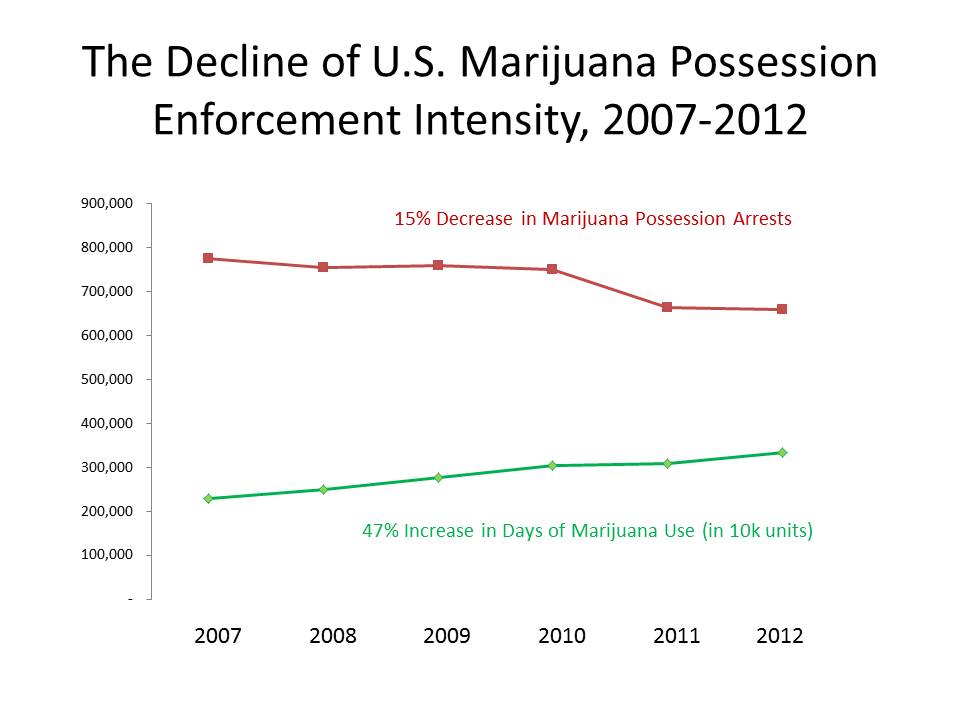
Marijuana Enforcement

Marijuana enforcement is getting more lax:

The chart [above] presents 2007-2012 FBI Uniform Crime Reports data on marijuana possession arrests and National Survey on Drug Use and Health data on aggregate days of American marijuana use … To put the two lines on the same scale, aggregate days of marijuana use are reported in 10,000s. The most striking feature of the data are that the two lines are going in opposite directions. The net result is a 42% decline in marijuana possession enforcement intensity (i.e., the number of arrests per day of marijuana use).