Working Too Much Is Bad For Business

So why do we do it?

The perplexing thing about the cult of overwork is that, as we’ve known for a while, long hours diminish both productivity and quality. Among industrial workers, overtime raises the rate of mistakes and safety mishaps; likewise, for knowledge workers fatigue and sleep-deprivation make it hard to perform at a high cognitive level. As Solomon put it, past a certain point overworked people become “less efficient and less effective.” And the effects are cumulative. The bankers Michel studied started to break down in their fourth year on the job. They suffered from depression, anxiety, and immune-system problems, and performance reviews showed that their creativity and judgment declined.

If the benefits of working fewer hours are this clear, why has it been so hard for businesses to embrace the idea? Simple economics certainly plays a role: in some cases, such as law firms that bill by the hour, the system can reward you for working longer, not smarter. And even if a person pulling all-nighters is less productive than a well-rested substitute would be, it’s still cheaper to pay one person to work a hundred hours a week than two people to work fifty hours apiece.

Recent Dish on work hours here.

Checking In On PreCheck

Amar Toor examines the TSA program that expedites the security screening process for travelers who either have applied for the program or who have been invited by “behavior-detection officers”:

There are … doubts over whether the TSA’s behavior-detection methods are even effective at identifying potential threats. A November report from the nonpartisan Government Accountability Office (GAO) found that behavior-detection techniques work only “slightly better than chance”, and that they may be applied on inconsistent or subjective bases. The report was especially discouraging considering that the TSA has spent an estimated $1 billion on implementing behavior-detection protocols since launching the program in 2007. The TSA later contested the report’s findings, saying they were based on a survey of academic studies focused on identifying liars, rather than the suspicious behaviors that its agents are looking for. …

Yet [the Cato Institute’s Director of Information Policy Studies Jim] Harper and security experts see value in PreCheck’s unpredictability. TSA agents select passengers to pass through PreCheck at irregular times and locations, usually depending on queue length, and some eligible travelers are randomly selected prior to going through security. That makes it harder for would-be terrorists to exploit the system, but Harper still has reservations about a two-tiered approach to airport security. As the program expands, he argues, it’s not hard to imagine a situation where affluent passengers whisk through PreCheck, while poorer or less experienced travelers remain trapped in longer lines.

Update from a reader:

Your note and link about TSA PreCheck is a little off base – and I should know as I designed and implemented PreCheck for United! There are currently five methods of obtaining access to the TSA PreCheck lane:

1) qualify for PreCheck based on flight criteria, 2) qualify based on membership in the DHS Global Entry program (which requires a background check and in-person interview), 3) qualify based on membership in the new TSA PreCheck application program (which again requires a background check and in-person interview but is cheaper than Global Entry), 4) have your itinerary selected at random by the TSA’s black box, and 5) be admitted to the lane by a Behavioral Detection Officer.

Of all of these, selection by BDO is a tiny, tiny percentage of the total.  I’m not in a place to speak about how well the BDO’s do their jobs, but I know for a fact that the first four methods I mentioned (and a sixth that may or may not occur this year) are designed thoughtfully and do provide a less stringent security posture for people who concretely pose less risk.

The TSA’s stated goal is to get an ever larger share of the traveling public into the more trusted security screening lanes over this year and the next, and I expect we can return to pre-9/11 screening for a large majority of passengers within the next five years.  This will all be done without any BDOs.

Dish Renewal: Your Thoughts, Ctd

dish-readers

A reader writes:

I want to pass along a short encouraging email to you all: I for one don’t feel annoyed by your posts asking people to renew. It’s no worse than what NPR or Wikipedia do once a year, and unlike them, your appeals seem genuine (rather than automated) and express how passionate you are about what you do. After reading your blog off and on for about three years, my wife and I decided to fully commit and become subscribers a few weeks ago. In fact, it was one of your “please pay us!” posts that helped convince us. That, and the fact that your site is better than any other news site out there. Keep it up!

Another quips, “I figure with the amount of lost productivity I can blame on the Dish, the least I can do is forward along a small share of my paycheck.” Another dissents:

I can’t be the only one to notice the irony of your recent railing about the blurred lines between editorial and advertising at traditional publications, and your use of the exact same practice with the extensive posts about renewing to The Dish. I’m gonna renew, but just sayin.

Exact same practice? Really? Another reader:

I look forward to renewing my subscription. You have for years been my #1 go-to blog. There have been many many topics discussed at length that have direct relevance to my life. It is the one place I can go where I feel like my life as a 20-year HIV survivor is not lost to memory. Also, your discussion of how Vietnam veterans were ill-received by the old soldiers at the VFW was so enlightening to me. After sharing with my partner of twelve years, himself a Vietnam Vet, he really opened up some more – even after twelve years – since he speaks so little of it. So much pain. Both of us are isolated and “forgotten” soldiers in our respective ways. It has also been a great pleasure to share the warmth and excitement of the Grace that is Pope Francis. And I am so grateful to your blog for not forgetting the incarcerated and the travails of the mentally ill. Your blog is truly more like a place to me than a digital abstraction. It’s a good place to go. Have a Jaeger for me.

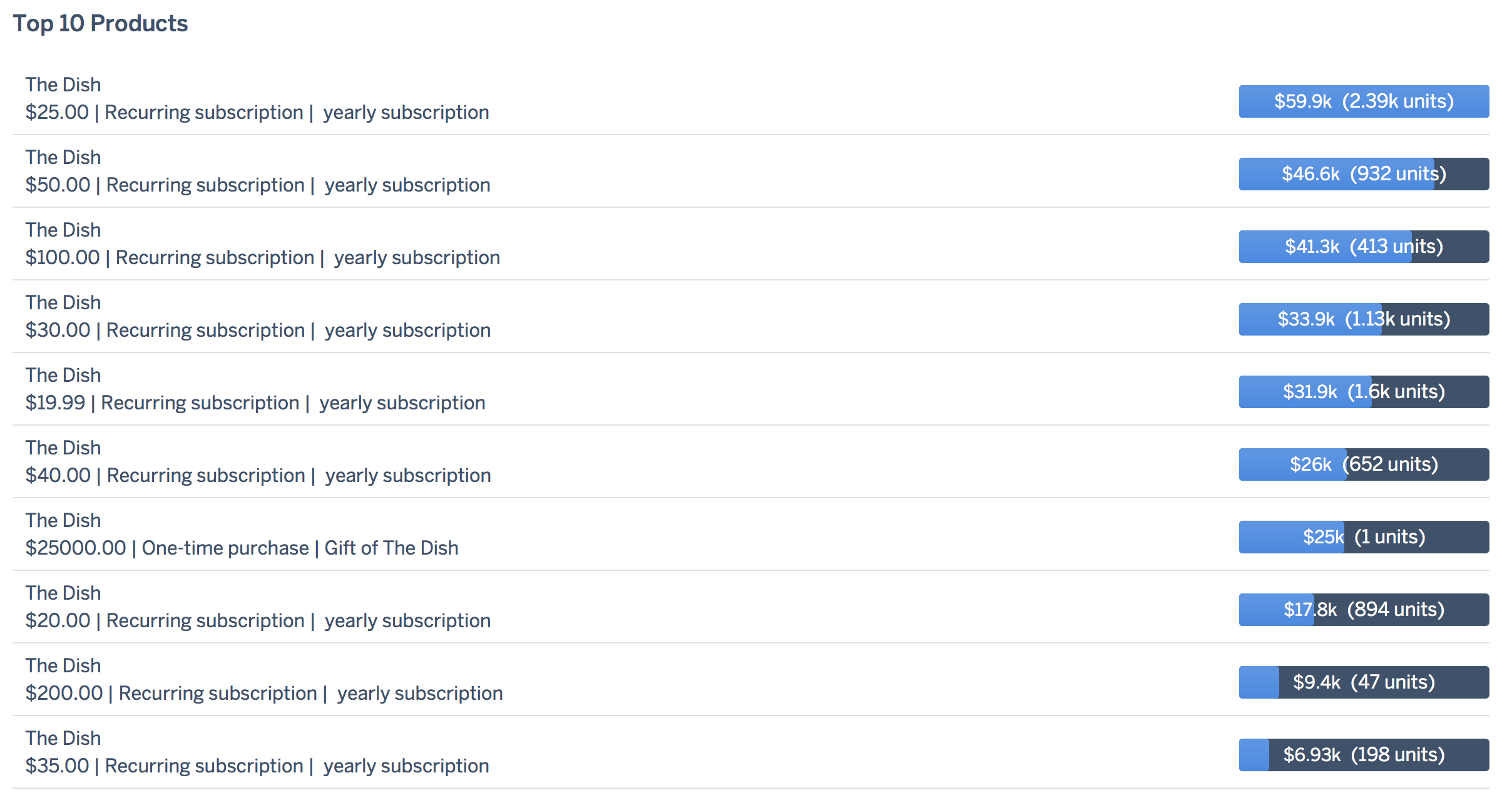
We’re not celebrating yet, since we still have a long way to go before matching last year’s budget. But we’re off to a great start: about 52% of our Founding Member revenue has been recouped so far. Below is a breakdown of the top 10 prices set by readers, ranked by total revenue for each chosen price (click to enlarge):

Screen Shot 2014-01-21 at 5.08.26 AM

The minimum price for a Dish subscription is still only $1.99/month or $19.99/year, but the average chosen price for an annual subscription is still hovering high at $37. One of the top contributors went with the monthly option:

I paid $19.99 the first day you opened for TinyPass business last year.  This year, when you asked for an extra $5, I thought “Hell, I can do more than that, and I WANT to do more than that”, and looked at my checkbook to see how much more I could do.  A quick review reminded that I pay $7.99 a month for Netflix, and I consume MUCH more Dish than Netflix.  So, I decided on a $7.99/month Dish renewal.  I also pay $9.99 a month for unlimited music on Spotify for my husband and me and our myriad devices.  I consume MUCH more Dish than Spotify.  Okay, I’ll hike it to $9.99 a month.

And then the killer: $32.80 every four weeks (13x year!) for The New York Times.  I read the hell out of The New York Times, but $32.80 is for digital access only on our computers, iPads, iPhones, etc.  (We get one dead-tree paper on Sunday, which we wouldn’t prefer.)  So, the nearest price point for the media item that I use/consume the most similarly to how I use/consume The Dish is The New York Times, and I pay them more than $425 a year.

So I renewed for $40/month – which comes out to $480/year.  It’s a huge sum, and I won’t be able to afford it forever, but today, as I measure its value to me compared to all the other media I pay for, it gets the pole position by far.

dish-launch-reax

Another reader:

I’m heartened to see the second-year spike in subscriptions you’ve received so far. And I want to apologize a bit: My own subscription isn’t up until February 4, and dollars are really really tight right now, so I’ll be re-upping with automatic renewal in early February.

But if that reader renews today, he won’t be double-charged for the next two weeks. (More details on that reader’s concern and others here.) So if you are already planning to renew your subscription, there’s really no need to delay. One more reader:

Happy to have renewed my subscription and thrown in $5 more than last year. I love the Dish, and I really loved the podcast with Dan Savage. Hopefully those in-depth conversations with interesting people will become a much more regular part of the Dish. (As a pioneer in blogging, I’d love to hear you chat with another pioneer of new media, podcaster Marc Maron, who I think has popped up before.) But I’m sure no matter what direction you take the Dish in, I’ll continue to find it informative, thought provoking and a unique voice in the noise.

Now that that’s out of the way, I’d like to ask you to pass something along to the free-riders: Pay up! No more excuses in year two. Andrew and the team have bent over backwards to make the Dish accessible and affordable to everyone, and they are truly putting themselves out there financially to provide you with content that you’re clearly consuming on a regular basis. $1.99 a month! That’s it! A cup of freaking coffee!

Renew now! Renew here! Update from a subscriber:

But my usual is a triple latte – almost $5.  So that’s what I renewed for – $5 a month. I hadn’t really thought of a monthly subscription. I was contemplating renewing at a higher yearly rate, but money is tight. Thanks to that subscriber, I thought of it differently. I can forgo an occasional latte to increase my Dish subscription amount – and doing it monthly will make it virtually unnoticeable.

And don’t forget to subscribe here if you haven’t already – another reader just did:

I’m a white married heterosexual atheist, inhabiting a Southern city with a rural job where I work in tractor/farm equipment sales. I chew tobacco, smoke pot, support marriage equality, love baking cakes and pies, making homemade ice cream (with a waistline that shows it), and I don’t drink – except from the Dish, which I now do with no inner pangs, as I finally coughed up some dough to support your enterprise. Cheesy segue I know, but I got nothing better. Thanks to all and keep it up!

One more renewal update, because who can resist this one:

I renewed for $100 – extended out to February 4th, 2015 – which happens to be the 36th anniversary of me losing my virginity. And now that I think of it, I will always be renewing my membership as of February 4th. So, two reasons to celebrate!

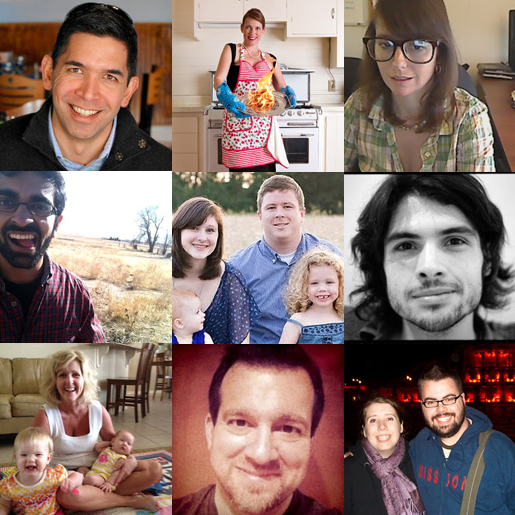
(Photos of Dish subscribers used with permission)

Will The Internet Swallow TV? Ctd

For a small monthly fee, Aereo makes broadcast TV available online (previous Dish coverage here). The Supreme Court has agreed to hear the appeal of major broadcast networks that object to Aereo’s services.  Michael Phillips explains why the case “may determine the future of television”:

To carry network programming, cable and satellite companies normally pay what are known as “retransmission consent fees,” which have come to make up an ever-greater portion of the networks’ revenue. CBS, for instance, pulled its channels from Time Warner Cable last fall while negotiating higher fees. However, Aereo, using a novel interpretation of copyright law, argues that the complex mechanics of its service mean that it doesn’t have to pay.

Under the Copyright Act, you need permission—typically an expensive license—from a copyright holder to show, say, a television program to a large number of people. But the act doesn‘t prohibit showing it “privately” to “a normal circle of family” or “social acquaintances.” This is why you can host a Super Bowl party in your living room without paying an additional fee to whichever network is broadcasting it, or worrying that a lawyer in a power suit will bust down your front door. Because each antenna is assigned to a single subscriber, Aereo claims that it is merely facilitating the sort of individual, private viewership that is allowed by the Copyright Act. …

The putative question before the Supreme Court is whether Aereo is violating the Copyright Act by putting on “public performances” without appropriate licensing. But the Court’s decision to hear the case may signal some sympathy for the networks’ argument that Aereo poses an existential threat to their industry. Out of some ten thousand petitions that the Court receives each year, it chooses seventy-five or so cases to review. Many of these cases earn the Court’s attention because of contradictory rulings between lower courts. As Aereo’s lawyers have emphasized, however, the broadcast industry has pursued its claims against the company in five cases and in three states, and every court that has reached a decision so far has sided with Aereo. This suggests that the Supreme Court has some other rationale for taking the Aereo case. It seems possible that the Court is willing to consider the networks’ argument that Aereo is so dangerous to the broadcasting industry that a review of the matter is of “national importance.”

The Enduring Popularity Of Print

dish_ebooks

A new Pew study shows that “though e-books are rising in popularity, print remains the foundation of Americans’ reading habits”:

Most people who read e-books also read print books, and just 4% of readers are “e-book only.” Audiobook listeners have the most diverse reading habits overall, while fewer print readers consume books in other formats. Overall, 76% of adults read a book in some format over the previous 12 months. The typical American adult read or listened to 5 books in the past year, and the average for all adults was 12 books. Neither the mean nor median number of books read has changed significantly over the past few years.

Hector Tobar notes that the Pew study “echoes a private survey in the United Kingdom last year that found that young people prefer print books to e-books.”

(Image by License Direct via Fast Company)

Art That Anyone Could Do

Julian Baggini identifies three “trends in art over the past century [which] have opened the door for dilettantes to make their mark: technology, abstraction and conceptualism”:

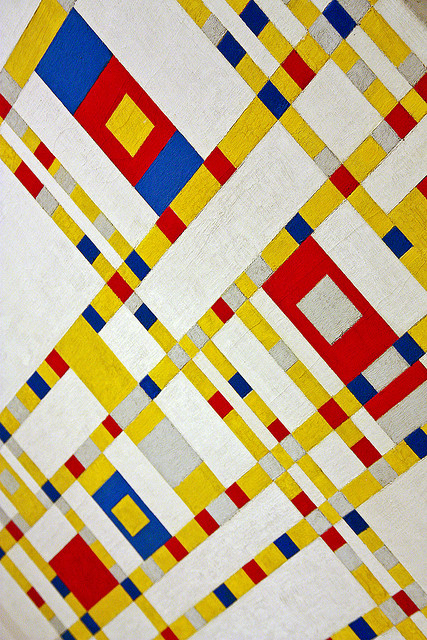
[F]or many art forms, it is indeed true that “anyone could do that”, in the sense that dish_mondrian2 anyone has the technology or technique to hand to execute the idea. It has become possible for more and more people, often untrained, to express their creative imagination as doing so has become less and less dependent on technical expertise. However, not everyone can have the ideas, the eye or the ear to come up with something worth making real. That core of invention remains elusive, beyond most of us most of the time. The best answer to the moan “I could have done that” remains “but you didn’t”. No one else came up with the geometric lines and block colours of Mondrian before he did, not because they lacked the skill, but because they lacked the vision. Technology and trends in art have not, therefore, made really good art more democratic, they have simply widened the membership of the elite.

(Close-up of Mondrian’s Broadway Boogie Woogie in MoMa by Tomás Fano)

The Sad Story Of Dr. V

Caleb Hannan’s Grantland profile of inventor Essay Anne Vanderbilt took an ugly turn when Vanderbilit committed suicide, causing many to blame the suicide on Hannan, who disclosed that Dr. V was transgender. My take on editor-in-chief Bill Simmons’ apology here. Christina Kahrl addresses the cavalier way in which Hannan dealt with the outing:

We’re here because Essay Anne Vanderbilt is dead. And she’s dead because — however loath she was to admit it — she was a member of a community for whom tragedy and loss are as regular as the sunrise, a minority for whom suicide attempts outpace the national average almost 26 times over, perhaps as high as 41 percent of all trans people. And because one of her responses to the fear of being outed as a transsexual woman to some of the people in her life — when it wasn’t even clear the story was ever going to run — was to immediately start talking and thinking about attempting suicide. Again.

It was not Grantland’s job to out Essay Anne Vanderbilt, but it was done, carelessly.

Not simply with the story’s posthumous publication; that kind of casual cruelty is weekly fare visited upon transgender murder victims in newspapers across the country. No, what Hannan apparently did was worse: Upon making the unavoidable discovery that Vanderbilt’s background didn’t stand up to scrutiny, he didn’t reassure her that her gender identity wasn’t germane to the broader problems he’d uncovered with her story. Rather, he provided this tidbit to one of the investors in her company in a gratuitous “gotcha” moment that reflects how little thought he’d given the matter. Maybe it was relevant for him to inform the investor that she wasn’t a physicist and probably didn’t work on the stealth bomber and probably also wasn’t a Vanderbilt cut from the same cloth as the original Commodore. But revealing her gender identity was ultimately as dangerous as it was thoughtless.

Dreher pushes back on the rush to blame Hannan:

Is Caleb Hannan morally responsible for Dr. V’s suicide? There’s no doubt that she would be alive today if he hadn’t begun writing the piece about her. But there’s also no doubt that Dr. V was happy to cooperate with the piece as long as she could control what was going to be written. She knew that the author was a golf nut and a fanboy of her invention. She also loved passing herself off as a mysterious genius. Trouble was, she couldn’t control the story, and once the reporter started digging, he found that the mysterious Dr. V was not at all who she said she was — and that her deceptions had victims. I think Hannan can’t be blamed for this mentally ill person’s suicide. He didn’t set out to take her down. He set out to write an admiring story about a reclusive genius who invented a new golf tool that stood to greatly improve the game. He had no idea, could not possibly have had any idea, where this story was going. When he found out her ultimate secret, how could he have kept it? She was happy to lie constantly when it suited her, and to steal, and to threaten, but when the journalist unraveled all her lies, she killed herself. And this is the journalist’s fault?

Josh Levin thinks the tragedy illustrates “the dangers of privileging fact-finding and the quest for a great story over compassion and humanity”:

I believe that “Dr. V’s Magical Putter” was a story worth telling, but this was not the right way to tell it. “What began as a story about a brilliant woman with a new invention had turned into the tale of a troubled man who had invented a new life for himself,” Hannan writes after describing Dr. V’s 2008 suicide attempt, at once revealing his ignorance about trans issues and his protagonist’s utility as a fascinating narrative arc. When you reread the story knowing that Essay Anne Vanderbilt is dead, the whole thing feels cold-hearted. … I don’t believe that Caleb Hannan and his editors were willfully callous. This is the kind of story, though, that breeds cynicism about journalists. It is a piece of writing that treats its subject as a series of plot points rather than a person, and that seems concerned with little else aside from propelling itself toward a dramatic conclusion.

A reader sounds off:

I found this tragic story and the coverage it has received compelling from day one. I have read all three articles on Grantland and other takes on the article and have been waiting for The Dish to weigh in. As someone who has an undergrad degree in journalism – I am actually a corporate writer now – and is almost half-way to a Master’s Degree in Marriage and Family Therapy, suicide is something I have reflected upon a lot as are journalistic ethics.

First, I find it extremely unfair to try and blame Hannan for Dr. V’s suicide. This was not her first attempt at suicide and more than likely would not have been her last if she never spoke to Hannan. It’s very likely that it was only a matter of time before she was approached by someone else. She told many lies for financial gain. She was deceiving her investors. She accepted the interview because – and I am assuming here – it would further promote her product and that would make her more money. Lies have a way of being discovered, especially lies told to many people.

Was the story insensitive to Dr. V? Absolutely. The story came off as more salacious than it needed to be and her gender changing should have never been included because it is irrelevant. That being said, suicide is a personal decision that an individual makes for his or herself. One person cannot compel another person to commit suicide. Hannan is no more responsible for her suicide than is her partner who is probably kicking herself for missing the warning signs. The only person responsible for Dr. V’s suicide is Dr. V.

Face Of The Day

US-WEATHER-SNOW

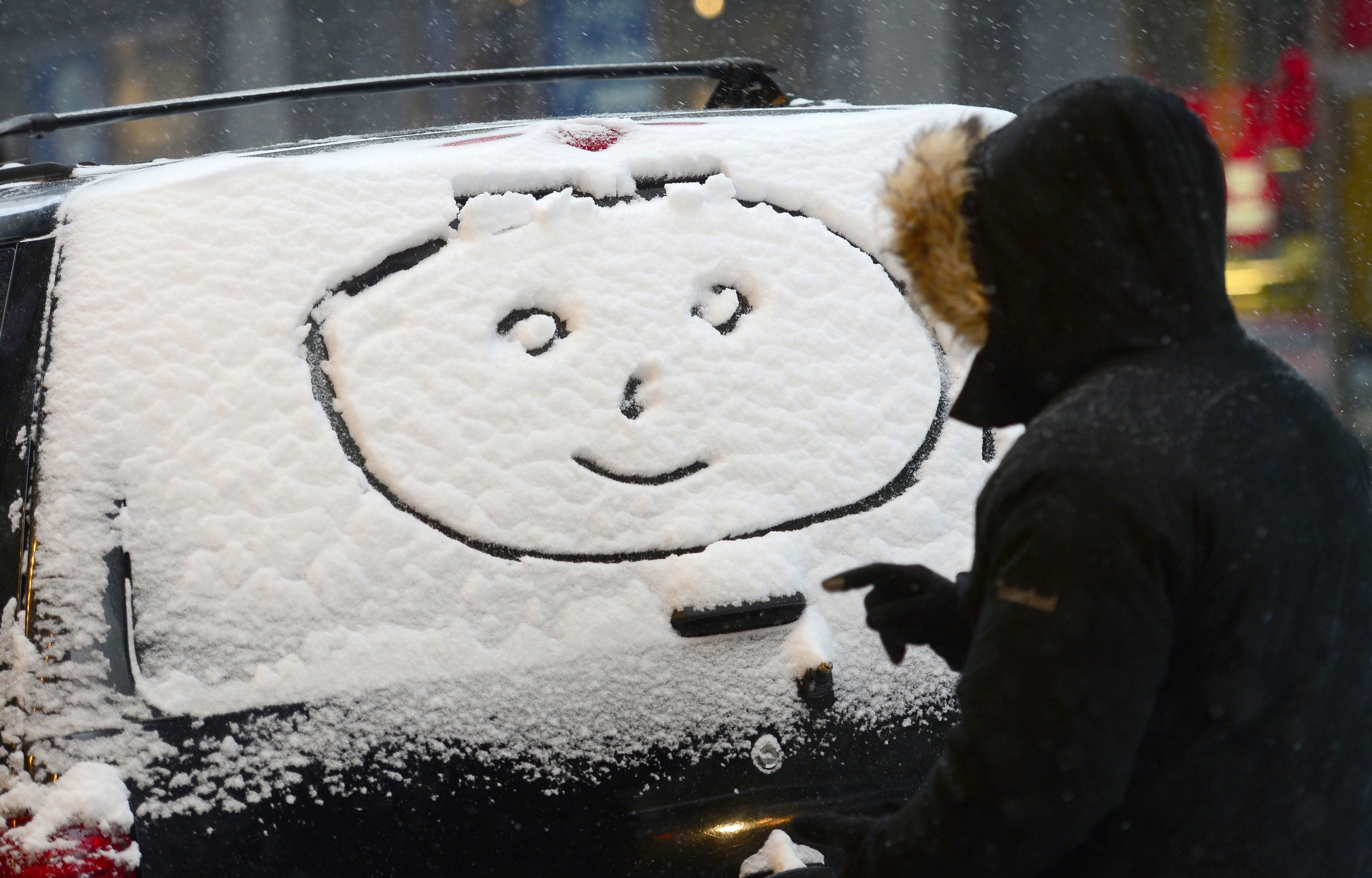
A person makes a happy face on a car window during a snow storm in New York City on January 21, 2014. In New York, a storm alert was issue for noon (1700 GMT) Tuesday to 6:00 am (1100 GMT) Wednesday with as much as a foot (30 centimeters) forecast for the metropolitan region. By Emmanuel Dunand/AFP/Getty Images.

An Olympic Embarrassment?

Leon Aron considers the challenges facing Sochi:

Putin’s expectations for a triumph may run into a stone wall of reality. Many are bracing for a disruption, even disaster. The Sochi games will be the first Winter Olympiad held in the subtropics and not unrelatedly, the gap between what has been needed by way of infrastructure and what was already available had never been as deep and wide. It is also beset with protest; it’s the first Olympics to be held in an area of mass expulsion of an indigenous people, whose descendants accuse Russia of genocide. Perhaps most hazardously of all, it is the first (and almost certainly the last) Olympiad to be held within a few hundred miles of a low-intensity but deadly jihad. Indeed, this is without a doubt the most precarious Olympiad ever attempted, for reasons of geography, climate and infrastructure—but also for the way the regime has chosen to address these challenges. Will Putin’s triumphalist narrative prevail? Maybe.