A Better Relationship With Iran

Post Election March

Walt imagines what it might produce:

When trying to make their case, in short, both sides tend to focus solely on the downside. But what about the potential benefits of a successful negotiation? To judge the pros and cons of diplomacy properly, we have to consider not just the downside of failure, but also the potential upside of success. And I don’t mean just the possibility of limiting Iran’s nuclear program (a desirable goal in itself), but also the more important possibility of putting U.S.-Iranian relations on a fundamentally different path (which is what AIPAC, et al are really worried about).

Among the potential benefits he outlines:

[I]f you’re not a fan of the clerical regime, you might want to consider killing it with kindness instead of bolstering it with belligerence. More than half of Iran’s population is under 35, and many are eager for better relations with the outside world (including the United States). Making it easier for Iranians to travel, get educated in the United States, and get exposed to the rest of the outside world will put those aging mullahs in a very awkward position. Have we learnt nothing from the failed Cuban embargo, which has helped keep the Castro Bros. in power for half a century? If we really believe in the transformative power of markets, Hollywood, hip-hop, the Internet, democracy, and free speech, let’s turn ‘em loose on Tehran. If your goal is a more moderate Iran, that approach is likely to work a lot better than ostracism, covert action, and repeated threats of military force, which merely galvanize Iranian nationalism and help justify continued repression by hardliners.

My view is that ignoring the positive potential of this engagement is a betrayal of the Green Revolution. And they do not deserve to be betrayed.

A Silver Age?

Edinburgh International Book Festival

I have to say it’s been amazing to see Washington get almost giddy about the Ezra Klein story. Well, maybe only Washington journalists … but, still. My basic take on the rise and rise of the super-blogs – from Nate Silver’s new enterprise at ESPN to our old friend Josh Marshall’s TPM to Kara Swisher and now Wonkblog – is here. All the stories about these ventures rightly take a wait-and-see approach as to whether we are witnessing a realignment in which those old big media companies accelerate their decline by being unable to accommodate their new media stars …  or whether these new ventures will eventually founder in a grim business climate for journalism. These new models may be evanescent or central to the future. We just don’t know yet.

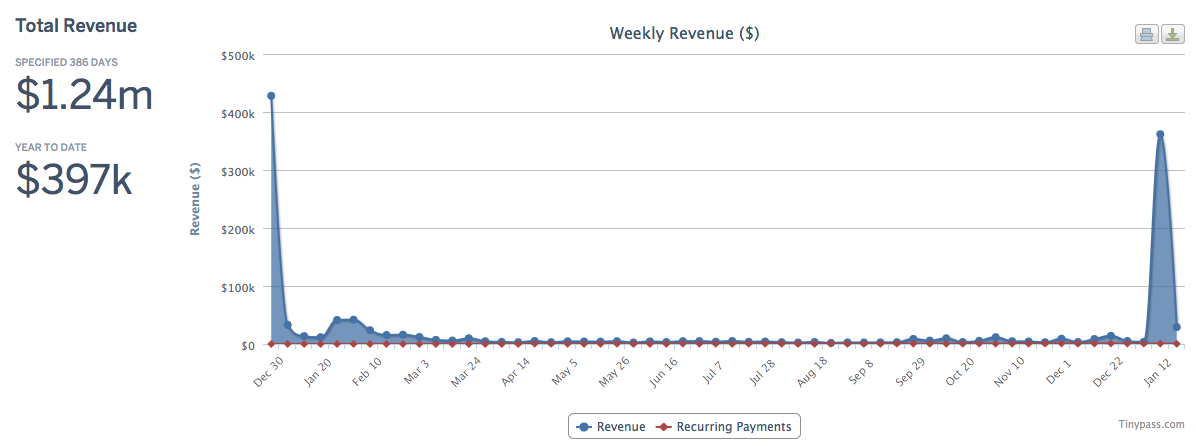
So here’s an update on the Dish’s progress in this new Nate Silver Age of media. Our crucial first year subscriptions all expire en masse in a couple of weeks. We currently have no other means of support, and have chosen to eschew investors and let this online community grow at its own pace and in its own organic way. Last year, as we jumped off the cliff, we got a one-off, staggering sum of $427,000 in the first week. Recouping that a year later was always going to be our biggest challenge as our little plane tried to reach cruising altitude.

So here’s the full graph of Dish gross revenues since we announced we were leaving the Beast:

Screen Shot 2014-01-22 at 11.32.03 AM

Those peaks tell it all. Since January 1 this year, we have raised almost $400K. On the one hand, that’s a long way from our total revenues of nearly $900K in 2013. On the other, we’re only three weeks in. Since subscriptions don’t actually expire for two more weeks, and since subscribers will still have their free read-ons for a while after that, we won’t really know till the end of March how the year is going to shake out. If we stall now, we’ll be in deep trouble. If you keep renewing, we’ll survive and even thrive. Whether this model works is entirely up to you at this point.

But here’s what’s really struck us after a year. The average subscription price we received from you last January was around $31. This year it is hovering around $37. So those readers who have already renewed have voluntarily increased the price. Ask yourself: how often does that happen in business? You offer something for sale at a certain price and the customer requests she pay almost double ($37 is damn close to twice the minimum of $19.99). I’ve never been a businessman, but, man, isn’t that unusual? And encouraging? Yes, we’re chuffed.

But not complacent. The downside is that the number of subscriptions is down considerably on last year. We are emphatically not out of the woods yet. Yes, we now have 19,000 auto-renewing subscribers. But we need many more if this model is to succeed without sponsored content or venture capital. It’s just one model for journalism in new media, and many others make sense as well. But it’s the simplest, clearest and most transparent there is. And you, the readers, play the critical part in this. You can decide to endorse this model and help sustain a fledgling new era in journalism. Or you can be a by-stander.

By my reckoning – over nearly 14 years – Dish readers are not the by-stander type.

Renew now! Renew here!

core-strength

Update from a reader:

I don’t mind at all your posts encouraging us to subscribe / re-subscribe. I LOVE the updates, where we get to chart how much you’ve earned. I disagree with your reader who suggested that your calls for subscriptions are advertorials or whatever. I WANT to see your number get to “900,000”, and it is enjoyable for me to see the “Dish Updates” with the numbers growing higher each time. If you want to install a real-time chart so that even when you’re reposting your calls for subscriptions we can see the very latest numbers, that would be cool but no biggie. As long as you keep me up on what’s going on.

We made that promise of transparency when we launched last January and we will keep it.

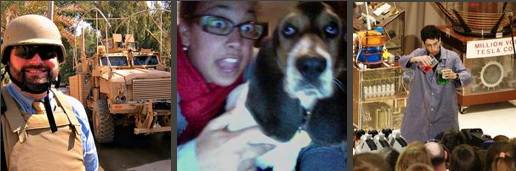
(Top photo: Nate Silver, American statistician, political forecaster and author of The Signal And The Noise, appears at a photocall prior to an event at the 30th Edinburgh International Book Festival, on August 13, 2013. By Jeremy Sutton-Hibbert/Getty Images. Bottom photos of Dish readers used with their permission.)

The Struggle For Syrian Peace, Ctd

The “Geneva II” Syrian peace talks got off to a rocky start today:

In his opening remarks, opposition leader Ahmed Jarba accused Syrian President Bashar al-Assad of war crimes, bringing up new evidence of torture investigated by three war crimes prosecutors, and demanded the government delegation agree to the “Geneva I” transition of power. Syrian Foreign Minister Walid Moallem accused the West of “pouring arms” into Syria and backing terrorism. He addressed U.S. Secretary of State John Kerry, who said Assad had lost legitimacy and that there could be no place for him in a transitional government, asserting, “No one, Mr. Kerry, has the right to withdraw legitimacy of the [Syrian] president other than the Syrians themselves.” U.N. Secretary General Ban Ki-Moon appealed to the warring parties to seize the opportunity to resolve their conflict.

The conference began with more than 30 international governments, but is expected to be followed by mediated talks between government and opposition representatives at the end of the week. Iranian President Hassan Rouhani, whose invite to the conference was withdrawn on Monday, said the peace talks were unlikely to succeed due to the lack of influential players at the meeting.

Given the fragmentation of the opposition, William Mccants and Jomana Qaddour are not optimistic:

After almost three years of brutal warfare, the Syrian ‘opposition’ is an alphabet soup of internally warring and ideologically polarized political and military forces: the National Coalition of Syrian Revolutionary and Opposition Forces (SOC), the al Qaeda-affiliated Islamic State of Iraq and Syria (ISIS), the Islamic Front, and numerous other independent battalions. The Syria-based Islamic Front has dismissed the talks (ISIS rejects power-sharing even for a transitional period, and thus rejects the conference in its entirety), and only the Turkey-based SOC has agreed to participate after a contentious vote that a third of its 119 members boycotted.

Even in the unlikely event that a political settlement emerges from the Geneva conference, there is no guarantee that the SOC can effectively negotiate and implement the agreement on behalf of the Syrian opposition in Syria due to the dwindling power of the Free Syrian Army (FSA).

Joshua Landis points out that Assad is negotiating from a position of strength:

The regime’s resilience is based, first and foremost, on the Syrian Army. Without its loyalty, Assad would likely have fallen as quickly as did Tunisia’s President Zine El Abidine Ben Ali and Egypt’s President Hosni Mubarak in 2011. But while many soldiers and officers did join the rebellion, most did so as individuals; few entire units defected and no entire divisions did. Structurally, the military held together, and it was able to replenish its ranks through intensive recruitment among the Alawite minority, where many are loyal to the regime and still more live in mortal fear of sectarian retribution at the hands of the Sunni-led armed rebellion. The same factors allowed the military to expand its capabilities through the paramilitary Popular Committees, often called shabiha. And it has also been able to enlist the support in critical battles of units of the Shia Hezbollah militia from neighboring Lebanon, whose leaders recognize that their own military fortunes depend on maintaining the re-supply lines that the Assad regime has long provided.

Stewart M. Patrick also doubts that the talks will succeed:

[T]he most likely diplomatic outcomes of this long awaited “peace conference” are likely to be pretty thin gruel. Even with the Iranian spoilers relegated to the sidelines, “Geneva II” is unlikely to see any major breakthroughs. At best, the summit will mark another phase in a protracted negotiating process that may continue for years, unless circumstances on the battlefield result in a clear victory for one side.

The Dish previewed the talks yesterday.

History Can Still Be Made

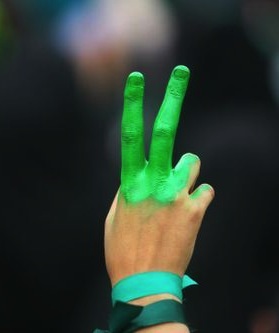
Earlier this week, Iran suspended its activities on its nuclear program, in accordance with an agreement reached with six great powers – the US, Russia, China, Britain, Germany, and France. And you could have heard a pin drop in the American public discourse in the face of this remarkable turn of events. And that is a bizarre thing.  For the constellation that came together these past twelve months is unlikely to happen ever again. All the major world powers – including Russia and China and the US – are in agreement. The Iranian regime and – most significantly – the Iranian people want a deal that would both restrain Iran’s nuclear capacities to civilian purposes green-peaceand slowly pry open its economy after brutal sanctions have close to extinguished it. A huge amount still needs to be figured out and it will be a formidable task of negotiation to move forward. It may all come to nothing. But surely, surely, it’s worth giving diplomacy a chance.
Why? For my part, it’s for the Iranian people, and global security. Neoconservatives portray their position against any agreement as one of solidarity with the Iranian people against their regime. And I’m sure that’s a genuine as well as admirable motive. But aren’t they engaging in a classic bit of ideological projection? In so far as we can tell anything about the views of the actual Iranian people – especially its younger and more educated generation – it is that they overwhelmingly want both a peaceful civilian nuclear program (in part as a matter of national pride) and re-engagement with the wider world, including the West. So the neocons are in fact either acting against the interests of the Iranian people, or accusing them of false consciousness. Neither seems to me the right response to this moment.

It’s also an ineluctable fact that Iran has acquired the intellectual and material infrastructure to become a nuclear military power if it wants to at any point in the foreseeable future. Let me repeat that: Iran’s potential as a nuclear military power is a fact. The time to prevent that would have been the Bush-Cheney years; but we tragically chose to pursue the control of imaginary weapons of mass destruction in Iraq instead. So the proximate actual choice we have with a regime with a disgusting record of internal repression and a nuclear potential is a) negotiating an internationally-monitored civilian nuclear program with strong inspections, b) a pre-emptive war with unknowable consequences to delay (but not end) the regime’s potential for a viable nuclear weapons program, or c) resume the Cold War stand-off, increase sanctions some more, destroy their economy and contain their military power.

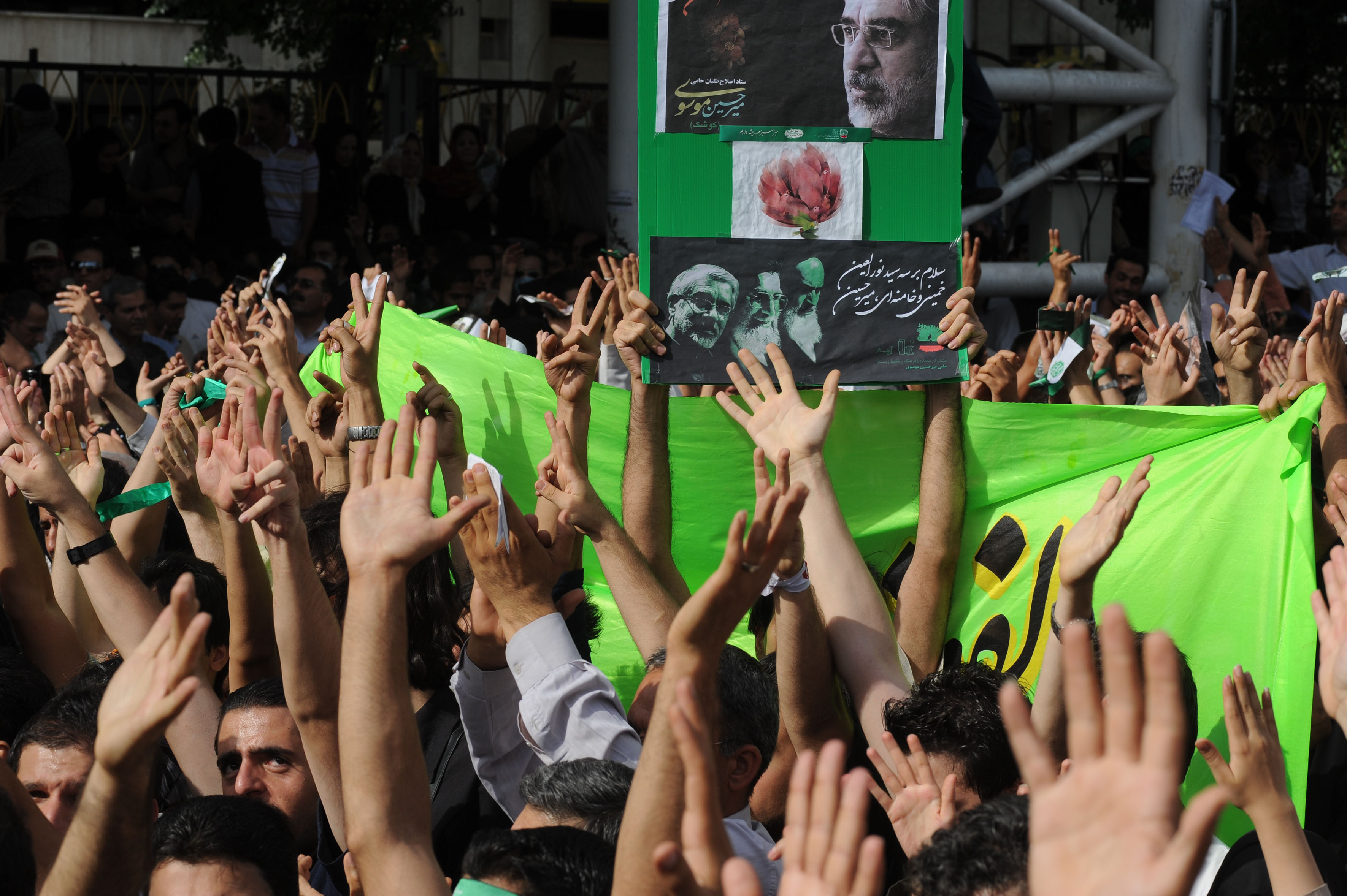
For a long time, I thought c) was probably the least worst, realistic option. That view was entrenched during the Green Revolution. To see such hope and positive energy crushed by merciless regime thugs was a sober reminder of the forces we are dealing with. But here’s the thing: the Iranian people did not despair. Hemmed in by rigged, approved political candidates, they nonetheless voted in 2009 for a clear shift back toward the West and then in 2012 for the most pro-Western candidates there were. The Iranian people told us that engagement – and not continued polarization – was the answer they wanted. This movement – combined with the effect of, yes, “crippling” sanctions – brought the Iranian leadership to the backrooms of diplomacy. It was a perfect constructive storm.

This is where we are. It is not an ideal situation – but after the catastrophe of the Bush-Cheney years in foreign policy, we have no ideal situations. But it is also not the worst situation.

It’s an extraordinary victory, in many ways, for pro-Western forces in the Middle East. A hugely important country – America’s natural ally in the region – is a hotbed of democratic activism and pro-American sentiment among many of its people. That country has declared that it will never use nuclear weapons and, unlike nuclear-armed Israel, is a member of the Non-Proliferation Treaty. Its newly elected government, backed by the theocratic Supreme Leader, openly says it wants to entrench a nuclear-weapon-free Iran in an international agreement. In return, it’s asking for relaxation of sanctions that would allow its economy to grow. And that growth would redound to the credit of the reformers, and perhaps begin a slow thawing of the regime itself.

These moments do not come often in human history. I remain of the view that the greatest single threat to our civilization is the combination of religious extremism with weapons of mass destruction. If we can reliably ensure that the biggest Shiite power does not seek to build or use nuclear weapons and retain that commitment over time, we have made a huge stride toward reducing the greatest danger we face, in the wake of 9/11. The Obama administration has already – by design or accident – managed to secure and begun to dismantle another major global WMD danger in Syria. To get an inspections regime in place to do the same for Iran would be a historic gain for global security in the most volatile region on the planet.

A deal would help Iran’s moderates; it would be a real achievement in a new global partnership between the major world powers; it is our only hope to keep Iran’s actual nuclear capacities restrained to civilian use without a full-scale war; its economic benefits would accrue to the regime – but also, critically, to the moderate path the Iranian people have chosen – in the face of bullets and torture and terror – for the last several years.

Let’s re-appraise the value of this moment, and not let it pass into the ether, because of fear or paranoia or habit, or fail to grasp the full extent of the advance that is now possible. And those Senators actively backing the American sabotage of the process should take a deep breath, put AIPAC on hold, and let diplomacy take its course. This is history. It deserves more than the politics of a domestic lobby. It deserves statesmanship. And prudence. And patience. And time.

What’s Next For The Religious Right?

According to Damon Linker, the religious right is “finished” and its remaining followers “have been reduced to playing defense.” He asks, “What will come next for these voters, now that the original religious right is fading out?”:

The first and most likely development is one that’s already underway: A stepping back from national ambitions across a range of issues to a narrower emphasis on state-level initiatives that restrict access to abortion. This is a shrewd move, politically speaking. Thanks to advances in ultrasound technology, public opinion on abortion is likely to remain deeply conflicted, with strong support for reproductive freedom coupled with a strong moral aversion to both late-term abortions and the termination of pregnancies for what many judge to be frivolous reasons.

The focus on passing legislation in conservative-leaning states, meanwhile, allows the remnants of the religious right to maximize the impact of their limited resources. The end result, at least in the short-to-medium term, is likely to be greater ideological polarization across the country, with abortion harder than ever to procure in some states and others proudly trumpeting their absolute commitment to reproductive freedom.

Another possibility he entertains is that “the next generation of religious conservatives will take a different path, withdrawing from politics altogether”:

There is already some evidence that younger religious conservatives are more inclined than their parents to look with suspicion on politicized faith. If this inclination persists, perhaps further encouraged by increasing disappointment with the available political alternatives in the United States, it could drive religiously devout conservatives away from activist engagement entirely.

African-Americans And Prohibition Of Weed, Ctd

A Medical Marijuana Operation In Colorado Run By Kristi Kelly, Co-Founder Of Good Meds Network

A reader quotes me:

So one of the most powerful arguments for legalization of marijuana – that Prohibition grotesquely singles out African-Americans for criminal enforcement and spares whites – carries no more weight among African-Americans than it does among whites. Of those African-Americans who feel strongly about the subject, 40 percent oppose legalization and only 32 percent support it. Overall, there’s no statistically significant difference between whites and blacks on this. I’d be fascinated to hear from readers why they think this might be so. It seems on the surface that social conservatism is outweighing civil rights. But I’m genuinely baffled.

The answer to your question is that African-American marijuana users aren’t being arrested at higher levels. African-Americans in general are being arrested at higher level for everything then their white counterparts. The weed is just along for the ride. We understand this, so that argument doesn’t hold as much sway as it could.

That reader is echoed by another with a “perspective as a public defender”:

I think that people in the African American community see the different treatment of blacks and whites vis a vis marijuana enforcement as a symptom, and not a cause, of deep-seated racism in the criminal justice system.

That’s the kind of thing my confirmation biases can blind me to. Which is why I love my job. Another reader with expertise on the subject:

I co-founded the grassroots nonprofit now leading legalization in Rhode Island. You’ve addressed the most unasked question in the legalization debate, but it only demonstrates the complete tone deafness of white people like you who have their heart in the right place but don’t fully appreciate the wider racial dynamics of prohibition. As my colleagues said after observing the sea of white at a major drug policy reform conference: “If these guys are trying to save black people, why can’t they bring any of them to their conferences?” The partial answer is the indefatigable pride and resilience in communities of color we’ve worked with. I encourage you to approach an elderly, church-going woman of color who’s seen her neighborhood destroyed by drugs. Try shooting the shit about legalizing weed and see how far you get.

But the second answer reveals one of the paradoxes of legalization.

In this country, the archetypal divide for social change is between activists who feel an acute, moral zeal, and the rest of us whose allegiance lies with pragmatism and decide from the sidelines. But legalization completely inverts this rule: because there is such an enormous long-term price tag attached to reform, the open secret in legalization circles is that the types of activists it attracts tend to think of themselves as pragmatic, forward thinking businesspeople getting in on the ground floor of a major industry – not really as moral crusaders. Meanwhile, the moral case for marijuana comes less from its activists than observers and commentators, often in journalism, like you.

Thus your “bafflement,” like most sympathetic white people, is pretty common. The irony will be that that the people unharmed by prohibition were the only ones privileged enough to lobby against it. It raises the Faustian question: given the eventual multi-billion dollar windfall, how much lower would black support actually need to be before white invocation of their plight was exploitative? As has so often been the case in this country, the outcome of finally rectifying long overdo injustice will be black people moving out of prison, and white people (in this case, overwhelmingly men) moving out of their tax bracket. I guess that’s the price of change.

Another reader:

I will keep shouting this from the rooftops until somebody listens but “Black people are conservative!”. This applies not just to African-Americans but all of our diaspora. I’m Nigerian and we are some of the most homophobic, biblical literalist, anti-drug people on the planet.

As it relates to drugs and the Af-Am experience, one has to remember the deleterious affect that drugs had on the community (see the crack epidemic). Many older AA (over 55) would never fathom drug use since it’s a highway, in their minds, to brokenness, incarceration and a slew of other ills. Also, many older Black people see drugs as something white people do that’s been introduced to us to keep us down.

Most AA are live-and-let-live libertarian types on some matters, but by and large the older set really don’t get this new liberalism amongst the younger set.  I’m sure if you tease out the younger AA cohort on the data you will see a fairly prominent divide. My Gen-X AA contemporaries fall into two camps weed legalization: “meh, not for me but let’s tax it” and “more fiya!”

Another:

For lower-income families, an addiction to drugs or alcohol, an illness, a pregnancy, etc. can have far more devastating effects than for wealthier people. So it would make sense if there was a stronger sense of social conservatism there. Leave aside that not going to jail is better for the families than going to jail. It might be a more general ethic of “don’t screw up, be safe, etc.”  The consequences are more severe. If on the whole, the African-American population has more lower-income families, you might have a greater number of those who oppose.

(Photo: Matthew Staver for the Washington Post via Getty Images)

Outsourcing Injustice

Jon Fasman calls private probation an extortion racket:

It works like this: say you get a $200 speeding ticket, and you don’t have the money to pay it. You are placed on probation, and for a monthly supervisory fee you can pay the fine off in instalments over the course of your probation term. The devil, as ever, is in the details, as a great Sunday story from the Atlanta Journal Constitution makes clear. Those supervisory fees vary markedly: in Cobb County, for instance, just north of Atlanta, the government charges a $22 monthly fee. Private companies charge $39, and often add extra costs on top of that to cover drug testing, electronic monitoring and even classes they decide offenders need. Fees often rise and even multiply when probationers cannot pay—and remember, these are people, for the most part, who could not come up with a hundred bucks and change to pay the initial fee; you have to expect they’ll have some trouble paying.

Even worse, people who fail to pay the fines imposed by these private companies can find warrants for their arrests sworn out and the period of their probation extended. I spoke with an attorney for a couple in Alabama who say they were threatened with Tasers and the removal of their children if they did not pay the company what they owed. In 2012 a court found that the fees levied by private-probation companies in Harpersville, Alabama, could turn a $200 fine and a year’s probation into $2,100 in fees and fines stretched over 41 months. A judge in Richmond and Columbia counties ruled such probation extensions illegal last autumn.

Drum adds:

Isn’t that great? It’s the free market at work, all right. It reminds me of last year’s piece in the Washington Post about the privatization of the debt collection in Washington DC[.] … You may remember this as the story of the 76-year-old man struggling with dementia who was thrown out on the street and had his house seized because of a mix-up over a $134 property tax bill.

Toward A Smaller, Smarter Army

A short history of US military spending:

Gordon Lubold looks at the consequences of downsizing:

The Army has long been criticized for being too big and lumbering – qualities that perhaps suited it all right for the conventional land wars of the past decade. Calls for a lighter, nimbler one haven’t made huge impacts yet on the institution. But aside from the conventional threats in the Asia Pacific like China, most people argue that in this budgetary environment, there are few reasons to have a large, sitting Army that topped about 570,000 just a few years ago. And an Army sized at 420,000 soldiers is not exactly skeletal. In fact, it’s roughly the size of the pre-war Army in 2000. And cutting it back isn’t anything like the hundreds of thousands of forces cut in the early 1990s.

A smaller force may have an impact on one of the Army’s cherished new concepts:

regionalized brigades. The idea is to give soldiers assigned to a brigade basic language and cultural skills for a certain region. Although the brigades are not assigned to a specific part of the world, they are theoretically “on the step” to deploy there — most typically in smaller, platoon- and company-sized units — for training and advising or potentially more “kinetic” missions. It’s an ambitious approach and one not without its critics. But for example, the Army has begun using the Army’s 2-1 brigade combat team as one of the first ones trained and ready to deploy to Africa. “I think what we want to make sure is that they’re much more culturally attuned to the area they’re going to,” an Army official working on the initiative, told Foreign Policy’s Situation Report last year. “I think that is an important part, and it’s certainly something that 12 years of operations in Iraq and Afghanistan has highlighted to us, that you’ve got to understand the culture within which you operate. If you don’t, it does come with potentially cataclysmic problems.”

The Will To Work Out

It may be genetic:

To a certain kind of sports fan—the sort with a Ph.D. in physiology—Olga Kotelko is just about the most interesting athlete in the world. A track and field amateur from Vancouver, Canada, Kotelko has no peer when it comes to the javelin, the long jump, and the 100-meter dash (to name just a few of the 11 events she has competed in avidly for 18 years). And that’s only partly because peers in her age bracket tend overwhelmingly to avoid athletic throwing and jumping events. Kotelko, you see, is 94 years old.

Scientists want to know what’s different about Olga Kotelko. Many people assume she simply won the genetic lottery—end of story. But in some ways that appears not to be true. Some athletes carry genetic variants that make them highly “trainable,” acutely responsive to aerobic exercise. Kotelko doesn’t have many of them. Some people have genes that let them lose weight easily on a workout regime. Kotelko doesn’t.

Olga’s DNA instead may help her out in a subtler way. There’s increasing evidence that the will to work out is partly genetically determined. It’s an advantage that could help explain the apparently Mars/Venus difference between people for whom exercise is pleasure—the Olga Kotelkos of the world—and the couch potatoes among us for whom it’s torture.

The Polls Of The Past

HistOpinion

Rebecca Onion profiles @HistOpinion, a Twitter account that tweets the results of public opinion surveys conducted more than 70 years ago:

The volume that supplies source material for the tweets is Public Opinion, 1935-1946, by Princeton psychologist Hadley Cantril. Cantril was a pioneer in the field of public opinion research, which took off in the mid-1930s after pollsters George Gallup, Elmo Roper, and Archibald Crossley successfully predicted FDR’s victory using statistical sampling in 1936. From his perch at Princeton, Cantril adapted these new methods for academic purposes, and advised presidents including FDR and Eisenhower. (Cantril also authored the first study of the Orson Welles War of the Worlds “panic” of 1938.) Public Opinion compiles data from 23 polling organizations around the world, with results coming from Hungary, France, Germany, Denmark, Sweden, Australia, and Britain, as well as the U.S. Shulman is working his way through the volume, selecting the most surprising, intriguing, or unusual responses to share on the Twitter feed.