Animals get to work on their New Year’s resolution:
Author: Andrew Sullivan
Where Are All The Black Atheists? Ctd
Another reader can relate to the thread:
I identify with your reader’s point that being a black atheist can be leave one feeling an outsider, particularly in social situations where people have a tendency to attribute life’s ups and down to “his will.” However, I wonder about him attributing his lack of black friends to his atheism. I am a black atheist from a Catholic family, but being raised in a largely segregated black community (Chicago), I am very familiar with the conventional black church. Though I don’t believe in God myself, I do understand and appreciate to role of the church and religion historically played in the lives of my people – but I am also wary about its influence.
Ironically, I came to atheism through my acceptance of conservatism, beginning in my senior year of high school and solidified as an undergraduate at Howard University. Specifically, I rejected a belief in God in conjunction with my rejection of the traditional civil rights style of politics. After numerous debates with classmates who came from a very church-grounded liberal politics, I found the notion of a “loving” god who allowed so many to suffer unbelievable. Because I believed there was no god, I must take care and do for myself, with no expectation of help. I was tired of my people believing “God will provide” and “He will save us,” which I felt generated the same sort of feeling about government help. Thus, I became a supporter of personal responsibility and free markets, culminating in me voting for GWB in my first presidential election.
Graduate school, maturity, and observation of bigotry and incompetence within Republican governance have moderated my politics substantially, but I’ve maintained the atheism.
The Wealth Chasm
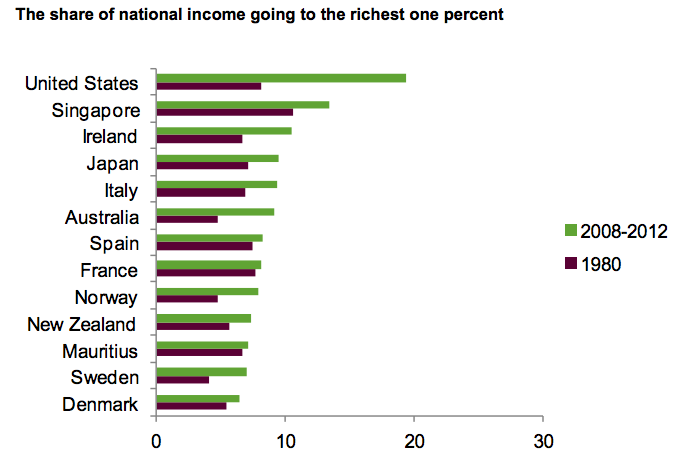
A new report (pdf) from Oxfam, issued just in time for Davos, reveals that the richest 85 people in the world own as much wealth as the poorest 3.5 billion. Will Oremus comments:
If there’s one kernel of hope—not mentioned in the Oxfam report, as far as I can tell—it’s that inequality between countries may be easing slightly (though it’s hard to tell for sure). On a country-by-country basis, though, the filthy rich have only been getting richer. Between 1980 and 2012, the wealthiest 1 percent increased their share of the spoils in 24 of the 26 countries Oxfam surveyed. This includes the United States, where the wealthiest 1 percent have captured 95 percent of all economic growth since the financial crisis of 2009, while the bottom 90 percent have gotten poorer.
Oxfam’s concern is not just that half the world’s population could be bought and sold by a group of individuals who could fit in a single large boardroom. It’s that this staggering disparity creates a vicious cycle.
Pethokoukis calls the report misleading:
Oxfam’s analysis is problematic.
First, does Oxfam’s simplistic narrative of crony capitalism tell the economic story of the past three decades better than the 80% decline in extreme poverty? And why exactly are there 250 million fewer extremely poor people in the world today? As economist Deirdre McCloskey puts it, “The Big Economic Story of our own times is that the Chinese in 1978 and then the Indians in 1991 adopted liberal ideas in the economy … And then China and India exploded in economic growth.”
Derek Thompson adds:
The rise in wealth inequality isn’t a measure of the poor getting poorer. It’s a measure of the rich getting fantastically richer thanks to the cascading benefits of privilege and the tremendous growth in stock wealth in the last decade. (Even in the U.S., 75 percent of household wealth is held by the richest 5 percent.)
Brian Merchant links rising inequality to automation:
Two hugely important statistics concerning the future of employment as we know it made waves recently:
1. 85 people alone command as much wealth as the poorest half of the world.
2. 47 percent of the world’s currently existing jobs are likely to be automated over the next two decades.
Combined, those two stats portend a quickly-exacerbating dystopia. As more and more automated machinery (robots, if you like) are brought in to generate efficiency gains for companies, more and more jobs will be displaced, and more and more income will accumulate higher up the corporate ladder. The inequality gulf will widen as jobs grow permanently scarce—there are only so many service sector jobs to replace manufacturing ones as it is—and the latest wave of automation will hijack not just factory workers but accountants, telemarketers, and real estate agents.
Kevin D. Williamson claims that liberals don’t actually want to do anything about global inequality:
What can we do about the situation of the global poor? We could seize all of the wealth of those 85 super-rich people whose portfolios so fascinate the Los Angeles Times, which would have the effect of raising the average wealth of the world’s poor from about $485 to about $970 — not exactly a solution.
The only way to help the world’s poor to a position of relative prosperity and economic independence is to help them to participate in the global economy, and here our progressive friends take a damned-if-you-do/damned-if-you-don’t approach. They’re scandalized by the scanty assets of the world’s poor, and they’re even more scandalized when rich countries open their markets to the global poor, or when companies from rich countries invest in poor countries and employ the poor people residing therein. The Democrats refer to Americans who do business with the global poor as “economic traitors,” and their most recent national convention was an energetic pageant of xenophobia, replete with ritualistic denunciations of the Yellow Peril come to steal our jobs.
Casey N. Cep points out that chances are, “if you read the report, then you are part of the problem”:
It will always be easier to rage against the one percent than to scrutinize our own wealth. Last week, I shook my fist at the Oxfam report while drinking a chai latte with the other, then emailed a friend from my iPhone to rant about those 85 moguls who own half the world. Trouble is, I’m a mogul in my own life: the iPhone is newer than it needs to be, I ate out twice last week, and I saw a movie the other day because it’s Oscar season. Yes, I have debts and I can’t even see the super-rich from my rung of America’s income brackets, but there are still more than a few luxuries in my life. I like to think they’re essentials, but like almost everyone, I have a talent for rationalizing my spending.
When Peter Singer writes that 19,000 children die every single day because of preventable, poverty-related causes, he’s not blaming their deaths on 85 individuals or a single percent of the world’s population: he’s blaming the rest of us, too. The rich might be able to do more, but we can all do something. Mammon isn’t just a mistress for the rich, but a companion for us all, whatever our percent.
China’s Dirtiest Export
Smog:
You can offshore manufacturing, but a new study shows that doing so doesn’t mean you’ll fully
escape the pollution. … According to this study, published in Proceedings of the National Academy of Sciences, up to one quarter of sulfate pollution on the West Coast can be traced back to Chinese factories making goods for export. Overall, pollution being dragged across the Pacific by the wind is responsible for Los Angeles experiencing one additional day each year where smog exceeds federal ozone limits. Smaller amounts of black carbon pollution, a significant component of both climate change and unhealthy air quality, also reaches the west coast of North America.
Previous research, conducted by the US Department of Energy, found that one third of airborne lead particles in the San Francisco Bay area could be traced to pollution originating in Asia.
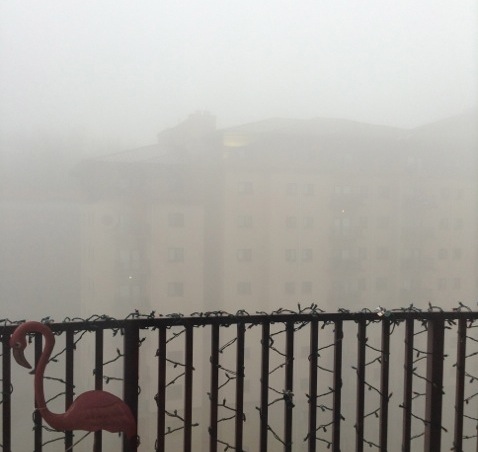
A reader sent the above photo last month:
It’s from Pyoengtaek, South Korea (about 60 miles south of Seoul). Thanks, Chinese pollution! See here for a related article on the problem.
Sydney Brownstone has more:
That pollution definitely translates to a health impact on American citizens, says the study’s co-author, University of California-Davis earth scientist Steve Davis. Still, he points out a small conundrum. “If you imagine we tried to make these things at home, rather than having them made for us in China, that manufacturing would happen on the East Coast. So air quality on the East Coast would suffer, but the West Coast would improve because we wouldn’t have this Chinese pollution blowing over.” Homegrown manufacturing, however, would likely create a net environmental benefit. “In terms of global pollution, for every widget that is made in the U.S., there is less pollution than that widget made in China,” Davis said. “They have less controls and technologies in place at this point.”
Keating notes that viewed another way, China has imported much more pollution from the US than it sends back:
This is one area where China may have something of a point when it comes to culpability for emissions. China’s pollution isn’t solely of its own doing. They’re tied to an export economy making goods for other countries, the U.S. most of all. America’s emissions are lower partially because China’s are higher. Viewed a different way, this is not so much a question of “China’s smog” reaching America as the vast majority of smog from the manufacture of American goods staying in China. Of course, as China’s economy continues to shift from export to consumption, this equation is going to change.
The Republican Resistance To Reform
Beutler compares the contemporary GOP to the pre-Clinton Democratic party:
Maybe a third defeat, in 2016, will catalyze a more rapid transition. But over time, I think the important differences between the Democrats’ old challenge and the challenge Republicans now face have started to show.
Democrats didn’t have an easy go of it, exactly, but they were able to modify their positions across a range of issues without, for instance, creating a left-wing-primary perpetual motion machine, or giving rise to a permanent population of resentful protest voters. Maybe Republicans can do the same. But the 2013 experience suggests they are so in hock to aging, white, conservative reactionaries that taking on new debts with minorities, gay people, single women and so on entails the risk of defaulting on the old ones.
Regardless, the GOP could win in 2016:
It is far too early to do a formal forecast for 2016. The economic and political conditions in that year will be paramount. But given that at least some in the GOP appear pessimistic as of today, it’s worth asking: If economic and political conditions in 2016 were the same as they are today, what would happen? So assume that Obama’s approval rating is about 41 percent. Assume that GDP has grown 1.6 percent in the first two quarters of 2016. And, of course, no incumbent will be running.
Based on those assumptions, the model predicts that the Republican Party has a 64 percent chance of winning the presidency. That is far from 100 percent, of course. At the same time, it doesn’t suggest much cause for GOP pessimism in January 2014 — maybe even some Democratic pessimism, in fact.
Should Republicans retake the White House, Chait predicts that they will ditch austerity:
Liberating themselves from austerity will allow them to back away from their brutal campaign of confiscating food stamps, Pell grants, and low-income tax credits, and still hand out tax cuts for the 1 percent. Tax cuts for one and all! That, after all, was the Bush formula: small elements of programmatic reform for low-income workers, stapled onto the agenda of The Wall Street Journal editorial page, all costs deferred.
A Republican Party that reprises the Bush era was a grim and unfathomable prospect in 2008, and is not exactly palatable now. But in the wake of the party’s thrall to Ayn Rand and Rand Paul and Paul Ryan, a return to Bushism sounds almost comforting.
The Impunity Of America’s Torturers
Another day, another act of cowardice and denial.
Chart Of The Day
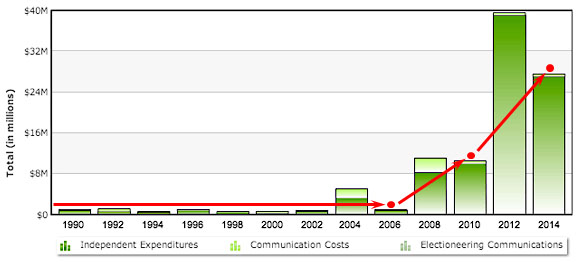
Drum looks at what Citizens United has unleashed:
The chart [above], based on data from Open Secrets, shows spending on midterm elections through January 21 in order to get a clean comparison of 2014 with previous election years.
Up through 2006, outside spending at this point in the election cycle had been flat for years at a very low level. In 2010, we were on an upward trajectory even before the Citizens United decision was handed down. And 2014? With Citizens United now in full operation, the sluice gates have opened wide. Outside spending is 25 times higher than it was at this point in 2006. Welcome to the future of American elections.
Meanwhile, Seth Masket studies publicly financed campaigns. One drawback to them:
Miller and I, along with Andrew Hall, have found some preliminary evidence that public financing contributes to partisan polarization. The method by which this occurs is not completely clear, but it appears that when we open up elections to a wider range of candidates, the candidates who take advantage of this tend to be more ideologically extreme than those who rise up through traditional financing schemes. Party donors don’t get to filter out candidates the way they normally do. My guess is that this outcome is not what most backers of public financing initially hoped for.
The Uninsured Aren’t Signing Up?
Last week the WSJ reported that “the majority of the 2.2 million people who sought to enroll in private insurance through new marketplaces through Dec. 28 were previously covered elsewhere.” Laszewski responds:
If this continues, people will be asking a very big question come election day:
While we needed to do health insurance reform, why did we have to do it in a way that so disrupted the existing individual and small group market if the people it was supposed to benefit, the uninsured, weren’t going to buying it?
McArdle thinks these numbers could indicate two things:
First, would-be applicants may simply be waiting until March. They’ve gone without insurance a long time; why not wait a few more months and save on premiums? The second possibility is more troubling:
There may be something seriously wrong with our understanding of who the uninsured are, and what they are willing and able to buy in the way of insurance. I don’t know exactly what the fault may be in our understanding. But if the numbers stay this low, I’d say we need to reassess the state of our knowledge about the uninsured — and the vast program we created to cover them.
Sprung looks on the bright side:
1) It is perhaps not that surprising that those accustomed to shopping for insurance would be quicker to buy on the exchanges.
2) According to HHS, 79% of those enrolled in exchange plans so far qualified for subsidies. It does seem surprising that a high percentage of those buyers were already able to afford insurance on the individual market. Perhaps current signups, at least those coming from the indvidual market, lean toward the higher end of the subsidy scale, say 200-400% of the Federal Poverty Level.
3) Weaver and Mathews emphasize insurers’ worries that they’re not getting new customers so much as churned existing ones. On the other hand, the already-insured are likelier to be healthier than the uninsured, perhaps easing worries that the early risk pool will skew too sick.
He later questions the validity of the research the WSJ relies on. Suderman’s view:
Given the fuzziness of the data, it’s still hard to tell exactly what’s happening. And even if it’s true that there are no more uninsured now than there were last year, there’s still time for that to change. As the administration is keen to remind us, people who want coverage have until the end of March to sign up for coverage this year. But even still, this doesn’t exactly bode well for Obamacare’s future. Certainly, the law isn’t off to the kind of start that the administration hoped for, or promised.
Tyler Cowen’s two cents:
I would emphasize that we still don’t really know quite what is going on here. But the view that everything is now in the clear simply is not warranted by the available evidence.
Beards Of The Week
The Canadian bobsled team, sent by a reader:
Double checking our race weight for the 4man Sunday @CDNOlympicTeam #whateverittakes @McNaughtonJames @TimRandall86 pic.twitter.com/7t9fcCYHV7
— Justin Kripps (@justinkripps) January 17, 2014
“A Lot Of Sliding Toward Undecided”
Noam Scheiber doubts media-bashing will work for Chris Christie’s comeback campaign:
[A]s satisfying as it may feel in the moment, media-bashing has a rather poor track record of papering over candidates’ ideological heresies. Just ask those august GOP nominees, Newt Gingrich (global warming, immigration, chronic bride-shopping) and Rudy Giuliani (gay marriage, abortion, gun control). The seams invariably show, especially since the media-bashers tend to be pols who’ve basked in a fair amount of media adulation at various points in their careers. Sooner or later, Republican voters tend to notice that the anti-media fulminating is suspiciously timed to deflect the most damning questions.
That’s not to say media-bashing can’t work—it clearly has on occasion. But the only reliable formula is when the infraction that kindled the media firestorm in the first place attests to one’s conservative credentials. Say, when Sarah Palin accuses the Democratic nominee for president of palling around with terrorists, then blames the resulting uproar on media bias. Or, to pick the more relevant example of a moderate trying to gin up conservative support, when Rudy Giuliani questions whether waterboarding is in fact torture, accuses Democrats of refusing to use the term “Islamic terrorist” out of misplaced political correctness, or trims the welfare rolls by hundreds of thousands of people. All of these prompted a media uproar, which in turn prompted Giuliani to attack the “liberal media.” (Not that he ever needed much provocation.) And though these frequent outbursts didn’t exactly secure the GOP nomination for him (see point one), they probably did boost his ratings among primary voters at various points in 2007.
Christie’s polling numbers are getting worse:
In the last Quinnipiac poll, 64 percent of Republicans said Christie would be a “good president.” Only 18 percent disagreed. That’s shrunk to 50 and 22 percent, respectively—a mere 4-point increase in the hard-no number, but a 12-point move from “good president” to “ask me something else.” Conservatives, more skeptical in general of Christie, had given him a 54–26 advantage on the “good president” question. That’s down to 37–24. Again, not huge movement to “no,” just a lot of sliding toward undecided.
 The Dish