The Best of The Dish Today

 
I just finished reading an article in The New Republic and feel the need to take a shower.

Sean Wilentz’s attempted “exposure” of Glenn Greenwald, Julian Assange and Edward Snowden is so incoherent, muddled, and, in the end, laughably trite that I actually forced myself to read it again. On the second reading, it just got worse. Somehow, opposing the NSA’s unprecedented surveillance is an attack on liberalism. Yep, you read that right. Somehow, a trio of very different people, an activist, a journalist and a whistle-blower/criminal, with transparently very different backgrounds, politics and agendas, all form something terribly dangerous to the liberal state.

Now I have lots of mixed feelings about Snowden and Assange, and have butted heads – usually productively – with Glenn for years now. And, yes, I think there’s more than a little utopian paranoia on the liberaltarian wing of those dedicated to our civil liberties. And I think Snowden should have taken his findings to the press in the US and if necessary, gone to trial, rather than run around the world seeking refuge in some truly unsavory places. But still, at the end of it all, as even Wilentz concedes, Snowden’s revelations did expose real over-reach by the NSA, and we are finally having a debate about the proper role of the surveillance state in the era of the Internet and global terrorism. More important: we would never have had this debate without him. So why all the hyper-ventilating about what the three musketeers of the anti-NSA campaign “truly believe” as if they hadn’t said so themselves a million times? Why the stupid graphics about the “heroism of fools”? Why the idiotic conceit that all three are somehow icons to every liberal in the West (when, quite clearly, they aren’t)? The great ringing conclusion of Wilentz’s cringe-inducing rant is the following:

They are right to worry, but wrong—even paranoid—to distrust democratic governments in this way. Surveillance and secrecy will never be attractive features of a democratic government, but they are not inimical to it, either.

So the huge conclusion of the piece is that it’s right to “worry” about surveillance but wrong to “distrust” democratic governments entirely. Yep you get to the end of a random assortment of anything and everything about Snowden, Greenwald and Assange that might make liberals wince to find that it’s right to “worry” but not to “distrust” the surveillance state. Seriously. There is no real argument here. There is certainly nothing new if you’ve been following this story. This, you realize, is just a classic smear. And that is all it is. A nasty, vicious, stupid smear. And you know what’s actually inimical to liberal discourse? Nasty, vicious, stupid smears. For a comprehensive take-down of this malicious, incoherent dreck, read Henry Farrell.

Today, I tried to make the positive case for persisting in the sole peaceful option for a nuclear-weapon-free Iran (as did Steven Walt). I reviewed the new HBO drama series about three gay men in San Francisco, Looking. We wondered if the latest data from the ACA showed that we still don’t understand the lives of the uninsured. And we published the latest numbers in our first subscription renewal drive.

The most popular post of the day was Exit Ezra, Smiling, followed by The Cognitive Dissonance in West Virginia.

Renew now! Renew here!

And see you in the morning.

The Need To See

An NYT Op-Doc based on the audio diary writer and theologian John Hull kept after going blind:

New research offers a glimpse at how we might someday cure blindness. Printed eye cells might be the answer:

Researchers at the University of Cambridge used a standard ink-jet printer to form layers of two types of cells taken from the retinas of rats, and showed that the process did not compromise the cells’ health or ability to survive and grow in culture. Ink-jet printing has been used to deposit cells before, but this is the first time cells from an adult animal’s central nervous system have been printed. The group hopes to develop the technology into a tool for generating new tissues that can be grown outside the eye and implanted in patients with retinal damage. Alternatively, the technique could potentially be used to insert cells directly into damaged retinas during ocular surgery, says Keith Martin, a professor of ophthalmology at the University of Cambridge, who led the research.

Gene therapy also shows potential:

A team of surgeons in Oxford have used a pioneering new form of gene therapy to stop six of their patients going blind--and it’s hoped the technique could be used to treat blindness more generally. The patients all suffer from a genetic condition known as choroideremia, which causes the light-detecting cells at the back of the eye to slowly die. Patients with the condition initially struggle to see in low-light conditions, but their sight gradually declines until most sufferers lose their eyesight completely by the time they reach middle age. Worst of all, there’s no treatment. Prof Robert MacLaren and his team, however, have been experimenting with a new technique which sees them inject functioning copies of the CHM gene—known to be faulty in these patients—directly into the retina.

Face Of The Day

US-POLITICS-ABORTION-MARCH

A man tries to stay warm as thousands of anti-abortion demonstrators hold a rally on the National Mall before walking to the US Supreme Court during the 41st annual March of Life on January 22, 2014. Held around the anniversary of the Roe v. Wade decision, the march draws thousands from around the country for a rally on the National Mall before marching up Capitol Hill to the US Supreme Court. By Saul Loeb/AFP/Getty Images.

A Good Death, Ctd

Spurred by Julie Myerson’s story, readers share their own:

My mother had a good death. She died in 2006, two days after gall bladder surgery. The surgery was “successful” and she was at home (she lived in a retirement community). I was not there but my sister was. Mother was sitting in her living room chair working a crossword and died very suddenly. Why this was a good death: 1) she wasn’t alone; 2) it was very quick; 3) it was (apparently) painless; 4) her greatest fear – losing her faculties – did not come to pass. Everything about her death was “auspicious”, and this has made my grieving process very easy. She always said, “If I ever get to where I can’t take care of myself, just shoot me.” I wouldn’t have done this but I can certainly understand the sentiment.

America’s handling of death is horribly backward. Everyone from their late 20s on (or even earlier) should have an advanced medical directive made. If you ask doctors what end-of-life treatment regime they want, invariably they select the least intrusive and aggressive option possible – because they have seen the hideous pain wrought by aggressive treatment.

Another reader:

My Dad died of heart disease. As his heart was failing, he considered surgery (even though he was already in his 80s) and the docs would have done it but for the fact he also had COPD and they knew they would never get him off a respirator if they did bypass on his heart. So I watched him come to terms with his own death (the day before he passed, he asked his doc if there wasn’t something to be done, only to be told no). He died in the Intensive Care unit after first refusing to use a bed pan and insisting he could still walk to the bathroom, and he had his last heart attack in that way. So he went out on his own terms, and I’m proud of him for not giving in, even when he had nothing left to give.

My Mom died a couple years later of complications from Alzheimer’s. Her decline was agonizing.

There came a time when my brother and I confronted her doctor about all the various prescriptions she was still taking in the nursing home, and he agreed that some of what she was getting was no longer necessary. To some degree, that might have hastened her departure, but at the same time, she was already so far gone that it made no sense to keep pumping various medicines into her, including the drug she was taking to slow the progression of her underlying disease. She actually passed away from pneumonia, and the doctor and nursing home honored our request not to take extraordinary measures even though they had never signed a medical directive.

I was present when they both passed, and though that didn’t make it any easier (no amount of forewarning can change the pain of losing a loved one), I never regretted anything we did to make their last few months easier. I have friends who think we should have done otherwise with regard to my Mom, but they are wrong.

Another:

My father died last year at this time.  My sisters and I spent his last 3 months taking turns being at his home, taking care of him and just saying good-bye.  We always knew that he wanted a natural death, did not trust doctors and wanted zero intervention. In the last months, he was genuinely frightened that someone would intervene.  It was to the point that we could not even say the word “Hospice” as it sounded too much like the word hospital and it would send him into a panic.

Every person that was allowed to enter the house had to first promise that if he had any type of event or, frankly, looked like he was about to die they would NOT, under any circumstances, call an ambulance.  He had a brain tumor and we were essentially just waiting for the end.  I think it was the greatest show of love that we could spend those last months protecting him from the medical establishment and made sure that the end of his life was as he always believed it should be.

Many people tell me they are sorry for my father’s death.  I am not sorry at all.  He had a wonderful life.  He raised three daughters, got to see all of them married, with children and in fulfilling lives and died with his beloved wife at his side.  Nothing to be sorry about at all.  He had a good death to go with his good life.

One more:

My mother’s death also was as good as I can imagine one to be. When she was diagnosed with lung cancer at age 76, her response was something like “It’s about time.” She’d been a smoker since her college days, and had tried to give it up in her 40s but then decided to stay a smoker. I think she was relieved that she would go quickly from cancer rather than have it take years with something like emphysema – but we never discussed it.

She refused chemotherapy – it might have given her a few more months to live, but she’d have started feeling awful right away. All of her family and all but one of her friends supported that decision.

When discussing what she wanted as a service, she personally shopped around for the cheapest cremation she could find. She didn’t have any directives what to do with her ashes – she said that was our problem. She read about a memorial where people sat around telling stories and eating and drinking. So she and her best friend (who also smoked since they were in college together but had given it up 20 years earlier) went to one of NYC’s swankiest funeral homes to check it out. When they asked who the deceased was, she said “Me!” Turns out New York law forbids food at a funeral home, so her friend agreed to have the memorial at her apartment.

She was given hospice care. A nurse came to visit her in her apartment weekly. She told the nurse that she didn’t believe in god or an afterlife so they discussed books every visit. The nurse gave her a comfort kit that included a low dose of some morphine. She didn’t take any till very close to the end, and was amazed at how good it made her feel. DUH. Not for the pain, but it slowed her body’s need for oxygen and she was short of breath.

She did have her doctor prescribe a presumably lethal dose – it was such a high dose that the pharmacy didn’t stock it. She made arrangement for me to pick it up, but it didn’t arrive till a day after she died.

She was in very little pain (or so she said) till the last few days. The hospice nurse had her admitted to the facility – they thought some radiation might relieve the pain for a little while. I went to see her that day and she was in good spirits. While I was there she actually made calls to her mutual fund company transferring money to an account where it would be easier for me as her executor to retrieve. She smiled and told me what fun it was making those calls. My sister who lived farther away made it up the next day and my mom passed that night. She had been given pain medication – that was her wish – so I’m sure she wasn’t very lucid at the last. I think she got the radiation treatment but I really don’t recall. It obviously didn’t matter, she wasn’t in pain at the end. It was about 4 or 5 months after her diagnosis.

The hospice was a Jewish one, and the next day I got a condolence call from the rabbi who said he’d been able to see her and pray with her the evening before she died. I thanked him and didn’t have the presence of mind to tell him that was probably what pushed her over the edge.

I have no regrets not being there as she breathed her last. We had said all we’d needed to in the weeks and months before she died.

Undemocratic Architecture

10972435963_8773fb552a_b

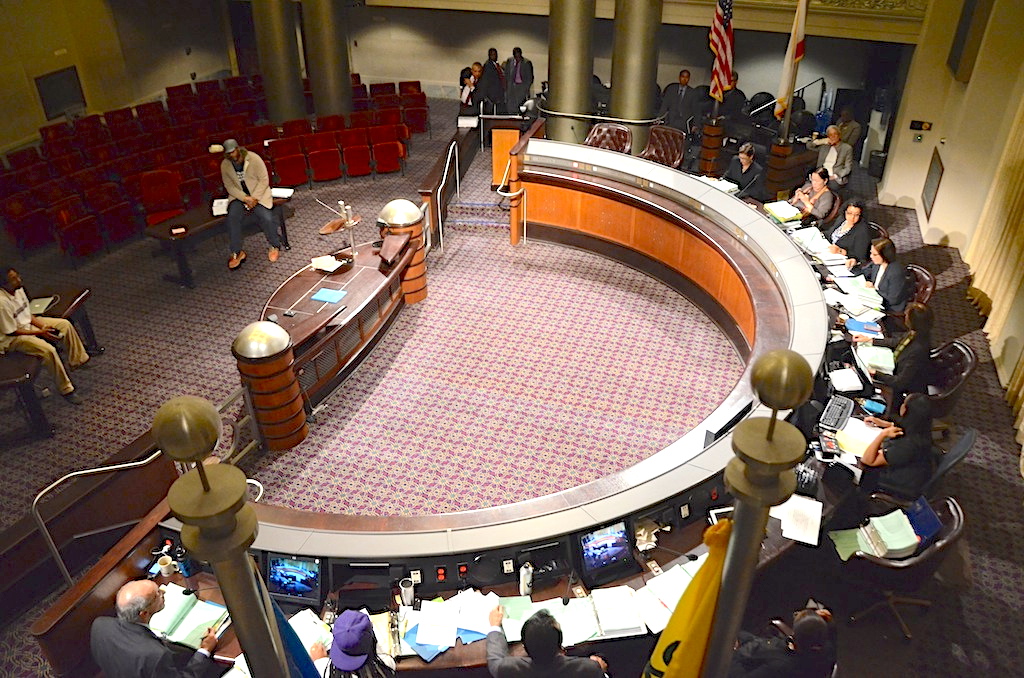
Joe Mathews argues that the average city council chamber is designed to kill civic conversation:

Walk into a council chamber or school board meeting room in your town, and you’ll likely see rows of chairs facing some sort of raised dais or stage, where the council members or board members sit. The whole point of the setup is to have you look at the politicians, not your fellow citizens. Essentially, city council chambers are laid out like church, and, as in church, you’re not supposed to talk too much. So it’s not surprising that fewer and fewer Americans bother to go to city council meetings (or, for that matter, to church).

For a better idea, he suggests looking to a certain coffee chain:

To unleash the untapped power of council and school board meetings – to make them about creating conversations – we must flip our priorities and redesign the spaces, so that council chambers and boardrooms are foremost places for people to gather and talk. What does that look like? Well, it looks like Starbucks. Take out the old fixed benches and seating of your council chamber. Set up tables and chairs and nice couches. Have a bar for serving coffee and healthy snacks and maybe even beer and wine. (I’m a teetotaler, but I don’t know how an elected official could summon the courage to grapple with California cities’ outsized pension problems without a slug of Jim Beam.) …

[People] go to places where they feel comfortable, where they can eat and drink, where tables and chairs are arranged in ways that encourage conversation. In my San Gabriel Valley community, there are so many people spending time sitting and talking at the three local Starbucks that it’s often hard to get a table. Great bars and restaurants always seem full. I don’t think I’ve ever managed to find an empty seat at our local ice cream parlor, Fosselman’s in Alhambra. Rarely have I had this problem at city council or school board meetings.

(Photo of Oakland City Council meeting by Daniel Arauz)

You Know Who Could Really Use Medical Marijuana?

The NFL:

In his book Marijuana Gateway to Health: How Cannabis Protects Us from Cancer and Alzheimer’s Disease, author and researcher Clint Werner notes that the federal government holds US Patent 6630507, titled “Cannabinoids as antioxidants and neuroprotectants,” before concluding that the herb should be “as common in an NFL locker room as icepacks.” And not just to prevent dementia. Marijuana is also a remarkably safe, effective pain reliever, with none of the dangerous side effects of commonly prescribed pharmaceuticals. Meanwhile, according to a study published in Drug and Alcohol Dependence, retired NFL players misuse prescription painkillers at a rate more than four times higher than the general population. “[NFL] players have a legitimate and substantial claim to use medical marijuana,” former Broncos receiver Nate Jackson recently told the Denver Post. “[Instead] teams pass out opioid painkillers, which are highly addictive. They are a derivative of the poppy plant—so it is basically pharmaceutical heroin.”

Medicating The Human Condition, Ctd

This embed is invalid


In an interview, Scott Stossel discusses his new book, My Age of Anxiety. Why he doesn’t appear outwardly anxious:

Some people say that in stressful situations I can seem unflappable, and I think that’s partly because I’m always kind of internally flapped. And so … when there’s actually something real to be concerned about, it’s actually less anxiety-provoking than these irrational things. It’s also fairly typical … of certain kinds of anxiety-disorder sufferers, particularly people with panic disorder, [they] are exceptionally good at hiding it. They’re able to convey an impression of competence, calmness and confidence, which is maybe substantially real … but there’s an internal fear. … The gap between that and this façade where people see you as competent and effective — you’re always afraid of being exposed, which is in itself anxiety-producing.

One of my more recent therapists calls this phenomenon impression management. Impression management is not only a symptom of anxiety, because you’re worried about being exposed, but it’s also a cause because you’re constantly worried that the house of cards that is your outward image … is going to come crashing down.

Louis Menand takes issue with the book:

“My Age of Anxiety” is not a memoir. Stossel tells us things about his parents, his marriage, and his children, but only things that are relevant to what he calls, after a famous remark of Freud’s, “the ‘riddle’ of anxiety.” The same is true of what he tells us about himself. He appears simply as a sufferer. Most of his book is a scholarly exploration of the history of anxiety and a journalistic account of the present state of medical knowledge. It’s intelligent, interesting, and well written, but the subject of anxiety is a mess, and the book, intentionally or not, is an accurate representation of its subject.

It doesn’t solve the riddle, either, but that’s not Stossel’s fault. It’s because anxiety of the kind he is afflicted with is not a riddle. It’s an illness. There is therefore nothing, except in the medical sense, to solve. That’s not what Stossel wants to believe, though. He has an idea that more is at stake. He thinks that there is a metaphysics of anxiety. “To grapple with and understand anxiety,” he says, “is, in some sense, to grapple with and understand the human condition.”

But he nevertheless praises Stossel:

He is an honest guide. He is committed to thinking through the philosophical, scientific, and human implications of a mood that appears to be universal (though people who live in underdeveloped countries seem to be less anxious) and that has attracted the attention of writers from Aristotle and Robert Burton (the seventeenth-century author of “The Anatomy of Melancholy”) to Søren Kierkegaard and William James. One of the best things about him is that he’s generally agnostic toward the theories and treatments he examines. He sees the possibilities in everything.

George Scialabba thinks Stossel lets capitalism off too easily:

Late in the book, buried in a footnote, a few sentences speculate that “life in a capitalist economy produces anxiety and uneasiness [and] can be psychologically corrosive. . . . Perhaps the human organism is not equipped to live life as society”—“society,” really?—“has lately designed it—a harsh zero-sum competition where the only gains to be had are at the expense of someone else, where ‘neurotic competition’ has displaced solidarity and cooperation.” That’s it. He devotes more space to the etymology of panic (the slightly crazy god Pan) and the physiology of blushing.

Previous Dish on Stossel’s new book here here.

Who Must Support A Union?

Harris v. Quinn asks whether public employees can be compelled to pay “agency fees” to unions they don’t belong to. Garrett Epps explains the case:

[T]he state of Illinois in 2003 designated the home-care workers as state employees for the purpose of collective bargaining. The workers then held an official vote, and a majority voted to certify the Service Employees International Union as their “exclusive bargaining agent.”  Non-members, like the plaintiffs in this case, pay a fee that is a set annual “chargeable” percentage of union dues.  The rationale for the agency fees is that non-union employees benefit from the contracts unions negotiate, and thus would be “free riders” if the union could not charge them.  If unions cannot collect fees, soon employees would stop joining, and they would lose their ability to speak for workers. …

The argument against public-sector agency fees is this: Since public employees work for government, everything they bargain about is political. Higher wages, better benefits, new work rules—all affect the state budget.  Assessing fees from non-members thus requires them to pay for political speech. All the expenses, in other words, are non-chargeable.

Lyle Denniston parses yesterday’s oral arguments:

Aside from what was said explicitly from the bench, the atmospherics of Tuesday’s argument suggested strongly that this case has very large potential.  The mood of the Court’s more liberal members was one of obvious trepidation, and that of its more conservative members — except for Justice Scalia — was of apparent eagerness to reach anew the core constitutionality of compulsory union support among public workers.

Ian Millhiser presents the pro-union view of the issue:

For decades, public sector unions have operated under a simple bargain. Unions are subject to two restrictions — they may not require non-members to fund the union’s political activity, and they must bargain on behalf of every worker in a unionized shop, regardless of whether each individual worker belongs to the union. In other words, the union cannot encourage non-members to join by bargaining for higher wages or other benefits that only apply to union members. When a union secures a wage increase, the non-members benefit from the higher wages as well.

The cost of bargaining with an employer can be significant, however. Negotiators must have the sophistication determine what sort of bargain would be beneficial to the workers but also feasible for the company to deliver. Lawyers are needed to review contracts and to draft them. Because non-union members benefit from the high wages, increased benefits and other advantages of having a union bargain on their behalf, unions are permitted to charge agency fees to non-members in order to cover those non-members’ share of the bargaining costs.

In practice, these agency fees are typically paid out of the increased wages that the non-members receive through the collective bargaining process, so the non-members wind up wealthier in the long run even though they are paying some fees to the union. If a union fails to deliver higher wages, a majority of the workers in a bargaining unit always have the option to vote not to be represented by the union.

Scott Shackford reads the Cato institute’s amicus brief in support of the plaintiffs:

Of note in Cato’s argument is that they tackle two of the major arguments that the courts have accepted to allow for compulsory membership in unions at places of government – to preserve “labor peace” (conflicts resulting from multiple bargaining representatives for different employees doing the same work) and to avoid “free riders,” those who reap the rewards of collective agreements without contributing to the costs of representation.

It should be fairly obvious that in the case of often self-employed home health workers, these two arguments don’t apply. The workers are hired by and work for individuals, and that’s not changing. There are no threats to labor peace, nor would there be any free riders. These home care workers all work in the same field but they are in no sense in the same business together. In Cato’s brief, they note that this forced unionization is only about lobbying for more pay and benefits, using the union to give “feedback” to the state about rates set by laws. It is offering nothing else. Thus, Cato notes, the state has no actual compelling interest in forcing home care workers into accepting union representation

Ilya Shapiro adds:

Justice Alito was the most skeptical of the union/government position, pointing out that unions don’t necessarily act in all workers’ interest, even when they succeed in negotiating certain “gains.” For example, a productive young worker might prefer merit pay to tenure provisions or a defined-benefit pension plan. Chief Justice Roberts was similarly concerned about administering the line between those union expenses that could be “charged” even to nonmembers (because related to collective bargaining) versus those that can’t because they involve political activity. Justice Kennedy, meanwhile, noted that in this era of growing government, increasing the size and cost of the public workforce is more than simple bargaining over wages and benefits; it’s “a fundamental issue of political belief.” In no other context could a government seek to compel its citizens to subsidize such speech. A worker who disagrees with the union view on these political questions is still made to subsidize it.

What Makes Politicians Run

The State Funeral Of Former South African President Nelson Mandela

Waldman wonders why ambition isn’t an acceptable reason to run for high office:

I have to ask why we assume there is something morally superior about the “conviction politician” like Ronald Reagan or Barry Goldwater, and something morally inferior about the guy who just thinks he’d like to be president and would do the job well. No matter how firm their ideology, conviction politicians are just as ambitious as people like Romney or Bill Clinton who knew they would one day run for president from the time they got to middle school.

What happens then is that the less ideological candidate, who can’t say “I’m running for president to defeat the socialist menace that lurks in every free school lunch,” has to convince us that he’s running because of some equally powerful impulse that exists outside of his own desires. So he presents himself as something like a firefighter. He doesn’t want the glory, he doesn’t want the hug from the grateful homeowner, the nation is on fire and he has no choice but to douse the flames with his brilliant leadership.

Larison’s take:

The easy answer is that many of the people that pay the closest attention to politics make this assumption about politicians because they have very firm and strongly-held political convictions.

They take an interest in election campaigns because they want someone holding as many of their convictions as possible to prevail, and so they tend to view conviction politicians more sympathetically than opportunists or technocratic managers. Many activists and pundits also tend to be more interested in conviction politicians because they want to be able to identify with a candidate because of what he professes to believe, and for the same reason they will usually be harder on candidates whose convictions are easily changed or cast aside. The opportunist is viewed with suspicion because he appears to be (may indeed be) unprincipled and is therefore potentially unscrupulous and untrustworthy, and the manager type is perceived as dull, bloodless, and excessively calculating.

Bernstein thinks of ambition “first as a job requirement for all politicians and second as a plus, not a minus”:

The idea is that ambition isn’t just about getting to the White House, but also seeking to be personally powerful after getting there — that it’s the (obsessive?) quest for power that produces presidential success. I’ve made this point about George W. Bush. As I see it, Bush was not particularly ambitious, and thus saw nothing wrong with his Vice President and his Secretary of Defense running the show, with predictably terrible results. Why predictably terrible? Because ambitious presidents aren’t going to accept the harm to themselves from catastrophic policy failure, while true believers (in the Oval Office or elsewhere) just might.

It’s worth noting that the consensus choices for the three greatest American presidents — Washington, Lincoln, and Franklin Roosevelt — were all extraordinarily ambitious. None is usually classified as a true believer. Granted, there’s no guarantee of success: Richard Nixon was surely a very ambitious non-ideologue, and he was a terrible president.

(Photo by Lefty Shivambu/Gallo Images/Getty Images)

Finding

A confession. I have long had an aversion to gay-themed plays, TV shows, movies, etc. I wasn’t born with it. I learned it. I learned it through what can only be called a series of cringes. I cringed at Philadelphia‘s well-intentioned hagiography of the “AIDS victim”; I cringed through Tony Kushner’s view of the plague as a post-script to the heroism of American communists; I winced at the eunuch, the sassy girlfriend, and the witty queen in Will And Grace; I had to look away as Ellen initially over-played her hand (understandably and totally forgivably, but still …). The US version of Queer as Folk was something I could not get out of my recoiling head for weeks – and I barely got through fifteen minutes of it. And please don’t ask me about Jeffrey. Please.

Maybe I should have sucked it up and celebrated each and every portrayal of gay people in any form – after so many decades and centuries of invisibility or minstrelsy. But, like many members of any minority group seeing themselves portrayed for the first time on screen, I felt betrayed when my own life wasn’t depicted, my worldview was ignored, my politics wasn’t acknowledged. In many ways this was utterly irrational. But it was emotionally real. When there are so few cultural expressions of your core identity, the few become weighted with far more cultural baggage than they can hope to uphold. In a fraught time – between liberation and mass extinction, between criminality and civil equality – it was hard to forgive anything that might be conceived as counter-productive or inaccurate or ideologized.

The same dynamic operated the other way on me, as well. When I rather naively became a gay public figure by answering “yes” to the question, “Are you gay?” after I became the editor of The New Republic at the crazy age of 27, the shoe was on the other foot. Suddenly I was supposed to represent all “virtually normal” gay men, because I was one of very, very few out people in the mainstream media in 1991. And boy did I not represent them. I never claimed to, of course, and said so explicitly; but that really didn’t matter. I was out there and not representative of many others. So I had to be knocked off my perch in a period of great exhilaration but also great personal pain. Looking back, the necessary madness of that period, its extraordinary range of sheer emotion as we fought not just for our dignity but for our very lives, seems clearer and more understandable now. But no less painful.

So when the opening scene of the new HBO series, Looking, shows a young gay man cruising for sex in a public park, I tensed up. But almost as quickly I realized that this was the most meta of the show’s moments (I’ve been able to watch all four of the first few episodes). As the dude starts to grope around, his cell phone goes off, the other guy’s hands are freezing on his cock, he tries to answer the phone, then drops it into a ditch. His friends – out for a lark to see if old gay culture still exists in San Francisco – were calling him; and they reunite to talk about the fun in exploring the old world of cruising. And so the circle is complete. Gay culture has evolved into a million-petaled flower, and the old petals are still in there, but ironized for many, if still urgent for others. Gay life in 2014 is … well, finally just life.

I loved the show. It is the first non-cringe-inducing, mass market portrayal of gay life in America since the civil rights movement took off. Well, the first since Weekend, the breakthrough movie of 2011:

For some reason, it wasn’t until Aaron reminded me last night that both Looking and Weekend are by the same Andrew Haigh that I put it all together.

Along with Michael Lannan, Haigh is the first director and writer to actually bring no apparent cultural or ideological baggage to the subject matter. There is no shame here and no shadow of shame. There is simply living – in its complexity, realism, and elusive truth. To get to this point – past being either for or against homosexuality – is a real achievement.

The emotional conflicts, the awkwardness of dating, the mixed feelings about some aspects of gay culture, the workaholism, the weed, the generational divides, the girlfriends and monogamish coupling, the weddings and the fetishes, the bears and the twinks: it’s all here, and served crisply as a well-mixed cocktail on the rocks. Sometimes, its realism becomes mere darkness as the show is filmed in weirdly dark tones. Sometimes there’s a false note: I’ve never heard anyone use the expression “Drug-Disease-Free” in speech, for example. It’s only ever used – with chilling HIV-phobic effect – on the web. And yes, this is not yet what I’d like to be able to watch: a convincing drama about gay men in, say, Houston or Atlanta, in 2014. And it doesn’t have the nuances and writerly quirks of Girls, even as it is close to it in realism (but not as much sex as in Girls). There are also a few frustratingly implausible plot developments and unpersuasive character developments that accumulate as the shows progress.

But I nonetheless recognized the reality of gay life now in this show. And not just mine – but intimations of countless others. The characters are not minstrels; and they are not eunuchs. They are for the first time recognizable human beings who happen to be gay. And that’s enough. Actually, it’s more than enough.

It’s an arrival.


Update: This post continued as a reader thread.