What Went Wrong With Public Housing?

A recent study examines “the entire public housing experiment by looking at the whole country from 1933 to 1973”:

[Researcher Katharine L. Shester] shows that by 1970, even taking into account local dish_pruittigoe conditions prior to their construction, public housing projects depressed counties’ social and economic levels. Critically, however, that was not true before 1970. Data from 1950 and 1960 suggest that public housing seemed to have positive local effects. Something changed in the 1960s. The source of change was not, in Shester’s analysis, the new projects built in the 1960s, but seems to have been some cumulative aspect of public housing generally.

Decisions and developments from 1950 to 1970, Shester argues, accelerated the physical deterioration of public housing and increased the concentration of troubled families living there. Limits on government maintenance funds, like the limits on the original construction costs, hampered the housing managers. And because of imposed rent ceilings, local housing agencies could not get the funds sufficient to keep up repairs by charging tenants. Physical dilapidation followed.

At the same time, tightening the requirements that housing be provided only to the neediest families meant that stable working-class families, once part of the mix, were gone. The renters became increasingly and exclusively the poorest and most troubled families. Their growing concentration in dense (and tense) settings compounded the problems of order. By 1970, public housing projects had gained their nightmarish image. Pruitt–Igoe (and others) came down.
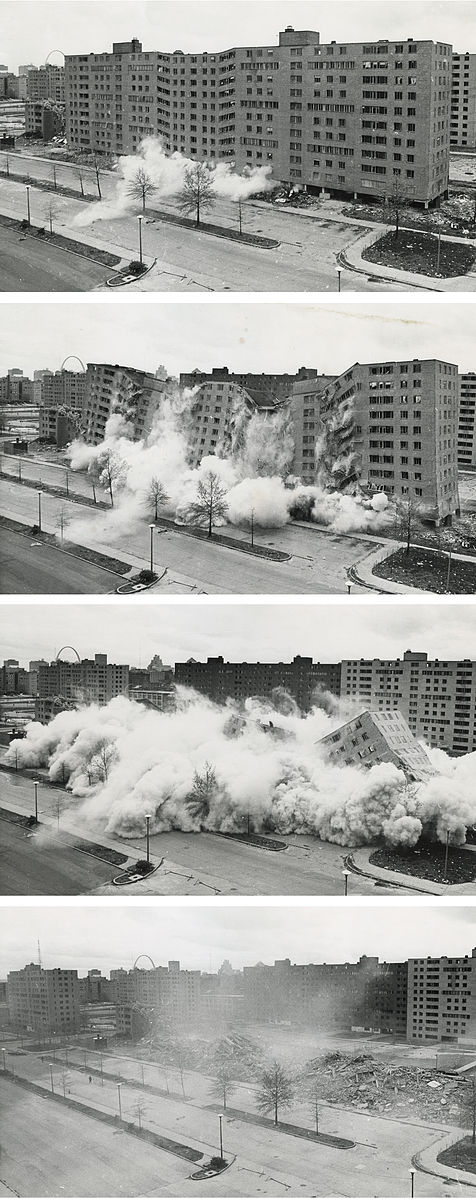
(Image sequence of 1972 demolition of the Pruitt-Igoe project in St. Louis via Wikimedia Commons)

The Football Dad’s Dilemma

Beinart wrestles with the morality of raising his eight-year-old to be an NFL fan:

When my dad made me a football fan, the press wasn’t filled with stories about the way repeated blows to the head erode brain tissue, causing a lifetime of confusion, depression, aggression, dementia, and memory loss. Former players didn’t attach suicide notes like the one found in 2011 in the apartment of former Chicago Bears safety Dave Duerson, which read, “Please, see that my brain is given to the NFL’s brain bank.” So my father can’t be blamed for fostering in me an emotional attachment to football that overrides the moral analysis I’d apply to some other activity that physically and mentally disfigures its participants.

I, on the other hand, have no such excuse.

I could, perhaps, break the chain. Whether he realizes it or not, my son likes watching football for the same reason I did: because it’s intimate time with his dad. If I didn’t let watching football become one of the things we shared, if I told him it’s something I regret, he might take to it anyway. But it would be less likely. And if he made it to adulthood without heartwarming memories of sitting alongside his old man watching other men pulverize their bodies and minds, he’d be more able to rationally decide whether professional football is something a decent society should allow.

An Unsettling Bestseller

Mein Kampf is rising to the top of e-book bestseller lists:

Mein Kampf hasn’t made The New York Times nonfiction chart since its U.S. release in 1939, the same year Germany invaded Poland, and its print sales have fallen steadily ever since. But with a flood of new e-book editions, Hitler’s notorious memoir just clocked a banner digital year. One 2012 English-language version is currently the number one Propaganda & Political Psychology book on Amazon. Another digital selection is a player in the Globalization category. …

The first Kindle edition of Mein Kampf surfaced in late 2008, selling for $1.60. Shortly after that, another version popped up for $1.58 and rocketed up Amazon’s Legal Thrillers chart, then suddenly vanished in March 2009, along with a slightly pricier rival version, after a blogger at CNET acknowledged its burgeoning success. At the time, Amazon did not respond to CNET, which found it “unclear who uploaded the Kindle Edition of Mein Kampf.” Nevertheless, the e-book behemoth removed the virtual versions while continuing to offer a range of cloth and paperback printings, the overwhelming majority of which sold poorly if at all.

Stephanie Butnick wonders about the sudden rise:

For one thing, it’s a lot easier to click open the Kindle version instead of whipping out a print copy of Mein Kampf on the subway.

The book is so notorious, even the most curious readers probably wouldn’t bring it to the checkout counter at Barnes and Noble. As Vocativ points out, the book’s popularity falls in line with the 50 Shades of Grey model: readers are much more likely to stealthily download the online version, just to see what’s inside.

And maybe it’s time they did. The book itself, published a decade before World War II, is frighteningly frank about Hitler’s plans. In it, Hitler details his intentions to eliminate the Jews, also suggesting the German Reich expand by taking some of Russia’s land. As Marc Tracy noted back in 2010, while the book outsold the Bible in Germany as Hitler rose to power, no one seems to have actually taken a look inside.

Jason Heller links the book’s resurgence to a new study that suggests there’s a formula for successful books:

Thankfully, literature is not a science. Yet the writing and selling of literature increasingly is. Thanks to a proliferation of analytics, it’s easier than ever for publishers to track, graph, and therefore do their desperate best to predict market trends. Judged on that cold scale of downloaded units, Mein Kampf—which has come roaring back recently thanks to a high volume of e-book sales—might now be considered a good book.

I won’t go so far as to say that reducing the richness of books to ones and zeroes, and then judging them on such a scale, is tantamount to literary eugenics. But it does raise a question about what it means for a book to be formulaic, and whether that’s a good or bad thing. Or whether those kinds of questions even mean anything anymore.

Update from a reader:

You should know that the Mein Kampf “bestseller” story is blown way out of proportion. At most it was selling 10 books a day before the media got ahold of it. Thorough debunking from a self-published author here. (I am one as well, and let me tell you, we pay attention to what rankings actually mean!) It’s an overblown story that provides fodder for a lot of think-pieces.

Stimulating Your Memory

A new study indicates that caffeine “may enhance consolidation of memories only if it is consumed after a learning or memory challenge.” Cathy Newman talked to one of the study’s researchers, Michael Yassa:

So you gave people who didn’t regularly use caffeine either a placebo or a 200-milligram caffeine tablet five minutes after they studied a group of images. Both groups returned 24 hours later to be tested. The caffeine users remembered the images better.

Caffeine was first isolated from the coffee bean in the 19th century by a German chemist. Do we know exactly how it works? There are several mechanisms. It acts on the adenosine receptors and increases heart rate, vigilance, blood pressure—the fight-or-flight response when you see a bear. It’s what happens when someone says, “I get an adrenaline rush.” It also acts on a small region of the hippocampus, which plays an important role in long- and short-term memory.

How much coffee do you have to drink to get 200 milligrams of caffeine?

It’s about two shots of espresso.

Should we all rush out and order triple-shot grande lattes as a result of these findings?

Keep in mind that those drinks also involve lots and lots of sugar. I’ve been a coffee drinker for years, and I’m not going to double my dose.

Victoria Turk feels that the study is being misreported:

Sure enough, the people who were given caffeine rather than a placebo (it was a double-blind study) completed the task a bit better. “We conclude that caffeine enhanced consolidation of long-term memories in humans,” wrote the researchers.

That’s all very interesting. But it doesn’t follow that downing an espresso after a revision session will make you perform better in an exam the next day, as some reports would have you believe.

What actually happened in the study is that those who had caffeine were better at spotting which images were similar but not exactly the same to the previous day’s. They weren’t significantly better at spotting which images were brand new and which were the same. That’s quite a specific effect observed, then, and one that doesn’t immediately transfer into real-life applications.

Previous Dish on how to time your caffeine consumption here.

Quote For The Day

“Now there is a final reason I think that Jesus says, ‘Love your enemies.’ It is this: that love has within it a redemptive power. And there is a power there that eventually transforms individuals. That’s why Jesus says, ‘Love your enemies.’ Because if you hate your enemies, you have no way to redeem and to transform your enemies. But if you love your enemies, you will discover that at the very root of love is the power of redemption. You just keep loving people and keep loving them, even though they’re mistreating you.

Here’s the person who is a neighbor, and this person is doing something wrong to you and all of that. Just keep being friendly to that person. Keep loving them. Don’t do anything to embarrass them. Just keep loving them, and they can’t stand it too long. Oh, they react in many ways in the beginning. They react with bitterness because they’re mad because you love them like that. They react with guilt feelings, and sometimes they’ll hate you a little more at that transition period, but just keep loving them. And by the power of your love they will break down under the load.

That’s love, you see. It is redemptive, and this is why Jesus says love. There’s something about love that builds up and is creative. There is something about hate that tears down and is destructive. So love your enemies,” – Martin Luther King, Jr., “Loving Your Enemies.”

Apocalypse Then

dish_apocalypse

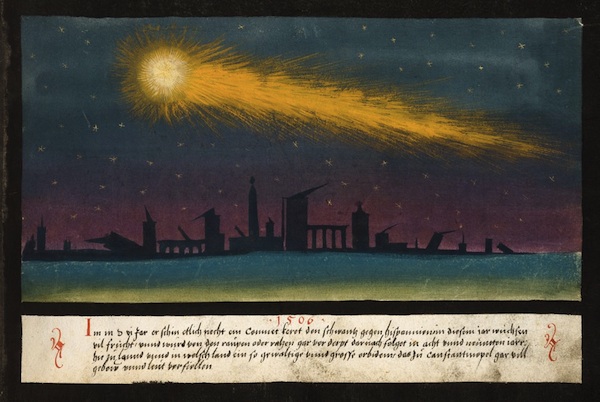
Ben Marks details the story behind 16th-century depictions of “Biblical miracles, flaming comets, multi-headed beasts, and apocalyptic chaos that fill the pages of the ‘Augsburg Book of Miraculous Signs,'” recently reproduced in Taschen’s Book of Miracles:

[T]he Protestant citizens of Augsburg, Germany, were enthusiastic and active collectors of portrayals of portentous signs, as well as written descriptions of ancient and astrological prophecies.  … In part, their passion stemmed from a collector’s fascination with such topics, but Germany’s 16th-century Protestants were also motivated by religious antipathy toward the Catholic church, whose Pope they derided as the Antichrist. Some took the epithet for fact: For them, since the end was nigh, it behooved one to pay attention to the signs.

As Joshua Waterman of the Germanisches Nationalmuseum in Nuremberg writes … “The late fifteenth century had witnessed a surge of interest in miraculous signs which steadily increased in the decades that followed, ultimately reaching a high point toward the end of the sixteenth century, especially in Protestant territories. This development coincided with the rise of illustrated broadsheets and printed pamphlets as news media that spread reports of prodigies and portents, and with the religious and political upheavals of the Protestant Reformation, which fostered special concern for signs of God’s wrath and the coming end of days.”

Marks calls these broadsheets the “Buzzfeeds of their day, featuring woodcut artwork and sensationalist headlines and text designed to capture the imagination of the common man.”

(Image of 16th-century depiction of comet via Collectors Weekly and Taschen)

Why Mindfulness Matters

Dan Hurley traces the dramatic rise of mindfulness meditation in Western psychology:

Although pioneers like Jon Kabat-Zinn, now emeritus professor at the University of Massachusetts Medical Center, began teaching mindfulness meditation as a means of reducing stress as far back as the 1970s, all but a dozen or so of the nearly 100 randomized clinical trials have been published since 2005. And the most recent studies of mindfulness – the simple, nonjudgmental observation of a person’s breath, body or just about anything else – are taking the practice in directions that might have shocked the Buddha. In addition to military fitness, scientists are now testing brief stints of mindfulness training as a means to improve scores on standardized tests and lay down new connections between brain cells.

Michael Posner, of the University of Oregon, and Yi-Yuan Tang, of Texas Tech University, used functional MRIs before and after participants spent a combined 11 hours over two weeks practicing a form of mindfulness meditation developed by Tang. They found that it enhanced the integrity and efficiency of the brain’s white matter, the tissue that connects and protects neurons emanating from the anterior cingulate cortex, a region of particular importance for rational decision-making and effortful problem-solving.

Perhaps that is why mindfulness has proved beneficial to prospective graduate students. In May, the journal Psychological Science published the results of a randomized trial showing that undergraduates instructed to spend a mere 10 minutes a day for two weeks practicing mindfulness made significant improvement on the verbal portion of the Graduate Record Exam – a gain of 16 percentile points. They also significantly increased their working memory capacity, the ability to maintain and manipulate multiple items of attention. That a practice once synonymous with Eastern mysticism could be put to the service of Western rationalism may sound surprising, but consider: By emphasizing a focus on the here and now, it trains the mind to stay on task and avoid distraction.

A Poem For Sunday

smith-letters

“Emily writes such a good letter” by Stevie Smith:

Mabel was married last week
So now only Tom left

The doctor didn’t like Arthur’s cough
I have been in bed since Easter

A touch of the old trouble

I am downstairs today
As I write this
I can hear Arthur roaming overhead

He loves to roam
Thank heavens he has plenty of space to roam in

We have seven bedrooms
And an annexe

Which leaves a flat for the chauffeur and his wife

We have much to be thankful for

The new vicar came yesterday
People say he brings a breath of fresh air

He leaves me cold
I do not think he is a gentleman

Yes, I remember Maurice very well
Fancy getting married at his age
She must be a fool

You knew May had moved?
Since Edward died she has been much alone

It was cancer

No, I know nothing of Maud
I never wish to hear her name again
In my opinion Maud
Is an evil woman

Our char has left
And a good riddance too
Wages are very high in Tonbridge

Write and tell me how you are, dear,
And the girls,
Phoebe and Rose
They must be a great comfort to you
Phoebe and Rose.

(From Best Poems: Stevie Smith © Stevie Smith 1937, 1972 and © New Direction Publishing Corporation 1988, 2014. Reprinted with kind permission of New Directions. Photo by Sandra Kharazashvili)

Questions Without Answers

Maria Popova digs into physicist Alan Lightman’s new volume of essays, The Accidental Universe, finding this gem on what distinguishes the sciences from the humanities:

At any moment in time, every scientist is working on, or attempting to work on, a well-posed problem, a question with a definite answer. We scientists are taught from an early stage of our apprenticeship not to waste time on questions that do not have clear and definite answers.

But artists and humanists often don’t care what the answer is because definite answers don’t exist to all interesting and important questions. Ideas in a novel or emotion in a symphony are complicated with the intrinsic ambiguity of human nature. …

For many artists and humanists, the question is more important than the answer. As the German poet Rainer Maria Rilke wrote a century ago, “We should try to love the questions themselves, like locked rooms and like books that are written in a very foreign tongue.” Then there are also the questions that have definite answers but which we cannot answer. The question of the existence of God may be such a question. As human beings, don’t we need questions without answers as well as questions with answers?

Lightman goes on to place this “tolerance for the unanswered” at the heart of faith:

Faith, in its broadest sense, is about far more than belief in the existence of God or the disregard of scientific evidence. Faith is the willingness to give ourselves over, at times, to things we do not fully understand. Faith is the belief in things larger than ourselves. Faith is the ability to honor stillness at some moments and at others to ride the passion and exuberance that is the artistic impulse, the flight of the imagination, the full engagement with this strange and shimmering world.