Connecting Through Chekhov

dish_cherryorchard

Brendan Mathews appreciates Chekhov for his descriptions of human empathy – or the lack of it:

It’s worth noting that Chekhov’s grandfather was a serf, his father was a hyper-religious tyrant, and he knew from the time he was in his twenties that tuberculosis would cut his life short (he died at 44). He didn’t believe in God or the reward of a joyous afterlife, and yet his stories affirm in ways large and small that the only hope we have lies in our relationships with other people. If the world is hell, it’s because we make it that way; if we are to be happy, it’s only by connecting with the people around us.

In Chekhov’s last play, “The Cherry Orchard,” — bracingly translated by Matthew Henry Heim in Chekhov: The Essential Plays — the young idealist Trofimov lectures his one-time patroness Lyubov Andreevna about her failings in love and money: she is a spendthrift whose estate is about to be auctioned; she has driven herself into debt for the love of a ne’er-do-well. Her response, a scorching indictment of Trofimov’s easy dismissal of all that she has suffered in life, climaxes with this demand: “Show a little generosity!”

Lyubov Andreevna is speaking to Trofimov; Chekhov is speaking to us. This writer who sought objectivity in all of his work and who was blasted by his contemporaries for being apolitical and amoral, condenses into this line a plea to us all. That before we judge, we understand. That we extend to each other the same compassion that we all seek.

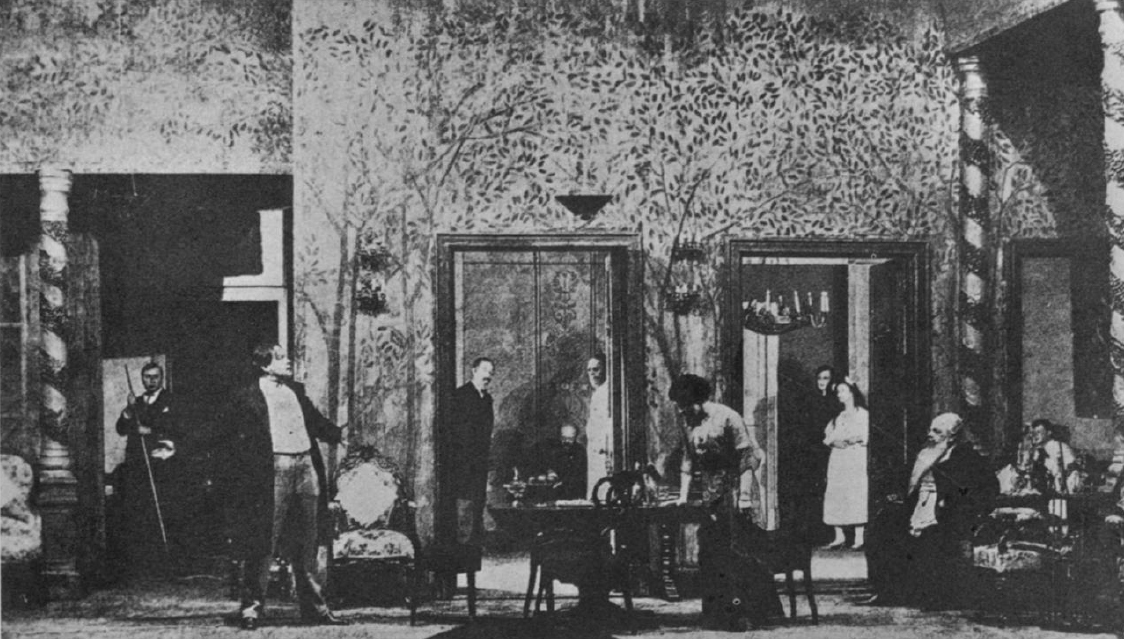
(Image of scene from the first production of The Cherry Orchard in 1904 via Wikimedia Commons)

What Mormons Have Against Marriage Equality

With support for marriage equality is surging in Utah, it should come as no surprise that the LDS Church recently issued a memo directing congregational leaders to review “The Family,” which Neil J. Young describes as “a document the church produced in 1995 that has appeared at times of social crisis ever since.” He considers the implications for the fight against same-sex marriage:

“The Family,” issued as the church began these fights, linked the Mormon theology of salvation rooted in the traditional heterosexual family unit to the civil rights question of gay and lesbian Americans without even acknowledging their existence. Mormon salvation—or exaltation to the Celestial Kingdom—requires that male and female Saints enter into a temple-based marriage and enact, as “The Family” describes, the “divine design” of their respective gender roles. Men are to “preside over their families” while women are “primarily responsible for the nurture of their children.” Together, they are to fulfill their religious responsibility to reproduce, creating an extensive earthly family that will be joined together eternally in the afterlife.

Same-sex marriage, of course, challenges all of this. While Mormons agree with other opponents of gay marriage that its legalization is “unbiblical” and a threat to the traditional heterosexual family unit, LDS objections also arise from the core of Mormon theology and its particular interconnection of heterosexuality, marriage, and salvation. In short, same-sex marriage threatens the basic foundations of Mormonism.

He also notes that “Mormon acceptance of gay marriage challenges the church’s authority, a core component of LDS belief”:

This is a crisis the LDS Church faced when some of its members became vociferous critics of the church’s efforts against the Equal Rights Amendment in the 1970s. The church dealt harshly with those women not because they supported the ERA, church leaders explained, but because they had publically challenged the church president’s prophetic role—a key tenet of Mormonism. Increasing societal support for same-sex marriage suggests another crisis moment for the LDS Church could be coming.

When Doctrine Is Disregarded

Douthat continues the debate about Church reform sparked by Damon Linker’s recent column, which included NPR caller Trish’s comment that “Catholics do not care about doctrine”:

There are dangers in reading too much into an NPR caller, obviously, but Linker is putting his finger on a real tension within liberal Christianity today — or, if you prefer, a real fork in the road, with one path leading in the direction that he assumed dissenting Catholics wanted to take (which seeks to alter church teaching precisely because it still believes that teaching really matters), and the other leading toward a kind of Emersonian, therapeutic, basically post-ecclesiastical form of faith, in which “Roman Catholicism” just happens to be the name of the stage on which your purely individual spiritual drama is taking place.

He wrestles with where this discounting of doctrine comes from:

Now some of those would-be reformers would argue that Trish-ism (which as Linker describes it is basically a Catholic version of Sheila-ism, Robert Bellah’s Reagan-era gloss on individualistic spirituality) is what happens, more or less inevitably, when the church’s leaders hollow out their credibility by trying to enforce the unenforceable, and that a church that had evolved with the culture forty years ago would have actually preserved a sense that doctrine actually matters. This argument is problematic, though, because the (mostly Protestant) churches that did evolve along those lines often seem to be churches where Trish-ism is fully enthroned and all talk of traditional doctrine is a dead letter. Hence the appeal of the conservative counter-argument that actually Trish-ism is the fruit of the Catholic hierarchy’s inattention to doctrinal matters, its eagerness to soft-pedal the tough stuff, its attempt to keep everyone on board in an age of division and dissent: “It’s not that dissenting Catholics don’t care what the Church teaches,” Matthew Schmitz writes in a response to Linker’s piece, “it’s that the Church has taught them not to care. To that lesson, they’ve paid close attention.”

But I wonder if this argument doesn’t oversimplify things as well.

Dreher comments:

Even after I left the Catholic Church, I would find myself in the bizarre position of arguing with Catholics, and defending Catholic doctrine. The thing is, it was impossible to find common ground, because a) they knew nothing about doctrine, not even basics, and b) whatever the Church taught didn’t matter to them, because they didn’t see it as binding anyway; and c) they genuinely did not understand why this had anything at all to do with their status as Catholics. The freaky thing, to me, was that this wasn’t a pose; they were as sincere as they could be.

Faces Of The Day

dish_fotdsun19

Ellen Jacob snaps shots of nannies at work around NYC:

As a resident of Manhattan’s Upper West Side, photographer Ellen Jacob would often notice nannies pushing children around in strollers on the street. Eager to learn more about the lives of these women, Jacob spent four years photographing dozens of nannies and the children in their care for her series, “Substitutes.” “My work explores the social, racial and economic relationships that powerfully affect life and largely go unnoticed,” Jacob wrote in a statement.

(Photo by Ellen Jacob, who has an exhibit at Soho Photo Gallery, 15 White St until Feb 1. Gallery hours Wed-Sat 1-6 and by appointment. Follow her on Twitter here.)

After Evangelism

Megan Hustad was raised by overseas Christian missionaries. She describes adapting to life in NYC:

All I wanted was to listen carefully and master correct pronunciations. I wanted to take note of how the beautiful people held forks and chopsticks and admired certain books but never others, not unless they were trying to be funny, and I wanted to exploit the fact that my accent made me sound wealthier than I was and slightly smarter, too. Mainly I sought forgetfulness. For a long time I was happy to have outrun God, because he really wasn’t going to be much help here.

On occasion the subject would come up. My evangelical background. Wow, flushed faces at parties leaned in to ask, what was it like growing up with adults so hooked on fairy tales? My ability to quickly change the subject eventually outstripped my embarrassment, but not before I had internalized every critique of what faith in God now signified in America: intolerance, sanctimony, tut-tutting over Hollywood and the welfare office, a yawning void where curiosity and compassion could be.

But when I felt led to a conversational place wherein I was expected to confirm that everyone who takes part in the rituals of organized religion drags their knuckles on their way to stoning the town slut, I would stop. I couldn’t. That I would have to drop the word “soul” from my vocabulary I hadn’t expected.

Where Are All The Black Atheists? Ctd

Darrin Johnson created a short documentary (above) about the role of non-belief in the African-American community:

From slavery to the civil rights era, to the enduring role of the church in community life, African-American history is deeply entwined with Christianity. An increasing number of black Americans are choosing to reject religion, but they remain a largely invisible minority in the face of media-reinforced stereotypes that presume that African-Americans will hold firm religious beliefs.

Previous Dish on black atheists here and here.

When Did The Culture Wars Begin?

Molly Worthen traces them back to “the theological feuds of the seventeenth century” when Christians developed doctrines that continue to inform evangelical and fundamentalist critiques of evolution:

The basic idea of biblical inerrancy is ancient. Christians have always been eager to defend the Bible as a source of perfect truth. But they did not necessarily use scripture to explain the intricacies of the natural world. The Protestant Reformer John Calvin believed that God created the earth in six days, but at the same time he discouraged Christians from trying to extract scientific details from the Bible: “Nothing is here treated of but the visible form of the world,” he wrote in his commentary on Genesis. “He who would learn astronomy and other recondite arts, let him go elsewhere.”

A couple of generations later, conservative Protestant theologians—mostly Reformed Christians who followed the teachings of Calvin and his colleagues—found themselves hemmed in by intellectual challenges on both sides. Catholic theologians critiqued Protestantism using the relentless logic of scholastic theology, while philosophers and scientists of the Enlightenment debunked Christ’s miracles. These embattled Protestants responded by trying to out-rationalize both the scientists and the scholastics in order to solve the great epistemological problem of modern times: to keep faith and reason fused as one single way of knowing the world.

Recent Dish on creationism here.

Scoring The Spiritual Vote

Steven Barrie-Anthony considers the challenges of appealing to “spiritual but not religious” voters:

[W]hat politicians often neglect … is that for spiritual voters the sacred strongly persists. Reading them narrowly as atheists or secularists misses out on the political rewards that come from constituents feeling seen and understood. This sacred is various, but it coheres for many in its resistance to religious enclosure and its support of certain progressive values. Politicians fire up religious blocs through careful attunement to religious values. Better attunement to spiritual values will help inspire spiritual voters.

What he suggests will help with that:

This includes, first and foremost, strategies of listening—polling, interviewing, researching—to understand not just how spiritual people vote but also the ways in which their relationships with the sacred open out into their civil involvements and political decisions. (Journalists and scholars need to become better listeners, too.) It includes strategies of speaking—of shaping political language inclusive of “spiritual but not religious” people rather than lumping them in with non-believers. Obama was the first U.S. president to acknowledge non-believers in his inaugural address—America, Obama said, is a “patchwork” of “Christians and Muslims, Jews and Hindus, and non-believers.” That was a step in the right direction, but the truth is that “non-believers” describes only a fraction of Americans who don’t identify with a religion. And it includes strategies of action—of setting policy agendas that emerge from this conversation. Such policy may look much like what pollsters already tell us the “nones” prefer. But in the context of intentional listening and speaking it will seem less jaded, more apt to come to fruition, and more inspiring of spiritual voters to show up at the polls.