Young Believers, Old Traditions

liturgyessay

Gracy Olmstead profiles Christian millennials leaving evangelical Protestantism for liturgical, sacramental churches that reach back into history:

One in four young adults choose “unaffiliated” when asked about their religion, according to a 2012 Public Religion Research Institute poll, and 55 percent of those unaffiliated youth once had a religious identification when they were younger. Yet amidst this exodus, some church leaders have identified another movement as cause for hope: rather than abandoning Christianity, some young people are joining more traditional, liturgical denominations—notably the Roman Catholic, Anglican, and Orthodox branches of the faith. This trend is deeper than denominational waffling: it’s a search for meaning that goes to the heart of our postmodern age.

Olmstead quotes Jesse Cone, who became an Orthodox Christian:

“If you ask me why kids are going high church, I’d say it’s because the single greatest threat to our generation and to young people nowadays is the deprivation of meaning in our lives,” Cone says. “In the liturgical space, everything becomes meaningful. In the offering up of the bread and wine, we see the offering up of the wheat and grain and fruits of the earth, and God gives them back in a sanctified form. … We’re so thirsty for meaning that goes deeper, that can speak to our entire lives, hearts, and wallets, that we’re really thirsty to be attached to the earth and to each other and to God. The liturgy is a historical way in which that happens.”

(Photo by Fr. James Bradley)

A God That Grounds All Things, Ctd

Oliver Burkeman expands on Damon Linker’s reading of David Bentley Hart’s The Experience of God.  He calls Hart’s work “the one theology book all atheists really should read”:

God, in short, isn’t one very impressive thing among many things that might or might not exist; “not just some especially resplendent object among all the objects illuminated by the light of being,” as Hart puts it. Rather, God is “the light of being itself”, the answer to the question of why there’s existence to begin with. … Since I can hear atheist eyeballs rolling backwards in their sockets with scorn, it’s worth saying again: the point isn’t that Hart’s right. It’s that he’s making a case that’s usually never addressed by atheists at all. If you think this God-as-the-condition-of-existence argument is rubbish, you need to say why. And unlike for the superhero version, scientific evidence won’t clinch the deal. The question isn’t a scientific one, about which things exist. It’s a philosophical one, about what existence is and on what it depends.

But too often, instead of being grappled with, this argument gets dismissed as irrelevant. Sure, critics argue, it might be intriguing, but only a handful of smartypants intellectual religious people take it seriously. The vast majority of ordinary folk believe in the other sort of God.

As Hart points out, there are two problems with this dismissal.

First, you’d actually need to prove the point with survey data about what people believe. But second, even if you could show that most believers believe in a superhero God, would that mean it’s the only kind with which atheists need engage? If a committed creationist wrote a book called The Evolution Delusion, but only attacked the general public’s understanding of evolution, we’d naturally dismiss them as disingenuous. We’d demand, instead, that they seek out what the best and most acclaimed minds in the field had concluded about evolution, then try dismantling that. Which is also why atheists should read Hart’s book: to deny themselves the lazy option of sticking to easy targets.

Isaac Chotiner is less convinced that Hart’s book poses a serious challenge to atheist thought:

I cannot speak for everyone, of course, and the amount of time I have spent with deeply religious people (Hindus, Jews, Buddhists, Christians, and Muslims) is relatively limited. But I have talked somewhat extensively with people in each of these religions and not a single one of them has ever described his or her belief in God in anything like these terms. As Jerry Coyne puts it in response to Linker, “Yes, it turns out that the 99% of believers who see God as an anthropomorphic being are wrong, and only the theologians—that is, some theologians—truly know what God is.” (Ideas such as answered prayers, or the parting of the seas, don’t really mesh with what Linker is laying out.)

But let’s say Linker is right and many people do believe in this type of God. He still seems to be conceding that less “transcendent” beliefs in God don’t make much sense, or at least that atheists who confront these beliefs are not confronting a strong case for God. This is a giant concession.

Linker fires back at Chotiner and Coyne:

The charges against me (and Hart, whose book neither Chotiner nor Coyne has read) boil down to two: Practically no one holds the view of God that I sketched in my review, and even if they did, that view is nonsensical. The core of my response is simply to say that the classical theism that Hart elaborates in his book and that I cursorily laid out in my review is far more widely held than Chotiner and Coyne appear to believe. It is found, in varying forms, in the work of Christian (Augustine, Gregory of Nyssa, Thomas Aquinas), Jewish (Maimonides), and Muslim (Avicenna) theologians, as well as numerous Hindu and Sikh sages. All of these sundry thinkers, and many others, describe a God who is (in Hart’s words) “the infinite fullness of being, omnipotent, omnipresent, and omniscient, from whom all things come and upon whom all things depend for every moment of their existence, without whom nothing at all would exist.” Chotiner and Coyne are free, of course, to follow A.J. Ayer and other strict logical positivists in saying that such language is meaningless mumbo jumbo. But they should understand that in taking that tack they are going easy on themselves in the way that people always do when they dismiss their opponents rather than engage with them.

Coyne rejoins the debate:

[I]t’s obvious that the bulk of harm committed in the name of religion is done by those not who see god as a Ground of Being, but rather as an anthropomorphic entity who has a personal relationship with his minions and supplies them with a moral system. For it is the belief that God has wishes for humanity, and a code of right and wrong, that drives people to do things like oppose abortion and stem cell research, deny rights to women and gays, burn “witches,” throw acid in the faces of schoolgirls, and torture Catholics with guilt about masturbation and divorce.

The vast majority of believers don’t even read theology, and are barely aware of the arguments for God made by Sophisticated Theologians™. So is it our duty as atheists to refute those arcane theological arguments, or to prevent instead the harm done by religion? To me, the latter course is preferable. Still it’s both fun and intellectually profitable to read and refute the arguments of theologians, for it’s only there that one can truly see intelligence so blatantly coopted and corrupted to prove what one has decided beforehand must be true. Theology is the only academic discipline where people get paid not to investigate their beliefs, but to rationalize them. Certainly it’s more useful for atheists to point out to “average” believers the lack of evidence for their faith—and that is precisely what Dawkins did in The God Delusion—but it’s more fun to chase the tails of obscurantists like Alvin Plantinga and John Haught.

Devoted To Intention

Background on Héloïse d’Argenteuil and Peter Abelard:

Nine hundred years ago, a celebrity philosopher fell in love with his star student and dish_heloise seduced her. Peter Abelard’s once brilliant lectures grew tepid, while his love songs placed the name of Heloise on every tongue. Passionate letters flew, and the Parisian gossip mill went into overdrive – until pregnancy, as so often, betrayed the secret. Much against Heloise’s will, Abelard insisted on marriage to soothe her enraged uncle Fulbert, and spirited their child off to his sister’s farm in Brittany. The pair married secretly at dawn, then went their separate ways. A resentful Heloise denied all rumours of the marriage, so Abelard, to protect her from Fulbert’s wrath, clothed her in a nun’s habit and hid her away at Argenteuil, the convent where she had been raised. This proved to be the last straw for Fulbert, whose hired thugs surprised Abelard in his sleep and ‘cut off the parts of [his] body whereby [he] had committed the wrong’. For want of a better option, the eunuch philosopher turned monk, while Heloise became a nun in earnest, prefacing her vows with a public lament.

The couple believed in “what philosophers call the ethics of pure intention: it is not the real or even the foreseeable consequences of an act that make it good or evil, but solely the intent of the agent”:

Since only God can discern intentions, however, that position complicates any attempt to render moral judgments. While many thinkers have adopted mitigated versions of the premise, Heloise was ruthless in its principled application. Thus she judged her exemplary religious life worthless in the eyes of God because she had done everything for Abelard’s sake, nothing for God’s. On the other hand, she held her love affair morally blameless because she had loved Abelard purely for himself, without regard to material advantage. Every inch the stylist, she shocks and thrills readers with the deliciously hyperbolic way she conveys that boast: ‘if Augustus, emperor of the whole world, thought fit to honour me with marriage and conferred all the earth on me to possess for ever, it would seem to me dearer and more honourable to be called not his empress but your whore.’ Not mistress or girlfriend, but whore – Heloise used the coarsest Latin words she could find (meretrix, scortum) to make her point. What is more, she went on to argue that the real prostitution is marriage itself, since women enter it for property and money rather than love. Such sentiments would have been radical even in the 18th century, let alone the 12th.

(Image of 14th-century depiction of Abelard and Heloise via Wikimedia Commons)

Is Richard Dawkins Growing Up? Ctd

Some good pushback from readers on this one:

The ideas that Dawkins put forward in the linked article are not new to him; he discussed them as early as 2005, in his book The Ancestor’s Tale (a superb read by the way, with next to no God-bashing). In what way is Dawkins being essentialist? Sure, there is a vast spectrum of religious beliefs and practices out there. What we call “Christianity” or “Islam” varies greatly depending on time, location, and social circumstances. But from this vast range of beliefs, commonalities can be drawn and subjected to criticism. This is not “treating all religions as the same essential thing.” The argument that:

(1) We cannot know whether the universe was created by a god of some sort, and
(2) Even if we did know that, we have no way to determine what this god wants or expects from us (if anything)

… can be used to counter any theist argument from this spectrum of beliefs.

Another reader:

I don’t believe Dawkins has ever applied essentialism to religion. He may not have expressed this clearly in every sound bite (who has?) but it’s completely consistent with his overall philosophy and the philosophy of most atheists I know.

Several years ago there was a bizarre report that Dawkins was converting to Deism.

It turned out to be related to an interview in which he said you could make a reasonable argument for a Deist god. Most atheists likely agreed with his position: you can make a far stronger case for a Deist god than an old-earth Christian god, and a stronger case for an old-earth Christian god than a young-earth creationist one. The odd part was that people apparently thought Dawkins was incapable of making this distinction. So they took his seemingly astounding acknowledgment that a good argument could be made for Deism as evidence he was embracing Deism.

Another:

In Dawkins’ 1996 book Climbing Mount Improbable, he writes:

If a species is intermediate in actual form (as many are) zoologists’ legalistic conventions still force them to lump one way or the other when naming it. Therefore the creationists’ claim that there are no intermediates has to be true by definition at the species level, but it has no implications about the real world – only implications about zoologists’ naming conventions. (page 96, italics his)

Similar quotes can be found in his other books. Of course, the idea of the evolutionary species (which extends the species concept through time) is integral to cladistics, or modern taxonomy. Evolution demands that throughout history, there have been millions of transitions between species and therefore millions of intermediate forms. This is seen today in many species /such as the geographically very widespread so-called “ring” species in which the members living at the extremes may not even be able to mate with each other but ultimately do so through all the intermediates.

So let’s not treat this new Dawkins article as a change of mind on his part; it just isn’t so.

Can Robots Consent?

Mike LaBossiere thinks we may reach a stage where sexbots will have to grant permission:

Since the current sexbots are little more than advanced sex dolls, it seems reasonable to put them in the category of beings that lack this status. As such, a person can own and have sex with this sort of sexbot without it being rape (or slavery). After all, a mere object cannot be raped (or enslaved).

But, let a more advanced sort of sexbot be imagined—one that engages in complex behavior and can pass the Turning Test/Descartes Test. That is, a conversation with it would be indistinguishable from a conversation with a human. It could even be imagined that the sexbot appeared fully human, differing only in terms of its internal makeup (machine rather than organic). That is, unless someone cut the sexbot open, it would be indistinguishable from an organic person.

On the face of it (literally), we would seem to have as much reason to believe that such a sexbot would be a person as we do to believe that humans are people. After all, we judge humans to be people because of their behavior and a machine that behaved the same way would seem to deserve to be regarded as a person. As such, nonconsensual sex with a sexbot would be rape.

(Video: The first webisode of “Jon Davis Gets A Sex Robot.” The other five here.)

A Jolly Joy-Ride

Dan Colman captions:

Season 3 of Comedians in Cars Getting Coffee kicks off with Jerry Seinfeld and his pal Louis CK piling into a very small 1959 Fiat Jolly and taking a leisurely (death) ride through New York City. Eventually, they escape the city and wind up at an unexpected place — aboard CK’s yacht. There, they share a cappuccino, navigate various nautical dangers, crack their signature jokes, and kibitz the day away.

Knocking Back Your Nicotine

Cocktails infused with tobacco are becoming as trendy as they are risky:

South American shamans drank simplistic tobacco teas during rituals and for its supposedly magical qualities, according to Iain Gately’s Tobacco: The Story of How Tobacco Seduced the World. However, the author notes that overindulging in these teas could “induce vomiting, paralysis and, occasionally, death.” That may have been due to the nicotine, which can be lethal in high doses. … The problem with tobacco-infused drinks, according to Stan Glantz, a leading researcher on the health effects of tobacco at the University of California-San Francisco, is that you simply have no way of knowing how much nicotine you’re getting. “It’s impossible to know what the dosage is since these guys are making this stuff themselves,” Glantz tells The Salt. “Don’t forget that nicotine was used as insecticide. So this is like putting pesticides – hazardous substances — into drinks.”

How Coke Gets Cooked

In the above video, Toby Muse reports on how cocaine is made in a small apartment lab in Colombia:

Over the last decade, America has given billions to the Colombian military to fight the narco-traffickers. In some ways it looks like the U.S. is getting bang for its bucks—Colombian authorities destroyed 2,356 labs in 2012, a serious dent in Colombia’s cocaine industry. But producers and traffickers of the drug are finding more creative ways to keep this lucrative business thriving. It’s like a never-ending game of whack-a-mole: Just when authorities think they’ve got the cartels on the run, their methods evolve and adapt. …

It turns out that the latest trend in Colombia’s cocaine trade is moving processing out of the huge plants in the jungle to small, mobile and disposable urban labs. In this new, decentralized world of cocaine production, two men with some buckets, a handful of microwave ovens and only the most basic knowledge of chemistry can take naturally growing coca leaves and turn them into 100 percent pure cocaine powder. And here’s the craziest part…they show us how they do it.

Previous Dish on illegal drug trade in Colombia here, here, and here.

(Hat tip: Kottke)

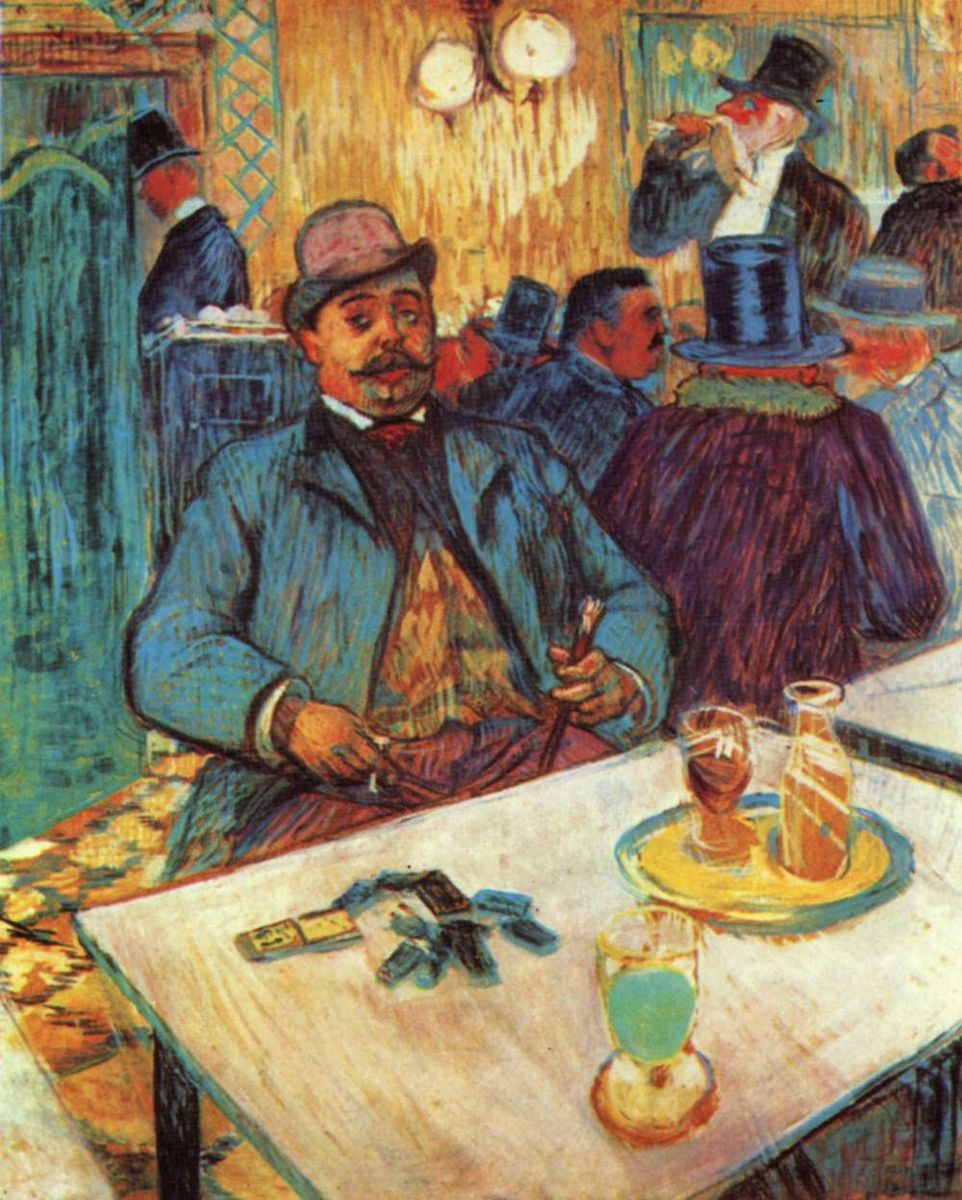
The Most Literary Liqueur

Absinthe:

In the poem Poison, from his 1857 volume The Flowers of Evil, Baudelaire ranked dish_toulouselautrec absinthe ahead of wine and opium: “None of which equals the poison welling up in your eyes that show me my poor soul reversed, my dreams throng to drink at those green distorting pools.” Rimbaud, who “saw poetry as alchemical, a way of changing reality,” Edmund White notes in his biography of the poet, saw absinthe as an artistic tool. Rimbaud’s manifesto was unambiguous: he declared that a poet “makes himself a seer through a long, prodigious and rational disordering of all the senses.” Absinthe, with its hallucinogenic effects, could achieve just that.

Guy de Maupassant imbibed, as did characters in many of his short stories. His A Queer Night in Paris features a provincial notary who wangles an invitation to a party in the studio of an acclaimed painter. He drinks so much absinthe he tries to waltz with his chair and then falls to the ground. From that moment he forgets everything, and wakes up naked in a strange bed.

Contemporaries cited absinthe as shortening the lives of Baudelaire, Jarry and poets Verlaine and Alfred de Musset, among others. It may even have precipitated Vincent Van Gogh cutting off his ear. Blamed for causing psychosis, even murder, by 1915 absinthe was banned in France, Switzerland, the US and most of Europe.

(Image of Monsieur Boileau by Henri Toulouse-Lautrec, 1893, via Wikimedia Commons)