How Profitable Is Legal Pot?

Legal Sale Of Recreational Marijuana Begins In Colorado

It’s less lucrative that you might expect:

Generally speaking, investors are interested in checking out a company’s gross profit margin, which is the ratio of its revenue minus cost of goods to its overall revenue. A high gross profit margin suggests the company could be highly profitable as it scales up its production. Over a six-month period, Brandon’s dispensary had an average gross profit margin of 32 percent. That’s not terrible—most grocery stores have gross profit margins around 20 percent—but it’s not great either, and not at all the financial bonanza many people make the legal marijuana business out to be. Starbucks, another company that deals in mind-altering, plant-based substances, regularly has gross profit margins of 57 percent, nearly twice that of Brandon’s dispensary.

When we shared a redacted version of Brandon’s financials with Alexander Ooms, managing partner at ClearCreek Partners, a Denver financial advisory firm, he was circumspect, to say the least. “Since I help companies raise capital, my thought here is, ‘Wow, it’s going to be really hard for any marijuana business to raise institutional equity,’ ” he says. “Can retail marijuana be a solid business? Clearly, yes. Can it be highly profitable? Not sure.”

Meanwhile, Harrison Jacobs looks at how legal weed threatens Washington’s medical marijuana system:

Medical marijuana’s lack of oversight was a prime reason so many voters with no stake in the marijuana debate voted to legalize recreational weed. Under I-502, the Washington Liquor Control Board authorizes licenses for businesses, enforces regulations and collects 25% excise taxes at three separate points: when the producer sells to the processor, when the processor sells to the retailer, and when the retailer sells to the customer.

Tack on state sales taxes and you are looking at nearly a 40% tax rate for recreational marijuana. A regulated, heavily taxed system had voters, politicians, and even potential marijuana investors with dollar signs in their eyes. Medical marijuana, on the other hand, is subject to only the state’s regular sales tax rate, which is just 6.5%.

It’s now clear that it doesn’t make sense to maintain Washington’s loosely medical marijuana business alongside the new, highly taxed recreational system. If people can obtain legal high-quality marijuana at a far cheaper price, users will likely attempt to go to the medical marijuana stores. That could be a lot of lost revenue for Washington state and provide ammunition for legalization’s opponents to call the experiment a bust.

Sullum also covers the issue:

Last summer Mark Kleiman, the UCLA drug policy expert who has advised Washington state’s marijuana regulators, told me “the legal market is going to have a hard time competing with the illegal market, but a particularly hard time competing with the untaxed, unregulated sort-of-legal market.” He was referring to the hundreds of medical marijuana suppliers in Washington, which are not licensed by the state but operate under creative interpretations of a provision allowing patients to create “collective gardens.” Yesterday the state House of Representatives took up the question of how to deal with these competitors. The leading proposal, reflected in a bill considered by the House Health and Wellness Committee, is to ban them. …

What works for patients … does not necessarily work for the state, which wants to maximize tax revenue and head off federal intervention by creating a tightly regulated system aimed at preventing diversion to minors and other states. Although the backers of I-502, Washington’s legalization initiative, assured skeptics that the measure would not change the rules for medical marijuana, it was pretty much inevitable that legislators would once they absorbed the fiscal and political realities created by the new distribution system.

(Photo: Tyler Williams of Blanchester, Ohio selects marijuana strains to purchase at the 3-D Denver Discrete Dispensary in Denver, Colorado. By Theo Stroomer/Getty Images)

Taking An Interest In National Interest

Beinart liked Rand Paul’s foreign policy speech:

Paul approvingly quoted the diplomat and scholar George Kennan as distinguishing “between vital and peripheral interests.” That may not seem significant, but it is. For most of American history, U.S. foreign policymakers had a rough idea of which chunks of the globe really mattered to American security. They started with the Monroe Doctrine, the belief that no foreign power should make the Americas a base for operations against the United States. In the 20th century that expanded to include the belief that no single power should be allowed to dominate Western Europe or East Asia, since that power might then threaten American access to key overseas markets. That principle was finally extended to the Middle East on the theory that no adversary should be allowed to threaten America’s access to oil. …

When the Cold War ended, however, the idea of a foreign power dominating Western Europe or East Asia, or creating a beachhead in the Western Hemisphere, suddenly seemed fanciful.

As a result, the language of national interest largely disappeared. It has been replaced by a discussion of foreign “threats” and American “values.” But without a definition of interests, it’s impossible to define what constitutes a threat. And without a definition of interests, supporting American “values” is a limitless pursuit. Americans will never reach a consensus on where exactly our interests lie, but just reintroducing the concept suggests an overdue recognition that because America’s power is finite, its interests must be too. Which is what Paul did on Tuesday night.

Larison responds:

[T]he problem of the last twenty years isn’t that American politicians and policymakers have ceased referring to national interest, but that many of them tend to treat even relatively minor foreign disputes and conflicts as things that threaten “our vital interests” and some go beyond that to pretend that “our vital interests” are at stake wherever our “values” are coming under attack. It isn’t enough to “reintroduce” the phrase national interest to the debate. It is essential that it be defined in a much less expansive, bloated way than it has been for the last twenty years, or else it will continue to be used to justify endless meddling all around the world.

Chart Of The Day

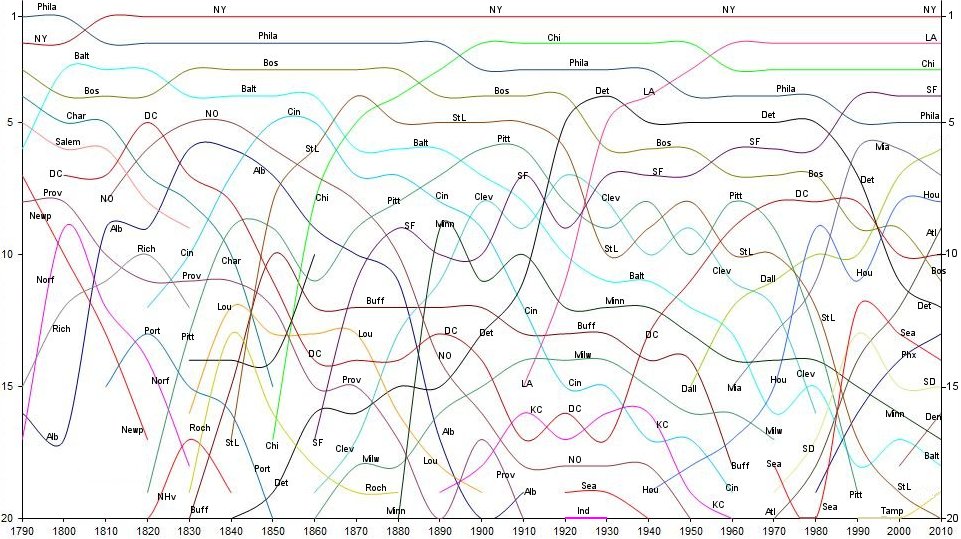
The rankings of the top 20 metro areas in the US over the past 200 years (click to enlarge):

Top Metro 2010

Cillizza comments:

Starting in the early 19th century, New York City has been number one and never given up that pole position. (It’s the Kentucky hoops recruiting class of big city populations.) Philadelphia, too, has been relatively consistent population-wise over the centuries — starting at number one in 1790 and standing at number five in 2010. Los Angeles, which only entered the top 20 metros in 1910, is now the second largest. Chicago — President Obama’s hometown — has risen from the mid-teens in late 1800s all the way to number three in 2010. …

Even more intriguing are the metros that have tumbled significantly over the decades.

Follow Detroit’s rise and fall and you follow the rise and fall of the manufacturing industry in America. The Motor City broke into the top 20 in 1840 and within 100 years was one of the five largest metro areas in the country. The last three decades have seen a population free fall in Detroit, however, all the way to the number 12 in 2010. St. Louis is now barely on the list after peaking at the fourth most populous metro area in the late 1800s. Baltimore has fallen from top five to barely top twenty.

He also looks at how current trends could change the electoral map:

In short, the demographic changes that began in the 1980s — population losses in the Northeast and Midwest, population gains in the South, Southwest and Plains — will only accelerate over the next few decades. … Republicans are right then to note that the states that will grow population-wise over the next five decades are in places where they have traditionally done well at the presidential level. But, the areas of growth within those states tend to be in places and groups where Republicans have struggled in recent elections. And, even if the 2060 map were in place in 2012, Romney still loses the election by a wide margin.

Reforming The Voting Rights Act

Last June SCOTUS ruled against the VRA’s preclearance provisions. Maya Rhodan reports on a bipartisan effort to amend the law:

The bill would offer new criteria under which states need to seek permission from the Justice Department before enacting changes to voting laws, known as preclearance. Reps. Jim Sensenbrenner (R-Wisc.) and John Conyers (D-Mich.), along with Sen. Patrick Leahy (D-Vt.), presented the new bill, which they called a direct response to the Supreme Court ruling. … The bill offers a new coverage formula requiring any state that has committed five voting violations over the most recent 15-year period be subjected to the Voting Rights Act’s preclearance provision. In the Shelby County v. Holder decision last year, the court ruled that the standards for determining the states and jurisdictions that needed preclearance were based too heavily on their history of discrimination, rather than current discriminatory practices. Under the new bill, individual jurisdictions could be subjected to preclearance after three voting violations, or only one if the jurisdiction has had “persistent and extremely low minority voter turnout.”

Justice Department rulings against voter ID laws, which have been pushed by Republicans and condemned by Democrats, would not count toward the number of violations that could lead to preclearance.

Zachary Roth and Adam Serwer explain the voter ID exemption:

The bill wouldn’t stop the Justice Department from challenging voter ID laws as racially discriminatory. But it would treat such laws differently from other types of racial discrimination in voting in two ways. First, the expanded Section 3 “bail-in” provision doesn’t apply to voter ID. So a state can’t be placed under federal oversight merely because it enacted a discriminatory voter ID law. That could have a big impact in Texas: The Justice Department’s ongoing lawsuit against the state’s voter ID law asks to have Texas brought back under federal oversight. Second, an objection by the Justice Department to a voter ID law can’t count as one of the five violations that puts a state under federal oversight—though a court ruling against a voter ID law does count.

Republicans in numerous states have pushed voter ID laws recently. Voter ID laws in Wisconsin, Texas, and North Carolina are currently being challenged by the Justice Department or civil rights groups. A wealth of evidence shows the laws have a disproportionate impact on minorities, who are more likely than whites to lack ID. But Spencer Overton, an expert on voting rights at George Washington University Law School, suggested the carve-out might be worth it if it helps gain GOP support. “These concessions,” Overton said, “may be necessary to satisfy the states’ rights concerns of the Roberts Supreme Court, and the political concerns of Republican members of Congress.[“]

Jenée Desmond-Harris looks at which states would lose preclearance requirements under the new rules:

According to the Advancement Project, the bill’s restoration of the federal preclearance requirement for states that have had at least five voting-rights violations within the past 15 years would appear to require Georgia, Texas, Mississippi and Louisiana to obtain preclearance before implementing voting changes. However, the civil rights organization also predicts that states such as Alabama, Alaska, Arizona, North Carolina, South Carolina, Virginia and Florida would not be automatically covered.

“The exclusion of North Carolina is especially egregious, considering the flood of harmful voting policies from the state,” said Advancement Project Co-Director Penda D. Hair in a statement released on Thursday. “These measures include a 2012 redistricting plan that diluted the power of African-American voters; the passage of a voter-suppression law that cut early voting by a week, eliminated same-day registration and requires strict voter ID, among many other restrictions; and last week’s decision that residents of the 12th Congressional District will be forced to go 300 days without representation.”

Supporters of the VRA are divided on the amendments:

While members of the Congressional Black Caucus signaled their support for the legislation, according to National Journal, the Hispanic Caucus and civil rights organizations have expressed misgivings. Voter ID laws are exempted from the violations list, meaning restrictive changes passed in North Carolina, Texas, and elsewhere won’t be held against those states. “These [voter ID] laws make it harder for people of color to  have a say in our democracy,” said Katherine Culliton-González, director of voter protection for the civil rights advocacy organization Advancement Project. “There’s no reason for this distinction. It’s arbitrary.” (Voter ID laws can still be blocked if the Department of Justice or federal courts deem them unfair; they just won’t count toward a state’s five-violation total.) Culliton-González also took issue with a provision that only court rulings, not consent decrees or settlements, will count in a state’s violation total. Organizations like Advancement Project often settle voting rights lawsuits to get changes implemented faster, she said, whereas the proposed bill would incentivize drawing out court proceedings.

Rick Hasen weighs the constitutionality of the new provisions:

There is lots of good and constitutional stuff in this bill. The idea of requiring jurisdictions making election changes to publicize them on the Internet is a terrific idea, and allows for timely lawsuits if necessary to combat draconian voting changes throughout the country. Disclosure is an unmitigated good here, and it is hard to see any constitutional objection. Similarly, making it easier to get preliminary injunctions in section 2 cases makes a lot of sense, and clears procedural hurdles without infringing on state sovereignty. … The new coverage formula pegged to relatively recent voting rights violation is likely, but not certain, to be held constitutional if enacted. The benefit of this new formula is that it is tied to current conditions—looking at recent voting rights violations, and in the case of subdivisions, recent minority voter turnout statistics. This tends to defeat the Shelby County holding that requires under principles of “equal sovereignty” of states that any preclearance regime be tied to current conditions.

Where the bill goes from here:

The effort does not yet have full buy-in from Republican leadership, said a senior GOP aide. Leaders are wary of pushback from conservative members and are skeptical that the bill could attract the support of a majority of the Republican Conference. They are also concerned that Democrats would politicize the issue to make gains in the 2014 midterm elections. Furthermore, Sensenbrenner, a former chairman of the Judiciary Committee and an author of the last extension of the Voting Rights Act in 2006, has occasionally voted against leaders’ priorities, most recently casting a “no” vote on the omnibus appropriations bill. That has damaged his clout with leaders, the aide said. Conyers suggested the fate of the new VRA legislation is in the hands of the House Judiciary panel’s current chairman, Robert W. Goodlatte, R-Va. “I haven’t raised it directly with him yet so I can’t say” whether he would support the effort, Conyers conceded, “but the question may come down to whether we want to do it in parts. … I’m not sure how this is going to play out.”

Beutler expects the GOP to muck it up:

[T]he full menu of objections suggests that Republicans are considerably more focused on the internal and external political ramifications of fixing the VRA than on the substantive and moral questions the Supreme Court thrust upon them. Not a hopeful sign. There are one or two countervailing dynamics at work, though. The bill is designed to attract some non-trivial amount of GOP support, including from Southern Republicans. Rep. Jim Sensenbrenner, R-Wis., who co-authored the bill, told reporters on Thursday that Reps. Trey Gowdy, R-S.C., and Spencer Bachus, R-Ala., have both signed on to the bill, and Sen. Patrick Leahy, D-Vt., expressed unusual confidence that the bill will pass the Senate.

And at the risk of veering into amateur psychology, I’m pretty convinced that some Republican leaders — particularly Majority Leader Eric Cantor, R-Va. — sincerely believe it would be wrong to let the Supreme Court’s decision be the final word on voting rights in states and districts with histories of minority disenfranchisement. But with $2 and a bundle of Eric Cantor’s best intentions, you can buy a slice of pizza after getting turned away at your polling place in November. And at this point it doesn’t look like GOP leaders are interested in putting more than their intentions on the line.

Do They Even Know What’s In The Bill?

In the to and fro on the AIPAC sanctions bill, it’s easy to get lost about how precisely the law would immediately kill the negotiations. Edward Levine has a terrific primer on why that would happen, citing various, specific parts of the law:

Section 301(a)(2)(I) requires the President to certify, in order to suspend application of the new sanctions, that “Iran has not schumerchipsomodevillagetty.jpgconducted any tests for ballistic missiles with a range exceeding 500 kilometers.” While this objective may be consistent with a UN Security Council resolution, it moves the goalposts by making the new sanctions contingent not just on Iran’s nuclear activities, but also on its missile programs. This paragraph also does not specify a time period (although the requirement in section 301(a)(1) for a certification every 30 days might imply one), so Iran’s past missile tests beyond 500 km might make it impossible for the President ever to make this certification.

Which is the point. Or take this provision:

Section 301(a)(4) reimposes previously suspended sanctions if the President does not make the required certifications. This paragraph applies not only to the sanctions mandated by this bill, but also to “[a]ny sanctions deferred, waived, or otherwise suspended by the President pursuant to the Joint Plan of Action or any agreement to implement the Joint Plan of Action.” Thus, it moves the goalposts even for the modest sanctions relief that the United States is currently providing to Iran.

Or this one:

Section 301(b) allows the President to suspend the bill’s sanctions annually after a final agreement is reached with Iran, but only if a resolution of disapproval of the agreement is not enacted pursuant to section 301(c). The primary effect of this insertion of Congress into the negotiating process will be to cast doubt upon the ability of the United States to implement any agreement that the E3+3 reaches with Iran. The provision is also unnecessary, as most of the sanctions relief that would be sought in a final agreement would require statutory changes anyway.

This stuff is hauling out old agendas and side-issues to ensure that Iran’s government cannot even begin to agree to a final deal. I’d take Levine’s analysis seriously if I were another Democrat sabotaging their own president, and all the major world powers:

If these requirements are enacted, all parties to the negotiations will interpret them as barring the United States from implementing the sanctions relief proposed in any feasible agreement. Rather than buttressing the U.S. position in the negotiations, therefore, Cory Booker Marries Same Sex Couples As NJGay Marriage Law Goes Into Effectthey will bring an end to those negotiations. Worse yet, they will create large fissures in the E3+3 coalition that has imposed international sanctions on Iran. Thus, even though the bill purports to support sanctions, it may well result in the collapse of many of them.

It is in that context that one should read the sense of Congress, in section 2(b)(5) of the bill, that if Israel is compelled to take military action against Iran’s nuclear weapon program, the United States should provide “military support” to Israel. While such support could be limited to intelligence and arms sales, there would be great pressure for the United States to take a more active military role. So this bill, by its many steps to close the window for diplomacy with Iran, could end the international sanctions regime and lead either to a nuclear-armed Iran or to a war in which U.S. armed forces might well be active participants.

It’s hard to believe that that’s what Michael Bennet or Cory Booker want to happen. And it’s something the president has been working to avoid for the past five years.

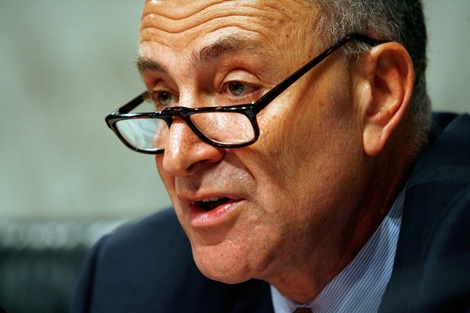
(Photo of Democratic Senators Chuck Schumer and Cory Booker by Getty Images.)

The Softer Side Of Plastic

Laura Bennett reviews the new film on Romney:

[A]s a campaign documentary, Mitt has none of the logistical intricacy of The War Room (about Clinton’s 1992 race) or Street Fight (Cory Booker’s 2002 mayoral bid in Newark). In fact, the actual mechanics of campaigning are notably absent. Though Whiteley is present at many politically crucial moments—before and after both presidential debates, through some of the fallout from the 47 percent gaffe, during the election night moment where Romney drafts his concession speech—he never seems more than mildly distressed about the actual prospect of losing. It’s a family drama much more than a campaign drama, and Whiteley’s willingness to embrace that fact is the source of the film’s unexpected warmth. In one scene, they sit together at the kitchen table laughing loudly, and somewhat uncannily, at a David Sedaris monologue on “This American Life.”

Mitt does not exactly save Romney from his reputation as a robot. But his formality begins to look less like an artifice and more like a kind of dorky tic that binds the Romneys, like a well-intentioned, alien tribe, against the larger world.

Marlow Stern is more critical:

For all the access granted to Whiteley and his filmmaking team, Mitt doesn’t contain too many illuminating scenes. We never really see Romney criticizing anyone—even Candy Crowley—nor do we see his reaction to many game-changing incidents during his campaign (e.g. the “47 percent” video). He doesn’t even utter the name “Sarah Palin” in the film. We also don’t see Romney discuss any hot button issues, from gay marriage and abortion to the repeal of Obamacare and Dodd-Frank Wall Street reform, nor do we see him address his numerous contradictions.

The Purity Of The Ideological Mind

Every now and again, a particularly rigid ideologue struts across the public stage. He may merely start out as a brawler or a comic or just a partisan, but eventually, as his awareness of his own ideological purity suffuses him, as the beauty of the eternal truth surrounds him, he doesn’t ever need to look beyond his own head for reality. He knows it all already. He knows it all instantly – in advance. He is the man Edmund Burke warned us about. His name is Rush Limbaugh and Conor Friedersdorf is his faithful, devastating scribe.

Malkin Award Nominee

“The question at the core of the debate of homosexuality is; what do we do with an abnormal person? Do we kill him/her? Do we imprison him/her? Or we do contain him/her? … You cannot call an abnormality an alternative orientation. It could be that the Western societies, on account of random breeding, have generated many abnormal people,” – President Museveni of Uganda, in a letter also appearing to argue that Uganda’s eliminationist anti-gay law might be invalid on technical grounds.

Jim Burroway has some accounts of the confusing developments here.

African-Americans And Prohibition Of Weed

A Medical Marijuana Operation In Colorado Run By Kristi Kelly, Co-Founder Of Good Meds Network

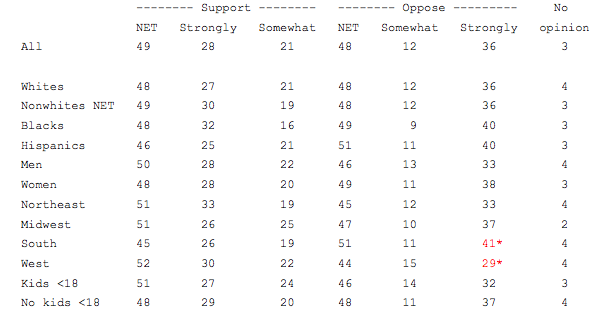
The latest poll on legalization of marijuana from ABC News shows an even split – 49 to 48 percent – by Americans on the subject – not a clear majority as some other recent polls have found (Gallup’s in particular). That’s still a record high for the ABC poll, which has the benefit of identical wording over time: “Overall, do you support or oppose legalizing the possession of small amounts of marijuana for personal use?” Support has doubled since the mid-1980s.

But what’s interesting to me about the poll is its internals. They’re really surprising to me. I asked ABC News for the full data and here it is:

Screen Shot 2014-01-17 at 12.18.19 AM

So one of the most powerful arguments for legalization of marijuana – that Prohibition grotesquely singles out African-Americans for criminal enforcement and spares whites – carries no more weight among African-Americans than it does among whites. Of those African-Americans who feel strongly about the subject, 40 percent oppose legalization and only 32 percent support it. Overall, there’s no statistically significant difference between whites and blacks on this. I’d be fascinated to hear from readers why they think this might be so. It seems on the surface that social conservatism is outweighing civil rights. But I’m genuinely baffled.

The second most striking thing is that having kids in the home doesn’t seem to change views much.

So that’s another perhaps lazy assumption debunked in this poll – that “protecting kids” works either for or against legalization. Even what you’d imagine would be a big regional split – between the West and the South – is pretty much a damp squib. The West favors legalization 52 – 44; the South opposes it by a similar margin. The only statistically significant variation in the regional polling is between the South and the West among those strongly opposing legalization. It’s 41 percent in the South and only 29 percent in the West. That makes more intuitive sense. But the South is far closer to the rest of the country on pot than on gays.

So what factor is statistically significant? It’s age:

Americans 65 or older are half as likely to approve of legalization as are those age 18 to 64 – 27 vs. 54 percent. And 59 percent of the elderly disapprove strongly. Support peaks among 18 – to 39 – year-olds, at 59 percent , including 37 percent who strongly support the idea.

This, in other words, is an issue like marriage equality or president Obama’s base of support. It’s generational. The young cannot see the logic behind criminal prohibition of a pleasurable plant much less dangerous than alcohol or tobacco. The old retain the attitudes and the fears of the past. Perhaps, over time, the young will become more like the old. But the huge shift in favor of this over the last two decades, like the huge shift in favor of marriage equality, suggests precisely otherwise. They all suggest a new, saner, more tolerant America is out there, waiting for one recalcitrant faction of one particular generation to die.

(Photo: Matthew Staver for the Washington Post via Getty Images)

Where Are Obama’s Scandals? Ctd

Waldman searches, again, and comes up empty:

There are three possible explanations for the lack of a major scandal in the Obama administration. The first is that something truly horrific has gone on, but as of yet it hasn’t been discovered. The second is that the scandals we know about haven’t been fully investigated, and will eventually yield more wrongdoing than we currently understand. And the third is that the administration has not, in fact, committed any horrible crimes. Which seems most likely?

That isn’t to say that they haven’t made plenty of mistakes, because they have. And there are three years left in Obama’s term, so you never know—maybe someone will discover that he’s having an affair with Jennifer Lawrence, or that Valerie Jarrett is a mole for the Yakuza, or that those FEMA concentration camps are real. But there’s also the chance that he’ll end his term without any major scandal, which would be quite something.

Previous Dish on Obama’s scandal-free status here.