Richard Gunderman emphasizes that “a dementia diagnosis is not the medical equivalent of falling off a cliff”:
To provide the best possible care for dementia patients, we n eed to get past some important misconceptions about the disease. One is that Alzheimer’s, which accounts for about 80 percent of dementias, is strictly a disorder of memory. In fact, it usually involves many mental processes, including the abilities to focus attention, organize thoughts, and make sound judgments. Another is the notion that Alzheimer’s is strictly a disease of cognition. In reality, it can affect emotions and personality, as well. But perhaps the biggest misconceptions [occupational therapist] Theresa [Klein] encounters regards a dementia diagnosis as the end.
Naturally, being diagnosed with dementia represents an important change in life, but it is certainly not a death sentence. Some patients diagnosed with Alzheimer’s disease will live another 15 and even 20 more years, though others will progress more quickly. Nor does it represent the end of all that is good in life. Theresa and her colleagues have learned a crucial lesson that needs to be disseminated to caregivers everywhere: “We should dwell less on lamenting what dementia patients are incapable of and focus more on bringing out and celebrating what they are capable of doing.”
(Video: “My Little Friends” documents a program designed in a facility in Mt. Kisco, New York that connects elders with dementia and young children)
Brian Doherty discusses how citations for petty crimes, like Los Angeles’ renewed push to strictly enforce jaywalking laws, disproportionally target the poor:
[A]n earlier wave of jaywalking enforcement in Los Angeles began back in 2006, under the aegis of the “Safe Cities Initiative.”L.A. police had already been issuing over a thousand tickets per month for jaywalking in the name of homeless management. A 2007 study from UCLA law professor emeritus Gary Blasi, “Policing Our Way Out of Homelessness? The First Year of the Safer Cities Initiative on Skid Row,” found such jaywalking or other petty citations given at rates 48 to 69 times those in the rest of the city. It noted that “of the 1,000 people per month who receive citations and are unable to pay the fines, most will face subsequent arrest and jail, even though the original offense may have been littering or a pedestrian signal.”
Balko focuses on how cities use these petty citations to make money at the expense of their residents’ wellbeing:
I’ve written quite a bit about how cities have come to use traffic cameras not to maximize public safety, but to bolster city revenues. It’s gotten to the point where several cities have been caught shortening yellow lights to hand out more tickets, a practice that makes intersections significantly more dangerous. … Arguments against policies like primary seatbelt laws, jaywalking enforcement, traffic cameras, “distracted drivers” laws, and arbitrary speed enforcement are often met with derision. But these laws inevitably become more about revenue generation than public safety, and when local and state governments start to see motorists and pedestrians as piggy banks, you get policies like those above. For a good percentage of the population these fines can be devastating, and for them, there’s nothing petty about the aggressive enforcement of petty crimes.
Bride Fatme Inus, her face painted white and decorated with sequins, emerges to present herself to villagers towards the end of her two-day wedding to Mustafa Sirakov on January 12, 2014 in Ribnovo, Bulgaria. The centuries-old tradition of painting the bride’s face white and decorating it with sequins and coloured paint is called “gelena” in Bulgarian and is unique to Ribnovo, located in the mountains of southern Bulgaria. Ribnovo weddings only take place in the winter and the entire village participates with group dances on the main square. Ribnovo is predominantly inhabited by Pomaks, a Muslim ethnic minority who are the descendants of Christian Bulgarians who converted to Islam during Ottoman rule. By Sean Gallup/Getty Images.
In attempting to build modern nation-states, the authorities insisted that Jews take last names so that they could be taxed, drafted and educated (in that order of importance). For centuries, Jewish communal leaders were responsible for collecting taxes from the Jewish population on behalf of the government, and in some cases were responsible for filling draft quotas. Education was traditionally an internal Jewish affair.
Until this period, Jewish names generally changed with every generation. For example, if Moses son of Mendel (Moyshe ben Mendel) married Sarah daughter of Rebecca (Sora bas Rifke), had a boy and named it Samuel (Shmuel), the child would be called Shmuel ben Moyshe. If they had a girl and named her Feygele, she would be called Feygele bas Sora.
Jews distrusted the authorities and resisted the new requirement. Although they were forced to take last names, at first they were used only for official purposes. Among themselves, they kept their traditional names. Over time, Jews accepted the new last names, which were essential as Jews sought to advance within the broader society and as the shtetles were transformed or Jews left them for big cities.
Some of the names were derived from personal traits:
Alter/Alterman — old; Dreyfus—three legged, perhaps referring to someone who walked with a cane;
Erlich — honest; Frum — devout ; Gottleib — God lover, perhaps referring to someone very devout; Geller/Gelber — yellow, perhaps referring to someone with blond hair; Gross/Grossman — big; Gruber — coarse or vulgar; Feifer/Pfeifer — whistler; Fried/Friedman—happy; Hoch/Hochman/Langer/Langerman — tall; Klein/Kleinman — small; Koenig — king, perhaps someone who was chosen as a “Purim King,” in reality a poor wretch; Krauss — curly, as in curly hair; Kurtz/Kurtzman — short; Reich/Reichman — rich; Reisser — giant; Roth/Rothman — red head; Roth/Rothbard — red beard; Shein/Schoen/Schoenman — pretty, handsome; Schwartz/Shwartzman/Charney — black hair or dark complexion; Scharf/Scharfman — sharp, i.e intelligent; Stark — strong, from the Yiddish shtark ; Springer — lively person, from the Yiddish springen for jump.
A few Jewish dudes got especially creative:
Update from a reader:
Interestingly, the word feygele (or feygela) is used in modern Yiddish to refer to a gay man. Most often, the word is spoken with some affection and is not typically used as a slur. Little did I realize that it was also a woman’s name.
Another:
Just a warning – you are likely to get a zillion emails about how sloppy and inaccurate the scholarship is in that piece on “Jewish surnames.” A good many of the names are misspelled (reversals of ei and ie being the most common error, but by no means the only one), and many of the derivations are patently wrong. I saw it in Slate and wrote it off as typical Slate shallow unresearched crap. Note that the original article is followed by a list of corrections as long as your arm (inexcusably not included in the Slate pickup).
Whitney Mallett delves into a thriving subculture:
It’s a three-hour drive from Mindy’s home to [Kern Valley State Prison in Delano, California] when there’s no traffic. When I talked to her on the phone, she’d already been in the car for four hours. She makes this trek every Saturday; once a month she gets a hotel room in Delano and visits Cody on both Saturday and Sunday. Her relationship is documented on her Instagram account, where she posts pre-visit selfies and screenshots of her recent call history after phone calls with Cody, shares letter-writing campaigns in support of allowing lifers conjugal and family visits, and regrams the prison photobooth pictures you can print with tokens during visiting hours—often hashtagged #highschoolsweathearts or #kvsp, for Kern Valley State Prison.
When Instagram is used this way, it’s more than mere vanity for women like Mindy and Alex. Hashtags like #prisonwife, #visitday, and #freemybaby help women connect and share stories and experiences. Mindy told me Instagram is somewhere she can find support without judgment, adding that in the rest of the world “there are too many negative comments and ideas about why I’m with a prisoner.”
Jiayang Fan reports on efforts to curb China’s vast trade in human organs:
Even though China performs more transplants annually than any country except the United States, less than one per cent of the population in need of life-saving transplants receives them (as compared to about twenty per cent in the United States). According to China’s Ministry of Health, some 1.5 million people continue to wait for transplants. Traditional Chinese customs calling for bodies to be buried or cremated intact (so that a person may be reincarnated whole) discourage individuals from donating their organs. For the past three decades, the government has tried to make up the difference by harvesting organs from executed prisoners. Until 2007, nine-tenths of the country’s organ supply came from its tens of thousands of death-row inmates, whose executions have sometimes been expedited for the purpose of harvesting organs. …
Bowing to international pressure over the past five years, the Chinese have recently introduced measures to reduce the number of executions and to curb organ tourism, a practice that brings foreigners facing long waits for voluntary donations in their own countries to China, where they can pay to immediately obtain the needed organ. Although no official records are kept for such transactions, the tourists and donors have remarkably consistent profiles: the tourist, usually the citizen of a developed country, pays a substantial sum; the donor is a financially desperate Chinese citizen, or, in some cases, a permanently incarcerated one. …
Nicholas Bequelin, a senior researcher with Human Rights Watch in Hong Kong, told me that “the complete lack of transparency led to the emergence of a lucrative gray market, through which wealthy or politically connected individuals could source the organ needed for a transplant from scheduled executions.” According to Bequelin, the booming organ business has, in turn, led to a situation “in which unscrupulous criminals have started sourcing organs themselves, either by buying organs from sellers or even, in some cases, kidnapping and harvesting organs from their victims.”
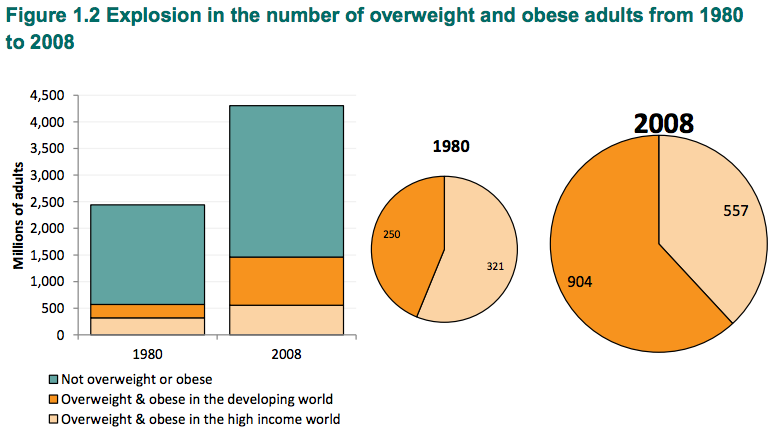
A new study (pdf) finds that obesity rates are skyrocketing in developing countries, such that “1.46 billion adults — or one third of the global adult population — are now overweight or obese”:
Between 1980 and 2008, the number of obese or overweight people in the developing world nearly quadrupled. Steve Wiggins, who co-authored the report, believes that’s a function of income growth in poorer nations. “As countries go from being low-income to middle-income, and heading towards high-income, people earn more [money], and they can eat the foods that they find tasty,” Wiggins explained to NPR. That doesn’t mean the obesity epidemic isn’t related to poverty; health disparities are still evident among different socioeconomic classes. Mexico provides one of the clearest examples of this dynamic. Mexico’s obesity rate surpassed the United States‘ this past summer, with the issue largely concentrated among the lower class. “The same people who are malnourished are the ones who are becoming obese,” physician Abelardo Avila with Mexico’s National Nutrition Institute told CBS News at the time. “In the poor classes we have obese parents and malnourished children. The worst thing is the children are becoming programmed for obesity. It’s a very serious epidemic.”
Sophie McBain examines the public health implications:
Over the past thirty years, wealthier individuals in low-income countries have been eating more, leading more sedentary lifestyles, and consuming a diet richer in meat, fat and sugar than ever before. The proportion of overweight and obese people in North Africa, the Middle East and Latin America is now about the same as in Europe and North America. This places hundreds of thousands of people in these regions at heightened risk of heart disease and diabetes, many of whom will not have access to adequate medical care and advice. According to the World Health Organisation, for instance, 80 per cent of diabetes deaths occur in low to middle income countries, and by 2030 diabetes is projected to be the seventh leading cause of death worldwide.
Meanwhile, the World Food Programme estimates that 784m go hungry, and the ODI reports that a third of infants worldwide are stunted due to malnutrition.
Jacob Weisberg reviews (NYT) Gabriel Sherman’s new book on Roger Ailes:
In Sherman’s telling, Ailes was driven more by money than by any fixed set of political beliefs. As late as 1972, he was willing to work for Democrats. Putting out his shingle as a theatrical producer, he brought an eco-musical called “Mother Earth” to Broadway for the briefest of runs. He took Robert Kennedy Jr. to Africa to make a wildlife documentary and staged “The Hot l Baltimore,” a Lanford Wilson play about down-and-outs. His identification with the right was mostly a matter of opportunities.
But Isaac Chotiner thinks Sherman exaggerates Ailes’ power:
[T]here is absolutely no doubt that Ailes is a remarkably intuitive and innovative television executive who took an upstart conservative channel and turned it—in less than a decade—into an agenda-setting behemoth. Sherman is so awed by Ailes’s skills, however, that he ends up overstating his influence, and taking Ailes’s own narrative too much for granted. “Roger Ailes has the power, more than any single person in American public life, to define the president,” he writes in his prologue. The problem is that Sherman’s account never sufficiently challenges Ailes’s cynical view of politics, wherein image and narrative are everything. Ailes has certainly revolutionized television news, but winning audience share is a far cry from winning the White House.
After leafing through several books on Ailes, Jill Lepore contrasts his biographers with Hearst’s:
One critic observed, “Mrs. Older writes an authorized biography, and the result is about what one would look for.” Chafets compares Ailes to Rudyard Kipling and Teddy Roosevelt. “Likenesses between William Randolph Hearst and Napoleon, Charlemagne, the Louis of France and the Popes of Rome are noted in Mr. Hearst’s official biography,” a reviewer remarked about Older’s book, “yet it is possible that Mrs. Fremont Older, the biographer, is amazed at her own moderation.”
Both Carlson and Bates’s and Lundberg’s Hearst biographies appeared a couple of months later, in April, 1936. Carlson was a historian of journalism, Bates an English professor; their account is a story of Hearst’s life as a decline into a savage cynicism, to the point that his “so-called ‘news’ papers are little more than a gigantic chain-store, selling political patent medicines and adulterated economics.” Lundberg called for a congressional inquiry into Hearst’s enterprises. The New Yorker called Beard’s introduction “as juicy a piece of invective as you will find in several months of Sundays.”

 She makes this trek every Saturday; once a month she gets a hotel room in Delano and visits Cody on both Saturday and Sunday. Her relationship is documented on her Instagram account, where she posts pre-visit selfies and screenshots of her recent call history after phone calls with Cody, shares letter-writing campaigns in support of allowing lifers conjugal and family visits, and regrams the prison photobooth pictures you can print with tokens during visiting hours—often hashtagged #highschoolsweathearts or #kvsp, for Kern Valley State Prison.