For Richer Or Poorer

Stephanie Coontz insists that marriage isn’t a solution to poverty:

In an era when two incomes are increasingly necessary to raise a family, getting married makes excellent economic sense for a woman who wants to have a child. But first she needs to find a man who can actually make a financial contribution to the marriage — an increasingly difficult task, especially for working-class African-American women. University of Maryland sociologist Philip Cohen reports in his forthcoming book, “The Family: Diversity, Inequality and Social Change,” that in big cities, there are often fewer than 50 single, employed black men for every 100 unmarried black women in the same age range, because of poor employment opportunities, high incarceration rates and disproportionate mortality rates. White working-class women, with or without high school degrees, also increasingly face a shortage of marriageable men. And they have good reason to approach marriage cautiously, even if they get pregnant, because economic insecurity is strongly associated with marital distress. This is one reason that high school graduates are twice as likely to divorce as more economically secure college graduates. Getting married and then divorcing often leaves a woman worse off than if she had remained single, with or without children, and had focused on improving her own earning power.

Yglesias compares marriage to having housemates:

Having roommates really did greatly improve my personal finances when I was in my early 20’s. And the same thing happened when my wife and I moved in together. We split the Internet bill, shared one Netflix account, etc. But the greater efficiency of shared expenses isn’t really what’s magical about marriage, and what’s magical about marriage isn’t really what leads to the poverty reduction.

McArdle takes the debate in a different direction, noting that marriage allows for specialization:

[M]y husband, who is much tidier than I am, took over organizing the house. Now, unless it’s a piece of my clothing or kitchen equipment, I have no idea where we keep anything. And while I’m pretty sure I used to be able to put up shelves, now all I know how to do is ask my husband to do it.

On the other hand, he has no idea how much money we have, or in what accounts. And he can’t do the grocery shopping, because he doesn’t know what we consume. Individually, we are less competent to survive on our own. But collectively, we eat better, and we have a tidier house and better-managed finances. And our shelves don’t fall down so often. …

Specialization also allows for external income gains — perhaps one reason that married men make a lot more than single ones do and married households are richer than single ones. Some of that is selection effect, of course — stable, responsible men are probably more likely to get married, especially in this day and age.

“A Golden Age Of Competitiveness”

Competition

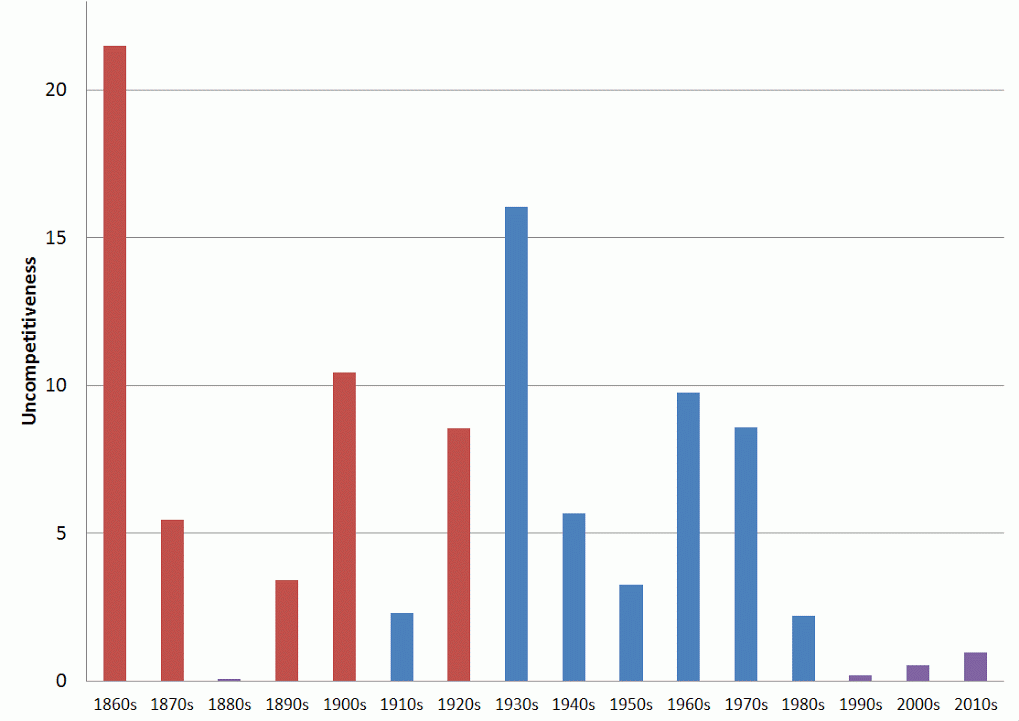
Frances Lee created the above chart, which “displays a simple index of two-party competition at the national level for every Congress between 1861 and the present”:

Competition fuels party conflict by raising the political stakes of every policy dispute. When control of national institutions hangs in the balance, no party wants to grant political legitimacy to its opposition by voting for the measures it champions. After all, how can a party wage an effective campaign after supporting or collaborating with its opposition on public policy? Instead, parties in a competitive environment will want to amplify the differences voters perceive between themselves and their opposition. They will continually strive to give voters an answer to the key question: “Why should you support us instead of them?” Even when the parties do not disagree in substantive terms, they still have political motivations to actively seek and find reasons to oppose one another. In an environment as closely competitive as the present, even small political advantages can be decisive in winning or losing institutional majorities.

Seth Masket welcomes the news:

Competitiveness is the key to democratic accountability. We generally want our politicians and parties to be responsive to voters and to be nervous about making mistakes. … Despite regular claims that one party or another has an electoral lock on the country or that demographic shifts are creating a permanent majority, we’re living in a golden age of competitiveness. If one party pushes its agenda too far or mismanages the country, that can cost it majority control. Political actions actually have consequences.

Making The Dems Play Defense

The Senate landscape is getting tougher for Democrats:

Republicans have found a candidate to challenge Sen. Mark Warner (D-VA) this year — GOP strategist and lobbyist Ed Gillespie. Gillespie faces an uphill fight; after all, Warner is the most popular politician in Virginia. But don’t lose sight on the fact that Senate Republicans have now put NUMEROUS seats in play beyond the Alaska/Arkansas/Louisiana/Montana/North Carolina/South Dakota/West Virginia playing field. They have a strong candidate in Michigan; they might get Scott Brown to run in New Hampshire; and now they have Gillespie in Virginia, who at the least will make Warner and the Democrats have to spend money in Virginia this year. We’re not saying VA or NH or MI are suddenly toss-ups. But they aren’t run-aways anymore for the Dems. That’s more resources and more incumbents (toss in Colorado and Minnesota to boot) asking the DSCC for help. By comparison, the only two Republican seats Democrats have put in play are Georgia and Kentucky, and both are states Obama lost in 2008 and 2012. There are no Chris Coons’ or Joe Donnellys waiting in the wings to take advantage of Tea Party victories in Mississippi, South Carolina, Kansas, Tennessee or Texas.

Weigel unpacks the GOP’s thinking:

Republicans are at Peak Confidence because of Obamacare. They can see it poisoning the water for even solidly popular Democrats the way Iraq did for solidly popular Republicans in 2006, or the financial crash did in 2008. This is ambitious.

Yes, Virginia’s a better Republican target when Barack Obama isn’t on the ballot. But Warner isn’t Cuccinelli. Warner hasn’t left himself exposed on the left—the big hit on him is that, like every Democrat in the Senate four years ago, he voted for Obamacare. Gillespie’s betting that even a candidate basically genetically engineered to win elections in modern Virginia can be brought low by Obamacare.

Last week, Sabato argued that Republicans could do very well this fall:

A hidden determinant is the division of the Senate into three classes—one-third is elected every two years, making the combination of competitive Senate seats unpredictable and ever shifting, unlike in the heavily gerrymandered House. One party is usually favored to gain seats from the outset, thanks to the pattern of retirements as well as the structure of the Senate class on the ballot.

So: How many Democratic Blue or Republican Red seats are there in an election year? How many incumbents are running, and did any senators holding seats in states favoring the opposite party step aside? How strong has the candidate recruitment been in both parties? Generally speaking, this year’s Senate slate strongly favors the Republicans.

Clean Coal, Dirty Water

A chemical spill from a coal facility has left 300,000 West Virginians with no drinking water since Thursday. Tomasky, who grew up in the area, reports:

My friend Rob Byers, the executive editor of The Charleston Gazette, the excellent (and independent) flagship newspaper of the state, drives past the Freedom Industries plant on his way to work every day. Thursday morning, something was different. “The smell,” he told me. “It just smelled like Robitussin coming into the car.” Later that day, a colleague took a drink from the newsroom water fountain. Oh. My. God, he said. Another colleague didn’t believe him and went and took a drink. And that’s the last drink taken.

There haven’t been any deaths, and Byers described it as more of a major inconvenience than a full-out crisis. For now, the National Guard has started bringing in bottled water. No one can say, or is willing to say, how long things are going to stay like this. In a rather unfortunate coincidence, the chemical plant is just upriver from a water intake facility. So the water system has been heavily infiltrated. In essence, the whole region’s water system has to be flushed out until the chemical runs through (to where, let’s not even think). “Does everybody just have to run their water at the same time?” Byers wryly wonders.

Maggie Koerth-Baker explains what exactly is contaminating the Elk River:

First off, what is 4-methylcyclohexane methanol? It’s used in coal washing, a process that it would be reasonable to think of as “a good thing”, because washing coal is what removes a lot of the sulfur that would otherwise contribute to acid rain. Basically, while we’d all prefer we didn’t burn coal, if we’re going to burn it, we want it to be washed. To do that, coal is crushed fine and dumped into a bath of frothy, foamy water. Relatively light coal floats and sticks to the foam. Relatively heavy sulfurous rock sinks. 4-methylcyclohexane methanol is one of the chemicals that can be used to make the froth.

This could explain why there hasn’t yet been any news of major fish kills associated with the spill, writes hydrologist Anne Jefferson at the Highly Allochthonous blog. This stuff is chosen for the job it’s meant to do because it’s light and floats on water. Meanwhile, because it’s winter, most of the fish are hanging out deeper in the water. But that doesn’t mean it’s safe and everything is cool. In fact, the big problem with 4-methylcyclohexane methanol is that there doesn’t seem to be a well-documented safety profile on it, one way or the other. Deborah Blum, a journalist and author who writes extensively about chemicals, poisons, and toxicology, tried to track down the safety data on 4-methylcyclohexane methanol and had a damn hard time doing so.

Chris Mooney talks to Blum about how little we know:

“We know methanol is toxic, we know that methylcyclohexane is moderately toxic, but I haven’t seen a full analysis of the entire formula,” says Blum. “Still, I think we can assume there’s nothing here that we’d want to drink or like to see in our rivers.” However, given that it is in the Elk River it will be “very diluted,” she added, and likely will ultimately be broken down and digested by microbes. In the meantime, Blum praised authorities’ cautionary approach. The fact that relatively little is known about the compound, says Blum, represents “another reminder that we have way too may poorly researched compounds in the toxic registry and we desperately need to update our creaking regulations regarding industrial materials.”

Benen thinks now might a good time to start talking about safety regulations again:

If recent history is any guide, once the crisis is resolved, the policy debate will fall into a familiar pattern: conservatives and their industry allies will insist that government regulation of free enterprise must always be resisted. But in this case, it was the private sector that caused the calamity; it’s the public sector helping put things right; and it’s government regulations that can help prevent similar crises in the future.

Bringing The Church Into Balance

Yesterday, the Pope appointed 19 new Cardinals, none of them Americans. Barbie Latza Nadeau reviews the picks:

Francis chose two new cardinals from Africa, two from Asia, two from North and Central America, and three from South America. Only two Europeans were chosen outside the Curial appointments. The cardinals’ primary responsibility is to vote for the new pope in a secret conclave held in the Sistine Chapel when a sitting pope dies, or, as in the case of Pope Benedict XVI, resigns.

Vatican spokesman Father Federico Lombardi said that the appointments of Bishop Chibly Langlois of Haiti and Archbishop Philippe Nakellentuba Ouédraogo of Burkina Faso underscored Pope Francis’s primary focus on ministering to the poor.

John Allen puts the choices in context:

With just under 70 million Catholics, the United States accounts for around six percent of the global Catholic total, meaning that it’s long been over-represented in the College of Cardinals relative to population.

With 11 cardinals under 80 and thus eligible to vote for the next pope, the United States has roughly ten percent of the world’s cardinal-electors. Both in 2005 and 2013, cardinals from the United States cast more ballots to elect the next pope than Brazil and the Philippines combined, despite the fact that those two nations together represent roughly four times the Catholic population of the United States.

Today’s announcement thus represents not only an acknowledgement of the church in the developing world, but also, arguably, a healthy reminder to Catholics in traditional Western powerhouses such as the United States of where they stand in terms of the Catholic footprint in the early 21st century.

Ditch The Rock?

Screen shot 2014-01-09 at 3.06.01 PM

Kay Steiger thinks engagement rings should go the way of the dowry:

[T]he amount one is supposed to spend on said diamond engagement ring — two month’s salary, supposedly— is a “tradition” that was invented by the diamond industry giant De Beers less than a century ago. (I really recommend reading The Atlantic’s expose on this — it may be from 1982, but the history of the industry hasn’t changed.) But my concerns aren’t just the legal or financial implications of a big rock. In my mind, a diamond ring is simply a terrible prerequisite for evaluating a potential lifelong partner. All it judges is one’s wealth, something that tells you nothing about his ability to be a great partner, husband or father. Spending so much money on something so frivolous should work against a potential partner, not for him.

A commenter who hates the diamond industry nonetheless confesses:

I find it very hard to stop myself from wanting a big honking ROCK on my finger. The status symbol and glamour it represents, and that notion that “he must love you if you get a big ring”. It’s ridiculous, but I’ve been so heavily conditioned that I guess I can’t help hoping for something impressive, even though I know my values are the opposite.

A few others weigh in:

Before my fiance proposed, I never put any thought into what kind of ring I wanted or even cared that much about it. But having one now, I understand why the tradition is so meaningful. … [E]very time I look at my hand now, I am reminded of him, how much we love each other, and of the future we’re going to spend together. [My fiancé has] expressed several times that he wishes men would have an engagement ring too because he wants to have that feeling too. So if rings aren’t for you, that’s great, but don’t bash it ’til you’ve tried it.

Another:

The ring, or lack thereof, is about a mutual decision between you and your fiancé. It is about commitment and respect and love. If this means not having a ring then great! If it does mean having a ring, also great! Either way it is personal.

(Photo by Philip Taylor)

Traffic Stop And Frisk, Ctd

Bouie comments on the Washington Monthly piece examining how black drivers are pulled over at much higher rates than others:

[T]his racial disparity can spark community distrust of law enforcement, to say nothing of the fact that regular police contact comes with the risk of violence—as with “stop and frisk” in New York City, confrontations are inevitable when you’re confronting large numbers of people on the basis of perceived criminality, and not actual offense. The main point, however, is that “driving while black” is a real phenomenon that can be observed and measured—another example of the routine racial bias that still pervades American life.

Kilgore’s take:

[B]road-brush practices like investigatory stops (along with similar “zero tolerance” policies towards minor infractions) are often confused with the community policing philosophy that arose in similar times and places in reaction to the crime boom of the 1970s and 1980s. In some respects, they actually point in opposite directions, since the linchpin of community policing is to reclaim crime-prone areas as worthy of positive attention and reconstruction, where police are viewed as allies rather than as part of an army of occupation. More to the immediate point, violent crime rates nationally are at the point where there is no longer any “emergency” rationale for crossing the line that treats citizens as respected equals so long as they are going about their business without providing probable cause of malfeasance. Strolling the wrong sidewalks of New York, and “driving while black,” should no longer be activities that merit a high risk of official hassling.

Israel’s Hero, Palestine’s Villain

Memorial Service And Funeral Held For Former Israeli Prime Minister Ariel Sharon

Jeffrey Goldberg reflects on the legacy of Ariel Sharon, who died on Saturday after eight years in a coma:

In 2000, he told me that, “The Arabs don’t want the Jews to be here. That is the secret of this whole story. This land we are on is considered by the Muslims to be holy land. They will never let anyone possess it. You should read the Koran. You’ll see what they think about the Jews. They want to take this land by violence.” Four years later, he told me more or less the same thing, though in language softened somewhat by knowledge that he was speaking as prime minister, not as the leader of the right-wing opposition. “We have a problem with our partner. It is not realistic to think that the Palestinians would agree to stop their war on us if they receive some pieces of territory.” Nevertheless, Sharon by 2005 reached the conclusion that a piece of territory is what the Palestinians would get, without even the hassle of negotiation. “I’ve decided that it is impossible to keep holding three and half million Palestinians in a situation of occupation,” he told me. His use of the word “occupation” in and of itself was revolutionary — in the 1990s, he would describe the West Bank and Gaza as liberated territory, not occupied.

What changed was not his heart, not his life’s aim, but his understanding of reality. In his heart, he understood Israel’s enemies to be implacable. His objective was unaltered: to defend the existence of the Jewish state by any means necessary. For many years, he believed that the existence of the Jewish state was dependent on the occupation of Gaza. But he then came to realize that the “occupation” of Gaza was undermining Israel’s democracy, international standing and security. And so he left. He left Gaza for the same reason he invaded Lebanon: He thought it would make Israel safer.

However, as Yousef Munayyer points out, it didn’t:

Of course, the departure of Israeli settlers from Gaza did not advance the peace process. Instead it worked to effectively freeze it and, according to one of Sharon’s key aides at the time, that was precisely the plan.

“The significance of our disengagement plan is the freezing of the peace process. It supplies the formaldehyde necessary so there is no political process with Palestinians,” Dov Weisglass, Sharon’s aide, said at the time. “When you freeze the process, you prevent the establishment of a Palestinian state,” he added. “Effectively, this whole package called a Palestinian state, with all it entails, has been removed indefinitely from our agenda.” The unilateral nature of the withdrawal meant that security coordination with the Palestinian Authority (PA) never happened. The Fatah-led PA found itself scrambling to fill a power vacuum left by the Israelis in an area where Hamas had significant sway and support. The events in the years that followed, including the political rise and election of Hamas, their eventual assertion of control in Gaza, and the ousting of the Fatah-led PA, meant that the West Bank and Gaza, the two territories of a would-be Palestinian state, were as separated as ever. Israel would continue to use this as an excuse not to make peace.

Hussein Ibish draws from Sharon a lesson on the perils of unilateral action:

Sharon yet again demonstrated that unilateralism between Israel and the Palestinians is a dead-end that only produces more conflict. Unilateral acts do not leave a party on the other side that has entered into a mutual agreement for its own reasons and therefore has a stake in making things work. It would have been wiser for Palestinians to have responded to the Gaza redeployment differently — in the event, they allowed Gaza to fall into the hands of Hamas rather than reflecting a well-functioning and properly-governed society. But Israel did not give them any clear incentive to see the action as an opportunity for progress. Exactly the same can be said of Israel’s withdrawal from Lebanon in 2000, which was as unilateral as its various invasions of that country had been. Israelis should consider this when they complain that their “withdrawals” from Lebanon and Gaza were “rewarded” with rocketfire from Hezbollah and Hamas. To conclude that Arabs are recalcitrant or that agreements with them are impossible is to badly misread the reality of such policies. What unilateralism produces is a change in the context of conflict, not an end to it. The same would almost certainly apply to any Israeli unilateral action, as reportedly contemplated by Sharon, in the West Bank.

Tobin, eulogizing Sharon, doubts his plans for a “unilateral peace” would ever have worked:

[T]hough we are being subjected to a chorus of eulogies lamenting that Sharon’s stroke cut short a real chance for peace, the Gaza gambit was as much a flawed big idea as the drive to Beirut. We are now told that the magic force of Sharon’s personality and political popularity would have somehow enabled Israel to set its own borders and then effectively hamstring Palestinian terrorism. But just as unforeseen circumstances proved that Sharon’s strategically brilliant vision for transforming Lebanon from a Palestinian terror bastion into an ally was inherently flawed, so, too, was the notion that the Gaza withdrawal would lead to de facto, if not  de jure, peace. As I wrote last week, the unwillingness of the Palestinians to recognize the legitimacy of a Jewish state no matter where its borders are drawn is what is preventing peace, not the lack of a leader of Sharon’s stature. For all of his great qualities and dedication to ensuring Israel’s security, Sharon’s popularity would not have survived the Hamas coup in Gaza and the years of missile strikes that followed. Nor would his plan for unilateral withdrawals in the West Bank have rallied the world behind Israel’s position. Though Sharon believed, as Abrams writes, that he had achieved a lasting victory by getting Bush to back Israel’s position on the settlement blocs, that triumph didn’t survive Bush’s replacement by Barack Obama.

Raja Shehadeh writes the opposite of a eulogy:

What others called his vision for peace—which he pursued as relentlessly as he pursued war—was based on the total surrender of the Palestinian side and its submission to the dictates of a militarily stronger Israel. But with the whole world watching, Sharon’s brilliance was to portray Palestinian surrender as a painful compromise he was willing to make on behalf of his country, to win for it a true and lasting peace with its aggressive neighbors. This vision was based on sweeping aside the international consensus regarding the end of Israeli occupation of the territory seized by Israel in 1967.

Instead, Sharon was working to force the unequal division of the land between Israel and Palestine, in which Israel would annex, without payment of any compensation, more than seventy per cent of the total land of historic Palestine—the territory administered by the British prior to 1948—including all those areas where water reservoirs are located. Thereafter, the Palestinians living in the fragmented land beyond the wall Israel had built inside their territory would be free to declare their own state or federate with Jordan. This “vision for peace” was based on an utter mistrust of the other side, and the conviction that any peace could only be maintained by a fortress Israel in a state of perpetual mobilization. Even if Sharon had succeeded in forcing his vision through, leaving the other side to make do with its patchwork territory—without a peace treaty, since his moves were always unilateral—any lull in the conflict would have been temporary. So glaring would have been the injustice against the Palestinians, suffering apartheid conditions, that sooner or later, any respite would have come to an end, and hostilities would have flare up once again.

Kevin Lees argues that Sharon was responsible for creating Hezbollah:

By occupying southern Lebanon, a region that even today remains less economically developed than the rest of the country, Israel inadvertently pushed Lebanon’s Shiite population toward the radical leadership that Hezbollah embodied. Had Israel not done so, Nabih Berri, a relative moderate who’s served as the speaker of Lebanon’s parliament since 1992, might today be the dominant spokesman for the Shiite Lebanese population instead of Nasrallah, and Berri’s Amal Movement might be the dominant Shiite Lebanese political force, not Hezbollah. As Labor Israeli prime minister Yitzhak Rabin succinctly put it in the years before his own assassination, Israel’s 1982 occupation “let the genie out of the bottle.” Israel’s invasion spawned an 18-year occupation that allowed Hezbollah to transcend its role representing the Shiite Lebanese community into a force fighting for the sovereignty of the Lebanese state, cheered by Israel’s enemies from Damascus to Tehran.

Yoav Peled reviews Sharon’s economic policies:

In economic terms, the Jewish upper class was paid off handsomely for its support of Sharon’s war against the Palestinians. In 2001 and 2002, Sharon’s first two years in office, the Israeli economy experienced negative growth due to the intifada and the global high-tech crisis. But when the economy recovered, in 2004-2005, the share of the top ten percent of earners in economic income rose to almost 35 percent, up from 30 percent in 1998. The other side of the coin was unprecedented levels of poverty and inequality created by Sharon’s economic policy (mistakenly attributed to Benjamin Netanyahu, who was finance minister only during Sharon’s second term in office), and especially his dismantling of the social safety net. Thus the Gini coefficient, measuring the inequality of income distribution, rose, for disposable income, by 4.3 percent between 2002 and 2004-2005 and by 6.8 percent between 1999 and 2004-2005.

Geoffrey Levin says “Sharon’s most enduring legacy… can be found in the mindset of Israelis”:

Just as Sharon argued years ago, many Israelis now think that there is “no partner for peace“ on the Palestinian side—a conviction that only hardened when Hamas took power in Gaza in the wake of the withdrawal and fired rockets on Israel. Rather than pushing the government leftward toward a peace settlement or rightward toward annexation of the West Bank, some Israelis believe that security is possible with “separation” from the Palestinians but without a formal peace agreement. Instead of supporting parties on the left and far-right that have advocated decisive action on the Palestinian issue, the two most popular blocs in the country’s 2013 election—Likud-Beiteinu and Yesh Atid—downplayed the conflict and instead focused on Iran and domestic affairs.

Finally, Gideon Lichfield calls up his cousins, former Gaza settlers, and asks them what they think:

I wondered whether his feelings about Sharon had softened. ”What would you say to Arik Sharon, if he were still alive and you could talk to him?” I asked. …  “I would say that he owes a lot of debts to the people of Israel… and that when he leaves this world, in order to leave it whole, he should repent and return Gush Katif to the people of Israel and compensate all its inhabitants for the crime.” And would Bnaya go back to Gush Katif if that happened? “No,” he said. “I see my mission as being here, with the general public. Unless they were to build Gush Katif differently, as a place for all of Israel and Israelis. Then I’d be the first to go back there.” That’s the lesson Bnaya took from Gaza: That the settlers allowed themselves to get too comfortable and too detached from the rest of Israel. Now they’re back in the heartland, winning other people over to the cause. Many people saw the Gaza pullout at the time as a body blow to Israel’s settler movement. If what happened to my cousins is any indication, Ariel Sharon’s legacy may have been to strengthen it instead.

(Photo: A mourner wearing a yarmulke, reading ‘Ariel Sharon Hero of Israel’ pays his last respects at the grave of Israel’s former Prime Minister Ariel Sharon during the funeral at Havat Hashikmim on January 13, 2014 in Israel. Former PM Ariel Sharon’s died on Saturday aged 85 in Tel Hashomer hospital near Tel Aviv and had been in a coma since January 4, 2006. By Ilia Yefimovich/Getty Images)

Healthcare.gov No Habla Español

On the Spanish version of the ACA website, “the translations were so clunky and full of grammatical mistakes that critics say they must have been computer-generated.” Ezra sighs:

Hispanics are particularly crucial to Obamacare’s success. About 15 million Hispanics — or more than 31 percent of the U.S.’s total Hispanic population — are uninsured. That’s a higher rate of uninsurance than for whites (13 percent) or blacks (21 percent). And because the median age for Hispanics in the U.S. is 27 while it’s 37 for the rest of the population, many of those uninsured Hispanics are the young, healthy applicants that Obamacare desperately needs to sign up.

It is hard to believe that the same team that won two elections is so hampered by federal contracting rules that it can produce something like this. There are worse examples of how government cannot do many things right – but this one, run by technocrats, with plenty of time to prep, will loom large in the public’s imagination for some time. Meanwhile, Suderman parses the replacement of Healthcare.gov’s contractor:

Given the troubled rollout of the health law’s online exchange system last year, this is not entirely surprising. But it also suggests that despite the administration’s happy progress reports, all is not entirely well with the federal exchange system, which covers 36 states. As the Post notes, “the administration’s decision to end the contract with CGI reflects lingering unease over the performance of HealthCare.gov.” The move suggests that remaining problems may be bigger than the White House is letting on. Accenture, which built California’s state-run exchange, does not have any prior experience with federal health IT systems. In other words, federal officials decided that CGI’s performance was still so poor that it was worth the considerable startup and transition costs of switching to an entirely new technology firm.