More Settlements On The West Bank

I suppose at this point it is just tedious to point out, repeatedly, that the Israeli government does not seem interested in a two-state solution and is currently acting in bad faith by continuing to build Jewish settlements on the very land that is contested. It’s even more tedious to note that the current Israeli government has explicitly shown it would sooner release the cold-blooded murderers of its own citizens than cease for one instant its de facto annexation of large tranches of what would be a Palestinian state. The logic of Eretz Israel grinds you down after a while, especially as the US seems utterly powerless to stop its relentless march forward, even as Washington remains Israel’s most vital partner and ally.

The latest argument in defense of the latest round of provocation is that it is being done in those areas that, in most negotiations, would be ceded to Israel anyway in a two-state deal. Notes on Error has a small but telling counter-point to that:

The question could just as plausibly be stated in reverse: if, for the sake of the argument, the areas in question are, in all negotiations, set to devolve themselves to Israel in any case, then what is the rush in building on them right now? If in the sense of the final settlement they are resolved, then why would Israel risk the opprobrium that current construction brings?

The answer, to my mind, is that building a permanent Greater Israel – with eventual forced transfers of Palestinians – is the clear direction in which Israel is headed. I say that not because of anything the Israeli government has said, but entirely by looking at what it does. One cannot help but admire John Kerry for keeping at it. And wonder at what point, if any, the United States will ever say no. And mean it.

The Christie Scandal Isn’t Over

CV1_TNY_01_20_14Blitt.indd

First Read says that “it’s looking like only the end of the beginning”

The Bergen Record reports that New Jersey Democrats plan to issue a new round of subpoenas as soon as today. “Assemblyman John Wisniewski said he plans to issue subpoenas demanding documents from the governor’s former deputy chief of staff Bridget Anne Kelly and spokesman Michael Drewniak, along with other aides whose names surfaced last week in documents related to the lane closures in early September.” Wisniewski even dropped the “I”-word — impeachment. “The Assembly has the ability to do articles of impeachment” if necessary, said Wisniewski, who added, “We’re way ahead of that, though.” (Still, mentioning the I-word only ratchets things up.)

Corn and Kroll highlight texts that may refer to other Christie officials:

Christie asserts that Kelly was the only member of his political team in on the bridge caper. But if others were aware of Baroni’s stonewalling, the governor has a problem—especially if that includes McKenna, whom Christie has used to probe the bridge scandal. At the least, it might be ill-advised for the governor to have a fellow who apparently praised Baroni’s bogus testimony in charge of penetrating the cover-up.

Then there’s the feds’ new investigation into alleged misuse of Hurricane Sandy funds for a p.r. campaign. And the NYT has uncovered more rather brutal politicking with Steven Fulop, the mayor of Jersey City – another local figure abruptly punished and cut off from Christie because he wouldn’t add another endorsement to the governor’s landslide re-election prospects. Andrew McCarthy’s view:

Do I believe Chris Christie instructed his people to retaliate against Sokolich, Fulop, and perhaps other specific Democrats? Highly unlikely. Do I believe Christie directed his trusted aides — officials who’d been with him a long time and had a good idea of the limits of their authority — to line up as many supportive Democrats as possible and not bother him with a lot of details about how they went about it? Well now . . .

Before the NYT story on Fulop went up, Cillizza wondered if more examples of political retribution would surface:

Democrats have long argued that Christie is a political bully masquerading as a straight talker (Buono said Christie runs a “paramilitary organization” on MSNBC Thursday) and that there are many more episodes of political intimidation out there.  Are there? We all know about Christie’s famous/infamous confrontations with reporters and teachers but will something new come to light that shows the sort of tactics on display in bridge-gate were closer to standard operating procedure than the exception to the rule? Every media organization in the country is currently looking into past decisions made by the Christie Administration to answer that question.

Maggie Haberman raises further questions:

Will Christie be subpoenaed?

Officials on the legislative committee that subpoenaed documents from former Port Authority appointee Wildstein have not ruled out the possibility that they will subpoena the governor himself to testify.

Christie was adamant that he knew nothing about the issue, pinning the blame entirely on rogue staffers. There’s been nothing released so far to contradict that.

But if the governor is forced to testify, it will be a spectacle. He could deliver a strong performance that strengthens his case that he knew nothing about the mess. But it will also draw maximum attention to the scandal, and it’s never a good look for a sitting elected official to be compelled to swear they’re telling the truth and nothing but the truth.

Hertzberg thinks Christie “has probably lost his chance to be the Republican Presidential nominee in 2016”:

With so much more Bridgegate baggage still to be delivered, the load is just too heavy. I expect that the Republicans, once the Rand Paul-Ted Cruz Punch-and-Judy show exhausts itself, will go with some intermittently rational-sounding intercoastal governor. Tea Party or no Tea Party, they usually end up picking one of their most electable—anyhow, least unelectable—candidates. That might’ve been Christie. It isn’t anymore.

Update from a reader:

When I saw the headline about the new investigation, the Sandy funds used for commercials, I initially thought, ok, doesn’t sound so terrible. But then when you read deeper, the investigation isn’t about using Sandy funds for advertising the state to tourists; it is that Christie’s people rejected another, lower bidder because the one they chose had planned an advertising campaign featuring Christie and his family and not so much New Jersey as the other proposal did – the allegation being essentially that they were using the funds for campaign ads. However, if you look at this man’s approach to everything, it is likely that featuring him in ads was not campaign related specifically, but because the man is such a narcissist he and his people probably felt featuring him was the best way to sell the state. Look at the keynote RNC speech where he spent 90% of the time talking about himself; the press conference last week, which was all about Chris Christie and his feelings, and oh, the bridge thing. All politicians are narcissists, but Christie takes it to a new level; it is fascinating, he is the Beyoncé of politicians.

Well there’s a mental image.

Quote For The Day

saint-francis-birds

“Environmentalists have pointed out that Christianity has emphasized God’s transcendence more than immanence, and has drawn an absolute line between humanity and other creatures. The idea of human dominion has sometimes been used to justify unlimited exploitation of the natural world.

But there are other neglected biblical themes that provide support for environmental concern. Stewardship is called for since “the earth is the Lord’s” and we are accountable for our treatment of it. Many of the Psalms celebrate nature and appreciate its diversity. Some traditions have held that the sacred is present in and under nature. Celtic Christianity in Ireland expressed a deep love of the natural world and a conviction that God is immanent in it. All these themes can encourage our concern for the world of nature at a time when it is threatened by our escalating demands … Without advocating pantheism we can say that the sacred is encountered in nature as well as history,” – Ian Barbour, who died last month, after a lifetime seeking dialogue between religion and science.

A Clinton Never Forgets

The State Funeral Of Former South African President Nelson Mandela

No one should be that shocked that a political dynasty in a major party that has been at the highest levels for decades would keep tabs on their friends and enemies. We’ve all watched House of Cards. Of course, in the white-knuckled campaign of 2008, which the Clintons were hoping would be a coronation, they were hurt, bewildered and betrayed by so many Democrats who saw in Obama something they didn’t always see in the Clintons: a political vision not entirely eclipsed by calculation. And you can see why they might have wanted to keep score of the hurt and the betrayal.

But the comprehensiveness of the list, the care with which it was constructed (on a scale of one to seven, for some reason), and the rawness of the feelings behind it should remind people that the Clintons have not changed:

They carefully noted who had endorsed Hillary, who had backed Obama, and who had stayed on the sidelines—standard operating procedure for any high-end political organization. But the data went into much more nuanced detail. “We wanted to have a record of who endorsed us and who didn’t,” a member of Hillary’s campaign team said, “and of those who endorsed us, who went the extra mile and who was just kind of there. And of those who didn’t endorse us, those who understandably didn’t endorse us because they are [Congressional Black Caucus] members or Illinois members. And then, of course, those who endorsed him but really should have been with her … that burned her.”

The list’s complexity and nuance aren’t shocking. But as Jonathan Allen and Amie Parnes note:

The difference is the Clintons, because of their popularity and the positions they’ve held, retain more power to reward and punish than anyone else in modern politics.

The minute they finished one campaign they were strategizing in minute detail for the next.

But that isn’t what troubles me about the story. What troubles me is the resilience of the entourage. Jake Weisberg long ago framed the Clinton circle of friends, allies, donors, ambassadors, and courtiers as a web of “Clincest” – constantly bubbling with money, networking, favors, back-scratching, threats, charm offenses and old ties. That Clincest remains. And it is a problem.

Notice, for example, the two list-makers, in Politico magazine’s excerpt from HRC: State Secrets and the Rebirth of Hillary Clinton. One, Kris Balderston, has been with them for two decades; the other, Adrienne Elrod, is an almost text-book example of Clincest:

Elrod, a toned 31-year-old blonde with a raspy Ozark drawl, had an even longer history with the Clintons that went back to her childhood in Siloam Springs, a town of 15,000 people in northwestern Arkansas. She had known Bill Clinton since at least the age of five. Her father, John Elrod, a prominent lawyer in Fayetteville, first befriended the future president at Arkansas Boys State, an annual civics camp for high school juniors, when they were teenagers. Like Bill Clinton, Adrienne Elrod had a twinkle in her blue eyes and a broad smile that conveyed warmth instantaneously. She had first found work in the Clinton White House after a 1996 internship there, then became a Democratic Party political operative and later held senior posts on Capitol Hill. She joined the Hillary Clinton for President outfit as a communications aide and then shifted into Balderston’s delegate-courting congressional-relations office in March. Trusted because of her deep ties to the Clinton network, Elrod helped Balderston finalize the list.

My italics. Again, there’s absolutely nothing wrong or that surprising about a politician retaining loyal friends from way-back-when, a coterie of trusted advisers, truth-telling friends and shoulders to cry on, in the glare of public office. But what distinguishes the Clintons is the sheer scale of the enterprise, the meticulousness of the extended family, the way in which money is interlaced with everything, and the remarkable loyalty of the Clinton court through the huge ups and downs of their political careers.

If the Clintons get their third and fourth terms in the White House, they will bring this vast retinue with them, with all the attendant baggage. And by that I mean the paybacks for supporting Obama (man, can you imagine that long list?) and the unhealthy atmosphere of a secluded clique where an open administration should be. Those cliques can lead to insular thinking, the kind of paranoia that led Hillary Clinton into her famous gaffe of a “vast right-wing conspiracy” (which, even if true, needlessly made Matt Drudge’s and Roger Ailes’ year).

It’s what led to all the utterly unnecessary hunkering down over minor “scandals” that, in time, were shown to be largely, if not entirely, in the eye of the beholders (including mine), and could have been defused with a little more transparency and access to those outside the inner circle of flacks and hangers-on.

I should be candid here. I believe Bill Clinton was a very good president, who sabotaged himself needlessly on many occasions. I believe Hillary Clinton was a good, if not spectacular, secretary of state. I believe their public behavior after their defeat has been close to exemplary. And I sure am not going to engage in a constant stream of Clinton-baiting if she decides to run for the presidency again. At this point, she absolutely deserves a fresh look. But it would be equally wrong to forget the patterns that led to their previous acts of self-destruction or the network of friends and dubious money-makers who seem not to have gone away, but to be reassembling in very similar dynamics for the next big push. They were and can be a liability. And it seems the Clintons still don’t see it that way at all.

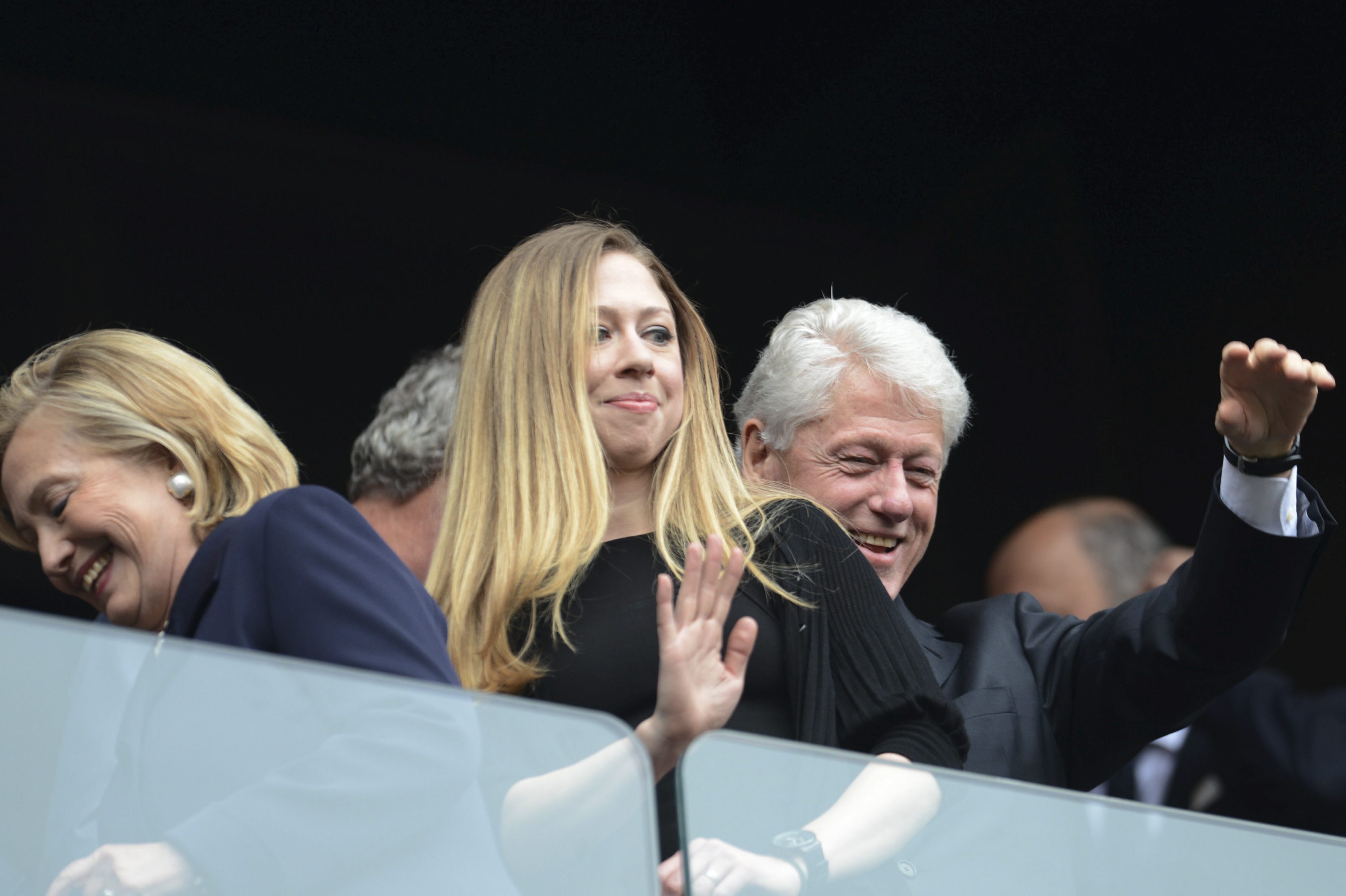
(Photo: Hillary Clinton, Former United States President Bill Clinton and Chelsea Clinton during the official memorial service for former South African President Nelson Mandela at the FNB Stadium on December 10, 2013 in Soweto, South Africa. By Lefty Shivambu/Gallo Images/Getty Images.)


Dissents Of The Day

This embed is invalid


Many readers disagree with my stance on the brain-dead pregnant woman in Texas whose family isn’t able to take her off life support:

I have to say I’m surprised – quite bracingly so – by the opinions you expressed in the AC360 Later clip.  After all the great testimonials that you facilitated in your It’s So Personal thread, it would appear that you’ve learned nothing from them.  One of the points of those stories, it seems to me, is that the decision to end a pregnancy, sometimes under the most unfortunate circumstances, is not one that ought to be second-guessed by outsiders.  You have done that exactly that in your comments, and by doing so have placed your value judgments ahead of that of the family members and the brain-dead woman in question.  While what you said may be right for you and your family, it is beyond presumptuous to assert that it is right for their family.  I hope that after some reflection, you’ll give a little more deference to their expressed wishes in the future.  I’m pretty sure you’d demand it for yourself.

The trouble is: there was no expressed wish for the baby to be aborted in this terribly painful situation. The mother did not express – understandably – any course of action if that were to happen. And the answer to the question – does this unborn child have a chance to be born and have a healthy life? – was unknown to me, even as I tried to find it. And to be precise, I did not stake out a position as such. I didn’t know enough to do that. I simply questioned the assumption that an unborn child was obviously dispensable in a very rare and tragic situation like this one.

I remain very sensitive to the wishes of the family, and deeply skeptical about crude laws that cannot take into account very specific circumstances. I should have expressed more sympathy for the horrible plight the family is in. But I cannot acquiesce in arguments that treat unborn human life as if it has no dignity and no relevance. I believe all human life has dignity and deserves to be weighed in a moral balance in exquisitely difficult circumstances such as this one.

Another reader emphasizes the extreme rarity of the case, adding, “While I understand the high emotions involved, this is precisely the sort of situation in which “‘hard cases make bad law.'” Another dissent:

I’m having a very hard time grasping your point of view as anything but a complete anti-abortion stance.  If a woman dies and is survived by her husband, assuming no other person was specifically named by the decedent prior to death, it’s handled like this:

  • The husband is the default executor of her estate.  Handling of insurance, assets, liabilities, subscriptions, service contracts … everything falls on him.
  • The husband is the default recipient of any of the wife’s assets unless specifically given to another.
  • The husband is in charge of any outstanding legal affairs.
  • The husband is given custody of any children he has fathered.

So if the woman had to right to have an abortion and is now deceased, why do you think it’s OK to prevent that right from passing on to the husband, who is responsible for half of the fetus’s DNA? If her supposed “wishes” in every other legal instance don’t matter and all choices are to be made by her surviving husband, what makes this one different?

That a man can make a woman have an abortion when she hasn’t explicitly consented to one as such? Another has more questions:

Who do you expect to pay for this? The family? The state, since it was mandated by the state? Have you given any thought to the idea that as a result of this, the child, if it lives at all, may be profoundly disabled and require 24/7 care – to be paid for by whom? Why do I or my relatives not deserve state mandated medical care at this level of cost? Is my current “living” life any less important that this extremely “potential” life?

That was a question I didn’t get an answer to in an impromptu conversation. And another:

If the possibility that a brain-dead human can be used to save the life of a fetus, why not forced organ transplants to save the lives of several other people. A heart, two kidneys, two lungs, a liver that could save several … why not?!

If that brain-dead person had consented in advance, no problem at all. The issue here is that the woman had not addressed the central question.

DIY Plastic Surgery

Nina Strochlic highlights new products meant to replace plastic surgery in Asian markets. One of the devices:

This glasses-like contraption pledges to glasses-like contraption provide a double-fold eyelid after five minutes a day of wearing it, as an alternative to the increasingly popular 20-minute eyelid surgery. The $16 plastic frame appears to push up into the eyelid cover to separate it from the lid. As you blink, the device supposedly trains your lids into the desired look of depth. The product apparently sold thousands of units in its first month, and was expanded to 200 stores.

Last month, Geoffrey Cain noted that the DIY approach is “popular among anxious Korean teens who lack the funds” to pay cosmetic surgeons:

Another popular contraption: the $6 jaw-squeezing roller device. Vendors claim it pushes the jaw line into a pleasing petite, oval form. The two teens spend hours rolling and molding the product along their jaw, trying to fit their faces into the perfect shape — and inflicting a good deal of pain in the process. … The pain pales compared to the infamous double-jaw surgery, a recent fad among South Korean and Chinese women. The procedure involves cutting off and realigning part of the jaw bone, and carries the risk of permanent damage.

Previous Dish on plastic surgery here, here, and here.

An Office Designed To Distract

Maria Kannikova explains the drawbacks of open offices:

[T]he most problematic aspect of the open office may be physical rather than psychological: simple noise. In laboratory settings, noise has been repeatedly tied to reduced cognitive performance. The psychologist Nick Perham, who studies the effect of sound on how we think, has found that office commotion impairs workers’ ability to recall information, and even to do basic arithmetic. Listening to music to block out the office intrusion doesn’t help: even that, Perham found, impairs our mental acuity. Exposure to noise in an office may also take a toll on the health of employees. In a study by the Cornell University psychologists Gary Evans and Dana Johnson, clerical workers who were exposed to open-office noise for three hours had increased levels of epinephrine—a hormone that we often call adrenaline, associated with the so-called fight-or-flight response. What’s more, Evans and Johnson discovered that people in noisy environments made fewer ergonomic adjustments than they would in private, causing increased physical strain. The subjects subsequently attempted to solve fewer puzzles than they had after working in a quiet environment; in other words, they became less motivated and less creative.

The Costliest Olympics

OLY-2014-RUSSIA

Joshua Yaffa explains how Sochi came to cost $51 billion:

Once Russian officials settled on Sochi as a host city … they guaranteed themselves a costly engineering challenge, since organizers didn’t have much choice as to where to put Olympic venues. Sochi, once a place of recuperation for Soviet workers under Stalin, sits on a narrow slope of land between the mountains and the sea, with no wide, flat space for large stadiums and arenas. The only feasible site was the Imereti Valley, a patch of flood-prone lowlands 20 miles from the center of Sochi. … Russia would have to build everything from scratch.

The fact that Putin saw the Olympics as a personal legacy made the problems worse:

Putin’s vow to spare no expense provided cover for sloppiness and mistakes in construction. When a road leading up to Krasnaya Polyana wasn’t finished on time, for example, a helicopter had to deliver the cement needed to build ski lifts. At the same time, the government’s willingness to overspend encouraged organizers to indulge their grandest, most over-the-top visions. At one point the team responsible for the opening ceremonies decided it wanted a closed stadium at Fisht and not the retractable roof that had been originally planned. That left the construction team only three months to procure a quantity of steel that would have ordinarily taken a year to get on-site. Damon Lavelle, an architect at the British firm Populous who worked on early plans for the venue, says it’s no longer so much a stadium as “the world’s largest theater.” The show for the opening ceremonies is said to include six locomotives, the troika from Nikolai Gogol’s Dead Souls, and Peter the Great commanding five ships.

Last month, Sean Guillory pointed out that Olympic laborers are getting shortchanged:

There is an estimated 70,000 laborers working in construction, 16,000 are foreign labor. They work long hours and for little pay. In its detailed report on worker abuses, [Human Rights Watch] reported that workers got typically paid $1.80 to $2.60 an hour with a monthly average salary of $455 to $605. Their pay is routinely delayed, and sometimes they’re never paid at all. One HRW respondent, Yunus, said “I have no written contract. I got paid only in February: 2,400 rubles [$77] for December. I wasn’t paid after that. I worked for 70 full days without pay. We worked from 8 a.m. to 8 p.m. with no days off.” He quit before receiving the wages owned to him.

Fnally, Barry Petchesky emphasizes the geographical unsuitability of Sochi as Olympic venue:

The actual city of Sochi sits on a slope—the only land flat enough to build an Olympic village and stadiums is 20 miles away, on a small slide of flood-prone soil. And flood it has. A new cargo port was destroyed in storms, causing millions in damage and delays, after officials failed to heed scientists’ warnings that the site was vulnerable. Underground streams have caused an embankment near the Olympic park to collapse and be rebuilt multiple times. The ski jump was constructed without geologic testing, and construction crews cleared trees whose roots stabilized the muddy soil. A major landslide occurred in 2012.

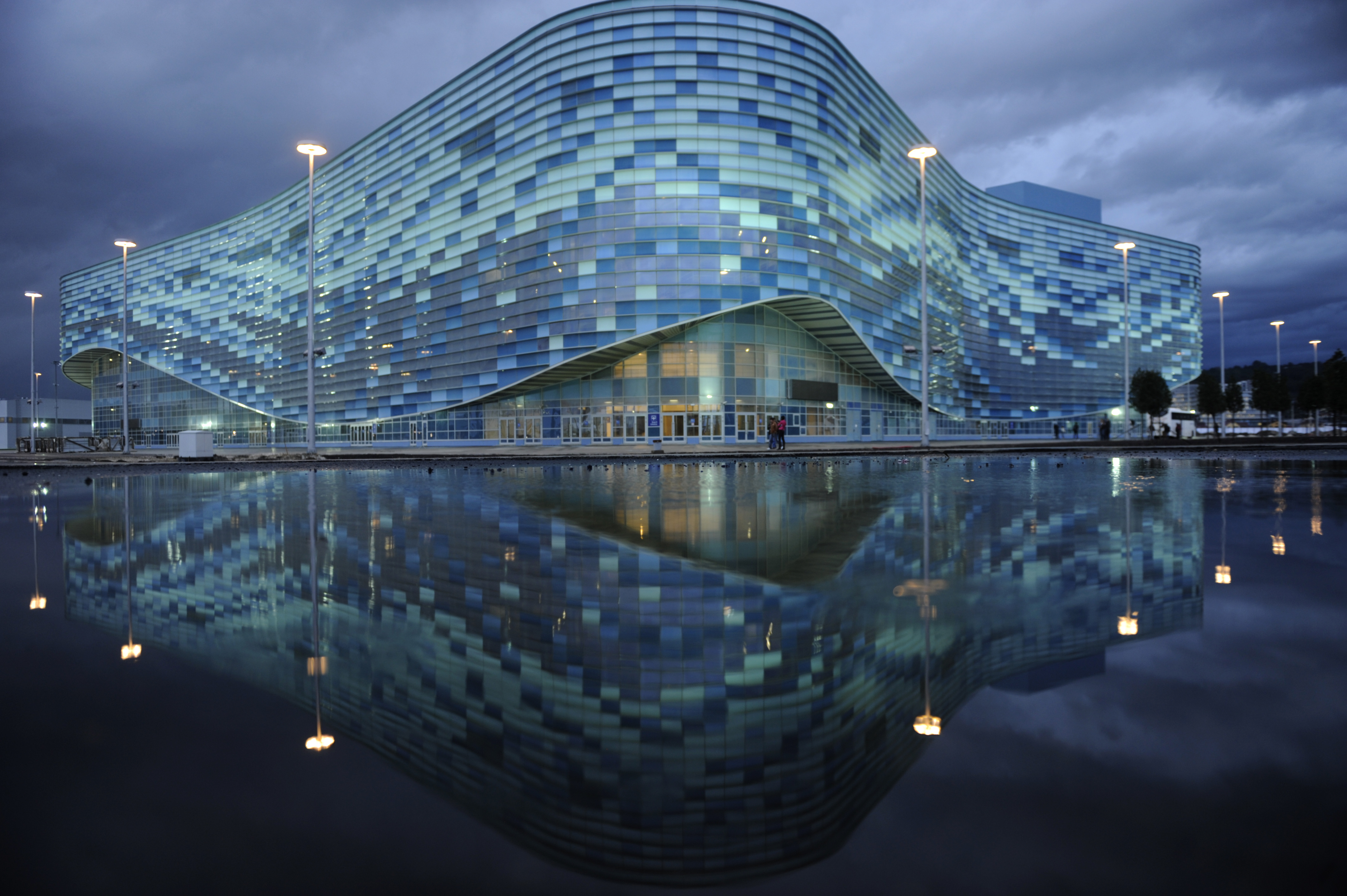
(Photo: A picture taken on September 25, 2013 shows the figure-skating and speed-skating arena at the Olympic Park in Sochi. Sochi will host the 2014 Winter Olympics starting on February 7, 2014. By Mikhail Mordasov/AFP/Getty Images)

An Economic Forecast For Literary Misery?

A study found (NYT) that “the emotional mood of literature reflects the mood of the economy over the previous 10 years.” Ben Richmond doesn’t buy it:

The actual researchers didn’t analyze any books specifically, they just filtered everything that Google scanned through their literary misery index, but something seems amiss when I test other examples. I pulled up the economic misery index for the second half of the 20th century and looked for spikes in misery. The George H.W. Bush years are pretty rough, but the highest years under his bespectacled watch are still lower than the least miserable years in the decade from 1974 through 1984, which includes peak misery, in 1980. So 1984 should have some real downers right? And it sort of does: There was a sequel to The Godfather by Mario Puzo, the Dr. Seuss that came out that year was a metaphor for war, Gore Vidal published a book about Lincoln, and we all know how that ended.

But to honest, it doesn’t seem that much darker any other bestsellers list. The top-selling Stephen King book wasn’t even a horror novel, it was the fantastical The Talisman, which might start with someone’s mother dying from cancer, but by Stephen King standards is still pretty upbeat. The nonfiction list had a book by John Madden and a book called Moses the Kitten, in addition to your standard CEO biographies (Leo Iacocca, in this case) and books about motherhood. Shel Silverstein’s A Light in the Attic was in there too.

Drugged To Think Like A Child

A new study suggests that a drug gives adults the opportunity to learn “perfect pitch” – defined as “the ability to identify or produce the pitch of a sound without a reference point” – long after the “critical period” for this capacity has passed in early childhood:

Valproate [a mood-stabilizing drug] was given to a group of healthy young men with no musical training. The men were then asked to perform a set of exercises for two weeks with the aim of improving their pitch while another control group was asked to perform the same exercises, but given a placebo.

According to the study, those subjects given valproate learned to identify pitch “significantly better than those taking the placebo.” [Researcher Takao] Hensch calls the results remarkable, telling NPR that until now there had been “no known reports of adults acquiring absolute pitch.” The implications of the study aren’t limited to learning how to sing beautifully: by altering brain plasticity, users of valproate could conceivably learn other skills normally picked up during the early critical period. Hensch picks out language learning as an obvious area of application for the drug.

In an interview, Hensch stresses the potential risks of his findings:

I should caution that critical periods have evolved for a reason, and it is a process that one probably would not want to tamper with carelessly. If we’ve shaped our identities through development, through a critical period, and have matched our brain to the environment in which we were raised, acquiring language, culture, identity, then if we were to erase that by reopening the critical period, we run quite a risk as well.

(Video: Ella Fitzgerald, who had perfect pitch, performing in 1957)