The Worst Jobs Report In Years

Net Jobs December

It’s ugly:

The new report from Bureau of Labor Statistics shows the U.S. economy added only 74,000 jobs in December, far below economists’ expectations. The unemployment rate dropped to 6.7% – its lowest point since October 2008 – but that appears largely to be the result of people dropping out of the workforce.

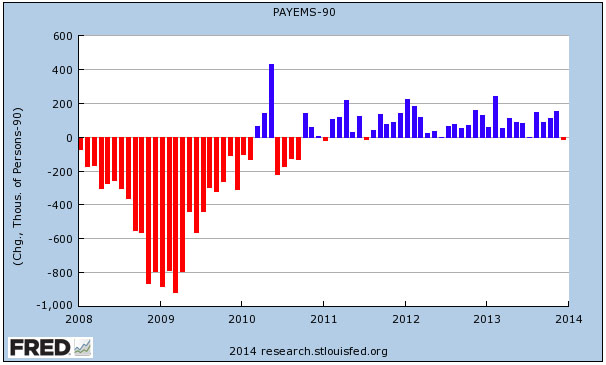
Drum created the above chart, which shows net job growth:

The American economy added 74,000 new jobs in December, but about 90,000 of those jobs were needed just to keep up with population growth, so net job growth clocked in at minus 16,000. There’s no way to sugar coat this: it’s pretty dismal news.

Matt Phillips suspects it was a fluke:

[S]omething doesn’t smell right about this report. For one thing, it jibes with hardly any of the other data we’ve been getting about the US labor market lately. … US stock futures are still in positive territory. And while there has been a bit of money flowing into US Treasurys, it’s not as if there’s a huge rush to safety driven by deep concerns about the economy. The market believes that this is a blip that’s better ignored. And for once, we’re going to say the market is right.

Felix Salmon blames the weather:

Once you take into account the weather … the December report wasn’t that bad.

A whopping 273,000 people were counted as “Employed – Nonagriculture industries, Bad weather, With a job not at work”, which is to say that they did not get counted in the payrolls figures even though they’re employed. Most of the time, that number is in the 25,000 to 50,000 range, and although it always spikes in the winter, this was the worst December for weather-related absence from work since 1977.

Greg Ip focuses on the bigger picture:

The more fundamental reason to worry is the ostensibly good news that unemployment had fallen to its lowest since late 2008. This was not principally due to the rise in employment but the fact that the number of people in the labour force (i.e. either working, or looking for work), tumbled 347,000 – even as the population grew 178,000. As a result, the labour force participation rate plunged to 62.8%, tying November’s figure for the lowest since 1978. The number of people who are not in the labour force but want a job – so called discouraged workers – jumped 332,000.

This is not a fluke. The labour force participation rate has been trending lower since before the recession. This remains by far the most vexing puzzle of the labour market.

Neil Irwin weighs in:

[T]he usual caveats around the jobs numbers — it is one month’s number, with a big range of error around it –apply more than usual in this one. Still, one doesn’t envy the policymakers who have to decide what to do based on this shaky data. The Federal Reserve’s policy committee meets at the end of the month and will have to decide whether to continue “tapering” their bond-buying program.

Kevin Roose adds:

The numbers are almost certainly going to be revised next month. But the initial signal is that we’ve been too hasty in calling this a healthy economy. The labor force participation rate fell by .8 percent, meaning that more people stopped looking for work altogether. And several key industries — construction and health care among them — lost jobs for the first time in months…. today’s report is a sign that we’re still dealing with a fragile economy, made more fragile on the policy side by threats of extending sequestration and letting unemployment insurance lapse.
Is The Christie Scandal Criminal?

TPM asks around:

Interfering with peoples’ ability to drive between states by closing lanes on the George Washington Bridge between New York and New Jersey might be a crime on its own. Law professors at two different schools pointed TPM to federal civil right laws, in particular Section 241 of Title 18 of the U.S. Code, which begins:

If two or more persons conspire to injure, oppress, threaten, or intimidate any person in any State, Territory, Commonwealth, Possession, or District in the free exercise or enjoyment of any right or privilege secured to him by the Constitution or laws of the United States, or because of his having so exercised the same …

According to Supreme Court precedent, your right to interstate travel is protected under the above statute, said Frank Askin, a professor at Rutgers University School of Law. Federal civil rights statutes also treat the use of federal interstate highways as a protected activity.

In the bridge scandal, the now-infamous “Time for some traffic problems in Fort Lee” email sent from a Christie aide in the governor’s office to a Christie ally at the Port Authority could arguably establish a conspiracy, said Burt Neuborne, a professor at New York University School of Law. Neuborne portrayed a charge based on these statutes as close to a slam dunk.

“The real question is more a prosecutorial discretion,” he said. “Is this low-level harassing kind of activity such a terrible thing? You have to decide whether you want to unload the heavy artillery.”

Brain-Dead And Pregnant

Texas prohibits removing a pregnant woman from life support regardless of the family’s wishes. This week on AC360 Later, I weighed in on the case of Marlise Munoz, who was 14 weeks pregnant when she became brain-dead:

This embed is invalid

Amanda Marcotte draws a different conclusion:

Marlise Munoz and her husband are just the latest victims caught in the crossfire of abortion politics. Mandating that pregnant women stay on life support regardless of their wishes is a neat and easy way to establish the claim that the state has an interest in fetal life, even at the earliest stages, that overrides a pregnant woman’s basic human rights. After all, brain death during pregnancy is incredibly rare, making these laws more symbolic in nature than pragmatic. If your goal is to legally enshrine the notion that pregnant women are incubators first and humans second, keeping their bodies alive to grow babies long after their minds are gone is a perfect way to do it.

Of course, rare doesn’t mean impossible, as Marlise Munoz’s family is discovering. “All we want is to let her rest, to let her go to sleep,” Munoz’s father, Ernest Machado, told the Dallas Morning News. “What they’re doing serves no purpose.” The family reasonably fears that the loss of oxygen that was enough to destroy Marlise Munoz’s brain probably did serious damage to her fetus. To make it worse, by going public with their story, Munoz’s family is being treated to a heavy dose of vicious anti-choice rhetoric.

Mary Elizabeth Williams feels that the family is being denied their right to grieve:

Munoz’s husband and parents are trying to come to terms with the fact that she’s gone and she’s not returning. That’s a grief that should be respected. That’s a devastating loss for any family, one that’s being viciously prolonged by a state that’s been petulantly dragging it through weeks of torment. Of course Munoz’s family never wanted to lose her or the child they were hoping to welcome in the spring. But true humanity means accepting loss. It means mourning it, not using a dead woman and her fetus as some insane experiment. “It’s not a matter of pro-choice and pro-life,” Munoz’s mother says. “It’s about a matter of our daughter’s wishes not being honored by the state of Texas.”

Tara Culp-Ressler elaborates on the law:

According to a 2012 report from the Center for Women Policy Studies, Texas is one of 12 states that automatically invalidate women’s end-of-life wishes if she is pregnant. Those state laws ensure that “regardless of the progression of the pregnancy, a woman must remain on life-sustaining treatment until she gives birth.” The hospital that is providing care to Munoz has declined to confirm that she’s been pronounced brain dead, saying only that she’s “pregnant and in serious condition” and their employees are fulfilling their legal obligations. “This is not a difficult decision for us. We are following the law,” a spokesperson told the Associated Press.

The Bottom Line On Surveillance

David Auerbach ponders the motivations of the Reform Government Surveillance (RGS) coalition, formed by Google, Apple, Facebook, and other tech heavyweights to lobby for restrictions on the NSA’s digital surveillance:

It’s notable when nearly all the major Internet competitors, some of them in bloody rivalries with one another, come together take a stance so vastly at odds with that of the government and a large chunk of their customers.

Not even the Stop Online Piracy Act, which would have made Internet companies subject to burdensome requirements to battle piracy and persecute pirates, united tech companies with such vigor. (Microsoft and Apple have generally only offered tepid opposition to anti-piracy bills.) When competitors agree across the board, there is usually only one broad motivator: money. The NSA, it seems, is very bad for business. Aside from damaging the overseas reputations of these international businesses (notably in Europe and China), the surveillance has caused RGS companies to take major financial hits just to protect themselves from the NSA. Google is now encrypting all its internal traffic, and Yahoo is following Google’s lead—expensive, time-consuming, and logistically ugly work. Add that to headaches like the NSA paying off encryption giant RSA (to the tune of $10 million) to add a back door into their default encryption algorithm, and it’s clear that the bottom line is at stake.

Bill Davidow, however, is just as worried about the data these companies collect and how they analyze them:

There will be files of facts about us such as our addresses, phone numbers, the calls we placed on our cellphones and where we were when we placed them, and the Internet sites we visited. But there will also be algorithmic predictions about our tastes, behavior, plans, opinions, thoughts, and health. Almost everything about us will be known or predicted. Those predictions may well become the self-fulfilling prophecies that determine our future.

While much of the world’s concern has been focused on NSA spying, I believe the greatest threat to my freedom will result from my being placed in a virtual algorithmic prison. Those algorithmic predictions could land me on no-fly lists or target me for government audits. They could be used to deny me loans and credit, screen my job applications and scan LinkedIn to determine my suitability for a job. They could be used by potential employers to get a picture of my health. They could predict whether I will commit a crime or am likely to use addictive substances, and determine my eligibility for automobile and life insurance. They could be used by retirement communities to determine if I will be a profitable resident, and employed by colleges as part of the admissions process.

“That Little Serbian”

Jasenovac1

As Bridgegate continues to unfold, a reader takes issue with an earlier comment:

You wrote: “I think anti-semitism has a more disturbing history and connotations than anti-Serbianism, but we’ll see.” You should check out the history of the Ustaša, which in World War II killed hundreds of thousands of Serbians. They also operated what is popularly known as the “worst” concentration camp, Jasenovac. This is a nasty history, which though it may not rank as high as the Jewish experience in terms of lasting-existential terror, is nonetheless so far beyond the pale that it qualifies easily as among the worst ethnic-cleansing experiences of the period. I am neither Serbian nor Croatian, but you wouldn’t need to be either to possibly have your feathers ruffled by the comparison, for the same reason a Chinese or Korean individual might take exceptional umbrage at a mistaken identification as Japanese.

Got it.

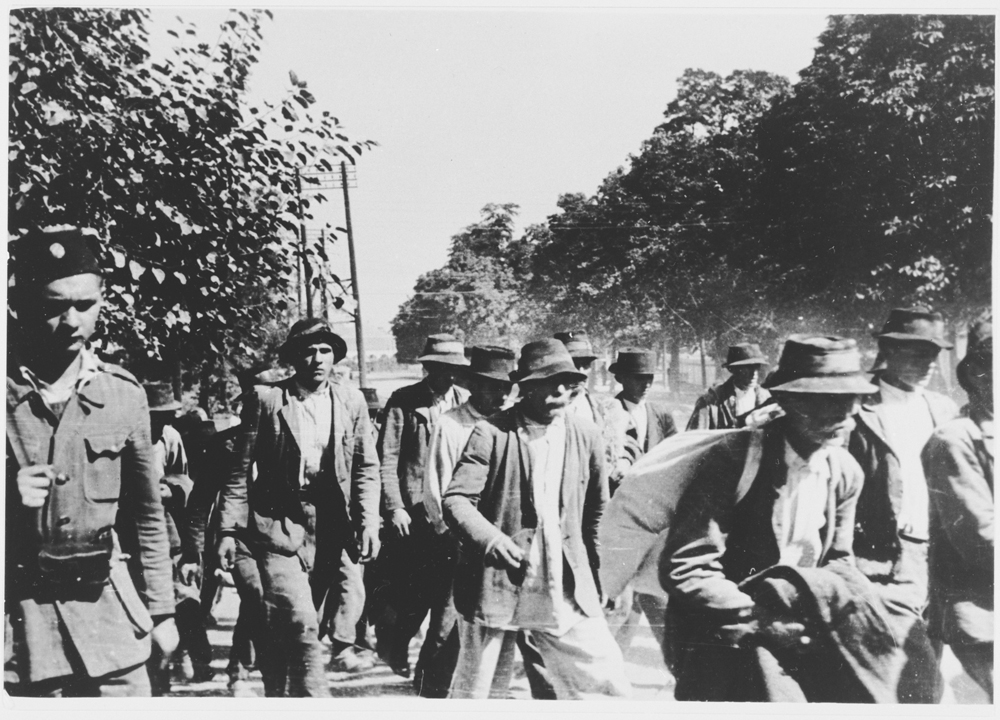
(Photo: Serbs and Gypsies who have been rounded up for deportation are marched to the Jasenovac concentration camp under Ustasa guards circa 1942-43. Courtesy of Muzej Revolucije Narodnosti Jugoslavije.)

The Friend Limit

No matter how many Facebook friends you amass, your real-life circle of close mates has a max capacity:

A new study published in Proceedings of the National Academy of Sciences suggests that humans have, almost uniformly, a “one-in-one-out” policy—every time you become close to a new person, someone else subconsciously gets the boot. “Although social communication is now easier than ever, it seems that our capacity for maintaining emotionally close relationships is finite,” said Felix Reed-Tsochas, a researcher at Oxford University and an author of the study. “While the number varies from person to person, what holds true in all cases is that at any point individuals are able to keep up close relationships with only a small number of people, so that new friendships come at the expense of ‘relegating’ existing friends.”

Emily Badger adds:

[I]f that’s the case, then advances in communication technology that were supposed to be revolutionizing our social networks probably aren’t doing that after all.

The ease of communication enabled by cell phones doesn’t necessarily allow you to grow closer to more people. And that guy you know who has 1,000 friends on Facebook? “It isn’t exactly that the computer has just done some amazing transformation of what humans are capable of doing socially, and that person now genuinely has 1,000 bosom-buddy friends,” says Reed-Tsochas. Most of those people are from the outer layers of the onion. Facebook (or Twitter or email) has certainly made it easier to stay in touch with these far-flung acquaintances, but it hasn’t fundamentally changed the number or depth of your relationships with the people closest to you. Modern communication tools were also supposedly going to eliminate the importance of “distance” in our lives, and we’ve repeatedly seen evidence that this isn’t true. This same technology is changing our world and how we interact with each other in many ways, but perhaps not quite so fundamentally as to alter our inherent “social signatures.”

A Prescription For Grandeur

5634787772_ee40ed927f_z

Breathtaking architecture is good for your mental health:

The fact is that environments do affect us, regardless of whether by design or by accident. In 2008, researchers in the UK found that a ten-minute walk down a South London main street increased psychotic symptoms significantly. In my own research, I find that the healthier a person is, the more a good environment will affect them positively and the less a bad one will affect them negatively. Mentally ill patients show about 65 times more negative reactivity to bad environments than controls and all these reactions translate directly into symptoms. The same patients have about half the positive responsiveness. That’s fewer smiles, less laughter and a reported drop in feeling the “fun of life.”

But that’s not all. The potential for architecture is richer still. The ease with which architecture can embrace sublime aesthetics makes it great for generating awe. Psychiatrists have found that awe reduces the prevalence and severity of mood disorders. Could sublime architecture even potentially save lives?

(Photo of Truro Cathedral by George Thomas)

“Medical Necessity”

David Goldhill considers how the definition has expanded:

Increasingly, health experts rely on the political system to answer the difficult questions of what should be reimbursable by insurers, Medicare, and Medicaid, but the results haven’t been promising in terms of consistency or principle, not to mention control over the expanding definition of care. The fifty states have imposed on health insurers more than 2,000 mandates—requirements to reimburse certain procedures—and the regulations required by the Affordable Care Act will include additional mandates on a national level.

Many of these mandates cover treatments that used to be thought of as cosmetic, optional, or at the very least not medically necessary. In 2008, ten states required coverage for hair prostheses; thirteen for in vitro fertilization. Thirty-one mandated contraceptive reimbursement. Forty-six required reimbursement for the services of chiropractors; fourteen for marriage counselors; and four for massage therapists. Arizona mandated the cost of athletic training. The issue isn’t whether any or all of these treatments are good or useful: the question is whether we should all be required to pay for some who want them.

When Messy Is More Effective

“Biomimetic” design draws on other species’ architectural habits and adapts them for human constructions. As Lee Billings explains, “those examinations yield surprises not only about the animal being observed, but also the observer”:

A telling example is the comparative architecture of orb-weaver versus tangle-web spiders. Imagine a spider web, and chances are you summon an orb-weaver’s work in your mind: A branch-hung 1548563407_ca04fb34d5_zmesh of silk spiraling around a central hub so orderly and symmetrical you would consider it beautiful, and certainly superior to the irregular skein of strands of a tangle web in a wood pile. An orb web’s beauty comes from the simple algorithm the spider follows to construct it within a single plane. By comparison, a tangle web is the result of a significantly more dynamic behavioral process of trial-and-error construction, methodically stringing and testing silk between any available surfaces until an ideal prey-trapping tension is reached. It looks messy, and primitive.

But the tangle web is actually derived from the more primitive orb web. A tangle web can be built almost anywhere, and it doesn’t require airflow to catch prey. Its marvelous, asymmetric design allowed the spiders that developed it to begin a great radiation into thousands of new species. “Humans like symmetry and order, I think because symmetry and order help us recognize patterns, and we like to think we understand things,” says [entomologist John] Wenzel. … “In my studies I’ve seen things many times that I think are anomalies, pathologies, almost like mutations,” Wenzel says. But what seem like pathologies … can become useful, even essential. And difficult to understand.

(Photo of a tangle-web spider by Joe Lapp)