Hope As A Human Right?

Dirk van Zyl Smit, a law professor, argues against life sentences without the possibility of parole, writing that “even the worst offenders have the right to hope”:

A commitment that we will never consider the release of some offenders serving life sentences, except perhaps when they are at death’s door, means that we write them off permanently. It means that we deny that with the passage of time they may change for the better; or that we may change our assessment of their crimes. Worse still, we are denying some fellow humans all hope. In that sense we are putting them in the same position as those awaiting execution on death row.

In July 2013, in the case of Vinter and Others, the grand chamber of the European Court of Human Rights explained why it was fundamentally unacceptable for the United Kingdom to deny these prisoners any prospect of release. Its thinking is best captured in the opinion of Judge Power-Forde of the Republic of Ireland:

Hope is an important and constitutive aspect of the human person. Those who commit the most abhorrent and egregious of acts and who inflict untold suffering upon others, nevertheless retain their fundamental humanity and carry within themselves the capacity to change. Long and deserved though their prison sentences may be, they retain the right tohope that, someday, they may have atoned for the wrongs which they have committed … To deny them the experience of hope would be to deny a fundamental aspect of their humanity and, to do that, would be degrading.

Charting A New Course Online

Gabriel Kahn discusses the meteoric rise of an obscure university:

Five years ago, Southern New Hampshire University was a 2,000-student private school struggling against declining enrollment, poor name recognition, and teetering finances. Today, it’s the Amazon.com of higher education. The school’s burgeoning online division has 180 different programs with an enrollment of 34,000. Students are referred to as “customers.” It undercuts competitors on tuition. And it deploys data analytics for everything from anticipating future demand to figuring out which students are most likely to stumble. “We are super-focused on customer service, which is a phrase that most universities can’t even use,” says Paul LeBlanc, SNHU’s president. …

SNHU boasts six-year online graduation rates of about 50 percent for bachelor’s students. While LeBlanc concedes that’s still abysmal—“Would you accept a 50 percent success rate for surgery? For construction?”—it’s partly explained by the fact that most SNHU students are part time and take even longer to finish.

The Best Of The Dish Today

port-authoritah

I can’t help feeling something is awry with Chris Christie’s ebullient contrition today. It was a command performance but the unanswered questions remain. Christie claims he found out about the shenanigans yesterday and yet has also claimed recently that he had been fully briefed on the matter. If that’s the case, why on earth not bring Bridget Kelly in to account for herself before summarily firing her? Why, for that matter, did Christie never run down the story that the snarl-up had been a traffic study?  A huge amount of it makes no sense to me, and the categorical denials of any idea that this kind of thing was going on … well, they just don’t ring true with Christie’s past or present.

Last night’s AC360 debate on Bridgegate here; my presser reax here; the blogosphere’s here. When did Christie know? How frenzied are the press? Why did Wildstein plead the fifth? Your thoughts here. The trouble for Christie is that this is not a boring story; and he emphatically does not have the right-wing noise machine firmly behind him. I thought the most devastating piece about him today was in National Review.

In other news: a silver gun hidden in a vagina; more coverage of the NYT’s “sponsored content” surrender; and another brilliant PSA from New Zealand.

The most popular post was He Hasn’t Gotten Around To Anger Yet; next up: The Character of Chris Christie.

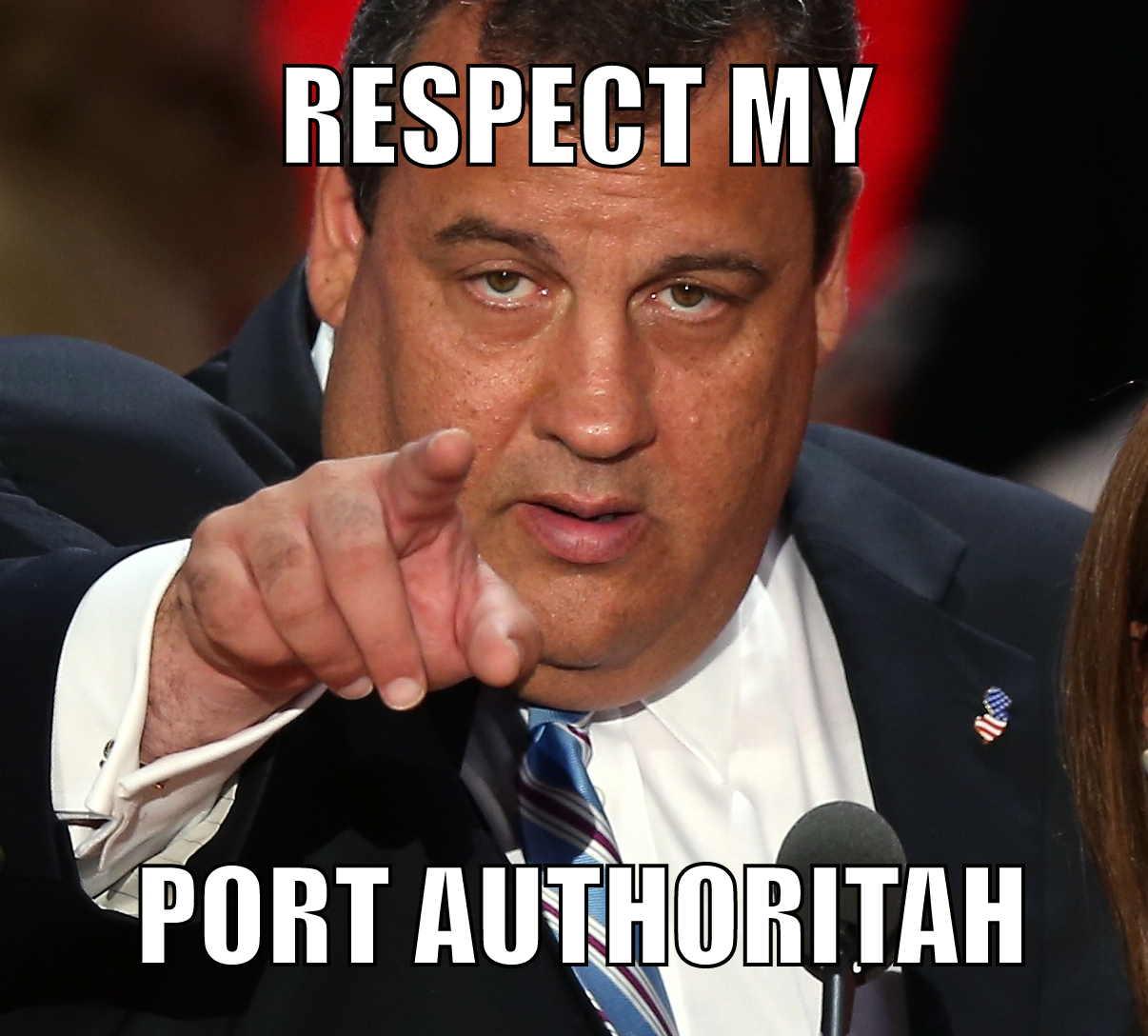
(Original photo by Mark Wilson/Getty Images. Cartman meme by Bodenner and Special Teams.)

Why Francis Matters, Ctd

Scores of readers over the holidays dove into the latest Deep Dish. “A mama from the It’s So Personal series” writes:

I couldn’t get through the Iraq war Deep Dish – it just made me go to a dark angry place and I could not go on – but, wow, did I love the piece on Pope Francis.  So much so that I explored Marian websites and even ordered a Novena for “The Untier of Knots”.  I have never done a Novena, as I’m an American Episcopalian, but the piece and Francis’ inspiration both really spoke to me. And I have some pretty thorny knots in my life right now.  Thanks for always expanding my world view.  I know everyone doesn’t love your Sunday postings, but I have to say I really get a great deal from them.  And I know Christmas is difficult for you, but you gave all of your readers a gift in this Deep Dish feature.

Another reader:

I became a subscriber just so I could read your deep dish on Pope Francis. The article was worth my $20.00. I kept going back to the sentence, “It is only in living that we achieve hints and guesses – and only hints and guesses – of what the Divine truly is.” Such a lovely, peaceful thought.

Another:

In your article about Pope Francis, which I enjoyed immensely, you wrote this:

Many of his followers, it is worth remembering, were often of his own well-to-do class, just as many early Christians were prosperous traders and businesspeople. It was not so much the experience of poverty that propelled them so much as the renunciation of their own wealth and power. This, observers sensed and recorded, gave them a liberation like no other.

I may understand one of the reasons that liberation was so desirable to that particular group of people.  Some time ago, Keith Humphreys wrote an article over at the Washington Monthly about Untier-Of-Knots-Cover-Imagetrying to fire a sub-par employee only to discover that the employee’s three-year-old daughter had just been diagnosed with leukemia.  As Humphreys put it:

What I concluded as an employer from experiences like these is that employer-based health insurance gives me far more power than I want or should have over the health of my employees and their families. Yes, I could just be a cold bastard and fire people like the employee in my fictional example, telling myself that if his daughter doesn’t like it she can complain to Adam Smith. But I’m not built that way and I don’t think most other employers are either. People who do their jobs badly may well deserve to be fired by their employers, but whether they and their families live or die should not also hang in the balance.

I could understand having a few brushes with that kind of power and seeking out some sort of liberation from it.  And I use the term “liberation” advisedly.  As Heinlein once noted (I think he did … can’t find the darn citation), buying into the idea that you have that power over others implicitly requires that you accept that someone else could have that power over you.  It’s literally liberating to reject the idea that any human can wield that kind of power.  You may be declining the opportunity to control someone else’s life, but in the process you’re freeing yourself.

Another reader dissents:

I’ve read/listened to the two new pieces in your new Deep Dish. I enjoyed the conversation with Dan Savage immensely. It was amusing to hear a discussion of the Campus Bar in Cambridge. I lived down the street and was a regular there for a number of years.

But I would caution you not to do too much early hero worship of Francis.

He’s moving away from the disaster of the conservative agenda of the last 30 years. It remains to be seen if he goes the distance. He’s made a good start with removing a theocon or two, but it remains to be seen if he addresses the institutional cover up of child abuse that has been Benedict’s Legacy. And he seems to be going forward with the instant canonization of JPII. I’m not a Catholic, so I’m not as involved in hoping there’s a home for gay people in the church. But in my judgment he’s only gotten “sucks a lot less than the last few” to his credit. Don’t canonize him at the beginning of his reign.

As another puts it, “Talk is nice, but rather cheap. Actions count, even in Catholicism.” I promise one thing: to be vigilant as a hawk on the child-rape question. Another reader sees “concrete changes to the Church already”:

11:00 mass on Sundays has been packed. We no longer can come 10 minutes late and expect to find seats all together. I think this is the Pope effect. My daughter and I love to see how our priest slips in a reference to the pope in every homily. He just loves him, and it’s obvious that having such an open-minded pope has enabled rank-and-file priests the freedom to say things they have wanted to say about the poor and our duty to help them, about God’s love for everyone, and how all are welcome to celebrate mass not just the pious and perfect. Your essay was an early Christmas present. Thank you. And thank you to your entire team for a fantastic year. Your blog is the only blog that I read religiously. I am actually looking forward to slapping down $100 for my renewal.

Another dissent:

In the same airborne news conference during which he made headlines for seeming to counsel against damning gay priests, he responded dismissively to a question about women’s ordination, stating bluntly, “That door is closed.” And then this, from his most recent interview:

When God meets us he tells us two things. The first thing he says is: have hope. God always opens doors, he never closes them. He is the father who opens doors for us. The second thing he says is: don’t be afraid of tenderness. When Christians forget about hope and tenderness they become a cold Church, that loses its sense of direction and is held back by ideologies and worldly attitudes, whereas God’s simplicity tells you: go forward, I am a Father who caresses you.

It just hurts.

Another is more hopeful:

I haven’t read your Deep Dish essay on Pope Francis, but I am looking forward to it.  I am writing mostly to express the odd reaction I have been having to the multiple quotes from Pope Francis you are posting on the blog. As a gay man who was raised in a strict Evangelical household in Oregon, my exposure to the Catholic church has been minimal other than a friend’s Catholic wedding. Starting in high school I consciously rejected my parents’ brand of faith (and politics), which later extended to all organized religion. It is not something I struggled much with after my teens and coming out nor thought much about since.

But recently, I have found myself tearing up when reading some the words of Pope Francis, and not the very-welcome passages relating to poverty and gays, but rather those that have to do with god’s love and hope, such as the one you posted here.

I don’t know if this is a part of me that has gone untouched since I left religion behind. It may also be that for the first time that I can remember someone is expressing religion and god in a manner that my family and their church never could which left me feeling cold and left out from what they were experiencing. Whatever it is, I feel like this Pope has awakened or touched something within me that I did not know I ever had or at least had let go of so long ago I forgot it ever existed. I don’t know if I’ll ever willingly go back to church, and if I did what that church would look like, but Francis has already affected me more than an ex-religious gay Northeast liberal ever would have expected possible. Thank you for your continued attention to this extraordinary Pope.

Another predicts:

This Pope will be the salvation of the Catholics, and a true leader to follow irrespective of your religious beliefs. At least someone you can listen to without that feeling of listening to someone from another century. Here’s a note from my dad, back in Kerala, India, who got a gift subscription of The Dish from me for Christmas. He is a Hindu, a Lord Krishna devotee, for the record. He read your deep dish on Francis and wrote me this:

yes, I read it son. i had not been a follower of these Papal messages or gospel for along time of the previouspopes, but from a recently published interview he gave to a  reporter, I understand that the present pope is much different than others, a down to earth one and that seems to auger well for mankind. Dad

So yes, the Pope’s message is reaching all corners of the world, and puts the Church and the Catholics in a fresh new perspective – a much needed light that might shake the cobwebs and the dust away.

One more reader:

I thoroughly enjoyed your essay on Pope Francis (and was glad I had chosen to subscribe). It called up a lot of emotion and thought and memories in me. I was once a Christian who converted to Catholicism (in the very year that John Paul II became pope) through coming to see it as the best historical vehicle of the gospel When Christianity became impossible for me (for oh so many reasons), I of course left the church. And I suppose I have ended up a “sort-of” Buddhist, in that the very basic teachings of the buddhadharma are what enabled me to go on living after the death of my 15-year-old son in a meaningless accident. You learn what is the truth for you when you are knocked flatter than you would ever think it possible to be knocked, and then you find a way to get up again and go on.

But what is so beautiful to me about the dharma is the way it allows me to look at someone like Francis and see a true bodhisattva – a true agent of truth a compassion – irregardless of what group they belong to. How marvelous for a new bodhisattva to appear as a pope! Who would have thought it? And as someone who once embraced the Catholic faith with a true passion and fierce devotion (until I was reborn into another life, as it were), it makes me glad to see what you see in Francis. How marvelous.

Previous thoughts from readers here.
Freezing As The World Warms, Ctd

pauldouglas_1388687977_MSPmintrends

A reader from Minnesota insists that the polar vortex was actually not that bad – at least by Minnesota standards:

Our coldest temperature recorded a couple days ago was -23 degrees Fahrenheit. That’s plenty cold. But 50 years ago, Minneapolis winters regularly hit -30 degrees Fahrenheit. In the ’60s and ’70s, this occurred every three to four years. Today we have hit that mark only once since 1980, and there is a very clear trend towards less-extreme cold snaps. In fact, it used to be rare to have a winter that didn’t go below -20 degrees Fahrenheit, and now it’s the rule. So even this cold snap is evidence for global warming, because, frankly, they don’t make them like they used to.

The above graph, from the Minneapolis Star-Tribune, backs this reader up. Meanwhile, Gopnik notes that “strong scientific theories are, whatever we might like to think, more often counterintuitive than self-evident”:

We teach science, we talk science, as though it were the triumph of the self-evident over the obscure, the empirical over the occult. This is a good propaganda technique—“Just look with your own eyes!” we say—until it isn’t. Five hundred years after Copernicus, it sure still looks as if the sun is going around the earth. The evidence for global warming is not, or not primarily, experiential. It is cumulative, statistical, and inferential—just like the evidence for biological evolution, ever-improving I.Q.s, and the Higgs boson. Cold days don’t disprove it, and hot spells in summer don’t show it’s true either. It first has to be grasped as an abstract concept, albeit one with real and scary effects.

Another reader chimes in:

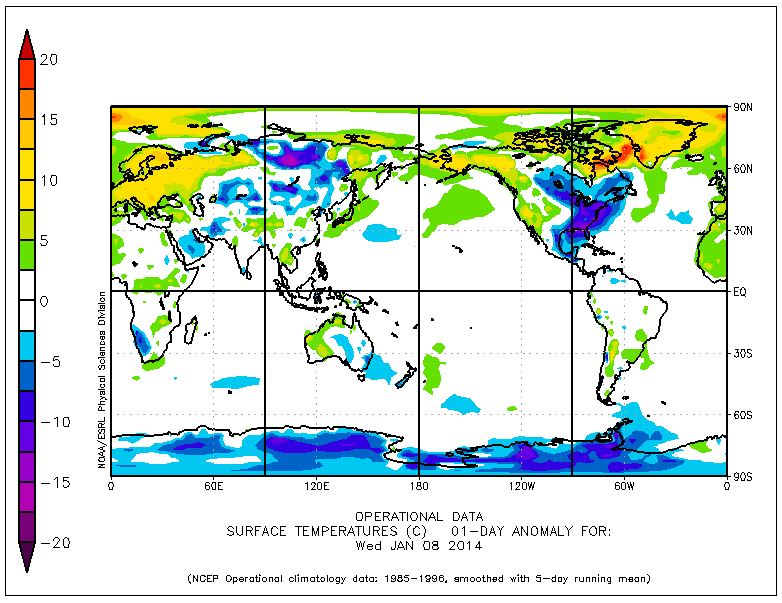
Check out this graphic for perspective on the relative global significance of the current East Coast “polar vortex”:

1

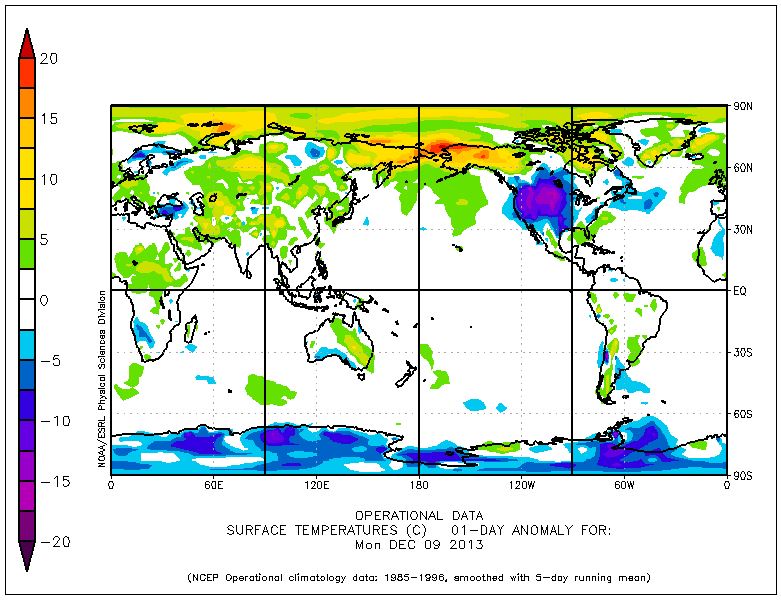
While half of North America and parts of Russia are in a deep freeze, a larger part of the Northern Hemisphere is experiencing significantly higher-than-normal temperatures. Below is another graphic showing the situation on December 9, 2013, the last time that North America experienced record lows:

2

The deniers on Fox and in Congress like to point to sub-freezing weather outside their windows as evidence that global warming is a myth, but looking at the complete picture tells a different story. Also, both images show that the Arctic, where it is winter, is abnormally warm, while the Antarctic, where it is summer, is abnormally cold. This is not an aberration; this has been typical of the weather for the several years that I’ve been following this graphic. If you check back in six months, you’ll see the exact opposite – a cold Arctic and warm Antarctic. These are not trivial temperature anomalies, either. It’s typical to see widespread areas at both poles where the anomaly exceeds 35 degrees Fahrenheit.

Of all the climate graphics I look at, this one, in my opinion, is the most convincing in demonstrating how much the climate has changed already.

The source of those two images is here. Another reader has a dispatch from the West:

I’m sorry that you’re having such cold weather, but there’s another issue you haven’t mentioned: California is having a severe drought. In fact, we’re in our third year of drought. If dry conditions continue, the so-called “Stage 5” drought restrictions – the most severe category – will likely come into effect in February. Some of the latest articles on this serious problem are herehere, here, here, and here. This may have serious repercussions not just for California but the nation. If you like your avocados, wine, pot, fruit, or any other California product, please pray that we get some big rain-producing storms!

Fast Food On The Farm

American farmers eat just as much junk food as the rest of us, largely due to the changing structure of rural families:

In theory, farmers should be poster children for the locavore movement. They have fridges and fields (or home gardens, in the case of some larger farms) stuffed with gorgeous produce. But such proximity to local food does not automatically translate to the plate. The evidence is perhaps most extreme in California’s Central Valley, where a startling 80 percent of farm laborers – many of whom are recent immigrants living in low-income communities – are obese. But the disconnect impacts farmers of all kinds. …

Historically, the social ecology of a family farm included systems to accommodate the harvest season time-crunch. Some members of the family, traditionally the father and brothers, worked in the fields while others, typically the women, were tasked with preparing and, when necessary, packing up, breakfast, lunch and dinner. They also spent hours canning, pickling, preserving and otherwise stretching the life of the season’s crop.

Some farms continue to work this way. “Where I live in North Dakota, most farmers have a mother or a wife making their food,” says Hagen said. In his case, it’s his mother and girlfriend. “Without that support, you begin to get into the junk food element.”

But if a farm is set up so that the whole family works in the fields, or one spouse works a supplementary job, those systems can break down quickly. Brad Wilson, 60, of Fireweed Farm in Iowa, says falling crop prices over the last half-century have eroded the traditional family structure on many farms: “The wives had to get jobs in town, which takes away the home garden and vegetables at dinner. After my mom died, with my wife working in town, I asked my dad to bring out food for the workers. Instead of sandwiches, he went to town and bought high sugar, artificially flavored junk food in packages.”

The Press On Christie’s Presser

The NYT dug up old clips of Christie acting like a bully. Recent events make them much more damning than they were previously:

Anne Marie Squeo spells out why the scandal is so devastating:

During a press conference, Christie said, “I am who I am, but I am not a bully.” And maybe by Webster’s dictionary standards, he isn’t abusive or intimidating per se. For sure, he has strong positive attributes –genuine, smart and pragmatic. But when you start listing the characteristics most closely associated with Christie, it’s hard not to find the words pugilistic and caustic are front of mind. … [Christie] says he had nothing to do with Bridgegate, and no evidence has been released to suggest otherwise. But his personal brand makes it easy to believe he was and that’s the kind of culture he developed and rewarded. And that’s the jam he needs to get out of to have a serious run at the White House.

Cillizza thought the presser went well:

It became clear as the news conference wore on (and on) that Christie and his team had decided beforehand that he was going to stay at the podium until no reporter (or anyone else) in the room could think of any more questions. That seems like the right approach — get out everything you can in a single day and make clear that you are open and ready to answer whatever is asked of you. As the presser wore on, some of the more “traditional” Christie began to peek out — he could have done without his answer on knowing David Wildstein in high school — but we still think politicians are better off going long rather than short when it comes to press conferences called to address controversies.

Josh Green isn’t so sure:

One school of thought in professional crisis management is that it’s best to come clean all at once: Say everything you know and answer reporters’ questions until they run out. That was obviously Christie’s approach, and it didn’t serve him well. The direct, forceful statement and list of actions he delineated at the beginning petered out into standard-issue political dodges and passive-voiced buck-passing. “Mistakes were made,” he said at one point. The longer Christie talked, the less he sounded angry and resolute and the more he sounded as if he were making excuses. It became harder to believe that he could have been ignorant of what his closest staffers were up to. The famous Christie narcissism also reappeared when he began referring to himself as a straight-talker and touting his achievements—and this, too, undercut the force of his opening statement.

Jonathan Bernstein explains how the scandal hurts Christie’s presidential chances:

I saw several pundits yesterday dismiss the idea that voters would still be focused on this scandal two years from now. They’re right — as far as it goes. … But what those pundits are missing is that the presidential campaign doesn’t begin in 2016 with the Iowa caucuses and the New Hampshire primary. It began months ago, with the invisible primary.

That’s the competition to secure support from key party actors, including politicians, party-aligned interest groups, campaign and governing professionals, formal party officials and staff, activists, and the partisan press. In effect, it’s the efforts of these party actors to coordinate and compete over the leadership of the party.

The invisible primary helps to structure, and often determines, what happens in the nomination battle.

Douthat adds:

When I’ve written before about Christie’s very plausible path to victory in ’16, the bedrock under my analysis has been a sense that the institutional party — and not just the Wall Street money — sees him as by far its best bet to take back the White House, and will donate and organize and endorse accordingly. Now a traffic scandal, even one with this one’s juice, is not going to make the G.O.P.’s donor class suddenly fall in love with Rand Paul or Ted Cruz (or Rick Santorum or Mike Huckabee). But it might make them look anew at Marco Rubio (who had a tough 2013, but just gave a good speech on poverty) or Scott Walker, or pine for the probably-not-gonna-do-it Jeb Bush. This is the big danger for Christie in this scandal, the shadow lapping at his ambitions: Not that Iowans or South Carolinians decide they can’t trust him (they probably aren’t paying attention), or that conservative activists sharpen their knives for him (they were doing that anyway) but that his party’s machers no longer see him as far and away the strongest horse.

Kleiman asks why Christie hasn’t spoken to Kelly:

Chris Christie, former prosecutor, wants to know what’s going on, but he’s so offended by having been lied to that he doesn’t call Kelly on the carpet and say, “OK, Bridget. You screwed up big time. Your job is on the line. Who the $#%* told you to pull this stupid %$#*ing stunt? Tell me the truth, tell me all the truth, tell me the truth right now, or you’re dead to me from this minute.” Srsly? Either he didn’t want to know what she would tell him, or he knew already and didn’t want to hear it.

MacGillis wonders who will speak out:

Will the scorned aides seek payback? Christie is generally known for his loyalty to his closest aides and confidantes, and the favor is mutual. That is why no one had any doubts that Baroni, say, would end up in a nice spot after stepping down from his $290,000 gig at the Port Authority. But so dire is Christie’s current spot that he went a bit heavy on the condemnations of his implicated team members, repeatedly lacing Kelly for “lying” to him and, remarkably, disputing the notion that he and Wildstein were high school pals by all but declaring Wildstein a teenaged loser—whereas Christie, he reminded reporters, was “class president,” Wildstein “didn’t travel in the same circles.” Would you like to add anything, David?

Allahpundit smells something fishy:

I find it hard to believe that Bridget Kelly is the mastermind of a revenge operation that extended to Christie appointees in the inner circle and at the Port Authority, especially in the middle of a reelection campaign. Even if Kelly wanted to punish the mayor of Fort Lee for not endorsing her boss, it’s mind-boggling to think that various members of Team Christie would have played along knowing that exposure could have jeopardized his reelection bid and presidential chances. It’s one thing for the candidate himself to be that reckless; it’s his life, after all. It’s another thing for subordinates to do it to their superior. That being so, how likely is it that Kelly, Stepien, and Wildstein would have instigated this retribution without any of them so much as mentioning it to him? They’ve briefed him on this before, at length, and no one said anything? Ever?

My take here.

Maliki’s War

Fawaz Gerges blames the Iraqi PM’s divide-and-rule style for the resurgence of al Qaeda in Iraq:

Americans learned the hard way that the most effective means of cutting their losses was to co-opt the local population, particularly the tribes, and to turn them against al-Qaida. From 2007 to 2011 it was the so-called Sunni awakening councils or Sons of Iraq – not George W Bush’s “surge” as the received wisdom in the US has it – that made Anbar relatively secure and forced al-Qaida insurgents out of their neighbourhoods. This important lesson has been lost on al-Maliki, whose short-sighted policies have polarised the country further along sectarian, social and ideological lines, creating an opening, a small space, for al-Qaida.

Chotiner gets Exum’s take on the recent events there:

IC: Okay so let me ask you about Iraq specifically. How worried are you about what has gone on there over the last week?

AE: What worries me about Iraq is, if you recall back to the spring and fall of 2004, there was a lot of angst and hand-wringing over how brutal the two US offensives in Fallujah were. The thing that worried me the most was this: if you thought the first battle of Fallujah and the second battle of Fallujah were brutal, the United States Marine Corps, highly trained, did their best to minimize civilian casualties. I worry that the third battle of Fallujah is going to be absolutely brutal. I worry that it’s going to be something that’s much more brutal, much more intense, like Hama in Syria or 1982 or, that’s probably a little unfair, maybe a Grozny-style insurgency, i.e. what Russia did in Chechnya in the mid 1990s. …

IC: The one area in which I feel some optimism is that, I feel like, if the last ten or twelve years have taught us anything, both in Iraq with the Sunnis and in places like the tribal areas of Pakistan, people do not want to live under Al Qaeda rule.

AE: The one thing that I would caution you on is that Al Qaeda has learned. On the one hand, you can’t overcome a crazy ideology, which is always going to alienate people, whether you’re talking about the tribes of western Iraq or the urban middle class of Syria. On the other hand, Hezbollah certainly learned in the 1980s, when they first got to Southern Lebanon. They thought, you know, ban card playing and all sorts of stuff—backgammon—and they learned from their error. I would think that Al Qaeda might have learned from their experiences, too.

Previous Dish on the latest conflict here.

Face Of The Day

Emails From Gov. Christie Aide Bridget Anne Kelly Tied To Ft. Lee Bridge Traffic Scandal

Deputy Chief of Staff Bridget Anne Kelly stands at the scene of a boardwalk fire in Seaside Heights, New Jersey on September 12, 2013. According to reports on January 8, 2014, Kelly is accused of giving a signal to the Port Authority of New York and New Jersey about two weeks before two lanes of the George Washington Bridge, allegedly as punishment for the Fort Lee, New Jersey mayor not endorsing the Governor during the election. By Phil Stilton/Getty Images.