How To Repel Tourism, Ctd

The reader who hoped to hear from an immigration worker gets his wish:

I spent 20 years in the Foreign Service, much of it adjudicating visa applications. In all, I probably issued and refused over 50,000 nonimmigrant visas. The first thing to understand about immigration is that there’s nothing fair about it. Is it fair that some of us were lucky enough to be born in this fat, happy, free, rich country while other souls came to life in benighted Third World hellholes? No. Are we obliged then to let in anyone who wants to come here? You tell me. Is it fair that a nasty, ill-educated person whose sibling happens to be a US citizen has a claim on an immigrant visa while a nice person with a decent education but no rare skill and no family here doesn’t? That’s the way the law is written.

Congress demands by law that every applicant for a tourist visa (or any nonimmigrant visa) be considered “an intending immigrant” until they prove otherwise. With good reason – a lot of them are intending immigrants. Why is it Americans have such an easier time traveling to other countries than citizens of those countries have traveling here? Because Americans go home, that’s why.

Even when US citizens work off the books for a year or two overseas, they almost always wind up coming home. The same can’t be said of most foreigners who come here, even Europeans. When I was in Lithuania in the mid-’90s, for example, about 5 to 10 percent of the folks to whom I issued visas didn’t come back. (Let’s not even talk about my refusals.) And Lithuania in the ’90s was a whole lot better place to be living than most of the world is today.

We want to have our cake and eat it too. We want to bring in tourist dollars but keep the intending immigrants out. Our elected representatives write laws demanding we make foreign citizens prove their intent, but send consular officers letters demanding to know why we refuse visas to applicants, who – their constituents assure them – only wish to visit Disney World or attend a wedding. You never hear from Congressmen demanding to know why you issued a visa to someone – until they go on a rant about illegal aliens or demand the head of whoever issued visas to the 9/11 hijackers.

Adjudicating visa applications is both science and art. You’re trying to determine not just if someone has a plausible reason for going to the US – and sufficiently strong ties overseas to bring him back home – but what his intent is. In the meantime, in the three minutes the average visa interview lasts – yes, three minutes – you’ve got to check if the applicant’s passport, visas, and immigration stamps are valid or fake, whether supporting documents about employment or assets are real or made up, whether the application is filled out completely, what kind of family members the applicant has in the US (and perhaps whether they got there legally or not) – and also, oh yeah, try to figure out if the applicant is a terrorist, criminal, or spy.

It can be an unpleasant experience for sure, for both sides. It’s State Department policy to conduct interviews in a professional and respectful way, and there can be serious professional consequences for Foreign Service officers who fail to do so. But FSOs are human, and the visa section can be a stressful place to work. Alas, lots of visa applicants lie, and many don’t take a refusal well. Even easygoing types like me lose their cool every so often. That’s the nature of the beast.

The system is imperfect but there’s only so much you can do to make it less unpleasant. The alternative is to get rid of tourist visas altogether. In which case, as some of us used to say, be prepared for a billion people to move here. The next day.

Internment In Israel

African migrants rally outside the Knesset

Batya Ungar-Sargon explains why 10,000 African migrants have taken to the streets in Israel this week:

The protestors, representing Israel’s estimated 55,000 African migrants, are protesting their treatment by Israel’s Ministry of the Interior, whose policies don’t recognize migrants from Eritrea and Sudan as refugees – instead designating them “infiltrators” – which has led to the detention of nearly 2,500 refugees in the Saharonim and Ketziot internment camps. That number is about to increase, the result of a new detention policy and the establishment of an “open” internment facility at which African migrants will have to check in three times a day. The protests also coincide with increased arrests among this population, who are required to renew their visas every one to three months. …

After a Supreme Court ruling in September deemed the three-year mandatory incarceration of Sudanese and Eritrean refugees in these camps to be in violation of Israeli human rights law, the Ministry of the Interior delayed releasing the incarcerated migrants, while passing new legislation which swapped three-year internment in closed internment facilities to indefinite internment in open internment facilities, says Tally Amir, professor of law at the College of Law and Business in B’nei Brak. “The focus of the protest is the violation of the refugee convention with the mass detention in Saharonim and in the open facility.”

Over at Ha’aretz, Bradley Burston implores Israelis to “let my people stay.” Meanwhile, Ruth Margalit is impressed by the scale of the protests:

For people who have lived for years on the margins of Israeli society, this week’s protests and strike mark an unusually public move. Since 2006, 53,000 asylum seekers have arrived in Israel, according to official figures; the vast majority of them – from Eritrea and Sudan, including from Darfur – trekked by foot for days across the Sinai desert. In 2012, some ten thousand African refugees crossed the once-permeable border from Egypt, before Israel erected a four-hundred-million-dollar fence, replete with cameras and sensors. The fence did the job: in 2013, only thirty-six refugees managed to find their way into the country. (That other refugees are now largely left to the mercy of the Egyptian border police, who have a history of gunning down asylum seekers, went largely unremarked.)

Fifty thousand out of a country of 8 million seems like a negligible number. But the problem, the government argues, is that the migrants, many of whom have been given a “conditional release” that does not include the right to work while their cases are pending, have taken over large swaths of working-class neighborhoods in Tel Aviv and seized jobs that could have otherwise gone to Israelis. That these jobs often pay less than the minimum wage, and that they used to be held primarily by Palestinians, is, apparently, beside the point.

Previous Dish on Israeli backlash against African immigrants here.

(Photo: Thousands of African asylum seekers demanding to be recognized as refugees rally outside the Israel’s parliament Knesset on January 8, 2014. By Salih Zeki Fazlioglu/Anadolu Agency/Getty Images)

A Budding Tourism Industry

In Colorado of course:

When it comes to marijuana tourism, there could be a lot of profit to go around. Colorado is already a major tourism destination: In 2012, the state made nearly $17 billion from a record 60 million visitors. In the coming year, let’s assume that a modest 5 percent of those visitors come here to check out the legal marijuana market. That would be 3 million new marijuana consumers, which could translate into a lot of money. The average American tourist spends more than 180 euros, or nearly $250, per person per day in the world’s other major marijuana destination, Amsterdam. And over the last fiscal year, Colorado made $329 million in sales-tax revenue from medical marijuana, while serving just the state’s 113,000 registered marijuana patients. “These are really exciting statistics,” says Tripp Keber, owner of the marijuana-infused soda company Dixie Elixirs. “There is going to be a huge economic boom.”

Rubio’s Anti-Poverty Plan

Alex Rogers summarizes it:

He outlined two major changes. One would move most of America’s existing federal anti-poverty funding into one single agency, which would administer a “revenue neutral flex fund” and dole out grants to states. The other major change would be to replace the earned income tax credit with a federal wage enhancement that would be “highly  targeted” to avoid fraud or abuse. Rubio also mentioned “bolstering” the nation’s existing job-training system and addressing the shortage in skilled labor through encouraging alternatives to the traditionally accredited college degree. Alex Conant, Rubio’s press secretary, said to expect legislation “sometime in the coming weeks,” but with a Senate Democratic majority, it’s highly unlikely that anything will come of it.

Drum has low expectations:

It’s a shame that Rubio is almost certainly not serious about genuinely fighting poverty. Because these aren’t impossible ideas.

The first one is basically the usual conservative dream of block granting everything and then dumping the whole load onto the states, something that liberals are quite reasonably skeptical about. After all, virtually every state controlled by Republicans is currently refusing to expand Medicaid coverage even though it’s nearly 100 percent paid for by the federal government. This gives everyone a pretty good idea of just how eager red states are to help the poor.

And that’s a shame, because Rubio is right when he says that state experimentation, a la welfare reform in the early 90s, could be pretty valuable. If states were truly serious about finding answers, and if each of the various state policies were rigorously studied, it could provide some genuine insights into how best to fight poverty. But what are the odds of that?

Yuval Levin likes the policies Rubio touted. A caveat:

We shouldn’t overestimate the potential of state experimentation. States are laboratories of corruption and waste as much as they are laboratories of innovation and creative policymaking. But the substantive argument for federalism or subsidiarity is particularly strong in the case of helping the poor.

Allahpundit wonders whether the Rubio should focus instead on the middle class:

In a sense, this is the perfect topic for him. His message since day one has been full-throated celebration of the American dream, using himself as Exhibit A in what a man from a humble background can achieve here. An obvious corollary to that is how to extend the dream to those whose background is way south of humble, and the corollary becomes even more obvious on the 50th anniversary of LBJ declaring a war on poverty. In another sense, though, this is an odd subject for the GOP generally and Rubio specifically to be tackling. Like Byron York says, the party’s big headache, and big opportunity, is with the middle class. All the anti-poverty speeches in the world aren’t going to convince impoverished voters that the GOP will be better for them than welfare-state Democrats will.

Douthat sees that as a false choice:

If you were to build a rhetorical frame around some of the better policy ideas floating around on the right-of-center these days — from Mike Lee’s family-friendly tax plan to the James Capretta Obamacare alternative to the kind of unemployment-fighting agenda A.E.I.’s Michael Strain outlines in the latest issue of National Affairs — it probably wouldn’t be neatly divided into a “message on poverty” and a “message for the middle class.” Instead, it would talk about how this new right-of-center agenda would offer the same kind of thing to Americans below the poverty line as it does to Americans anxiously holding on to their place in the middle class: Not a conservatism of “compassion” (that Bush-era frame was always a mistake, even when the substance was decent), but a conservatism of respect, in which benefits and tax credits are tied to effort, responsibility, family, work, in ways that apply up and down the income ladder.

Cohn’s bottom line:

There are plenty of reasons to be cynical about Rubio’s motives. And who knows what his actual legislation will include when, and if, he ever introduces it. But on Wednesday, Rubio engaged in a conversation Republicans have shunned for too long. That’s progress.

Pursuing Professorship

AAUP_Trends_In_Professor_Employment-thumb-570x421-118600

Amid a lively debate about exploitation in academia, McArdle suggests a simple solution: “If we want the job market to get better for academics, then graduate programs have to admit fewer students”:

The “tournament model” of employment, in which a lucky few win the lottery while most people scrape by on very little, is a cruel and unattractive way to run a business. But it is cruelest in glamour industries such as the arts. Growing up on the Upper West Side, before it became the exclusive province of the wealthy, I inevitably met a lot of the people this model destroyed. The worst off were the folks who’d kept getting just a taste of success – a minor part in a Broadway show, a critically acclaimed performance at a second-tier festival. Those folks kept waiting until their late 30s or early 40s for success and security that never arrived. By the time it was clear it never would, they were broke, and trying to start another career at a time when most people are heading into their peak earnings years. And the slow crushing of hope over a process of decades often did something tragic to their souls.

Professional sports also runs on the tournament model, but with one key difference: athletes find out pretty early that they’re not going to make it – early enough to still have a basically normal life doing something else. As the time it takes to get a PhD has stretched out, academia is looking less and less like athletics, and more and more like the theater. The students would be much better off if they were weeded out earlier, in the application process for PhD programs. A substantial fraction – maybe the majority – of PhD programs really shouldn’t exist.

Caplan is supportive. Freddie, not so much:

If there’s one group that shouldn’t throw stones about job prospects, I’d say journalists applies. I still marvel at the way people throw shade at grad students while their career To Do List reads “become big-time successful writer!”

McArdle waxes sympathetic for all of us saps in the academic game, pointing out that the academy is a tournament-style employment field where many take risky gambles but few succeed. She does this from her position in political punditry. I can only assume she’s aware that there’s several thousand desperate youngsters trying to be journalists and bloggers and pundits for every one spot among the elect, so I’m not sure why she doesn’t similarly indict her own profession. I mean, if I was going to decry winner-take-all lottery style employment, I likely wouldn’t do it from the vantage of writing for Bloomberg, you know what I mean?

Megan responds:

[M]ost people don’t spend five or six or eight years just preparing to be eligible to get a job in journalism, and an additional four years or so cycling through post-docs before it becomes clear that that journalism job isn’t going to happen. Nor, when they are six years into their first permanent job, do they have a committee that meets to decide whether to fire them and put them back on the job market, quite possibly with very poor prospects. They don’t have to move to towns in the middle of nowhere or give up relationships because their partners will never be able to find work in the Ozarks. Female journalists do not have to put off starting a family until they’re pushing 40 because it would be insane to reproduce before the tenure committee approves them. The opportunity costs of trying to become a journalist are quite a bit lower than the opportunity costs of trying to become an academic.

(Graph via Jordan Weissmann)

Who Will Run Against Hillary?

Obama Accepts Nomination On Final Day Of Democratic National Convention

Weigel suspects former Montana Governor Brian Schweitzer:

He’s been visiting Iowa and promising to visit all 99 counties. (It’s on his “bucket list.”) The Venn diagram of people who visit all 99 Iowa counties and people who run for president is basically a solid circle. Schweitzer’s only just been added to presidential polls, where he comes in between zero and 2 percent. He talks about these numbers the way a presidential candidate always does. “The Republicans tend to choose the candidate who came in second place in the last election, and Democrats tend to move on,” he says. “Ask President Ed Muskie how it worked out to be the front-runner. Ask President Howard Dean how it worked out.”

Sam Kleiner looks at where Schweitzer deviates from your average Democrat:

Becoming famous as a “blue man in a red state,” Schweitzer compromised on core liberal commitments to gun control and allied himself with the NRA. In his 2008 run, Schweitzer was endorsed by the NRA with an “A” rating and a personal visit by Wayne LaPierre for a campaign rally. Schweitzer signed an array of NRA-backed bills into law, including a 2009 “stand your ground” bill that the NRA called a “victory.” …

While it’s tempting to write off Schweitzer’s relationship with the NRA as a kind of compromise that Western Democrats must make in order to stay in office, it’s worth recalling that [Montana] Senator Jon Tester was a supporter of the Manchin-Toomey gun control bill. Schweitzer is either a genuine conservative on gun control or, more troublingly, a candidate willing to “tack hard right” in order to get elected, as he would put it.

On the environment, Schweitzer has similarly been far to the right of the Democratic Party, and he isn’t sorry about it. He blamed “jackasses” in Washington for the delays on the building of the Keystone Pipeline. While Western Democrats have a tradition of producing some of the party’s greatest conservationists, including Secretaries of the Interior Stewart Udall and Bruce Babbitt, Schweitzer has gone the other direction. He has been one of the strongest advocates for expanding coal production, with extensive plans to ship coal to China. That plan has been met with fierce resistance from groups such as the Sierra Club. Western Democrats have a rich tradition of being the vanguards of the party’s environmentalist wing, but Schweitzer does not fit there.

(Photo: Montana Governor Brian Schweitzer speaks on stage during the final day of the Democratic National Convention at Time Warner Cable Arena on September 6, 2012 in Charlotte, North Carolina. By Alex Wong/Getty Images)

Saving Antibiotics For The Sick, Ctd

Rather than banning antibiotic use in animals, why not make farmers pay extra for it? That’s the proposal in a recent issue of the New England Journal Of Medicine:

A user fee would have four important advantages over a ban. First, it would be relatively easy to administer, since it could be imposed at the manufacturing or importing stage.

screen-capture-3Second, a user fee would deter low-value uses of antibiotics. Farms with good substitutes for antibiotics – for example, vaccinations or improved animal-management practices – would be discouraged from using antibiotics by higher prices, whereas farms with a high incidence of infections would probably continue to use antibiotics. The idea is to allow the farmer or veterinarian to decide whether the antibiotic confers enough benefits to make it worth the higher price, rather than relying on the intrusive, indiscriminate hand of government.
Third, user fees would generate revenues that could help to pay for rewards to companies that successfully develop new antibiotics, or to subsidize antibiotic-research investments, or to support antimicrobial stewardship and education programs. …

The fourth key benefit of the user-fee approach, as compared with a ban, is international replicability. Resistant bacteria do not respect national borders. Although the United States would benefit from imposing user fees on its own, an even better approach would be an international treaty to recognize the fragility of our common antibiotic resources and to impose user fees to be collected by national governments.

Maryn McKenna notes, “This isn’t the first time a user fee for antibiotics has been put forward”:

[L]ongtime readers may remember that the issue surfaced in spring 2011 during the observances for World Health Day. That proposal came from the Infectious Diseases Society of America – not an economists’ group, but a physicians’ association that has pressed for new incentives for drug development. At the time, one of their spokespeople compared a drug use-charge to the cost of the admission ticket for entering a national park – a fee paid to offset personal consumption of a jointly owned, over-used resource.

Lede Of The Day

The Smoking Gun reports:

A domestic dispute over space aliens escalated Saturday morning when a lingerie-clad New Mexico woman allegedly pointed a silver handgun at her boyfriend, a weapon she retrieved from her vagina, where it had been placed while the accused was performing a sex act, police allege.

The woman is the ex-wife of novelist Cormac McCarthy.

(Hat tip: Emma Carmichael)

Chart Of The Day

obamacare-boredom-cropped

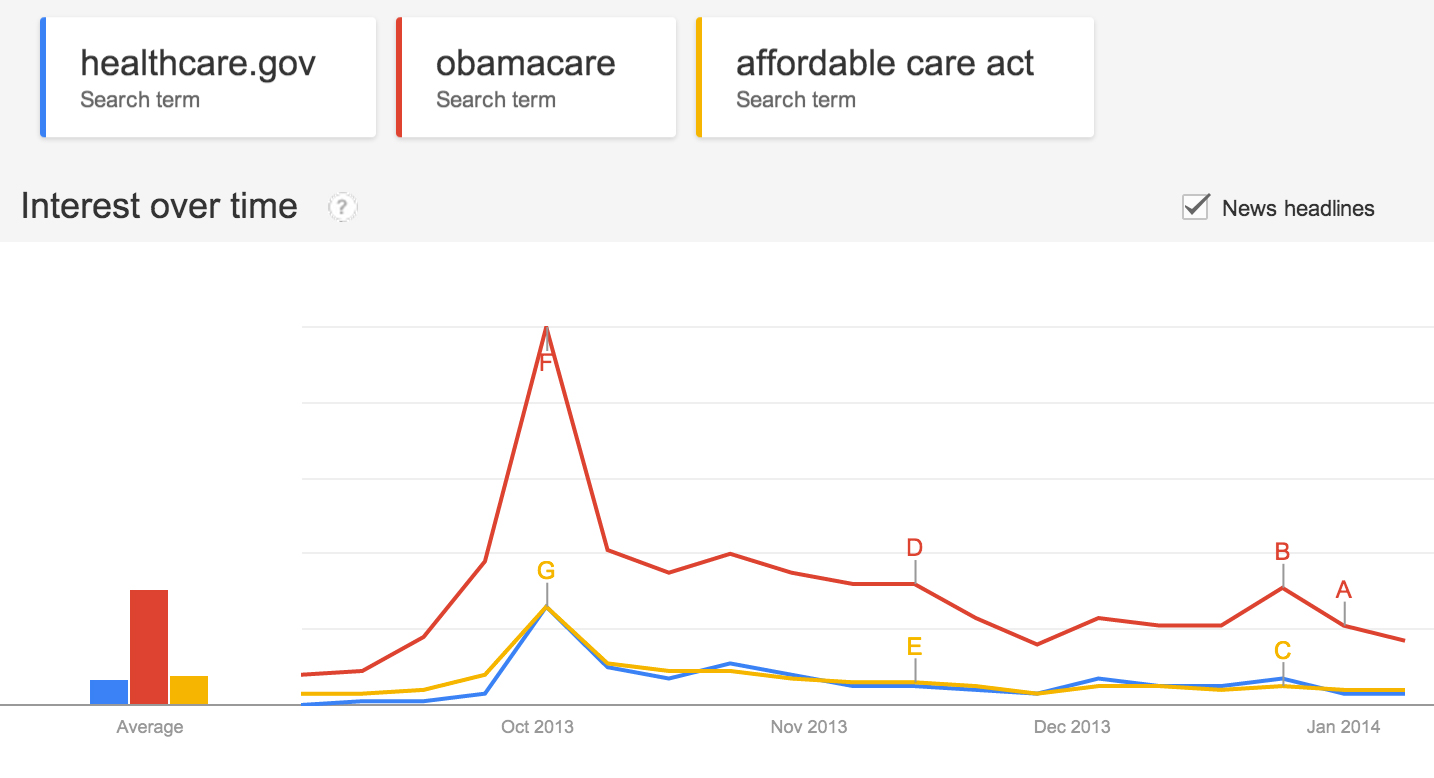
Kliff finds evidence of Obamacare boredom:

Those who have watched other insurance expansions come and go offer two theories. One is that the coverage people signed up for is, by and large, working. And it’s a whole lot less exciting to write about things that work as they’re supposed to than things going haywire, as was the case with HealthCare.gov’s initial rollout. This is the more optimistic theory of Obamacare boredom: The law is working, thus leaving us reporters with few screw-ups to write about. … Another possibility is that the problems just haven’t cropped up quite yet.