The In-Tray Swarms the Christie Presser

This lunchtime, Governor Christie insists he couldn’t pick Mayor Sokolich out of a police line-up. A reader writes:

Hm. Plausible, just barely: he meets a lot of people, after all. But “until [he] saw [Sokolich’s] picture last night on television,” he wouldn’t have been able to pick him out of a lineup? Last night? How many months has this bridge scandal been going on? Color me unconvinced.

Another:

Governor Christie was once the US Attorney.  His Chief of Staff, Chief Counsel and Deputy Chief Counsel were all former Assistant US Attorneys.  All of them know how to investigate misconduct.  It is absolutely inconceivable that Christie or these senior staff members did not recognize that the answers to the swirling allegations would be found in the emails.  Either they learned  the damning facts right away and sat on them or they said to each other “we better not go there because we will only find trouble”.   There is no good explanation for the Governor here.

Another:

It seems to me that two simple questions should pry the lid off this: “Governor Christie, your staff told you the lane closures were part of a traffic study. Did you ever ask your staff or the DOT to produce the results of the traffic study, or even a contract ordering the study? If not, why not?”

Another:

Here’s something to add to the “obvious pattern” you talked about.

We know that Christie was focused on running up the score by the fact that he scheduled a special election for Senate (at great expense for the State) a few weeks before the general election in November to make it less likely that Cory Booker supporters (Democrats) would show up at the polls and reduce his margin. For a man that intent on maximizing his margin, it is easy to believe that he would be vindictive against those who refused to go along.

Another:

I’m surprised no one seems to be talking about the fact that this traffic sabotage occurred on 9-11. Isn’t the GWB a high value target? And wouldn’t the people of NJ be more sensitive to, and stressed out by, something so out of the ordinary? Not to mention the need of first responders to be on high alert. Is it just a coincidence that they planned this for the week of 9-11 or was that part of the effort to inflict as much pain as possible on Fort Lee residents?

Another:

The emails that were turned over were heavily redacted. Who redacted them? They were obviously reviewed by someone. Why didn’t alarm bells go off? I don’t get it. And the person who reviewed them did not hear the bells going off. I’m not buying Christie’s explanation that he had no idea until 9AM yesterday.

That would have made his statement that he’d lost sleep the last couple of nights a little off, don’t you think? Unless he knew this was coming.

The Rise Of The Independents

Independents

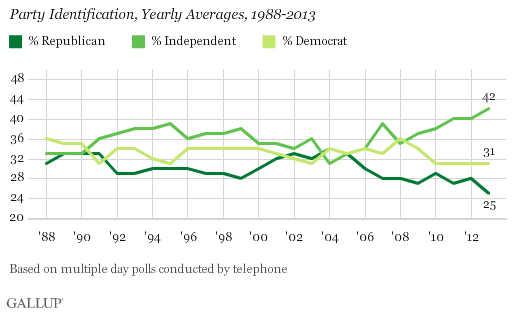
The latest numbers:

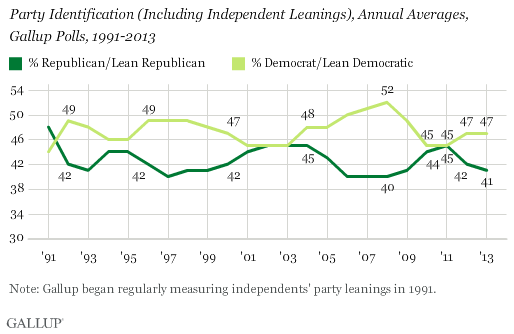
A record 42% of people consider themselves Independent, compared to Democrat (31%) or Republican (25%). That’s a huge shift from just a decade ago, when affiliations were divided around a third for each. The chart below shows how Americans’ dissatisfaction with the parties is nothing new. (Note the surge in independents around the time of Ross Perot’s 1992 presidential campaign.) The spike in Independents is eating more into the GOP, which has seen party moderates sidelined by extremists. The data suggest that there may be a place for a Bloomberg presidential bid after all.

Alan Abramowitz disagrees with that final sentence:

Despite Gallup’s findings, you won’t see a large number of successful independent candidates next November, nor will many Democratic or Republican candidates distance themselves from their own party on major issues. That’s because, despite the apparent rise in independent identification, Americans are actually becoming more rather than less partisan in their behavior. Yes, even “independents.”

What I see is a bunch of formerly Republican voters/leaners being too embarrassed to admit it any more. Sides digs into the data:

Most self-described “independents” do lean toward a party. This other graph by Gallup is really the more important one:

Independents Party

Why is it more important? Because independents who lean toward a party — or “independent leaners” —  behave like partisans, on average. They tend to be loyal to their party’s candidate in elections.  They tend to have favorable views of many political figures in their party. They are not much more likely to identify as ideologically moderate. To be sure, independent leaners are not as partisan as the strongest partisans. But they resemble weaker partisans much more than they do real independents. In actuality, real independents make up just over 10 percent of Americans, and a small fraction of Americans who actually vote.

Matt Welch has a different perspective:

[A]s Nick Gillespie and I argue in The Declaration of Independents: How Libertarian Politics Can Fix What’s Wrong With America (a distillation of which you can read in the August 2011 issue of Reason), the economy/society-wide loss of brand loyalty and gain of individualized, tech-fueled disruption will hit politics and especially governance last, because of government’s guaranteed revenue streams and party-rigged insulation from competition. But just because it will happen last, doesn’t mean it isn’t already beginning to happen.

Finally, Drum thinks the poll “goes a long way toward explaining that Pew survey last week, which found that belief in evolution had plummeted from 54 percent to 43 percent among Republicans over the past four years”:

If you dig into the details of that poll, the decline is actually a little more moderate than it seems, and it’s probably explained mostly by the fact that so many moderate Republicans have left the party. When you remove a big chunk of people who believe in evolution, the group that’s left will have a higher percentage of deniers even though no one’s beliefs have actually changed.

Wildstein Pleads The Fifth

One of the key officials in the Christie vendetta scandal – David Wildstein, former appointee to the Port Authority of New York and New Jersey – has just refused to testify apart from pleading the fifth in front of the New Jersey legislature. I wouldn’t take that as an encouraging sign for Christie.

A Sign Of The Times, Ctd

Dell York Times

A reader testifies to the local impact of national news brands going the way of sponsored content:

I work at a newspaper in flyover country, and Wolff’s column on the NYTimes’ embrace of “low advertising” hit me like a brick. Not that my organization has anything resembling the cachet of the Times – far from it. But like every other newspaper in America, we’re undergoing head-snapping changes that, at times, feel as if the ultimate goal is to turn us into Buzzfeed, or a local-level clone.

Five things you can do to avoid traffic jams! Here are 10 things you should do when the mercury drops below zero! More and more, our publication and web site are filled with the “cheesy come ons” that Wolff describes – and that’s the supposed NEWS content. I can’t help but think this ultimately devalues us as a legitimate source of real news, even if it drives web traffic higher. Maybe this is the democratization of content, where content that generates clicks is considered the “best” type of content, but best for whom? It’s as if we’re replacing meat and potatoes with Cheetos – delicious but ultimately frivolous and unsatisfying.

When you see the metrics every day, and it’s clear that quick-hit crime stories or freak-show stories generate as many clicks as an investigative piece that took weeks to report, what rationale can there possibly be for doing the investigative work, the longer-form stories that actually help explain the workings of a community to the people who live there? That’s what I fear; that in our relentless pursuit of clicks, in our mania to remake ourselves in the image of Buzzfeed, we’ll ultimately make ourselves less relevant. And then what would differentiate us from any other aggregator or producer of cheesy come-ons?

Another sends the above screenshot:

I saw this when I went to the New York Times website a few minutes ago. “The New nytimes.com” – it’s “Sleeker. Faster. More Intuitive” – just like a Dell?

I should add that I do think that the design – especially the light blue and the blunt disclosure “PAID FOR AND POSTED BY DELL” – put the NYT in a different league than, say, Buzzfeed. But I get queasy reading another disclosure that reads:

This page was produced by the Advertising Department of The New York Times in collaboration with Dell. The news and editorial staffs of The New York Times had no role in its preparation.

This is what we were told yesterday:

The labor and cost of creating native ads is a hurdle, and the Times made it clear that it sees the product as suited to only a limited number of advertisers. It won’t come cheap for the Times, either, which is looking to hire a dozen or so people for a “content studio” to staff the effort.

So I guess the NYT employees who will be writing the copy for a sponsored page with the New York Times brand at the top are not part of the news and editorial staffs. So what kind of staffers are they exactly?

The NYT picked Dell in part because the chief copy-writer has “journalistic chops.” So I assume the new “content studio” employees will also have journalistic chops. What department will they be regarded as being in? Advertizing? I don’t think employees with journalist skills have ever been used at the NYT to help corporations write ad-copy designed to read like NYT articles. What do we call them? Neither pure copy-writers nor independent journalists, they are, I suppose, “content providers.” The deeper you go into this miasma in which public relations and journalism become close to indistinguishable, the more the newspeak has to proliferate. Another reader:

When you first started swinging at Buzzfeed about all of this blurring of journalism and ad revenue, I was thinking “Meh, I hate Buzzfeed. Buzzfeed’s stupid, why would you go there unless to waste some time and braincells anyway?” But Time, Inc. and the NYTimes?! That is bad. Bad for all of us. If the NYTimes morphs into fucking ad copy we’re at a very, very low point of our culture. For this, you guys get more than the $25 I gave last year. I’ll give The Dish as much as I can afford next month at renewal time. Because independent journalism MUST THRIVE.

When we picked a pure subscription model over a year ago, I honestly wouldn’t have believed that a year later, even the NYT was knee-deep in corporate propaganda with the NYT logo and other articles at the top of the page. Especially after their great pay-meter success, why sacrifice something so special as the integrity of the NYT for what cannot yet be big bucks? My fear is that one day – soon – it will be. And your ability to look at a random NYT page on the web and know for sure it’s not a gussied-up ad will slowly atrophy. As, I fear, will whatever reputation for integrity journalism has left.

When Did Christie Know?

Barro has a hard time believing that Christie was completely in the dark until yesterday:

Here’s what I don’t buy. Let’s stipulate that this hare-brained scheme was hatched by Christie’s staff and appointees without his knowledge. Therefore, he didn’t know about the lane closures or their motivations before Sept. 13, when Port Authority Executive Director Patrick Foye (a New York appointee) started complaining about them. There have been 117 intervening days, during which Christie accepted the resignations of two of his Port Authority appointees who are caught up in this scandal. I assume he and his top staff have had a lot of conversations during that time, trying to figure out exactly what happened in Fort Lee. Did his people really manage to keep him in the dark for that entire time such that he’s shocked today? If so, what does that say about his skills as a personnel manager?

After watching Christie’s presser, Barro asks four questions. Among them:

The governor says Kelly lied to him and said she had no involvement in the bridge lane closures. But Kelly wasn’t the only person who knew Kelly was involved. In August, she emailed David Wildstein, Port Authority Director of Interstate Capital Projects: “Time for some traffic problems in Fort Lee.” Wouldn’t Wildstein have told the governor, in the process of tendering his resignation, that Kelly had told him to do it? Bill Baroni, Christie’s top appointee at the Port Authority, was also checking in with Wildstein about whether “Trenton” was happy with the handling of the closures. Why didn’t Baroni tell the governor his staff had known?

Josh Marshall points out that many Christie loyalists must have been involved:

Clearly, a lot of different people in Christieland were in on this, at least in the sense of knowing it was going on, if not taking a direct role themselves. And the tone is pretty much universally one of joking about it or enjoying it rather than in any sense seeing it as a major inconvenience they were trying to rectify. … The emails do not suggest a bad apple each at Port Authority and the Governor’s office up to no good. This is a range of Christie staffers and appointees sitting back observing and chuckling as a big multi-day traffic snarl unfolds.

If Christie didn’t know about this there must have been a concerted effort on the top of his top people to keep him in the dark.

Tomasky sees three possibilities:

1. He’s telling the whole and complete truth in yesterday’s statement, that this was the first he’d known that the lane closings were political;

2. He was in on it from the start and helped mastermind it or at least winkingly approved it;

3. The middle position, which is that he didn’t have prior knowledge but he learned it was political some time ago—not long after it happened, say—and is now lying about having just learned.

If it’s two or three, I’d say you can forget not only his presidential ambitions. He’ll have to resign the governorship. Right? Hard to see any way around it. To have lied to your people for months about something like this, if that’s what he did, is a pretty good definition of being unfit for office.

Allahpundit is on the same page:

[A]t this point, given his emphatic denials that he had anything to do with the lane closings, what’s the alternative to resigning if a smoking gun emerges proving that he did? He’s not going to stand at the podium, cop to having lied baldfaced to the world about his role in punishing the public in order to retaliate against a political enemy, and then say, “Oh well, see you tomorrow.” His whole shtick is that he’s a straight talker who tells the truths that more polished politicians are too afraid to tell. He can’t admit to having lied to protect himself and then go back to business as usual. So what’s the alternative to resignation if he gets caught red-handed? Which, I guess, is another way of saying that the odds of him getting caught red-handed are verrry low or else his denials wouldn’t be so emphatic.

He Hasn’t Gotten Around To Anger Yet

original

A few thoughts about Christie’s presser (which continues to go on). He’s a pro. He stood there and took the heat, kept on message, revealed an impressive grasp of detail, explained what he’s been doing these last few days, and declared himself “betrayed.” The general assertion is that he could have had no direct responsibility for creating a culture in Trenton that gave us “callous indifference” to the welfare of the citizens of New Jersey and what he called a rogue political operation run by his own deputy chief of staff. He was poised; he did not seem too rattled; he took responsibility for the blow to New Jerseyans’ confidence in the integrity of their government. He claims, moreover, that he had no idea who the mayor of Fort Lee was. He had no idea he refused to endorse him. So he had no motive to do anything nefarious. So it remains a “mystery” to him.

As long as he’s telling the truth, the whole truth and nothing but the truth, I think he did about as well as anyone in that pickle could. But … one thing truly stuck out to me. Christie fired Bridget Kelly without talking to her since the emails emerged. That does not seem to me a chief executive entirely interested in how this actually came about. If I were in his position and believed I was betrayed to the point of going out there and telling untruths, I would want a face-to-face with my deputy chief of staff to understand the full context, and get to the bottom of it. Firing her summarily without even talking to her seems a weird act of abrupt distancing. I’m not sure it’s even wise. Sure he was right to fire her. But why do so in such a way as to alienate a close staffer without giving her a chance to explain herself? What happens if she returns the distancing herself? She will likely be subpoenaed and we’ll find out.

I was also struck by Christie’s insistence that Kelly was fired because she lied to him. Not because she engaged in petty vindictive politics. But because she deceived him. He claimed that she had never deceived him previously in any way. Again, his core issue is what was done to him, not what was done to the inhabitants of Fort Lee. What he cannot explain away, it seems to me, is the tone of the emails which suggest that this kind of thing was so routine it could be talked about almost in code and another official would instantly respond “got it” to a mere suggestion of “traffic problems.” That’s not a rogue moment, it seems to me. It’s part of an obvious pattern. The vindictiveness is not a leap; it’s a premise. The idea that Christie had no responsibility for creating a culture in which that premise was unremarkable is, to my mind, deeply implausible.

But he sure has put himself out there on a very long limb.

His administration, he tells us, as he told us for months, has “nothing to hide.” He wants to be judged now for expeditiously firing the responsible people, not letting this kind of petty, vindictive abuse of power spread in the first place. He is, he insists, a total victim in all this, blindsided, shocked, surprised. And he nailed that performance.

But if I were Christie, I’d be a little worried about Bridget Kelly. He threw her under the bus without even seeing her face to face. He’d better be damn sure she has no way to implicate him as well. And, after being blindsided by one bunch of leaked emails, what happens if he’s blindsided by more?

I give him a high grade for this performance. If it contains even an ounce of inaccuracy, he’s toast. And this thing will doubtless go on. And subpoenaed emails and texts are unpredictable things.

What Happens To Utah’s Marriages? Ctd

Yesterday Utah declared that it will not recognize same-sex marriages that were already performed. Serwer parses:

The circumstances facing Utah are sufficiently rare that there are few prior precedents for how to handle same-sex couples who are married after a same-sex marriage ban is overturned but before the issue is settled in the courts or at the ballot box. In New Mexico and California, courts ultimately ruled that those marriages had to be recognized by the state. The fact that the law is unclear however, doesn’t mean that Utah’s decision was necessary.

“I don’t think it’s a foregone conclusion that they had to do this, they could have said while the litigation was pending, anyone who got married before the stay was issued is still considered married,” said Samuel Bagenstos, a professor at the University of Michigan Law School. “The fact that they didn’t is as much about their choice about how to interpret state law and the stay from the Supreme Court as what was required.”

Timothy Kincaid’s analysis:

In addition to being awkward and placing same-sex couples in extreme legal confusion, this may have been a strategic misstep on the part of the state.

It places Utah in the position of treating people in exactly the same situation (same-sex couples married under Federal authority) in disparate ways. The second problem with the Attorney General’s decision is that in many ways this closely mirrors the Proposition 8 scenario. In Hollingsworth v Perry, the Ninth Circuit found that you cannot grant rights to a group of people and then take those rights away. Here the state granted specific rights to married same-sex couples and then swooped in and took those specific rights away. And while the Ninth Circuit decision does not create precedent in the Tenth Circuit, it nevertheless will be given consideration. Had Utah simply said, “if you got married, you are married; if you didn’t, you are not”, that would have been a clean and simple ruling. But by taking a “we will not give you one iota of protection that we haven’t already processed” stance, the state demonstrates a significant degree of hostility. And by doing so, they have strengthened both our argument that the banning of same-sex marriage is rooted in animus and our call for heightened scrutiny in legal decisions.

Ari Ezra Waldman weighs in:

The state may not want to recognize the marriages performed in Judge Shelby’s equality window, but the federal government should. The federal government, according to instructions from agencies like the IRS and the Office of Personnel Management, will recognize marriages performed in the states as long as those marriages were performed in a state that recognized those marriages. That is the “state of celebration” rule. Utah recognized the validity of same-sex marriages when the 1300 marriages were performed. And nothing has changed. The stay granted by the Supreme Court did not invalidate those marriages. Nor did it undo Judge Shelby’s decision, despite what some commentators have suggested. Governor Herbert’s decision to put the marriages “on hold” does not deny their validity, either. Everything is just on hold. And that doesn’t change the fact that the marriages were valid in Utah when they were performed. That’s the end of the story.

Earlier Dish on Utah’s marriages here.

The Character Of Chris Christie, Ctd

As I absorb the on-going presser by Christie, here are Toobin, Gergen, Davis, Anderson and I tossing around the bridge scandal on AC360 Later last night:

This embed is invalid


A reader dissents:

I am a long-time reader and devotee, but I don’t understand your hostility towards Christie. I’m admittedly biased, of course. As a New Jersey Democrat who’s fallen hard for this big guy (daylight between us on social issues not withstanding), I know that I have a very particular point of view on the governor that is not universally shared. He’s our hometown flavor of blunt and brassy, I get that. But your post on the emails by Bridget Anne Kelly is so vitriolic and unfair that I felt I had to write and say so.

Christie, the man himself, is “a vindictive, petty, egomaniac” and a “bully… or a liar” because someone who works for him did something contemptible? You’re kidding me, right? That’s the threshold for summarily trashing a guy’s character? Is there any evidence whatsoever that the governor ordered or directly approved these actions? Any evidence at all that he even knew about them? Did you or did you not rightly defend the president from the all of the low-blow character assignation stuff that played the same song on Reverend Wright, William Ayers, Khalidi, etc.? Do any of those people make President Obama a racist, terrorist, anti-semite? Of course not.

There are plenty of reasons not to want Christie as president without having to rabbit-punch a guy who, in my personal experience, is a pretty big-hearted and compassionate fella. Until there is hard evidence to the contrary, please try to keep the transitive personal character stuff to a minimum, okay?

Another differs quite a bit:

Honestly. The bottom line here is that Christie knew about this. The “staffers” in question include people who have been friends of his since fucking high school. These are not random underlings US-POLITICS-CEO-CHRIS CHRISTIEgoing off on a lark. There is no way he didn’t know. Now, that can’t ever be proven unless Christie was stupid enough to be recorded talking about it with these staff members, but come on.

His denials shouldn’t pass the smell test in any sort of sane and accountable democracy. That our media (and citizenry! ye gods) is willing to give him the benefit of the doubt on a case like this – which is more clear cut than anything short of the Nixon tapes or a semen stain on a dress – just speaks to how deferential we are to power and how little the needle of our collective outrage is moved by even obvious corruption and abuse of power. (See also e.g.: The torture scandal and many officials’ “I can’t recall” statements when questioned about what they knew and when. We routinely let all sorts of powerful officials get away with this kind of denial-of-the-obvious-facts, but that doesn’t make it right.)

Another echoes Toobin:

Chris Christie is in very deep trouble. In fact, he’s toast. Those who poopoo the implications of this scandal underestimate a very important part of this scandal: that it’s one that’s very easy for voters to understand. This isn’t some complex money-laundering scandal involving complex financial instruments. It is, instead, as you rightly noted, an intentionally-constructed traffic jam that inflicted suffering, pain, and perhaps death on his own constituents.

Another is on the same page:

Did the Christie-bridge debacle kill anyone? That’s what I want to know.  Did anyone die in an ambulance trying to make it to a hospital?  Did anyone die in the ER waiting for a delayed doctor to get there?  Did anyone’s child suffer preventable brain damage for these same reasons?  My guess is that this may well have happened, and if it did, and a reporter or political operative finds the evidence, Christie is in for a world of hurt, and deservedly so.

Update from a reader:

An elderly woman was stuck in an ambulance and didn’t make it.

Another reframes the media debate:

The Christie scandal, in my opinion, really shows what’s wrong with the press today. A governor either took some petty revenge on his own constituents (with possible devastating results), or was too incompetent to know that his staff was doing so (or however you want to frame this), and the media speculates about his chances for 2016.

Shouldn’t people speculate about his chances to still be governor in 2014? Not to throw out an old trope, but if I started “exacting revenge” at work people wouldn’t so much speculate about my chances for a promotion as much as they would speculate about when I was going to be fired. Isn’t there any responsibility by the media to actually discuss the role of governing, as opposed to just politics?

On that note, many readers are taking apart Christie’s tenure:

I’d be interested if your “Democrat” reader who calls Chris Christie “our asshole (but) he gets things done” could actually tell us what Christie has gotten done.  Property taxes are still rising, and thanks to Christie’s cuts in aid to property-tax payers, homeowners are paying more out of pocket than before Christie.  We lost out on millions of federal dollars for Race to the Top thanks to Christie’s administration missing a deadline. We lost out on even more in federal dollars and economic grown when Christie unilaterally cancelled the new tunnel to New York City.  During Sandy, Christie’s administration moved millions of dollars of trains into the flood zone and they were destroyed. Last spring, thousands of taxpayers had their refunds held due to … no one knows.  Christie has slow-played medical marijuana at the cost of thousands of people’s health, blocked marriage equality, spent more resources on investigating abortion clinics, and pulled us out of the regional greenhouse gas initiative. At the same time New Jersey’s employment rate is higher than any of our neighbors in the North East, and our recovery is slower.

The only real “success” is getting federal aid for Sandy recovery, but it’s not like we weren’t going to get that anyway.  What did hugging Obama and slamming the Congress actually get us?  Then the aid was slow in arriving, and the multi-million dollar fund he and his wife created for Sandy recovery still hasn’t given away half of what it raised. What exactly is it that Chris Christie has gotten done?  Besides being “our asshole.”

Another reader:

Remember, this is the governor who nixed a desperately needed trans-Hudson train tunnel to establish his bonafides as a cost cutter with national Republicans. It would be a delicious piece of poetic justice if trans-Hudson traffic jams proved his undoing.

Another drills down on the tunnel:

Not only was the Access to the Region’s Core project a New Jersey priority, it was a national priority. One of the reasons there’s only two trains to DC at 5-ish in the afternoon is that there is no more space in the existing tunnels. If Amtrak had the cars and locomotives I’m sure there could be a few more trains. A 5:15 and a 5:30 to start. Christie did it to punish all those awful people who want to go to vile disgusting Manhattan, lots of them not stereotypical straight white guys. Pity he got reelected. Amtrak is busy planning on spending more money to build something that will have slightly less capacity and, this is my opinion, sucks compared to Access to the Region’s Core. ARC was going to be in “Macy’s Basement” with long escalator rides to 34th Street. With more or less direct connections to the subway. So all the people who used it, who would be getting on the subway, wouldn’t be in Penn Station. The Gateway plan has the southern most platform at approxiamately 30th Street and all the people who want the subway will have to walk across Penn Station. And the ones who don’t will have to walk across Penn Station instead of taking an escalator ride to 34th and 35th. I think the new entrances were on 35th. They may have been on 36th.

Update from a reader:

Your readers are wrong on the tunnel project. The problem with ARC simply is that it ended in a dead-end cavern, that did not connect to any of the other city transit infrastructure. It was utterly limited from a transportation point of view, and if you speak to any infrastructure expert, they will summarily agree. The other thing is that the tunnels would have been exclusively for NJ Transit, thus again limiting the connectivity of the network.

I agree that Christie canceled it for the wrong reasons, but he did the whole region a favor as many of the alternatives proposed (including the Gateway project), are much better as they connect to Penn Station, thus allowing Amtrak, NJT, etc to use the tunnels.

Of course the ideal would be for what was called Alt-G (the ultimate ARC tunnel was Alt-P in the various plans chosen), which would have also had a tunnel from Penn Station to Grand Central, integrating the whole transportation network. Alas, that will never happen.

Another sees a more systemic problem:

I started as a low-level employee at a big New Jersey state agency, and the governor is running them into the ground. They’ve been forcing out upper-management-level scientists at the DEP, professional engineers at the DOT and NJTransit and replacing them with real-estate and business cronies. These cronies are remarkably stupid and have implemented policies that have caused the state to go from being a model in the areas of efficiency and safety to laughing stocks in the country. I have a few private examples, but the biggest public one is the NJTransit train car flooding scandal.

When Jim Simpson took over as chairman of transit, one important directive he put into place is that no agency is to publicly acknowledge the existence of climate change. Or a need for additional infrastructure spending. This is supposed to only be for the public, but the internals have been run even worse. As Sarah Gonzales of NPR reported recently, before Hurricane Sandy, there was no storm preparedness plan in place for Transit or the DOT except for a two-page, fully redacted document. The MTA had considerably more planning done, for a much smaller area, and a comparable population. The fully redacted document was eventually unredacted (you can read it, there was no reason to be redacted except for surreal secrecy and ass-covering) and was depressing in how crappy it was. In interdepartmental presentations, our departments have again put presentation of how “well” we reacted to Sandy over acknowledging mistakes and fixing them.

Either he, or his picked cronies are pretty awful in how they are managing state agencies. There’s a huge brain drain now, as people (like me!) flee to other jobs because of how dysfunctional it is. If he becomes president, be prepared for more crappy cronies getting positions of power and then abusing it because they’re assholes.

(Photo by Paul J Richards/Getty)
The American Plutocracy

Nicholas Carnes’s new book, White-Collar Government, examines the prevalence of the wealthy in our government. If American millionaires had their own political party, he notes, it would have “a majority in the House of Representatives, a filibuster-proof super-majority in the Senate, a 5 to 4 majority on the Supreme Court and a man in the White House”:

Political observers in the United States have always worried about the effects of government by the rich. During the Founding, Anti-Federalists warned that the Constitution would create a government of wealthy merchants that would “consist . . . of men who will have no congenial feelings with the people, but a perfect indifference for, and contempt of them.” Federalists such as Alexander Hamilton countered that although the Constitution might produce a white-collar government, the effects would be small because different classes of Americans would have the same basic views about economic policy. We all want growth, so what’s the harm in letting the upper class call the shots?

White-Collar Government is the first book to bring hard evidence to bear on this long-standing debate. In it, I’ve compiled every available source of data on how legislators from different occupational or social-class backgrounds think and behave in office. What I found is squarely at odds with the rosy notion that class doesn’t matter in our political institutions. Pollsters have known for decades that Americans from different classes have different views about economic issues, that working-class Americans tend to be more progressive and that the wealthy tend to want government to play a smaller role in economic affairs. White-Collar Government shows that politicians are no exception.

In an interview last November, Carnes explained his current research project:

Right now I’m working on a big set of research projects designed to shed light on why there are so few working-class people in office. I just finished surveying all 10,000 of the people who ran for state legislature nation-wide in 2012, and in a month or so, I’ll survey all 6,000 of the people who lead the state and county chapters of the Republican and Democratic parties.  I’m also mining existing data on the social class makeup of state legislatures to see whether there are times and places where working-class people have made progress in our political institutions. My approach is essentially the same one that I used when I wrote White-Collar Government: I’m going to pull together every available source of data on this problem (including some that I have to collect from scratch) to try to get the most complete picture possible. In a few years, I hope to be able to definitively say, “These are the factors that are keeping working-class people out of public office, and this is what you can do about it.”