As Arnold points out, there is an otherwise inexplicable shift in direction in the Piccadilly linepassing east out of South Kensington. “In fact,” she writes, “the tunnel curves between Knightsbridge and South Kensington stations because it was impossible to drill through the mass of skeletal remains buried in Hyde Park.” Put another way, the ground was so solidly packed with the interlocked skeletons of 17th-century victims of the Great Plague that the Tube’s 19th-century excavation teams couldn’t even hack their way through them all. … Thus, like the example of the Aztec skulls unearthed by subway crews in Mexico City, London’s Tube also sits atop, cuts around, and tunnels through a citywide charnel ground of corpses, its very routes and station locations haunted by this earlier presence in the ground below.
(Photo: A sign announces a skeleton crew at London’s Barons Court station. By Annie Mole)
Charles Kenny reminds us not to mistake the rise of the East for the fall of the West:
What’s happening now is that the Rest are growing faster. China, the world’s most populous country, grew at an average rate of over 9 percent between 2010 and 2012. India grew at nearly 7 percent over the same period. Seven percent is more than three times our long-term growth rate. The developing world has an easier time growing fast, because we have invented a lot of technologies they can use to catch up to our levels of wealth. If they avoid tragic incompetence in policymaking, that means we should expect them to converge toward Western levels of income per person. In turn that implies the world is slowly returning to an era when economic dominance is largely a function of population—the default state for humanity for most of history, barring the industrial revolution. So we can stop blaming Washington, or Eurocrats, or kids today or wastrel boomers for the decline of the West. However annoying they surely are, they are not to blame for China getting bigger than we are. There’s one simple reason for that: China has a lot more people than the United States or Europe.
Looking at the broad span of history, Noah Smith argues that China’s global dominance isn’t assured either, precisely because it’s so large:
China has always been one of the world’s leading civilizations over the last five millennia. But it has only held both economic and military preeminence for brief periods of time—the late 1300s and 1400s being the most notable. Why has China not been preeminent for longer stretches? History is not a science, but we can make some guesses. The very thing that makes China so powerful and important–its titanic size–also endows it with fundamental weaknesses. …
Fortunately for China, this time may really be different. Modern communication and transportation technology mean that a big country is easier to defend and to integrate. Globalization, and China’s embrace of trade, mean that China is more open than it was during most of its history. But China has shown signs of worryingly isolationist instincts, harassing foreign companies operating within its borders. Meanwhile, China’s increasingly aggressive policies toward its neighbors—notably Japan and India, but also Vietnam and the Philippines—run the risk of inviting an effort at containment. The “Middle Kingdom,” like Germany in Europe a century ago, runs the risk of fighting all of its neighbors at once. In other words, China is vulnerable now for the same reason it was vulnerable in ages past. History is not a tale of Chinese preeminence, but a tale of Chinese oscillation.
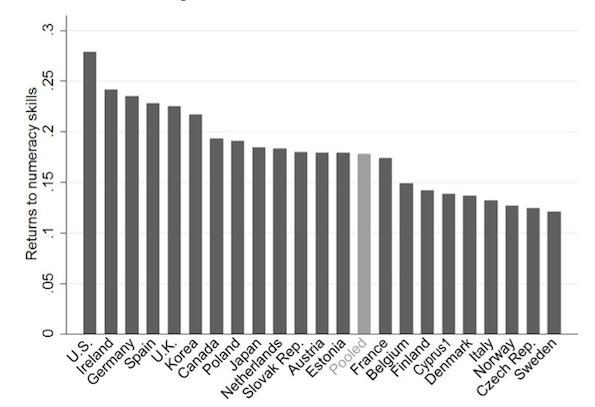
Overall, the effect of skills on earnings (what economists call “returns-to-skills”) is unsurprising. The authors focus on numeracy and show that people with more skills earn more. A one-standard-deviation increase in numeracy skills is associated with an 18% wage increase among “prime-age” workers (workers between 25 and 54). But there is massive variation in returns-to-skills. Why? The authors conduct a series of regressions and, some would argue, show the limitations of social-democratic policies:
[R]eturns to skills are systematically lower in countries with higher union density, stricter employment protection, and larger public-sector shares. The analysis shows, for example, that a 25% point increase in union density (the difference, say, between Belgium and the United Kingdom) leads to a 3.5% point lower wage increase for each one-standard-deviation increase in numeracy skills.
Looking at the same data from the OECD, Pethokoukis ponders why the US comes out on top:
I find particularly interesting the finding that (a) the return to skills is highest in America and lowest in Nordic-land, and (b) returns are higher in economies with more open, private-sector based labor markets. Wouldn’t this seem to argue that higher US inequality — based on pre-tax, pre-transfer market incomes — reflects 21st century market forces rewarding ability rather than some sort of breakdown in social norms? If so, shouldn’t the policy response favor creating, as much as possible, a labor force better and more broadly capable of flourishing in this environment rather than artificially lowering the return to skills and America’s growth potential?
David Gianatasio is struck by the latest bit of brilliance from the New Zealand government:
This eerie safe-driving PSA from New Zealand employs an Outer Limits-style time freeze to impressive, heartbreaking effect as we watch two drivers, poised to collide in a matter of seconds, emerge from their vehicles and discuss the situation. … “This campaign aims to reframe the way people look at their speed when they’re driving,” the New Zealand Transport Agency says. “We usually get to learn from our mistakes, but not when driving—the road is an exception. Even the smallest of mistakes on the road can cost us our life, or someone else’s.” The spot, by Clemenger BBDO, marks a departure from the agency’s recent work for the client, which successfully used humor and charm to highlight the dangers of driving while stoned. Here, the tone is intensely serious, and the riveting results are memorable and stand up to repeat viewings.
The Dish has posted both the stoned-while-driving PSA and this one on drunk driving. A reader adds, “I have no idea why NZ PSAs have gotten so inventive, but they are tapping into very working-class representation and language in such memorable ways.”
It turns out almost every green plant that’s been studied releases its own cocktail of volatile chemicals, and many species register and respond to these plumes. For example, the smell of cut grass — a blend of alcohols, aldehydes, ketones and esters — may be pleasant to us but to plants signals danger on the way. [Martin] Heil has found that when wild-growing lima beans are exposed to volatiles from other lima bean plants being eaten by beetles, they grow faster and resist attack. Compounds released from damaged plants prime the defenses of corn seedlings, so that they later mount a more effective counterattack against beet armyworms. These signals seem to be a universal language: sagebrush induces responses in tobacco; chili peppers and lima beans respond to cucumber emissions, too.
University of Missouri Professor Jack Schulz discusses a mechanical nose he is developing that might help farmers understand and even respond to these plant signals:
One day, farmers might not just be able to eavesdrop in on their crops’ airborne anxieties. They might even be able to whisper back. The idea comes from Professor Jack Schultz at the University of Missouri, who earned a brief mention in Michael Pollan’s amazing article on plant intelligence in the New Yorker. Schultz, a chemical ecologist, pioneered some of the first studies of plant communication in the 1980s. He is now working to develop a mechanical nose a farmer could use to pick up the chemical alarm bells of a crop under attack. If it works (which remains an if) farmers could apply pesticides with a high degree of precision. …
Gaining a richer picture of plant conversations takes an extremely precise nose, which humans lack, but dogs have. Vineyards in California contract dog trainers to search out invasive mealy worms. “So if you could duplicate a dog’s nose,” says Schultz, “you could see the world of chemical signalling. Us humans just aren’t attuned to that.” Other animals know bits and pieces of plant language, which is exactly why the plants might put out the signals in the first place. When a caterpillar starts munching on a corn crop, Schultz has found, the plant releases a beacon for wasps to take care of the problem.
Your post on black names reminds me of a study, which came out a decade ago: “Are Emily and Greg More Employable Than Lakisha and Jamal?” [pdf]. The title says it all, and the answer is yes. To conduct this experiment, researchers “applied” for jobs posted in newspapers by sending out identical resumes under both white and black names. They found that job applicants with white names needed to send out 10 resumes to get one callback, while job applicants with black names needed to send out 15.
I’m not sure how “white trailer park” names like “McKynleigh” or “Maddysen” or “Shain” would stack up, though. I suspect those applicants would also not do as well against the Emily Walshes and Greg Bakers of the world.
Another reader:
Penn Jillette named his daughter Moxie CrimeFighter. Gwyneth Paltrow named her kid Apple. APPLE. Sure there can be class and racial politics to names. But sometimes a weird name is just a weird name.
A former NYC teacher notes an upside to distinctive names:
It’s a lot easier finding my former African-American students on Facebook.
Another has a nuanced take on the whole issue:
De Boer is quite right to observe that much of the derision toward “ridiculous” black names is rooted in racism. He is correct that racism is far more harmful to society than the class envy that mocks similarly “ridiculous” names among affluent white children, and that names are invented constructs. So what are we to do with these observations? This was always the point at which this sort of diversity harangue broke down for me.
In principle no child should be mocked or disadvantaged for their name, just as in principle any woman should be free to walk home alone, drunk, at night, in perfect safety, or in principle a free market should always distribute resources efficiently. Unfortunately for black children with unusual names, college women at closing time, and Friedmanites and Randroids everywhere, reality couldn’t care less about principle.
It’s just as wrong to mock a child for their name as for their skin color, disability, or any other characteristic they can’t control. But I think it is perfectly all right to criticize the self-centered vanity of parents who impose highly unusual names upon their children, especially in cases when it has real, widely understood – and yes, unjust – consequences for their future.
Another observes:
Many non-black Americans have ethnic pride but do not give their children ethnic names. Why? Perhaps because they have ethnic last names, like Murkowski, Chang, Scalia, Jindal, Bierstadt, Ozawa, Chavez, etc. They can name their children Emily and Michael and not lose their sense of identity. Very few black Americans have African surnames, which were lost to slavery. First names are their only chance to tie their names to their heritage.
Another shares an article on the history of that heritage:
Distinctive black naming persisted through the centuries; the folklorist Newbell Niles Puckett turned up thousands of such names culling records from 1619 to the mid-1940s, names like Electa, Valantine and Zebedee. But by and large, it remained a minority practice within black culture, and most black names weren’t all that different from those given to whites. Then, in the 1960s, something changed, resulting in an unprecedented spike in black creative names, to the point where just a few years ago, Freakonomics authors Steven Levitt and Stephen Dubner noted that “nearly 30 percent of the black girls are given a name that is unique among the names of every baby, white and black, born that year in California.”
What happened? The dates, of course, are suggestive. The ’60s were a time of massive black protest from which emerged an accentuated separatist strain in black thought, epitomized in the Black Power movement. Blacks became increasingly interested in Africa and eager to show pride in their roots. (Indeed, “Roots” – Alex Haley’s book as well as the TV miniseries based upon it – itself had a remarkable effect on naming practices. According to Harvard sociologist Stanley Lieberson, the name Kizzy, which belonged to a “Roots” character, skyrocketed from oblivion to become the 17th most popular name for black girls in Illinois in 1977.)
Islam began in these years to have a clear influence, too, most visibly with Cassius Clay adopting the name Muhammad Ali in 1964. Others followed suit, including two fellows named Lew Alcindor and LeRoi Jones, whom you know as Kareem Abdul-Jabbar and Amiri Baraka. Around this time, an American boy named Barack Hussein Obama would be born. His given names, of Semitic origin, mean “blessed” and “good.” Soon, out of these more political traditions grew a new one of creating names whose sounds the parents merely found pleasing.
The short answer is that it tasted good. Also, it was easy to kill and so abundant that it often seemed, in the days before refrigeration, like the quail that fell on the Israelites in Exodus. … For both Native Americans and European settlers, the appearance of passenger pigeons or the discovery of one of their giant roosting grounds became a festive occasion where every member of the family had a role: shooting the birds, knocking squabs out of nests, chasing the unfledged runaways, and collecting the dead for pickling, salting, baking, or boiling. …
As long as America was rural and untraversed by railroads, the killing did not seem to do much more than dent the vast pigeon population. After the Civil War, however, things began to change rapidly.
You could find out by telegraph where pigeons were nesting, get there quickly by train, and sell what you killed to a city hundreds of miles away. Soon market hunters began operating on an enormous scale, cramming tens of thousands of birds into boxcars—especially after Gustavus Swift introduced the refrigerator car, in 1878. This meant that rural migrants to growing cities could still get wild game, and the well-heeled could eat Ballotine of Squab à la Madison, served by a new class of restaurant, like Delmonico’s, in New York, where fine dining was becoming a feature of urban life. All this coincided with an explosion in logging, which began destroying the habitat of pigeons just as hunters were destroying the pigeons themselves.
Update from a reader:
You probably don’t want to start a “Ctd” thread on passenger pigeons, but I thought I’d share this anyway. John Muir wrote beautifully about the passenger pigeons (all birds, in fact). The Exodus reference in your excerpt from Rosen reminds me of it – a passage from Muir’s book The Story of My Boyhood and Youth, in the chapter “A Paradise of Birds”:
Every shotgun was aimed at them and everybody feasted on pigeon pies, and not a few of the settlers feasted also on the beauty of the wonderful birds. The breast of the male is a fine rosy red, the lower part of the neck behind and along the sides changing from the red of the breast to gold, emerald green and rich crimson. The general color of the upper parts is grayish blue, the under parts white. The extreme length of the bird is about seventeen inches; the finely modeled slender tail about eight inches, and extent of wings twentyfour inches.
The females are scarcely less beautiful. “Oh, what bonnie, bonnie birds!” we exclaimed over the first that fell into our hands. “Oh, what colors! Look at their breasts, bonnie as roses, and at their necks aglow wi’ every color juist like the wonderfu’ wood ducks. Oh, the bonnie, bonnie creatures, they beat a’! Where did they a’ come fra, and where are they a’ gan? It’s awfu’ like a sin to kill them!” To this some smug, practical old sinner would remark: “Aye, it’s a peety, as ye say, to kill the bonnie things, but they were made to be killed, and sent for us to eat as the quails were sent to God’s chosen people, the Israelites, when they were starving in the desert ayont the Red Sea. And I must confess that meat was never put up in neater, handsomer-painted packages.”
Muir goes on to quote Audubon at length, describing the wasteful hunting practices that led to the birds’ extinction. The whole chapter (and all of Muir, if you ask this lifelong Californian) is worth a read if you’re interested. As always, thanks to everyone at the Dish for being such an essential part of my day.
(Image of Passenger Pigeon Net, St. Anne’s, Lower Canada, 1829, via Wikimedia Commons)
Daniel D’Addario suggests that print books are becoming luxury objects:
And, of course, aesthetic pleasure is what books are all about. But the era in which publishers could meaningfully restrict their books from being sold digitally has effectively closed; to refuse to sell a book online, even in spite of how much less money one can make from Amazon than from physical sales in stores, is to cut off a revenue stream and to ensure money is spent on a competing publisher’s book. And more and more consumers, accustomed to reading on screens, are using e-readers, and fewer physical outlets even exist to sell books in the first place. If a book isn’t immersive and incredibly visual, is there much of a point in seeking out a paper copy?
Anna Holmes defends print copies, explaining that “the volumes we keep on our shelves — and in our hands on a busy subway — tell several stories” (NYT):
There’s the author’s story, which is the actual text; there’s the publisher’s story, which has to do with the choice of format and design; and, finally, there’s the reader’s story — what a particular book telegraphs about one’s education and tastes. Who or what we choose to read can be as telling as the clothes we wear, and an e-book feels like a detail withheld, even a secret kept. (This is not necessarily a bad thing, and it probably explains why the three books I own about dealing with a loved one’s alcoholism are on my Kindle, not my bookshelf.)
Meanwhile, Nicholas Clee defends Amazon’s book business:
Price and convenience point me towards Amazon. I enjoy reading ebooks, and if the print equivalents are bulky and have small type, I prefer to read them on a lightweight device with adjustable fonts. I love browsing in bookshops, but I love browsing online, too, and get a small thrill every time I make an order that enables an instant download or a posted parcel. Furthermore, Amazon’s service is superb. Its website is the best, its Kindle Paperwhite is by reputation the best e-reading device of its kind, and its prices are usually the lowest.
My point is that this is what the overwhelming majority of Amazon’s customers feel about the company. Yes, we disapprove of its tax avoidance, but we have learned that every multinational will behave in this way, given the opportunity. It is for governments to sort out. But giving publishers a hard time? Why should we care about that? And if we felt that Amazon did not deserve to take business from the terrestrial bookshops, we would click on those Buy buttons less frequently.
Previous Dish coverage of the death of print here, here, and here.
My own provisional view, for what it’s worth, is that the “fuck-the-Serbian” scandal is a pretty damn serious one for Chris Christie. I sure hope his “shocked, shocked!” statement today is completely truthful (if not he’s toast), but even having to dress down some of his closest aides for “unacceptable” and “completely inappropriate” behavior casts a bad light on his judgment and, yes, character. You can’t distance yourself from the culture in your closest circle.
But the other reason I think this will sink in is because there are few things that people hate more than traffic jams. What Christie’s closest aides did was create days of traffic jams for ordinary citizens because of a petty internecine feud. That makes them raging assholes in the minds of most normal, sane people who have ever driven a car. And they are assholes.
Then there’s the question of tone. Christie’s deputy chief of staff emailed: “Time for some traffic problems in Fort Lee.” Who is she, a rejected minor character in “House of Cards”? Then this, when Christie’s peeps find out that children are late for school because of their “traffic problems”:
“Is it wrong that I am smiling?” Mr. Wildstein texted Ms. Kelly.
“No,” she texted back.
“I feel badly about the kids,” he texted.
“They are the children of Buono voters,” she said.
This is Sorkin-esque.
Here’s what I want to know. Who misled Christie so he was caught out in a lie/factual inaccuracy by denying all of this not so long ago? And what will happen to the assholes not already fired? How Christie responds in the next few days will be very revealing – either for the good or the bad.
See you later tonight on AC360 Later and in the morning.
(Photo: Traffic moves over the Hudson River and across the George Washington Bridge between New York City, and in Fort Lee, New Jersey on December 17, 2013. By John Moore/Getty.)
After watching Jehane Noujaim’s documentary, The Square, Eric Trager blames the original Tahrir Square revolutionaries for the failure of Egypt’s revolution:
The protesters’ relationship with the military stands out in this regard. While the small group of protesters on whom The Square focuses warily accepts the military takeover following Mubarak’s fall in February 2011, the bulk of the film highlights the profound violence of the junta’s 16-month rule. During this period, over 12,000 Egyptian civilians were tried before military courts, and security forces’ deadly crackdowns on protesters are now memorialized by their geographic locations around Tahrir Square—Maspero, Mohamed Mahmoud, Magles al-Wuzara—as if they were major battles in a drawn-out war. The film’s protagonists are occasionally among these battles’ casualties: They are chased and beaten by thugs, and repeatedly choke on expired teargas. At one point, Ahmed takes some birdshot to the head. The violence subsides temporarily after Mohamed Morsi’s victory in the June 2012 presidential elections, as the junta’s reign ends shortly thereafter. But one year later—and only 15 minutes after Morsi’s victory in the 100-minute film’s run-time—the activists are suddenly willing to accept the military’s return to power.
In an interview with Larry Rohter, Noujaim explains how she decided on a place to end the film, even as the events in Egypt continued to unfold:
That’s always the most difficult part of making these films, but especially so with this one, because the revolution was ongoing, things were changing constantly. The first time that the film allowed us to end it was when Morsi was elected. That was a political continuum, from the bringing down of a dictator to the election of a president. And we had finished that film and were on our way to Sundance in January 2013, and two weeks before we went there, all of our characters were back in the streets again saying, “Morsi is using the tools of democracy to create another dictatorship.” We realized there was a much more interesting story to tell, and it required us to continue filming, because the story became about holding government accountable, no matter who that government is.
So did you feel a twinge when Morsi was overthrown last summer, a desire to keep going?
We felt we were like on another chapter, of the military coming back into control again. But this was the beginning of another cycle, and another film. In the end it’s a character-driven film rather than a news-driven film, and our characters had come to the point where their arc had come to a conclusion, even though events continued on the ground.
writes, “the tunnel curves between Knightsbridge and South Kensington stations because it was impossible to drill through the mass of skeletal remains buried in Hyde Park.” Put another way, the ground was so solidly packed with the interlocked skeletons of 17th-century victims of the Great Plague that the Tube’s 19th-century excavation teams couldn’t even hack their way through them all. … Thus, like the example of the Aztec skulls unearthed by subway crews in Mexico City, London’s Tube also sits atop, cuts around, and tunnels through a citywide charnel ground of corpses, its very routes and station locations haunted by this earlier presence in the ground below.