A Poem For Wednesday

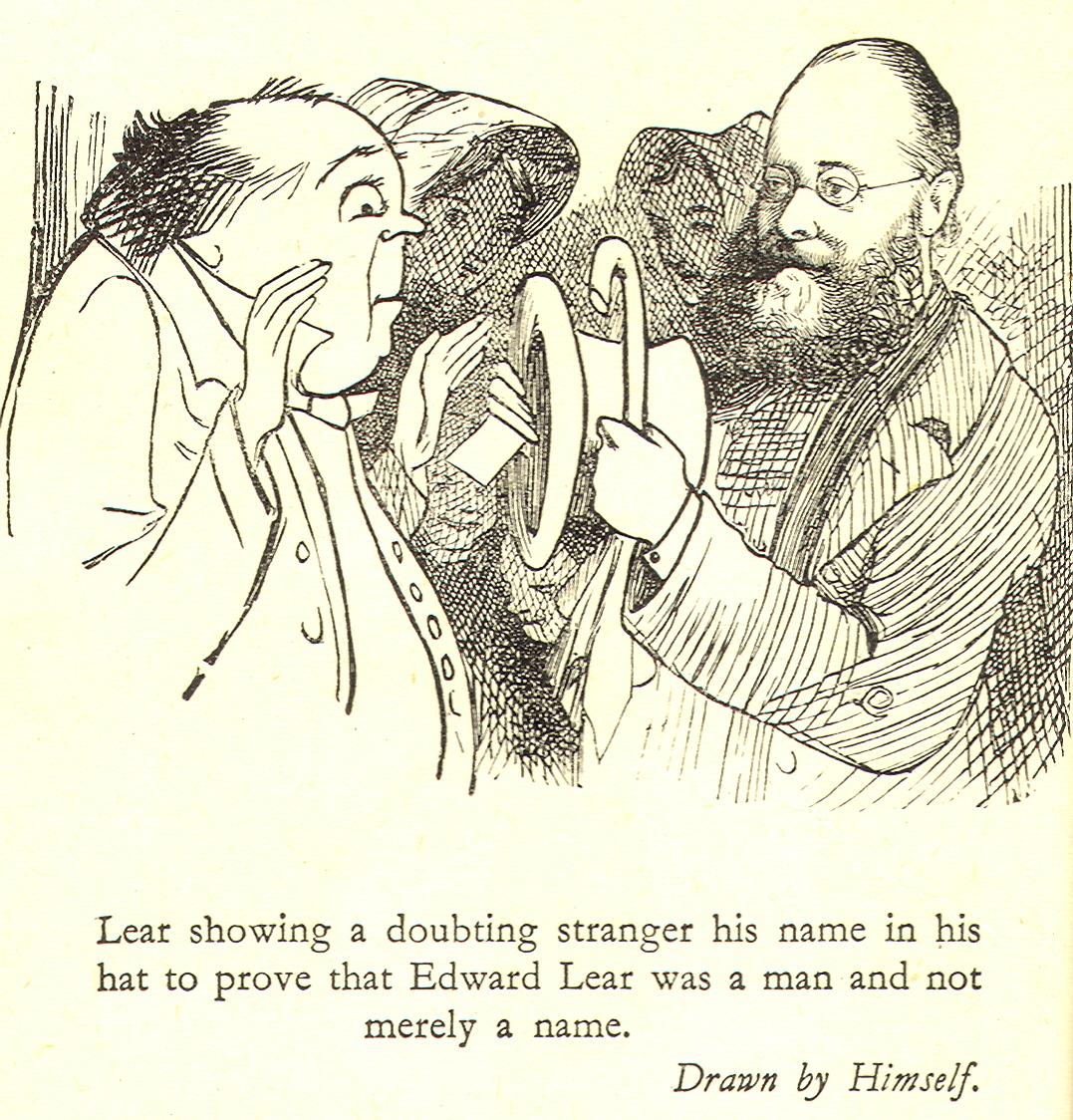
EdwardLearSelfPortrait

“By Way of Preface” by Edward Lear (1812-1888):

“How pleasant to know Mr. Lear!”
Who has written such volumes of stuff!
Some think him ill-tempered and queer,
But a few think him pleasant enough.

His mind is concrete and fastidious,
His nose is remarkably big;
His visage is more or less hideous,
His beard it resembles a wig.

He has ears, and two eyes, and ten fingers,
Leastways if you reckon two thumbs;
Long ago he was one of the singers,
But now he is one of the dumbs.

He sits in a beautiful parlour,
With hundreds of books on the wall;
He drinks a great deal of Marsala,
But never gets tipsy at all.

He has many friends, laymen and clerical,
Old Foss is the name of his cat:
His body is perfectly spherical,
He weareth a runcible hat.

When he walks in a waterproof white,
The children run after him so!
Calling out, “He’s come out in his night-
Gown, that crazy old Englishman, oh!”

He weeps by the side of the ocean,
He weeps on the top of the hill;
He purchases pancakes and lotion,
And chocolate shrimps from the mill.

He reads but he cannot speak Spanish,
He cannot abide ginger-beer:
Ere the days of his pilgrimage vanish,
How pleasant to know Mr. Lear!

(A self-portrait by Lear, from Edward Lear’s Nonsense Omnibus, via Wikimedia Commons)

The Sad Clowns

Andrew McConnell Stott muses over the dual personas of many comedians:

Is it a condition of comic genius to be perpetually wrestling with demons? From Canio, the iconic, stiletto-wielding clown of Ruggero Leoncavallo’s 1892 opera, Pagliacci, to modern greats like Richard Pryor, Andy Kaufman, and John Belushi, it would seem so. Even in Chaplin’s day, the depressed and often violent clown was a well-established trope, both offstage and on.

Around the time of his divorce, Chaplin had fallen into such “full-blown despair” that he told the journalist Benjamin De Casseres:

There are days when contact with any human being makes me physically ill … I am oppressed at such times and in such periods by what was known among the Romantics as world-weariness. I feel then a total stranger to life.

Back to Stott:

That comedy is a mansion built on tragic foundations was a theory given credence by Sigmund Freud.

“A jest betrays something serious,” he wrote in Jokes and Their Relation to the Unconscious, which argued that humor was a means of circumnavigating taboo and repackaging unpalatable thoughts into digestible form. At the heart of Freud’s argument is a reluctance to accept comedy on its own terms as comedy, viewing it rather as a proxy for something kept hidden. For Freud, Chaplin was “a particularly simple and transparent case” of someone who used humor to explore the darker states of mind. Writing to his friend Max Schiller, Freud commented how Chaplin always seemed to play the same part:

The weak, poor, helpless, clumsy young man for whom things turn out right in the end. Do you think he has to forget his own ego for this role? On the contrary, he only acts himself as he was in his bleak youth. He cannot escape from those impressions, and even today he is compensating himself for the deprivations and discouragement of that period.

On that note, Harmony Korine depicts a deeply conflicted Chaplin in a NSFW scene from his 2007 film Mister Lonely:

A.I. Intimacy, Ctd

Brian Christian adds to our recent discussion on Spike Jonze’s new film, Her, comparing modern devices to “the first chatbots” – books:

“Her,” not unlike the Turing Test itself, says more about the nature of human intimacy than it does about the limits of computation. As both an author and a lover of literature, I would be a hypocrite to condemn too strongly the power of indirect or one-way intimacy. I run the disembodied thoughts of some other mind through my own, like code, and feel close to someone else, living or dead, while risking nothing, offering nothing. And yet the communion, I would argue, is real. Books themselves are perhaps the first chatbots: long-winded and poor listeners, they nonetheless have the power to make the reader feel known, understood, challenged, spurred to greatness, not alone.

The Character Of Chris Christie, Ctd

US-POLITICS-CEO-CHRIS CHRISTIE

The more I think about the culture that Christie created in Newark Trenton among his top staffers the more disturbed I am. Maybe that’s why Henry Kissinger loves Christie so: he reminds him of Nixon. Still, this is the Dish, so a reader sticks up for the governor:

Calling New Jersey politics “Soprano-style” is like explaining what a word means by using it in the definition. There are books written about this kind of corruption (hell, one of them is even called The Soprano State) and this kind of action is par for the course. As a lifelong New Jersey resident, the only difference is that the person involved in this happens to be a major national political figure with the worst case of presidential aspirations. Most of the previous New Jersey political shenanigans end up being a one-off punchline in a late-show monologue or footnotes in political history books.

You ask: “Is he a bully? Or a liar? Or both?“ He’s an asshole. More importantly for the people who want to get anything done in New Jersey, he’s our asshole. I may not like all of his politics and antics as a solid Democrat, but I respect that he gets things done and doesn’t think bipartisanship is a dirty word – as opposed to our soundbite driven, do-nothing Congress. In this age of swinging-dicks politics, it pays to be represented by someone who is eager to pulls theirs out.

I’m not going near that metaphor for obvious reasons. For the most part, though, readers are piling on Christie:

Back during the Hurricane Sandy aftermath, there was the whole debate over whether Congress was moving slowly on funds because the area affected was prone to corruption. Senator Inhofe of Oklahoma said, “Everyone was getting in and exploiting the tragedy.”

Here is Christie responding to the vote delay (not Inhofe directly): “I think, unfortunately, folks are putting politics ahead of their responsibilities,” he said. “It’s absolutely disgraceful. … It’s why the American people hate Congress.”

So now we have Bridgegate, which to those of us out west seems much more corrupt than it may actually be because mobility is much more a part of our lifestyle. If you drive 20 miles to the grocery store, or 50 to a high-school football game, a guy who can get away with closing a highway and city seems as corrupt as Karzai or Putin. Good luck selling that in Iowa.

Another reader:

I loved the comment from Christie’s staffer that all those kids on the buses were kids of Buono voters. I guess that implies that only Democrats send their kids to public schools? Wow.

Another sees a neglected story within the story:

The excerpts you highlight from the Christie administration are, indeed, disturbing. Something else I found outrageously offensive: the repeated references to Fort Lee Mayor Lee Sokolich’s ethnic background, including calling him “the little Serbian.” (Sokolich is Croatian, as it turns out, but it’s the intent I’m getting at, not people’s inability to distinguish between two distinct South Slavic peoples.)

If government officials referred to, say, a Jewish politician as “the little Jew” or incorporated his or her religious/ethnic/cultural identity into demeaning and dismissive comments in other ways, I’m guessing that would be a huge deal and would draw significant attention. Shouldn’t that be the case here as well?

I think anti-semitism has a more disturbing history and connotations than anti-Serbianism, but we’ll see.

(Photo: New Jersey Governor Chris Christie is interviewed by Gerard Baker (out of frame), Editor-in-Chief, Dow, Jones & Company, and Managing Editor, The Wall Street Journal, at The Wall Street Journal CEO Council, November 18, 2013 at the Four Seasons Hotel in Washington, DC. By Paul J Richards/Getty.)

Face Of The Day

Villagers Panic As Mount Sinabung's Volcanic Ash Reaches Their Homes

A girl stands in the foreground as Mount Sinabung spews pyroclastic smoke in Karo District, North Sumatra, Indonesia on January 8, 2014. The number of displaced people has increased to 22,000 in Western Indonesia as Mount Sinabung continues to spew ash and smoke after several eruptions since September. Eleven deaths have now been recorded as a result of the eruptions, with hundreds more falling ill. By Ulet Ifansasti/Getty Images.

Traffic On The Road To The White House

Christie responds to the bridge scandal:

What I’ve seen today for the first time is unacceptable. I am outraged and deeply saddened to learn that not only was I misled by a member of my staff, but this completely inappropriate and unsanctioned conduct was made without my knowledge. One thing is clear: this type of behavior is unacceptable and I will not tolerate it because the people of New Jersey deserve better. This behavior is not representative of me or my Administration in any way, and people will be held responsible for their actions.

Ezra reacts to the story:

It’s entirely possible that Christie didn’t know very much about the bridge episode. It might just be the product of the culture he’s created, or permitted, to arise around him. What’s dangerous for Christie, though, is that now every political reporter in the country will begin believing rumors of his punishments and hunting down evidence of his retaliation. And things Christie was able to do before to wide applause — like berate a schoolteacher and then have his staff upload it to YouTube — will begin feeding a very different kind of narrative.

Ambers weighs in:

The fact that Christie’s deputy chief of staff believed it was morally permissible to cause pain to innocents in order to retaliate against a perceived slight, without seeking his permission, and then refused to own up to it, tells us something about the culture that Christie creates around him. She assumed the boss would be okay with what she did. And so did many other Christie advisers, including his campaign manager. And since Christie denied having anything to do with the bridge study, he apparently has fostered a culture where it’s okay to lie to the boss in order to protect him.

Sean Davis expects the revelations to seriously damage Christie:

Most people understand that politics ain’t beanbag. There’s a certain amount of rough-and-tumble, back-and-forth backbiting that’s expected from the kind of people who choose to spend their lives trying to accumulate as much power as possible. As a result, backroom maneuvering to remove some political privileges enjoyed by one’s opponent probably wouldn’t draw a second glance. But that’s not what Christie’s top aides did. They deliberately chose to target innocent civilians:  moms and dads trying to get to work on time, school bus drivers trying to get children to school, first responders trying to take ill people to the hospital.

It doesn’t matter who you are:  that type of behavior is inexcusable. Nobody likes the guy who intentionally abuses his power in order to indiscriminately punish people just trying to get through the day.

Barro’s related remarks:

One of the key raps on Christie is that he’s a “bully” and that he engages in naked power politics. That rap hasn’t hurt him with voters — until now — because they perceived Christie as bullying people who deserved to be bullied and using strong-arm political tactics to make New Jersey’s government work better. Christie’s governing style led to bipartisan agreements on budgets and employee benefits reform, and the targets of his ire were unpopular: teachers’ unions and distrusted municipal officials.

But now we’re seeing an example of Christie’s team doling out punishment in a way that was both incompetent and petty. This isn’t just about the Christie administration engaging in unseemly retributive politics; it’s about them being bad at it.

Chait sticks a fork in Christie:

Mitt Romney managed to win the GOP nomination in 2012 despite some ideological vulnerabilities — smaller ones than Christie’s, I’d argue — because he was the sole electable candidate in a field lacking any plausible alternatives. The 2016 field already looks to have several plausible Republican contenders. Christie’s path to victory always involved a desperate-to-win party Establishment circling around him. Why would they circle around a candidate teeming with corruption scandals, when they could instead nominate a more conservative alternative with a more attractive personal image? What reason, at this point, does any Republican have to nominate Christie?

David Graham pushes back:

Perhaps this will be the end of Christie’s career, but it’s hard to see how anyone can tell at this point, and there are several reasonable, and equally speculative, reasons this may blow over. Here we have a regional dispute that—contra Chait—is fairly arcane for non-locals: He closed down a few but not all lanes of a bridge that managed by a bi-state agency? Huh?. Iowans probably care even less for B&T folks than Manhattanites. Everyone already knows Christie is a bully, and it’s hard to see how many more people this will convince. And most important of all, there are almost exactly two years until the Iowa caucuses.

Nyhan’s view:

On the one hand, it’s important not to overhype the significance of events like this to ordinary voters, very few of whom are paying close attention to the jockeying among potential 2016 candidates. The problem for Christie is that his principal asset in a Republican primary is an aura of electability. That aura may now start to dissipate along with his previously impressive favorable/unfavorable ratings, which were already looking more like those of a conventional politician. Moreover, widespread coverage of the bridge controversy could renew fears among elites about other potential skeletons in his closet and embolden GOP rivals and operatives who oppose his candidacy. Research by political scientists suggests that those party elites play a critical role in choosing the party’s nominee. If Christie is not seen as the most electable candidate, he’s unlikely to get much traction given his previous ideological heterodoxies.

Erick Erickson calls the intentional traffic jam on the Jersey bridge “routine hardball politics that Republicans and Democrats alike engage in at the local level”:

But there’s more here and it is going to be the problem that haunts Chris Christie. I’m ambivalent on his run for the Presidency. But I don’t see him getting that far for the very reasons underlying this issue — he and his staff operate as divas. I have had Congressmen, Governors, and the staffers of Congressmen and Governors tell me horror stories about dealing with Christie’s people. All of them seem to dread it.

Larison expects the scandal to blow over:

The pathetic thing about all this is that it will probably have little or no effect on Christie’s presidential ambitions. Many people are already declaring that this marks the demise of a future Christie campaign, but I have a feeling that the story will be received very differently inside the GOP than it is by everyone else. It will probably be treated as a political “hit” by hostile media, and partisans will begin dutifully repeating claims that the story isn’t that important, or that it’s old news, or that it is irrelevant to the state/country’s real problems. That seems likely because that is what partisans usually do when one of their party’s stars is accused of some wrongdoing.

Ramesh’s take:

I think Christie is going to have to do something more to get some distance from this scandal (and not just for the Serbian- and Croatian-American votes). If he does, I think this is just a blip for his 2016 campaign.

Alec MacGillis joins in the speculation:

I don’t believe this is necessarily the end of Christie’s presidential hopes, as Jonathan Chait argues—I am constitutionally averse to making predictions pro or con prospects with three years to go until the Iowa caucuses. And I’d also caution against overstating the facts at hand here: Christie’s people did not “close the George Washington Bridge,” as some reports are now suggesting—they shifted two of Fort Lee’s three rush-hour access lanes to the main flow of Interstate 95 traffic, thus causing horrific backups in Fort Lee but easing the main flow onto the bridge from I-95. It was, in that regard, a devious surgical strike.

But, we now know, too devious for its own good. There is something going down today—and it’s Chris Christie’s standing in the field of 2016 contenders.

Finally, Josh Marshall points out that these actions were completely unnecessary:

All year last year it was clear that Christie was set for a massive win. So just think how needless this was. Whether he did it or his aides did, this was an effort to get a Democratic mayor to endorse him. A Democratic mayor. No one expects members of the opposite party to endorse you, though many did.

Now, there’s some sense in which Christie didn’t just want and need to win. His 2016 presidential strategy rested on racking up a big number, somewhat along the line that George W. Bush did in his second term as Governor of Texas. And this even more so in a blue state. But at the end of the day, just in the crassest and most cynical terms, there was simply no reason to do this.
The UnSchool

Mark Oppenheimer visits the Sudbury Valley School in Framingham, Mass., where there are no required classes and students make their own rules:

In a 2004 study of 119 alumni who had attended the school for at least three years, over 80 percent had gone to college or university. Others became entrepreneurs, chefs, carpenters, artists, etc. The school is filled with books, most students have laptops, there is Wi-Fi. But students can roam outside and play, or tinker on the piano, or draw. Everyone learns to read, eventually, although I met a couple of students who confessed that, while they could write by hand, they did not know cursive. They may do and study whatever they like. They may learn by building robots, or making up role-playing games with elaborate rules, or by serving on the budget committee, or by participating in the school administration, or in countless other ways. The current head of the school—the actual head of school, elected by the community—is an 18-year-old girl.

The Sudbury Valley School is a dangerous place to visit, as I did earlier this month.

It upends your views about what school is for, why it has to cost as much as it does, and whether our current model makes any sense at all. But what’s most amazing about the school, a claim the founders make which was backed up by my brief observations, my conversations with students, and the written recollections of alumni, is that the school has taken the angst out of education. Students like going there, and they like their teachers. Because they are never made to take a class they don’t like, they don’t rue learning. They don’t hate homework because they don’t have homework. School causes no fights with their parents.

In short, Sudbury Valley students relate to their work the same way that adults who love their jobs—many artists, writers, chefs; the very fortunate doctors and lawyers and teachers—relate to work: They chose it, so they like it. Perhaps that’s because students at Sudbury are, in fact, treated as full adults. They have equal votes in making budget decisions, administering the school, making and enforcing discipline. There are currently about 35 Sudbury-model schools, in 15 states and six foreign countries, and one thing they have in common is their stance against age discrimination. They say that all ages are equal, and they mean it.

Our Outrageous Media

Jeffrey M. Berry and Sarah Sobieraj ask whether Americans are addicted to outrage:

On cable news networks, talk radio and in the political blogosphere there is a constant stream of name-calling, belittling, character assassination and falsehoods. Americans tell pollsters they dislike this kind of talk and believe it degrades our political system.

But the audience data tell a different story: In fact, Americans find this type of political commentary quite compelling. By our calculation, part of an analysis we did for our new book, The Outrage Industry: Political Opinion Media and the New Incivility, the aggregate daily audience for such content is roughly 47 million people. In a cluttered media landscape where advertisers have a sea of choices, anxious television and radio producers hungry for revenue have sought new ways to break through the clutter—to stop the channel surfers as they peruse other options—and reach audiences. And the popular agent provocateurs of political talk media not only do the job—they also do it relatively cheaply. (Consider that CNN’s administrative expenses make up about twice as much of its budget share as at Fox or MSNBC.) As a result, America has developed a robust and successful Outrage Industry that makes money from calling political figures idiots, or even Nazis.

In a review, James Boylan puts Berry and Sobieraj’s book in historical context:

While The Outrage Industry offers a thorough survey of recent and present developments, it does little to convey the historical depth of the phenomenon. Although the authors present liberal and right-wing outrage as roughly equivalent in technique if not in size, in fact their foundations are profoundly different.

The historian Richard Hofstadter, who died too young in 1970, foresaw the persistence of right-wing outrage in his 1965 book, The Paranoid Style in American Politics. He saw in what he called the “pseudo-conservative” movement, which had pushed forward Barry Goldwater’s failed run for president, the appearance of an ostensibly patriotic faction that was, paradoxically, deeply unhappy and angry with America and the American system. Hofstadter understood that elements of this movement would survive: “In a populistic culture like ours . . . in which it is possible to exploit the wildest currents of public sentiment for private purposes, it is at least conceivable that a highly organized, vocal, active, and well-financed minority could create a political climate in which the rational pursuit of our well-being and safety would become impossible.”

In an excerpt from their book, Berry and Sobieraj explain why we don’t have a liberal analog to Rush Limbaugh and aren’t likely to get one:

One basic reason for the modest size of the market for liberal talk is that much of the potential audience listens to other types of radio. Together, African Americans and Hispanics constitute somewhere near 30 percent of the nation’s population, but they constitute a much larger proportion of the nation’s liberal population, and these listeners can choose programming that is specifically targeted toward them. Talk programming is particularly popular among African Americans and there have long been stations catering to that market in urban areas. There are also Spanish-language alternatives that appeal to many Hispanic listeners. The potential audience for liberal talk radio is further reduced by the popularity of National Public Radio (NPR), which is more popular with liberal listeners than with conservatives. NPR rejects the charge that it reports news from a liberal point of view, but conservatives consistently deride NPR as biased. Ratings put the weekly audience for NPR at around 34 million and it is a major force in radio nationwide.

Traffic Stop And Frisk

Black drivers who obey all traffic laws get pulled over three times as often as whites do:

In traffic safety stops, being black has no influence: African Americans are not significantly more likely than whites to be stopped for clear traffic safety law violations. But in investigatory stops, a black man age 25 or younger has a 28 percent chance of being stopped for an investigatory reason over the course of a year; a similar young white man has a 12.5 percent chance, and a similar young white woman has only a 7 percent chance. And this is after taking into account other possible influences on being stopped, like how you drive.

Police focus investigatory stops on younger people, and so as people grow older they are less likely to be stopped in this way. But a black man must reach 50 – well into the graying years – before his risk of an investigatory stop drops below that of a white man under age 25. Overall, black drivers are nearly three times more likely than whites to be subjected to investigatory stops.

These differences are not lost on African Americans. According to our survey, African Americans view normal traffic stops as legitimate exercises of law enforcement, and do so at about the same rate as whites do. Indeed, the main difference is that blacks, unlike whites, are even more likely to view a traffic stop as legitimate when the officer lectures them on driver safety, taking that lecture as a reassuring cue that they were in fact stopped for their behavior, not for the color of their skin.