Freezing As The World Warms

Sub-Zero Temperatures Put Chicago Into Deep Freeze

Greg Laden insists that this week’s frigid temperatures don’t mean global warming isn’t real:

What is happening instead is the cold air mass that usually sits up on the Arctic during the northern Winter has moved, drooped, shifted, gone off center, to engulf part of the temperate region. Here in the Twin Cities, it is about 8 below zero F as I write this. If I go north towards the famous locality of International Falls (famous for its cold temperature readings often mentioned on the national news) it will in fact be colder. If I go even farther north it may still be a bit colder, but at some point it will start to get warm again, as we leave the giant blob of cold air that has engulfed us. In fact, it is relatively warm up on the North Pole right now.

Eric Holthaus goes one step further:

[D]espite the trolling of Donald Trump and other climate change deniers, global warming is probably contributing to the record cold, as counter-intuitive as that may seem. The key factor is a feedback mechanism of climate change known as Arctic amplification. Here’s how to explain the nuts and bolts of it to your under-informed family and friends:

Snow and ice are disappearing from the Arctic region at unprecedented rates, leaving behind relatively warmer open water, which is much less reflective to incoming sunlight than ice. That, among other factors, is causing the northern polar region of our planet to warm at a faster rate than the rest of the northern hemisphere. (And, just to state the obvious, global warming describes a global trend toward warmer temperatures, which doesn’t preclude occasional cold-weather extremes.)

Since the difference in temperature between the Arctic and the mid-latitudes helps drive the jet stream (which, in turn, drives most US weather patterns), if that temperature difference decreases, it stands to reason that the jet stream’s winds will slow down. Why does this matter? Well, atmospheric theory predicts that a slower jet stream will produce wavier and more sluggish weather patterns, in turn leading to more frequent extreme weather. And, turns out, that’s exactly what we’ve been seeing in recent years. Superstorm Sandy’s uncharacteristic left hook into the New Jersey coast in 2012 was one such example of an extremely anomalous jet stream blocking pattern.

Plumer adds a caveat:

This is still a relatively new idea, and there’s a lot of debate on whether there’s actually a link between Arctic warming and extreme weather. Jennifer Francis of Rutgers laid out the theory here. Back in August, a paper in Geophysical Research Letters disputed the link (and Francis responded here). For now, there doesn’t appear to be a consensus on this topic.

More caution:

The breaking off of a large chunk of the polar vortex and its visit to the northern U.S. is a random event resulting from a serendipitous arrangement of weather systems. In short, the clockwise flow around giant areas of high pressure over Alaska and west of Greenland have forced the atmosphere’s steering currents to shove the vortex into the northern US. It happened before humans dumped billions of tons of carbon dioxide into the atmosphere and will happen again.

This polar vortex excursion is a single weather event directly affecting about 2 percent of the world. Climate change is measured by evaluating continental to global trends in weather over decades – not events happening over a few days in a little region. For this reason, a fleeting cold wave (or snowstorm) over part of a continent should never be used as evidence for or against climate change.

But it should be used for German DJ YouTube fodder:

A Power Of Prayer That Even Atheists Can Appreciate

A new study premised on the idea that “cognitive resources, like our physical resources, are limited” has found that prayer helps block some of the effects of cognitive depletion. First, researchers asked participants to watch funny videos while stifling “all emotional responses, verbal and non-verbal, to the content … [which] requires a good amount of cognitive energy to pull off successfully.” Then, another experiment further tested participants’ brainpower:

The second, called a stroop task, asked participants to indicate the ink color of various words flashed to them on a computer screen. The trick is that the words spell the names of various colors that are either consistent or inconsistent with the ink they are to identify. Check it out here. You’ll find that the inconsistent word/ink items are harder to respond to than the consistent items. Researchers have found that after cognitive depletion, this task becomes even harder.  So, the authors had an elegant methodological question: will people who pray be able to avoid the depleting effects of emotion suppression and not show a deficit on the stroop task? In other words, will prayer give them the cognitive strength to perform well on both these challenging tasks?

Indeed it did.

Participants who were asked to pray about a topic of their choosing for five minutes showed significantly better performance on the stroop task after emotion suppression, compared to participants who were simply asked to think about a topic of their choosing. And this effect held regardless of whether participants identified as religious (70 percent) or not.

Paul Fidalgo suggests that the methodology was slightly flawed:

Certainly it’s more difficult to perform intellectual tasks following an emotional drain, but it doesn’t surprise me at all that folks would perform better on the intellectual exercise after a short period of mindfulness or meditation. The study happens to label the activity as “prayer,” but it sounds to me that they just got 5 minutes to relax and reset their brains in a concentrated and intentional manner, as opposed to the less formal “think about something else for 5 minutes” control group.

Meanwhile, another recent study examined the brains of children and grandchildren of participants in an earlier study about depression and found a link between religiosity and thicker brain cortices:

Overall, the researchers found that the importance of religion or spirituality to an individual – but not church attendance – was tied to having a thicker cortex. The link was strongest among those at high risk of depression.

Playing Political Football With The Unemployed

Josh Green makes the “case for extending jobless benefits in seven charts.” One of the most striking:

Unemployment Ending

How Republicans are approaching the unemployment insurance fight:

[M]ultiple Republicans are going all in on the suggestion that they would support extending benefits if only it were paid for. Republicans want to reframe this as a battle over how to pay for extending benefits, not over whether to extend them at all — as a fight over fiscal responsibility, not over whether to preserve the safety net amid mass unemployment.

Beutler suggests calling the GOP’s bluff:

[I]f Democrats relent and agree to an offset, one consolation will be some insight into the split between the GOP’s political opportunists and its unyielding ideologues — those who refuse to subsidize the less fortunate and have convinced themselves that the long-term unemployed have been lulled into complacency by unemployment benefits or have determined that it’s not in their interest to return to work. These are the folks who side with Heritage Action and other conservative groups warning Republicans not to vote for any UI extension, even one that’s deficit neutral.

Remember, nobody actually thinks unemployment is such an emergency that it’s appropriate to renew emergency unemployment benefits but not such an emergency that it’s better to let them expire if they add to the deficit. If anyone actually fit into that category they’d be willing to defray the cost by closing tiny tax loopholes. In the days ahead I wouldn’t be surprised if Republicans vote down such an offset unanimously.

Cassidy notes that “the financial cost of the program is pretty modest: about two billion dollars a month in 2013”:

Other than an ideological aversion to government spending of any kind, there is no reason not to extend unemployment benefits for a while longer. Economists sometimes worry that making them available for long periods will encourage the jobless to remain unemployed rather than taking jobs, but careful studies have failed to show much evidence of this. When employment openings are scarce, as they are still, a bigger worry is that curtailing benefits will encourage some of the long-term unemployed to drop out of the labor force completely. (As a condition for receiving benefits, recipients have to be looking for work.) When that happens, it inflicts further suffering on many of the people concerned, and crimps the growth potential of the economy at large.

Perhaps it isn’t accurate to say that most Republican senators and congressman don’t care about these things. But they are trapped inside a party and a conservative movement that, increasingly, makes them act as though this were the case.

Waldman considers the moral underpinnings of the UI debate:

When liberals talk about extending unemployment insurance, they talk about people who can’t find work and are keeping their heads above water only because of those benefits. Take away the benefits, and that family could lose their home or suffer other kinds of deprivation. What distresses liberals is the thought of a family that needs help not getting it. Conservatives don’t deny that those people exist. But they don’t talk about them. When conservatives talk about this issue, they focus on a different kind of person, the one who could get a job, but hasn’t because he’s chosen to suckle at government’s teat, making taxpayers pay for his continued enjoyment of things like food and heat.

Liberals don’t deny that those people exist, either. Somewhere, there’s an unemployed engineer who could get a menial job somewhere, but is managing to pay the rent and feed himself with the help of unemployment benefits, and is hoping that if he holds out a few more months he’ll be able to find a job in his chosen field. What liberals believe is that even if you think that guy is “undeserving,” taking away 50 other deserving people’s benefits just so you can tell that one guy to get his butt down to Arby’s to fill out an application would be unconscionably cruel. But that numeric argument is utterly unpersuasive to conservatives, because the family not getting the benefits they need—even fifty such families—doesn’t, for them, have the same moral urgency as the one guy getting benefits they think he doesn’t deserve.

Recent Dish on the unemployment insurance debate here.

“Because We’re Stupid, Not Evil”

Ashutosh Jogalekar explains that the high price of drugs isn’t entirely due to corporate greed:

Often you will hear people talking about why drugs are expensive: it’s the greedy pharmaceutical companies, the patent system, the government, capitalism itself. All these factors contribute to increasing the price of a drug, but one very important factor often gets entirely overlooked: Drugs are expensive because the science of drug discovery is hard. And it’s just getting harder. In fact purely on a scientific level, taking a drug all the way from initial discovery to market is considered harder than putting a man on the moon, and there’s more than a shred of truth to this contention.

In this series of posts I will try to highlight some of the purely scientific challenges inherent in the discovery of new medicines. I am hoping that this will make laymen appreciate a little better why the cost of drugs doesn’t have everything to do with profit and power and much to do with scientific ignorance and difficulty; as one leading scientist I know quips, “Drugs are not expensive because we are evil, they are expensive because we are stupid.”

I could actually end this post right here by stating one simple, predominant reason why the science of drug discovery is so tortuous: it’s because biology is complex. The second reason is because we are dealing with a classic multiple variable optimization problem, except that the variables to be optimized again pertain to a very poorly understood, complex and unpredictable system.

In a later post, he focuses on the difficulty of finding new drugs:

Almost every single time, irrespective of the starting source, a promising newly discovered molecule is what’s called a hit. A hit is to a drug what a freshly minted West Point graduate is to a four-star general. It is weak and unpolished in its interactions with biological system and it can often be too toxic. It may be poorly absorbed or it may hang around in the body for much too long. It may be impossible to press it into a pill and it may be impossible to simply get it into cells in the first place. Namely, it may have a lot of potential but very few real credentials. With some effort a hit may be turned into a lead which is a better version of a hit but still inadequate. Turning a hit or lead into a drug occupies the mind of the best scientists in academia and industry and even after decades of efforts there is no general formula which will achieve this. But not for lack of trying.

The NYT Follows Buzzfeed

Screen Shot 2014-01-08 at 2.12.57 PM

The pinnacle of American journalism is now hiring a Dell employee to write its “articles”:

“We wanted to start with someone who we thought really understood how to be a great storyteller,” said Meredith Kopit Levien, evp of advertising for the Times. “And [Dell global communications managing editor] Stephanie Losee was [a writer] at Fortune. She has deep journalistic chops herself. So this was a very deliberate choice to go with Dell.”

Let me get this straight: the New York Times is hiring a copy-writer as a pseudo-journalist because she used to work as a real journalist. Time Inc is now having its “editors” report directly to the business side and the NYT is opening its elegant blue-stocking legs as wide as it decently can to accommodate a computer company. This passage was particularly revealing:

Dell used its launch ad to spotlight stories on topics like millennials in the workplace, marketing tech and women entrepreneurs. The campaign, which is set to run for three months, contains a mix of content from its own newsroom, articles from the Times’ archives and original stories by Times-contracted freelancers on Dell-chosen topics.

My italics. So Dell is now a “newspaper” partnering with the New York Times. By which I mean that the New York Times will actually hire people to write Dell’s ad copy and make it look as close to the rest of the paper as possible. Then this:

After Dell, a handful of other clients whom the Times wouldn’t name have committed to using the product in the coming months. But the labor and cost of creating native ads is a hurdle, and the Times made it clear that it sees the product as suited to only a limited number of advertisers. It won’t come cheap for the Times, either, which is looking to hire a dozen or so people for a “content studio” to staff the effort.

Always follow Orwell to the language. Have you ever heard of a newspaper having a “content studio” before?

Note that the NYT is not simply taking Dell’s ad-copy and gussying it up to deceive casual readers into thinking this advertizing is editorial (with a firm disclosure as a fig leaf). They are creating an in-house team to write the fricking ad-copy and calling it “content”. So what is the rest of the paper? Non-content? What is a newsroom but a content-studio?

Yes, they will add a clear identifier – and better than most. But, as Adweek notes, since the whole point of native advertizing is to deceive the inattentive readers into reading it because it looks an awful lot like regular copy – this is a very wobbly and blurry distinction. And when viral pages get completely disconnected from the rest of a news-site, the clear contrast between ads and journalism is close to invisible.

So look: it’s time to congratulate Jonah Peretti. He sure is winning. The business of journalism is now indistinguishable from the business of public relations. The New York Times has a newsroom. And so does Dell. Dell has an advertizing department – and the New York Times helps staff it. In the future, most big companies will have their own newsrooms (read: propaganda/advertizing outlets) and independent journalistic institutions will just have competing newsrooms, increasingly dependent on the corporate in-house “content studios” and answerable to them. At some point, and certainly at the rate we’re seeing, the distinction will soon evaporate altogether.

We are all in public relations now. Thanks, Mr Sulzberger.

Having Their Steak And Eating It Too

Siddhartha Mahanta exposes how your tax dollars are funding the National Cattlemen’s Beef Association, the lobbying arm of Big Beef:

Imagine if the federal government mandated that a portion of all federal gas taxes go directly to the oil industry’s trade association, the American Petroleum Institute. Imagine further that API used this public money to finance ad campaigns encouraging people to drive more and turn up their thermostats, all while lobbying to discredit oil industry critics—from environmentalists to those calling for better safety regulations or alternative energy sources. That’s a deal not even Exxon could pull off, yet the nation’s largest meat-packers now enjoy something quite like it. Today, when you buy a Big Mac or a T-bone, a portion of the cost is a tax on beef, the proceeds from which the government hands over to a private trade group called the National Cattlemen’s Beef Association. The NCBA in turn uses this public money to buy ads encouraging you to eat more beef, while also lobbying to derail animal rights and other agricultural reform activists, defeat meat labeling requirements, and defend the ongoing consolidation of the industry. …

[I]n the case of the NCBA, the degree of subsidy is particularly extreme.

With its membership having shrunk from 40,000 in 1994 to 26,000 today, only 7 percent of the NCBA’s revenue comes from membership dues. That means that most of the cost of its overhead, from the $434,477 it paid its chief executive in 2010 to the cost of keeping the lights on and maintaining its Web site, comes from public money. As such, the comingling of its public money with lobbying activity is inherent and of great value. If the NCBA didn’t have those checkoff funds, says rancher Steve Charter, “they would have a pretty tough time keeping going.” Put another way, without the public money it receives, the NCBA might not even exist, and certainly would not have the lobbying clout it has today. As it is, the NCBA uses its power to lobby on a broad range of issues besides meat labeling that benefit meat-packers and other concentrated interests in agriculture. Most dramatic has been its successful effort to sabotage the Obama administration’s high-profile campaign to use antitrust law to limit the power of the big packers.

The NCBA is also a major opponent of animal welfare legislation:

The NCBA’s hostility to the Humane Society also puts it at odds with many independent ranchers. To be sure, ranchers and animal rights activists have stood for decades on almost entirely opposite sides of all farming issues. But that is changing, as consumer awareness and concern grows over the ethical and public health issues raised by confined animal feeding operations and other forms of industrial agriculture. Ranchers who treat their animals well want the public to know their story, and don’t want to be forced to subsidize a trade group that vilifies their potential customers as animal rights “radicals.”

Update from a reader: “In his new book Meatonomics, David Robinson Simon digs deeper“:

·         Average market value of a cow in the North Central United States : $245

·         Average cost to raise a cow in that region : $498

·         Amount US taxpayers spend yearly to subsidize meat and dairy : $38 billion

·         To subsidize fruits and vegetables : $17 million

·         Revenue collected by US fishing industry per pound of fish caught : $0.59

·         Portion of this figure funded by taxpayers as subsidies : $0.28

·         Annual government-managed “checkoff” spending to promote meat and dairy : $557 million

·         To promote fruits and vegetables : $51 million

·         Human lives that a 50% excise tax on meat and dairy would save yearly : 172,000

·         Animal lives it would save : 26 billion

·         Pounds this tax would cut yearly from US carbon-equivalent emissions : 3.4 trillion

·         Pounds of carbon equivalents emitted yearly from all US motor vehicles and vessels : 3.3 trillion

Another:

I think the beef post is a little misleading. The article is referring to the USDA “check off” program from the mid-’80s. Now, I can’t stand NCBA, the dairy producers, or the egg or pork guys (based on health and animal welfare grounds) who all use this program. If the author wants to repeal the law, that’s fine, but it’s not fair to keep insinuating that it’s public money, as though Congress is appropriating general fun revenue to these ag industries. They agreed to tax themselves to raise the money. There are plenty of insidious corporate welfare programs to attack without making one out to be more than it is.

The Morality Of Obama’s Afghan Surge

korengaljohnmooregetty.jpg

I have very little but extreme admiration for Bob Gates, as a human being and as a defense secretary. He has always seemed to me a very level-headed, pragmatic and sane realist – the kind of conservative that would bring me back to the GOP if there were more like him. So why is his book so baffling? Greg Jaffe puts his finger on one core flaw:

[Gates] recounts his thoughts during a tense 2011 meeting with Obama and Gen. David H. Petraeus, then in charge of U.S. and NATO forces in Afghanistan, in the White House Situation Room: “As I sat there I thought: The president doesn’t trust his commander, can’t stand Karzai, doesn’t believe in his own strategy and doesn’t consider the war to be his. For him, it’s all about getting out.” …

Gates’s problem with the president is less about strategy or substance than about heart. “I myself, our commanders, and our troops had expected more commitment to the cause and more passion for it from him,” Gates writes. He compares Obama unfavorably with Bush, who “had no second thoughts about Iraq, including our decision to invade.”

That last formulation is close to deranged. Better to have a true believer pursuing impossible goals than a sober skeptic trying to make the least bad call? Dreher rightly asks why Obama’s skepticism is so scandalous:

Obama’s judgment of the sleazy Karzai was correct, Obama knew the war was unwinnable, Gates thinks Obama made the right calls — but he faults the president for not being a True Believer? As if George W. Bush’s unwillingness to reassess American strategy in light of cold, hard experience is a sign of wisdom and character! I suppose Gates has a point if he’s faulting Obama for pursuing a military strategy that he (the president) didn’t believe in, but does Gates believe that an immediate withdrawal from Afghanistan would have been the better strategy, even if it had been politically feasible (which it may not have been)?

Like almost everyone else, I’m relying on reports about the book, not the thing itself. But here’s my gut sense of where this deeply honorable man is coming from. By the time of Obama’s first inauguration, the only way to describe the Global War On Terror was what David Brooks recently called (about Israel/Palestine) a “tragic situation.” There were no good options. The idea of staying there for ever – the neocon fantasy – was simply inconceivable in a democratic society long appalled by the cost of war. A decision to suddenly get out would have compounded the failure. Obama’s response in Af-Pak was Bush’s in Iraq: a face-saving surge in order to get the fuck out of there without too much collateral damage. The killing of Osama bin Laden made it all a lot easier and the logic of withdrawal all the more compelling.

But there is a deep moral issue behind sending young Americans to die in order for a country to save face. I have to say that the Afghan surge remains to me the most morally disturbing of all Obama’s decisions in office. He knows his Niebuhr, and is clearly aware of the horrible but necessary decisions presidents have to make that can lead to the deaths and brutal injuries of many young patriots. Between 2009 and 2011, over a thousand Americans died in a war to save face. Obama sent many more soldiers to their deaths in Afghanistan than Bush did. I know there are no morally easy calls in wartime, and perhaps this was a defensible move in terms of global strategy and domestic politics (which has to be a part of any national security debate in modern times). But I can very well understand how Bob Gates, knowing all this, felt increasingly emotionally wrung out by sending so many men to die for one last push that, in the end, failed. The emotion in the book and, apparently, raging in his psyche all along, is perhaps best understood in that way. I find it admirable that a human being in such a position can feel that powerfully about the horrors of war.

But, on the broader picture, as Gates concedes, Obama was right.

Amy Davidson points out that Obama was shrewd to be suspicious of Karzai, noting that he has “not yet signed a bilateral security agreement on the status of American forces in Afghanistan after 2014” because he would like to wait, “maybe until after his country’s next Presidential election, in April”:

The arguments about staying in Afghanistan all have to do with not squandering what we have supposedly won there. That might better be protected by going, if it has anything to do with the rule of law. Why, after all, would Karzai want to wait until after the Presidential elections? He can’t run again, because of term limits—so why is he holding on to a bargaining chip in a game he should, by then, no longer be in?  … There are close to a dozen candidates, a number of them Karzai’s allies, among them his brother, Abdul Qayum Karzai. The dread one has is that Karzai wants to make sure that he has leverage to insure we tolerate a fixed election. Is that the sort of player we want to be, and is that why Americans died in Afghanistan? Is that what we can stand?

Ambers ponders Gates’ comments:

The whole project of getting into these wars and staying, leaving a big American footprint — that’s what Obama ran against. He ran to get out of that.

What was up for debate was the mechanism of withdrawal, or how long it would take. Obama’s principle priorities were two: The safety of redeploying American troops and ensuring that al Qaeda could not be reconstituted in the region.

Why Gates should be surprised by this is difficult to tell from the excerpts. He is smart enough to have interpreted Obama’s campaign rhetoric realistically. He is also, funnily enough, convinced that Obama made the right calls.

Memoirs, and memory, are curious things.

Mark Thompson notes that Gates doesn’t spare Congress:

The fact is, Congress as a whole is a far bigger problem than Gates’ dealings with the White House. Executive branch relations can change with an election or new Cabinet secretary, but the congressional modus operandi that Gates cites is pathological. In concert with their uniformed Pentagon allies, lawmakers in key slots on the armed services and appropriations committees block progress and succor sloth through both their action and inaction. It has led to an immensely inefficient defense establishment, flabby in the wrong places and gaunt where it should be muscular.

Sprung flags Thom Shanker’s NYT review of the book:

My impression of Shanker’s review is that systemic dysfunction dominates Gates’ narrative: the book may portray a collective tragedy, a nation that can no longer govern itself effectively. As Shanker notes, Gates does not spare himself from criticism. There’s a dysfunctional Congress, a dysfunctional Pentagon, and two administrations that went severely awry, in his telling, in different ways. Contrast this collective dysfunction with his earlier portrait of five or six administrations that tacked left and right but ultimately hewed to a successful Cold War consensus strategy.

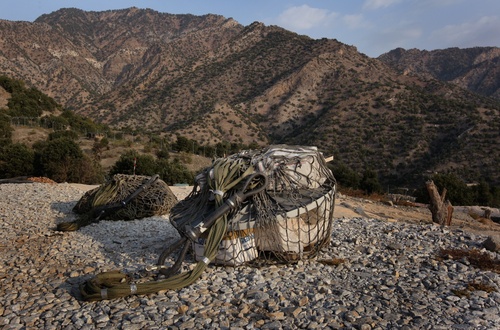
(Photo: A large load of mail sent to soldiers killed or wounded in action sits awaiting transport out of the Korengal Outpost October 29, 2008 in the Kunar Province of eastern Afghanistan. U.S. Army Viper Company of the 1-26 Infantry, based in the battle-scarred Korengal Valley, has had 6 solidiers killed since the unit deployed there in mid-July. Because of the delay in transporting items to such remote outposts, mail for soldiers killed in action often arrives many months after they died. By John Moore/Getty Images.)

The Character Of Chris Christie

New Jersey Governor Chris Christie Holds Election Night Party

Perhaps it is no big surprise to discover that governor Chris Christie is a vindictive, petty egomaniac contemptuous of the people he serves. But it’s hard to avoid that conclusion when you’ve pored over the new tranche of emails that show how he and his staff made life miserable for a large number of New Jerseyans – and, yes, trapped unnecessarily in traffic is misery, even when you have the gorgeous scenery of the George Washington Bridge to absorb. The point was punishment of a mayor who didn’t endorse the governor, whose re-election was cruising for a landslide victory in any case.

The small details of the email exchanges between Christie staffers are a little insight into the mindset of the men and women Christie surrounds himself with. It’s not a pretty picture. The few that leapt out at me:

“Time for some traffic problems in Fort Lee,” Bridget Anne Kelly, one of three deputies on Christie’s senior staff, wrote to David Wildstein, a top Christie executive at the Port Authority, on Aug. 13, about three weeks before the closures. Wildstein, the official who ordered the closures and who resigned last month amid the escalating scandal, wrote back: “Got it.”

What strikes me about this is the Soprano-style archness of it all, the sense of total impunity in vindictiveness, as if this is the way politics is always played in Christie-land. When the traffic jams orchestrated by Christie’s staff snarled up even school buses, we get this:

“I feel badly about the kids,” the person replied to Wildstein. “I guess.” “They are the children of Buono voters,” Wildstein wrote, making a reference to Barbara Buono, the Democratic candidate for governor, who lost to Christie in a landslide in November.

“I guess.” Fuck the kids – let’s get even, when we have no real need to. Christie has more than one problem here. He has been revealed as a deeply petty man, willing to sacrifice the public good to pursue narrow political vendettas – not exactly a qualification for a president. But he has also repeatedly denied all of this. Is he a bully? Or a liar? Or both?

(Photo by Kena Betancur/Getty Images)