The Big Picture On Iran

Beinart focuses on it:

One day, I suspect, the people obsessing about the details of an Iranian nuclear deal will look a bit like the people who obsessed about the details of the Intermediate-Range Nuclear Forces treaty between the U.S. and U.S.S.R. in 1987. In retrospect, what mattered wasn’t the number of ballistic and cruise missiles each side dismantled. What mattered was ending the cold war. …

In December 2001, before the Bush administration called Tehran part of the “axis of evil,” Iran proved a crucial partner in the Bonn Conference that forged a post-Taliban government in Afghanistan. “This experience,” suggests Seyed Hossein Mousavian, who ran the Foreign Relation Committee of Iran’s National Security Council from 1997 to 2005, “can serve as a blueprint for a new collaboration on Syria.”

Let’s hope so, because although America’s leaders sometimes romanticize our half-century-long standoff with Moscow, cold wars are brutal, ugly things. Ending America’s cold war with Iran would deny Iran’s regime a key pretext it uses to repress domestic dissent. And it would increase the chances of ending a war in Syria that should shame the world. That’s what’s really at stake in the nuclear negotiations America and Iran will pursue in 2014.

Wearing Your Death On Your Sleeve

Kyle VanHemert talks about a new tool for keeping time:

Durr [seen above] is a watch designed to draw attention to that slippery disconnect between time as it passes and how we perceive it passing. Instead of hands or numbers, it’s just a solid, colorful disk. Every five minutes, it vibrates. … [Designer Theo] Tveterås says it adds an undeniable “rhythm” to the day, chopping it into chunks small enough to let you look back and consider what you’ve been doing (vibrating any more often than every five minutes, they found was annoying; any longer than 10 and it became hard to remember when the last interval started).

Of course, giving people an existential metronome can have the opposite effect. In some cases, it hasn’t led to the wearer noticing the passing of time but rather time passing away. “We’ve gotten feedback from other people using it that it acts a little like a countdown for life, which wasn’t the intention at all,” Tveterås says. “But the memento mori aspect is very fascinating, too.”

Tikker, another new watch, is designed to be a countdown of your life, second by second – based on “an algorithm like the one used by the federal government to figure a person’s life expectancy“:

Tikker’s inventor is a 37-year-old Swede named Fredrik Colting. He says he invented the gadget not as a morbid novelty item, but in an earnest attempt to change his own thinking. He wanted some sort of reminder to not sweat the small stuff and reach for what matters. Colting, a former gravedigger, figured imminent death was the best motivator there is. That’s why he calls Tikker “the happiness watch.” It’s his belief that watching your life slip away will remind you to savor life while you have it. And, it turns out, there is some evidence for his point of view. A 2009 study showed that thinking about death makes you savor life more. And a 2011 study has shown that thinking about death makes you more generous, more likely to donate your blood.

Jenny Davis doesn’t mind that the algorithm is flawed:

Really, the Tikker is not much different than putting an inspirational saying on your bathroom mirror. It reminds you to live a certain way, focuses your energies on this lifestyle mentality, and encourages you to remain reflexive, always mindful of who you are, who you want to be, and how you have to live to get there. … This technology quantifies the self inaccurately, but these inaccuracies are of little consequence, as the numbers are but tools in the pursuit of a particular kind of mindfulness; a particular urgency of life.

Anticipating The Strain

Scientists are studying the brains of athletes in search of “brain-training techniques that will enable the rest of us to develop elite-level mental agility”:

In a series of studies starting in 2009, [researcher Martin] Paulus and his colleagues put hardened Marines, elite adventure racers, and regular Joes through various cognitive tasks while monitoring their brain activity in real time with an fMRI scanner. To provide an “aversive stimulus”—a scaled-down version of the stress they’d experience when coming under enemy fire or taking a wrong turn during a multi-day race—the researchers occasionally interfered with subjects’ breathing, restricting airflow to masks they were wearing.

The subjects knew the sensation was coming but not always when. Some members of the control group panicked and had to be removed from the scanner, but the Marines and the adventure racers handled the scenario with ease. In the fMRI scanner, they showed higher activation in the insular cortex immediately before the restricted breathing started. They had, essentially, prepared themselves for the unpleasant sensation. Then, while it was happening, the same region of the brain showed lower activity and carried on with business as usual. “That kind of anticipation and preparation is critical,” Paulus says. The goal, then, is to train your brain to anticipate, and not overreact, to unexpected stress. …

For now, the most promising technique is one that’s already familiar to many professional athletes:

meditation. Paulus’s latest study put 30 Marine recruits through a program in mindfulness, an approach to self-awareness with roots in Buddhist teachings. “You learn to monitor how your body actually feels while suspending judgment about it,” Paulus explains. In the study, subjects followed an eight-week course that taught simple breathing exercises, sitting and walking meditation, yoga, and techniques like “body scans,” in which they focused awareness on each part of their bodies, progressing from head to toe. Brain scans before and after revealed that the trainees acquired some of the same brain patterns that the Marines and adventure racers had shown in the earlier experiments. More surprising, the changes persisted a year later. The biggest effects were in the MPC [medial prefrontal cortex], which moderates knee-jerk responses to external stimuli.

Another War We Can’t Win?

Poverty

Derek Thompson marks the 50th anniversary of Lyndon Johnson’s war on poverty, partly blaming the problem’s stickiness on the rise of the single-parent household:

The poverty rate among married couples is quite low: 6 percent. The poverty rate among single-dads/moms is quite high: 25/31 percent. Since the share of single-parent households doubled since 1950, we should expect it to stress the poverty rate, especially since low-income people closer to the poverty line are less likely to marry, in the first place. Things get really interesting when you zoom into the marriage picture. Among what you might consider “modern families” (e.g. the 61 million people married and living together, both working), there is practically no poverty. None. Among marriages where one person works and the other doesn’t (another 36 million Americans) the poverty rate is just under 10 percent.

But take away one parent, and the picture changes rather dramatically. There are 62 million single-parent families in America. Forty-one percent of them (26 million households) don’t have any full-time workers. This is something beyond a wage crisis. It’s a jobs crisis, a participation crisis—and it’s a major driver of our elevated poverty rate.

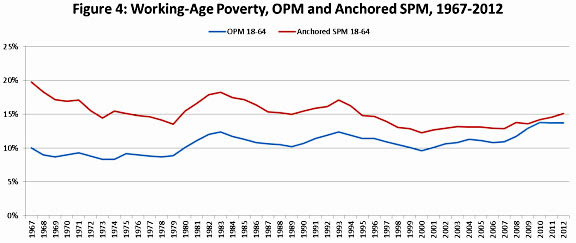
Drum touches on the anniversary as well, passing along the above chart and noting that he sees the war as more of a stalemate:

The Great Society programs of the 60s got the working-age poverty rate down from 20 percent to 15 percent, but then we gave up. Since the mid-70s, the poverty rate has stayed stubbornly stuck at about 15 percent[.] This is a chart to really keep in mind as you read the inevitable retrospectives. The overall poverty rate has gone down substantially in the past half century, but that’s largely because of the huge effect of Social Security on elderly poverty. But as much as this is a great achievement, it’s not what most people think of when you talk about “poverty.” Rather, they’re mostly thinking of working-age people who are either unemployed or earning tiny wages. And among those people, we simply haven’t done much for the past 40 years.

Jared Bernstein points out that poor families are up against a worse economic climate than they faced a few decades ago:

The data clearly show that anti-poverty policies have been effective, but they’ve had to work harder in the face of increasing economic challenges facing low-income families.  We could try to push the safety net further, but the politics aren’t there, to say the least.  Moreover, unless we do more to deal with the underlying structural problems in the economy that are increasing poverty — especially the lack of decently paying jobs, which I link closely to the absence of full employment — we’ll have to increasingly ratchet up government support year after year.

The American safety net is actively helping millions of economically disadvantaged families, and we should protect and improve it.  But the best way to help it — and more importantly, the poor themselves — is to strengthen the underlying economy in ways that will take some of the pressure off of what has, over the last 50 years, become an effective set of anti-poverty social policies.

Flavelle argues that the Republicans have a point in criticizing the anti-poverty project:

[T]he OECD data suggest that for every dollar of social spending, the U.S. gets less poverty reduction than other developed countries. There are plenty of possible explanations for that, including poorly run programs; spending that is disproportionately focused on certain groups (such as the elderly); and noneconomic barriers facing some minorities. Another explanation could be the share of social spending that comes in the form of cash, rather than services. U.S. social spending is evenly split between cash benefits and services; in France, cash makes up almost two-thirds of the balance, according to the OECD.

Whatever the reasons, the combination of relatively high social spending and relatively low poverty reduction gives credence to a main plank of Republicans’ argument: When it comes to the war on poverty, the current approach isn’t working that well, in terms of getting the most value for what the U.S. is already spending. What should be done differently is another question.

But Zeke J Miller, Maya Rhodan, and Alex Rogers don’t see the parties coming together on this issue anytime soon:

Both sides largely reject the others’ proposals as misguided. “The goal ought to be, is to get people out of entry-level jobs, into better jobs, better-paying jobs. That’s better education. That’s a growing economy,” Ryan said in response to President Obama’s State of the Union last year. “I don’t think raising the minimum wage, and history is very clear about this, doesn’t actually accomplish those goals.” Democrats object that Republicans are trying to gut welfare programs and public education with their so-called reforms. At the root of the dueling rhetoric around the The War on Poverty is a political question: Does the government enable, or is it an enabler? “There is a lot more clarity on the current trends in inequality than there is on what to do about it, much less any agreement,” said Isabel Sawhill, Senior Fellow in Economic Studies at the Brookings Institution. “Amongst experts there is much more clarity. We need a bipartisan agreement about what to do about inequality because if we don’t nothing will happen.”

A Room More Than His Own

James Baldwin’s second novel, Giovanni’s Room, follows the tragic love affair of a gay American in Paris. When Chris Abani encountered the book as a bullied, unhappy adolescent, it made him feel less lonely:

As the youngest of four boys, I often found it hard to come to terms with the expectations of masculinity around me: the performance of it, so to speak. Afikpo [Nigeria], when I was growing up, was caught in that moment between a centuries-old way of being and a more modern one. There were expectations of how one proved one’s masculinity, but I wasn’t interested in those. I had a fraught relationship with my father, and a sweet and gentle one with my mother.

And yet, not being gay myself, there is a level of confusion, of hurt, that I couldn’t ever access. It always eluded me, made me feel like there was something more behind this story, something that was as tantalizing faint as the scent of Earl Grey Tea, but that would always remain closed to me.

And then again, perhaps not. Perhaps this is not the feeling of a straight man looking into the life of a gay man, unable to completely relate, but rather that of a self gazing deeply into another self and never ever being able to see it. Maybe it’s the existential melancholy we all carry, that of knowing there is more to us, and wrestling with the frustration that it will always be out of reach, darting into our peripheral vision when we are lucky.

Face Of The Day

Devotees Gather For The Beginning Of The Feast Of Black Nazareth Celebration

Images of Jesus Christ are paraded by Catholic devotees during the start of the Feast of the Black Nazarene on January 7, 2014 in Quiapo district, Manila, Philippines. The Feast of the Black Nazarene culminates in a day-long procession on January 9 as barefoot devotees march to see and touch the image of the Black Nazarene. The Black Nazarene is a dark wood sculpture of Jesus brought to the Philippines in 1606 from Spain and considered miraculous by Filipino devotees. As many as 6 million devotees are expected to attend during the culmination in this predominantly Catholic nation in Southeast Asia. By Dondi Tawatao/Getty Images.

How To Repel Tourism, Ctd

Another reader marvels at the visa bureaucracy of the US:

I just read your post about how hard the US makes it for tourists. What struck me is that it’s a lot harder than going to China. When a friend and I decided in 2012 to go on a tour there, I was apprehensive about getting a visa. However, it was actually not bad. I filled out an application and paid $50 to a company so I didn’t have stand in line at the Chinese embassy. I got the visa less than three weeks later. You might think that it was easy because it was a tour. However, a friend of mine is going to China with her Chinese roommate and a few other people; she also had a pretty easy time getting a visa. It is really depressing that it is much harder to be a tourist going to the US than it is going to China.

But another reader pushes back:

I really hope we can hear from an immigration agent on this thread. I would bet that they are explicitly instructed to presume that each person is lying, because they have so little power once a person has entered the country.

We need to acknowledge that the US is such an outsized destination. When you left England, you wanted to come here. When my wife left Colombia, she wanted to come here. Not Canada, not Japan, not Australia. If we relax our visa policy, it’s not a stretch to imagine that our illegal alien population would skyrocket. Can the US handle such an influx? The current economy would seem to indicate that there are not enough jobs to go around.

A few more readers share their stories:

Like you, I’m a British citizen. That is, I’m a citizen of the USA’s closest ally, a country that has fought alongside the US in most of its recent wars, a NATO member and a wealthy country that doesn’t export large numbers of illegal immigrants to the US. Although I technically don’t have to get a visa to enter the US, I would have to apply for ESTA, which is effectively a visa by another name.

I was treated so badly at the border the one time I’ve been to the US since 9/11 that I now refuse to go back. The impact has been that I’ve travelled within Europe a lot more in the last decade or so than in the previous one. If you want to talk about “soft power,” then I’ll say that I’ve come to feel much more European and much less attached to the Anglosphere, in part as a result.

While American tourists to Britain get treated a lot better than British tourists to America, we still treat American immigrants terribly. Getting an ILR (the British equivalent to a green card) is a long and difficult process that is little better than the green card process, not to mention that the filing fees are a lot higher.

It would be terrific policy for countries with little problem with illegal immigration to sign a mutual immigration treaty, granting their citizens the ability to go to each others’ countries, both as tourists and as worker-immigrants, without having to fight the immigration system – that is, a UK passport would be treated like a US one at entry to the United States, and vice versa, excepting a few people excluded as persona non grata (e.g. deported criminals). This would benefit every American who wanted to travel to Britain to work, for a vacation, or visiting family or friends, benefit every Brit who wants to travel to the US – and who loses?

Another:

I’m not sure if you are still hoping to keep this thread going, but I thought I’d add my experience as a native-born American. My wife and I recently adopted a little boy from Ethiopia. The visa process itself was onerous but understandable; due diligence is rather important when considering matching a child with a family that is not biologically his or hers.

To complete the process, we flew to Ethiopia twice. The first time, we appeared in an Ethiopian court and adopted our son under Ethiopian law. The second time, about three months later, we finished the process at the U.S. Embassy and flew home with him. Both flights were eye-openers. (For background, it’s helpful to understand the visa that our son received entitled him to American citizenship upon arrival, so he was legally an Ethiopian citizen for the flight until wheels down at Dulles.)

We took Ethiopian Airlines on our first flight back. The plane experienced mechanical issues during a refueling stop in Rome, and after several hours we offloaded and waited for mechanics to fix it. The wait was going to be long, and the airline booked rooms at a nearby hotel for passengers. One of the airline employees called everyone together and asked by show of hands who was an American or European citizen. He told us to follow him to the hotel and halfheartedly added that those with other passports that “acquiring visas is just too difficult right now.” Half of us – including lots of Americans of Ethiopian heritage – followed him to the hotel. The other stayed in the terminal another 15 hours until we all boarded again.

Not only did this highlight the global haves and have-nots, but my wife astutely pointed out that, if we had our son (then only six months old) on this flight, we would be entitled to leave the airport but he could not.

Three months later, we landed on an Emirates Airlines flight. The sequester-related elimination of overtime for passport control officers had kicked in, and two other flights – one from Europe and another from Asia- landed just minutes before us. We waited 2½ hours in the citizen line, which provided a lot of time to watch passport control in its finest. While everyone in my line was in possession of a blue passport, it became very, very obvious that those born in the United States were rushed through, while immigrants received a much more thorough screening.

As a country built on immigration – and as a new dad of a newly arrived immigrant – I saw that as little more than a big “fuck you” to an American citizen who just happened to be born outside of our shores.
Why So Few Black Women On SNL?

[youtube:http://www.youtube.com/watch?v=5377GA_4_HM#t=83%5D

Sasheer Zamata, the 27-year-old comedian seen above, has been tapped to join the cast of Saturday Night Live, becoming the first black woman on the show since Maya Rudolph’s departure in 2007. Drew Grant comments:

It’s an uneasy victory: While it’s definitely a good thing to have more diversity in the cast, the fact is that Ms. Zamata was hired in direct result to the backlash caused by Kenan Thompson’s comments to TV Guide last October, when he claimed the show had a hard time staffing black women because many of them were not qualified. The show’s producers were under considerable pressure to address the problem, and held several auditions to find someone who could reprieve Mr. Thompson of having to put on a dress every time the show needed an Oprah character. (SNL, which does have a sense of humor about itself, did a brilliant send-up of the issue in its cold opening with Kerry Washington last year.)

This is not to say Ms. Zamata is not qualified. A graduate of the University of Virginia, the acting major has been taking classes UCB, a popular feeding pool for late night, since 2009. Her YouTube videos show that she has a wide array of characters and impressions up her sleeve, including Beyonce and Michelle Obama. She’ll make a great addition to the show, and hopefully going forward, SNL will not have to hold seperate auditions for black women.

Erik Voss explored the controversy back in October:

The lack of diversity on SNL has always been a thorn in the paw for the show’s progressive fan base.

Since SNL premiered in 1975, only 15 black performers have been in the cast (and only two Latinos and zero Asian-Americans), and only four of those black performers have been women: Yvonne Hudson (1980-81), Danitra Vance (1985-86), Ellen Cleghorne (1991-95) and Maya Rudolph (2000-2007). Since Rudolph left, viewers have complained that SNL has no one to play zeitgeist celebrities like Michelle Obama, Oprah Winfrey, or Beyonce — not to mention a wealth of original black female characters. In the past, Thompson donned drag to play Whoopi Goldberg and Star Jones, but he now refuses to play such roles. SNL‘s casting process is notoriously secretive, leaving outsiders wondering why the show hasn’t diversified its cast. Is it, as Thompson suggested, simply a matter of the SNL‘s producers being unable to find black women who are “ready”? How is that possible when those of us in the alternative comedy scene know hilarious black women who have auditioned, only to be mysteriously rejected? Is anyone ever “ready” for SNL?

Poniewozik says SNL’s writers have work to do as well:

The next step will be making sure Zamata has someone to play besides Beyoncé, Michelle Obama, and Oprah Winfrey. Impressions, for better or worse, have been SNL’s bread and butter for decades; pretty much everyone in the cast needs to do them (Rudolph had a famous Oprah) and presumably so will Zamata. It’s one reason that diversity on SNL matters for practical reasons and not just social ones: you need people who can play everyone in the wide world of public figures.

But what will make Zamata’s hire worthwhile, for her and for the show, is making sure that she gets written great, memorable characters who aren’t black female celebrities as well. It’s the difference between being an African American woman SNL star (a funny performer who is black and female) and being the African American woman SNL star (a performer who’s specifically there to be black and female). That may seem like semantics, but it’s also about what real diversity on a cast means–giving a performer like Zamata the kind of range that the show’s most successful white men have had (and white women, and black men like Eddie Murphy).

Watch five impressions by Zamata here and many more videos of her work here.

A Nose For Our Pets

It’s no surprise that dogs can identify their owners by smell, but can people sniff out their pets? Researchers at The Queen’s University of Belfast put the question to the test:

In the study, dog owners smelled two blankets — one that had been infused with the individual odor of their dog, and one that had the smell of an unfamiliar dog. In case you ever want to try this at home, to infuse a dog’s smell in a blanket, the researchers placed the blanket in the dog’s bed for three nights with nothing else in there. Dog owners were blindfolded and then smelled the two blankets. The blindfold prevented owners from noticing, for example, that the blanket was covered with their dog’s hair….

So what happened in the sniff test? Owners rocked! Without the help of visual cues, 88.5% were able to accurately say which blanket smelled like their dog (23 out of 26 owners).

Is The World’s Newest Country Falling Apart? Ctd

SouthSudan

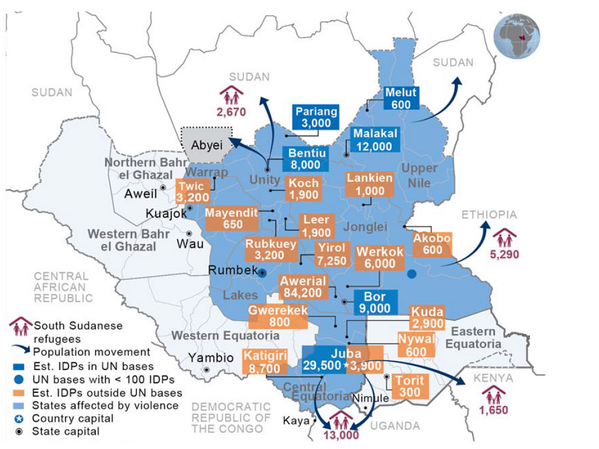
Fisher passes along the above map showing refugee displacement caused by the unrest in South Sudan, noting that “people are getting displaced across huge swathes of the country, suggesting that fighting and instability are spreading wide and fast across the Texas-sized country.” Another ominous observation:

[A]t least a few thousand people have fled into Sudan, the country that the South Sudanese spent decades fighting to break away from, which is not in itself hugely significant except as a depressing symbol of South Sudan’s troubled start as an independent country. South Sudan’s crisis is not yet an all-out ethnic conflict. But there are some awfully worrying signs. That so many people have fled their homes is one indication that people are worried about being targeted for their ethnicity. As NPR’s Gregory Warner reported from the country a few days ago, “People are starting to ask who their neighbors are.” One of the thousand or so people killed so far is Andrew Bith Abui, one of the “Lost boys of Sudan” who had won asylum in the United States but later returned to South Sudan to help build the newly independent country. Abui was killed in what appears to have been ethnic violence in his home town.

Peter Run explains that the conflict is primarily about power politics, not ethnic strife:

Despite its appearance, this conflict is not between the Dinka (South Sudan’s largest ethnic group) and the Nuer (its second largest). In fact, the Nuer are doing most of the strategic and tactical work on both sides. The government’s armed forces, the Sudan People’s Liberation Army (SPLA), is led by a Nuer, General James Hoth. Many of the officers leading the operations in Upper Nile, Unity and Jonglei states are also Nuer. The SPLA has always been an ethnic mix with significant Nuer numbers. Some Nuer soldiers are loyal to commanders who have joined Riek Machar, and others have been with the SPLA since its formation in 1983. The suggestion that this is an ethnic conflict accounts for some facts but leaves out other contradictory ones. For instance, Machar has a lot of non-Nuer support in the ruling Sudan People’s Liberation Movement (SPLM) party, where this conflict began as a political rivalry between him and president Kiir.

When allegations of the attempted coup emerged, those arrested included prominent Dinkas Majak D’Agoot and Chol Tong Mayay. Ethnicity was insignificant at the political level and it does not appear to feature prominently on the military agenda of either the SPLA or the rebels. However, the march of the Nuer White Army rebels to Bor, a city on the Dinka territory, has raised alarm bells. As Sudan researcher Eric Reeves has pointed out, the “White Army” – an ethnic militia, which once threatened to wipe out another ethnic group, the Murle – is unpredictable and indiscriminate.

Josh Rogin wonders what the US could do to help:

The problem for the Obama administration as it tries to influence events in South Sudan is that the United States only has the ability to bring pressure to bear on one side of the dispute—the government that is dependent on hundreds of millions of dollars of U.S. assistance. Experts say the only actor who may have influence over Machar is Omar al Bashir, the indicted war criminal who serves as President of Sudan and has a long history of making deals with Machar. Machar has already indicated he may work with the Khartoum regime to protect oil fields in Unity and Upper Nile states, lands Khartoum has sought to control ever since the country split in 2011.

“Given Riek Machar’s long history of collaboration with the Khartoum regime, it is reasonable to be alert to the potential for reengagement over oilfield security,” said John Prendergast, founder of the Enough Project. “If Khartoum would seek to gain advantage from Juba’s current weakness, it would be like throwing gasoline on a smoldering fire.”

Gregg Zachary wants to revisit the concept of trusteeship for South Sudan:

The best justification for rethinking South Sudan’s sovereignty is the country’s lack of an experienced and effective political elite. Massive corruption in the Kiir government has translated into billions of aid dollars being looted by leaders or (probably to a lesser extent) shared along ethnic lines as a form of political patronage. In 2012, Kiir himself accused government officials of looting $4 billion and (pathetically) asked his colleagues to return the money. Instead of building desperately needed infrastructure and providing crucial services, the South Sudanese government has done little to meet its people’s needs. An assessment by two Brookings Institution scholars in December was blistering. “It is apparent,” they wrote, “that South Sudan, two years after independence, is yet to establish legitimacy as a state with a functioning government that can keep its people safe and provide services to them.”

The solution to these problems is not to send in more peacekeepers to Juba and Bor, or hammer out a power-sharing agreement between the warring parties. Or rather, not only to do these things. The response to South Sudan’s turmoil should be crafted with a set of policy tools that were popular in the 1950s but have been used only selectively in recent years. I am referring to the process known as “trusteeship,” whereby a newly independent nation is granted special forms of assistance and special constraints on sovereignty. In some cases, the former colonial power sought to administer the trusteeship, and in other cases an international coalition or the United Nations did so for a defined period of time. Something along these lines succeeded in the West African country of Ghana, where the British colonial authorities ceded sovereignty to the government of Kwame Nkrumah in stages, culminating in full independence in 1957.

Previous Dish on South Sudan here.