No Flying Cars Yet, Ctd

Isaac Asimov’s predictions from 50 years ago have gone viral. Brian Merchant pushes back on them:

Taken as a whole, Asimov’s vision for 2014 is wildly off. It’s just that ’Genius predicted the future 50 years ago’ makes for a great article hook. Asimov does hit a couple of his predictions pretty close to home: He ballparked the world population (6.5 billion); he anticipated automated cars (“vehicles with ‘robot brains’”); and he seems to have described the current smartphone/tablet craze (“sight-sound” telephones that “can be used not only to see the people you call but also for studying documents and photographs and reading passages from books.”)

But he also thought we’d have a colony on the moon, be living under a global population control regime, eating at multi-flavored algae bars, and letting machines prepare us personalized meals. Most divergent of all, he believed that increasing automatization of labor would spawn not inequality or joblessness, but spiritual malaise.  … Asimov imagined that humanity would decide to distribute the wealth accrued by the automatons, and the problem wouldn’t be lost capital for workers, but lost meaning. Of course, in reality, it’s both—and therefore a much, much bleaker scenario.

Jerry Coyne points to the Internet as something Asimov didn’t see coming either:

[T]he world is becoming plugged in in a way Asimov simply couldn’t predict. When you walk down the street in an industrialized country, or ride in a plane or train, notice how many people are using their cellphones, iPads, iPods, or computers. Google Glass, the wearable computer, is next. This is the way the whole world will go. (My theory is that eventually the entire Earth will resemble New York City.) Connectivity has brought tremendous advantages: think of the ability to access information at your desk instead of a making a laborious trip to the library. And electronic journals and instant publication have markedly sped up the progress of science. Well, perhaps we won’t be as bored, but we may lose the skills of interpersonal communication.

Asimov made many other predictions. In general I think he did pretty well—certainly better than I would have—but it’s remarkable how many other people got stuff wrong, usually predicting a more technologically advanced or ideologically repressive society than we have now. Remember Nineteen Eighty Four (written in 1949), or The Jetsons cartoon series, which supposedly took place in 2062?

A Winter Wonder

dish_snowflake

Photographer Alexey Kljatov captures the delicate intricacies of snowflakes:

Kljatov has outlined his technique on his personal blog, where he explains the technical issues he faces as he shoots on the balcony of his home. ”Not every snowfall brings good-looking crystals, and many shots will be discarded later because of bad focusing or uninteresting subjects,” he told Hyperallergic. “When I started to shoot snowflakes five years ago, I couldn’t imagine how different and unusual they looked. With the naked eye we usually see only big crystals, 5 mm and bigger, and most of them just one type, stellar dendrites. But [the] most unusual and interesting crystals [are the] medium and small ones, 1–4 mm, and even smaller,” he said.

(Photo by Kljatov, whose Flickr album is here)

Better Wages Can Trickle Up

Adam Davidson argues (NYT) that better paid, better treated employees reap more benefits for their employers:

The success of Costco, Trader Joe’s, QuikTrip and Mercadona, Spain’s biggest supermarket chain, indicate, [business professor Zeynep Ton] argues, that well-paid, knowledgeable workers are not an indulgence often found in luxury boutiques with their high markups. At each of the aforementioned companies, workers are paid more than at their competitors; they are also amply staffed per shift. More employees can ask customers questions about what they want to see more of and what they don’t like, and then they are empowered to change displays or order different stock to appeal to local tastes. (In big chains, these sorts of decisions are typically made in headquarters with little or no line-staff input.) Costco pays its workers about $21 an hour; Walmart is just about $13. Yet Costco’s stock performance has thoroughly walloped Walmart’s for a decade.

Along the same lines, Daniel Gross explains why Henry Ford doubled his employees wages in 1914:

Ford was playing a deeper, longer game. The Ford Motor Company was in the business of building an expensive durable good. The first cars he had built in number, the 1903 Model N, cost about $3,000, and so were accessible only to that era’s one percent. Henry Ford recognized that the automobile would be more successful as a volume business than as a niche product. “I would build a motorcar for the great multitudes,” he proclaimed. Through relentless innovation, vertical integration, and the obsessive development of an assembly line, Ford had already managed to bring the cost of the Model T, the first democratic car, down to about $500. And the company was moving about 250,000 cars a year. But per capita income was only $354 in 1913. The U.S. didn’t have a developed consumer credit industry. People paid for things with the wages they earned and their savings.

So this was Ford’s theory: Companies had an interest in ensuring that their employees could afford the products they produced. Put another way, employers had a role to play in boosting consumption. While paying higher wages than you absolutely needed to might lower profits temporarily, it would lead to a more sustainable business and economy over time. If the motorcar was going to be a mass-produced product for typical Americans, not a plaything for the rich, Ford would strive to pay his workers enough so they could afford the products they worked on all day.

Previous Dish coverage of Walmart’s labor practices here, here, and here.

The Psychos Of Cinema

Vaughan Bell quotes from a recent study that identified the “most accurately depicted psychopaths” in Hollywood films:

Among the most interesting recent and most realistic idiopathic psychopathic characters is Anton Chigurh in the 2007 Coen brothers’ film, No Country for Old Men.

Anton Chigurh is a well-designed prototypical idiopathic / primary psychopath. We lack information concerning his childhood, but there are sufficient arguments and detailed information about his behavior in the film to obtain a diagnosis of active, primary, idiopathic psychopathy, incapacity for love, absence of shame or remorse, lack of psychological insight, inability to learn from past experience, cold-blooded attitude, ruthlessness, total determination, and lack of empathy. …

In terms of a ‘successful psychopath’, Gordon Gekko from Wall Street (1987) is probably one of the most interesting, manipulative, psychopathic fictional characters to date. Manipulative psychopathic characters are increasingly appearing in films and series. … For the past few years, with the world economic crises and some high-profile trials (such as the Bernard Madoff trial), the attention of the clinicians is more focused on ‘successful psychopaths’, also called corporate psychopaths…. Films and series presenting characters such as brokers, dishonest traders, vicious lawyers, and those engaged in corporate espionage are emerging (e.g., Mad Men, The Wire) and are generally related to the global economy and international business. Again, we see a strong parallelism between what happens in our society and what happens in film.

Dead, But Still Breathing

The sad case of 13-year-old Jahi McMath, who suffered brain death after complications from a botched tonsillectomy, has renewed the debate over brain death and whether her family has the right to keep her on feeding tubes and ventilators when there is no hope of recovery. Michael Byrne discusses how resistant people are to the idea that a brain-dead person is really, truly dead:

[D]eath is not obvious, or necessarily obvious. In fact, you can very neatly be dead and alive at the same time, in a sense. If, for example, if all of your brain dies except some of the autonomous stuff in the brain stem, you can go on breathing and “living” while having forever forfeited the ability to have a thought, let alone interface with the world. This is post-death. Faux-life. People confuse post-death with life because not only do you still have the body there in front of you, but it does stuff. The body reacts to its environment just the same. This doesn’t mean, however, the brain is enlisted in the activity because the body does plenty of things reflexively without ever bothering with the brain, like shrink from pain or heat. So post-death can sometimes even do a pretty decent impression of life, though you really need to be properly alive to feed yourself or, indeed, have thoughts.

The truly frightening thing in the case of Jahi McMath is that it’s not thoughts that seem to matter to the family. “I believe in God, and I believe that if he wanted her dead, he would have taken her already,” Nailah Winkfield, the girl’s mother, told the New York Times. “Her heart is beating, her blood is flowing. She moves when I go near her and talk to her. That’s not a dead person.” It’s a lower standard for life than it might first seem.

Surgeon Soumitra Eachempati explains how attitudes like Winkfield’s result in a shortage of transplantable organs:

The best chance for a successful organ transplant comes from either a living donor or from organs belonging to an individual declared deceased by brain death. Living donors can only surrender a kidney—and in relatively few cases—a portion of their liver. The patient declared cardiac dead has organs that are sub-optimal due to loss of blood flow to the organs. Most of the successful transplanted organs in the world are from patients declared brain dead.

Organs from brain death represent the overwhelming resource for the livers, hearts, lungs, and pancreases transplanted in the world to victims of such diseases as congestive heart failure, pulmonary hypertension, cystic fibrosis, and diabetes. The major limiting factor precluding donation of these potentially harvestable life-saving organs is refusal of organ donation by families of patients declared to be deceased by brain death criteria. Importantly, organ donation rates vary by country, race, and ethnicity.

Different studies have tried to ascertain why families would refuse the donation of organs even though the demise of their loved one is both imminent and irreversible.  Some families may not consider organ donations for religious reasons while others may have misperceptions as to how the body of their loved ones will be handled. Others still simply lack consensus among family members to make a decision in a timely manner. The most common factor, as is the case with the McMath family, is refusal to accept the criterion of brain death as finality for their loved one. In the case of Jahi McMath, the late child’s heart is reportedly spontaneously beating as her organs are being kept alive by a ventilator and other circulatory support.  Her mother has said she hopes for a “miracle” and that she is not convinced her child is dead because the heart is beating.  Her words and actions clearly indicate that she recognizes cardiac death as finality but not brain death despite the fact that both are clinically and legally recognized as such.

The Fittest Americans

dish_fitnessmap

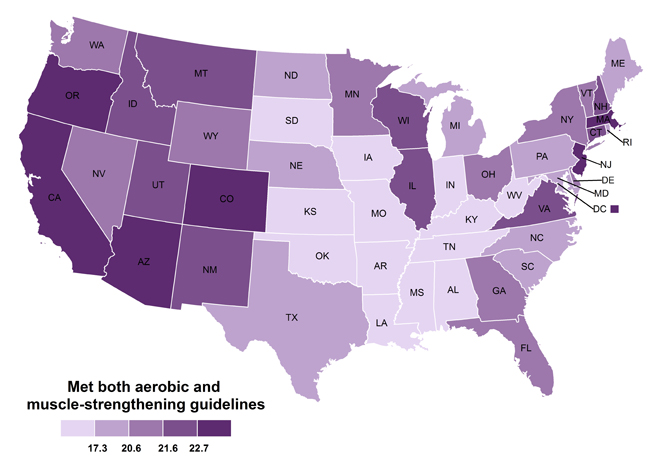
Researchers mapped exercise patterns by state:

You might think people would exercise more in warmer, sunnier states. But that’s not the case. [Martin Prosperity Institute analyst Charlotta Mellander] found a negative correlation (-.38) between yearly average temperature and exercise across the 50 states. Exercise levels also correspond to wealth and affluence, with substantial positive correlations to both income (.65) and wages (.64). States where people exercise more are also more highly educated, with a significant correlation (.68) to the share of adults who are college graduates. And exercise levels are higher in states with more post-industrial economies, as participation was highly positively correlated with the share of knowledge, professional and creative workers (.51) and negatively correlated with the share of blue-collar workers (-.65).

Fitness participation also tracks the nation’s red/blue divide, being positively associated with the share of Obama voters (.51) and negatively associated with Romney voters (-.53). Exercise also hews closely to America’s religious divide. People in more religious states exercise less (the correlation between religiosity and exercise is -.69).

Divorcing Your Family, Ctd

Many readers discuss the wrenching decision to cut off a family member for good:

My mother is a borderline personality. She sees people as either wholly evil or wholly saintly, and her views can switch like lightning. Her rage is terrifying, unpredictable, and targeted, à la Mommie Dearest. After yet another very difficult Thanksgiving, I decided I was going to “divorce” her, since all the years and all the other techniques I had tried hadn’t eliminated the abuse.

The only complication has been her relationship with my siblings; she is the only topic my sisters and I cannot speak frankly about. They not only tolerate but refuse to acknowledge behavior that they would label domestic abuse if our significant others did it. Our mother married a manic-depressive man who also refuses to acknowledge his own disorder and take prescribed treatment. At what point does one decide that the mentally ill do not deserve the position of power they’ve taken for themselves?

Another reader:

Just today I had a conversation with a coworker about this very same issue. We both have sisters who are (or have been) in desperate need of help. In my case, one of my sisters developed some mental health issues that prevented her from being able to maintain a job.

She was never out of control or completely dysfunctional; she just found it impossible to keep a job. As a result, she struggled financially for years. Our parents helped her out for some time, largely because my mother needed to know that her grandchild – my sister’s daughter – always had a roof over her head. When that grandchild turned 18 and moved out, our mother no longer needed to help. We made one last-ditch effort to reach out to my sister as a family and she bit our mother’s head off, blaming all of her troubles on our her.

After our last effort failed, my sister moved out-of-state. The family has had almost nothing to do with her since. I think every once in a while about reaching out to her, to make sure she’s okay, but then I think of what the last 30 years have been like – again, nothing that’s really, really bad, but just bad enough – and I don’t reach out. Why should I open up myself and maybe the rest of the family to all of that again?

Another:

I won’t get too detailed because I doubt you want to read a ridiculously long email, but in short, she forged a document or two, manipulated the family court system – with which she was very familiar, having worked as a sort of social worker in the county courts – and wove a web of lies in an effort to gain primary custody of my 10-year-old sister and to extract maximum financial pain from my disabled father. This was an extremely difficult time, as I was 17, applying for college (as the first in the family to go), and not mature enough to deal with the almost sociopathic way that my own mother just invented memories – both recent and not-so-recent – out of thin air to justify her actions.

Bottom line: you just can’t get over some stuff people do. Especially when they not only do really bad things but never admit to having done anything wrong – and then insist that you are the bad person for not agreeing. In the end, I couldn’t have that sort of poison in my life, so I had to make a choice if I was to ever have healthy relationships and a healthy psyche.

Another:

I was adopted as an infant. The emphasis on blood kin is perplexing to me even now that I have a biological child, because for most of my life family has been other than biological in nature. Perhaps the blood fixation is simply a human prejudice.

That said: Who cares? If someone is dangerous, indifferent or simply too big of a pain in the ass to engage with regularly, why does it make a difference if they are family? You wouldn’t, I would hope, put up with such nonsense from people who weren’t related to you, right?

An Eye On Crime

A new study shows that the “pupil of the eye in a photograph of a face can be mined for hidden information, such as reflected faces of the photographer and bystanders.” What this could mean for law enforcement:

The researchers say that in crimes in which the victims are photographed, such as hostage taking or child sex abuse, reflections in the eyes of the photographic subject could help to identify perpetrators. Images of people retrieved from cameras seized as evidence during criminal investigations could be used to piece together networks of associates or to link individuals to particular locations. By zooming in on high-resolution passport-style photographs, Jenkins and co-researcher Christie Kerr of the School of Psychology, University of Glasgow were able to recover bystander images that could be identified accurately by observers, despite their low resolution.

Megan Garber explains how it’s done:

First, you have to zoom in (really, really zoom in) on images of eyes—since, as Jenkins notes, “a face image that is recovered from a reflection in the subject’s eye is about 30,000 times smaller than the subject’s face.” Then you have to enhance those zoom-ins to isolate the faces—the “bystander images“—that the human subjects’ pupils contain. But even if you do that, the question remains: Are the pupil-mirrored images, given their small size and curvature, even discernible as faces? If the reflection in the eyes is someone other than yourself, can you make out who it is?

To test that, the researchers presented a series of pixellated faces—an average of only 322 pixels each—as part of a face-matching task they administered to subjects. The subjects who were unfamiliar with the bystanders’ faces were able to match the pixellated faces to the standard images of them with 71 percent accuracy; when they were familiar with the faces (if the pixellated face belonged to, say, Barack Obama), they performed with 84 percent accuracy.

(Hat tip: Kottke)

Losing The Afghanistan PR Battle

New research suggests that the Taliban’s brutality alone isn’t enough to turn the public against them:

Counterinsurgency theorists (well, most of them) have argued that winning “hearts and minds” is a key, if not the key, to victory — or at least what passes for victory in these settings. Now, new research shows that just how hard winning hearts and minds can be.  Afghans who experience violence at the hands of NATO forces become less supportive of these forces and more supportive of the Taliban.  But Afghans who experience violence at the hands of the Taliban don’t react nearly as strongly against the Taliban. …

These findings carry several implications for understanding the dynamics of violence in Afghanistan today. Hoping that Afghans will turn away from the Taliban in disgust at civilian casualties, for example, is unlikely to be a viable strategy, at least among Taliban supporters. According to UNAMA’s data, the Taliban have been responsible for at least 80 percent of civilian casualties since 2008. Yet this victimization is unlikely to have the same meaning, or political impact, as (much rarer) ISAF civilian casualties. Concluding that efforts to influence attitudes are hopeless would be equally mistaken, however. We found suggestive evidence, for example, that small, targeted assistance programs among those harmed by ISAF managed to reverse much, though not all, of the outflow of support to the Taliban. On the other hand, massive district-level aid programs that sought to stoke feelings of gratitude among recipients hardly budged individuals’ views of ISAF, especially among those victimized by its forces.

The Best Of The Dish Today

780px-Magi_(1)

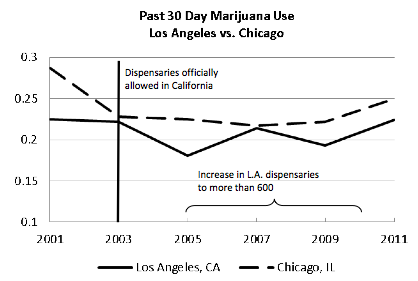
Since the marijuana debate is now in full force, I thought I’d add some more data to the mix. I think it’s pretty damn obvious that making marijuana legal, as in Colorado, will increase usage. Making marijuana more widely available, as with medical marijuana, especially in the wild and crazy regulatory scheme of California, would also do the same. That’s my general sense. And we’ll get some decent data soon enough. But there is data comparing California’s drug use after its medical marijuana took off with other states with no such provisions – and the results are rather mixed:

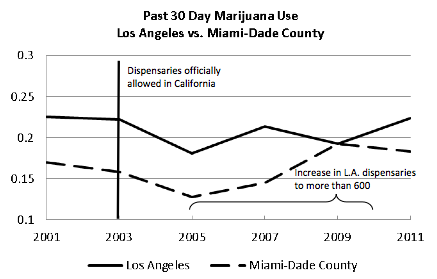
Screen Shot 2014-01-06 at 7.19.23 PMNot much to worry about there. Here’s a comparison with Miami:

Screen Shot 2014-01-06 at 7.20.41 PMMiami caught up in 2009, but then faded. Los Angeles, more to the point, barely has any more marijuana use in 2011 than in 2001. This is from the Mark Anderson study I referred to earlier today.

I guess my point is that this may be more of a non-event than we anticipate – again, a bit like marriage equality. And also like marriage equality, federalism is our friend here. I wonder too how big a disincentive for kids to smoke pot will be the sight of their parents going to their favorite store and picking out their preferred strains of CBD/THC and the like. There’s nothing like parental approval to kill off the thrill of the illicit. Maybe, finally, pot will become uncool.

In other matters today, we asked why dogs walk around in circles before they take a dump; why the Freedom Tower has such a disappointing spire; whether the GOP will come to support extending unemployment benefits; and how conservatism can jettison excessive ideology and return to pragmatism.

The most popular post was the Dish’s Correction Of The Decade; next up was a take-down of TED talks. And don’t forget the revolt of the Catholic school kids.

See you later tonight on AC360 Later and in the morning.

(Mosaic: Basilica of Sant’Apollinare Nuovo in Ravenna, Italy: The Three Wise Men” (named Balthasar, Melchior, and Gaspar). Detail from: “Mary and Child, surrounded by angels”, mosaic of a Ravennate italian-byzantine workshop, completed within 526 AD by the so-called “Master of Sant’Apollinare”, and photographed by Nina Aldin Thune.)