
New York, New York, 11.30 am
New York, New York, 11.30 am
“Union with God is not something we acquire by technique but the grounding truth of our lives that engenders the very search for God. Because God is the ground of our being, the relationship between creature and Creator is such that, by sheer grace, separation is not possible. God does not know how to be absent. The fact that most of us experience throughout most of our lives a sense of separation is the great illusion that we are caught up in; it is the human condition. The sense of separation from God is real, but the meeting of stillness reveals that this perceived separation does not have the last word. This illusion of separation is generated by the mind and is sustained by the riveting of our attention to the interior soap opera, the constant chatter of the cocktail party going on in our heads. For most of us this is what normal is, and we are good at coming up with ways of coping with this perceived separation (our consumer-driven entertainment culture takes care of much of it). But some of us are not so good at coping, so we drink ourselves into oblivion or cut or burn ourselves ‘so that the pain will be in a different place and on the outside.’
The grace of salvation, the grace of Christian wholeness that flowers in silence, dispels this illusion of separation. For when the mind is brought to stillness, and all our strategies of acquisition have dropped, a deeper truth presents itself: we are and have always been one with God and we are all one in God,” – Martin Laird, Into the Silent Land.
(Hat tip: Richard Beck)
Two-thirds of Evangelicals aren’t fans of Darwin’s work (pdf):
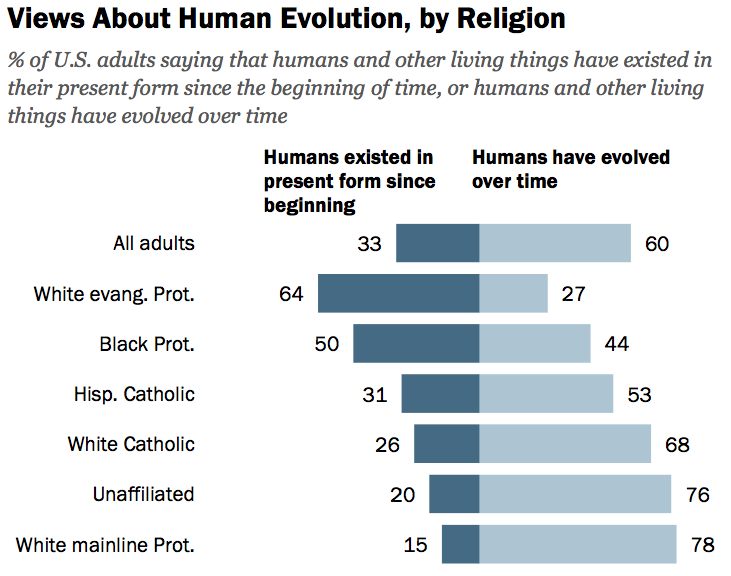
Karl Giberson reflects on his experience teaching evolution at an evangelical college:
For a quarter century I taught scientific theories of origins—evolution and the Big Bang Theory—under a cloud of suspicion that waxed and waned but never totally disappeared. With few exceptions, my mostly evangelical students accepted these ideas. I took informal polls indicating that most of the 50 percent of my students who rejected evolution at the beginning of my course accepted it by the end. My colleagues at other evangelical colleges report similar experiences. We were hopeful that these evangelical students would become leaders of their faith communities and gradually persuade their fellow evangelicals that evolution was not a lie from hell—which was what many of them had been taught in Sunday school. But instead scientifically informed young evangelicals became so alienated from their home churches that they walked away, taking their enlightenment with them.
An alarming study by the Barna group looked at the mass exodus of 20-somethings from evangelicalism and discovered that one of the major sources of discontent was the perception that “Christianity was antagonistic to science.” Anti-evolution, and general suspicion of science, has become such a significant part of the evangelical identity that many people feel compelled to choose one or the other. Many of my most talented former students no longer attend any church, and some have completely abandoned their faith traditions.
The debate has been percolating again recently. Gregory Wolfe goes one more round, defending his thesis that faith hasn’t disappeared from the literary landscape, but writers are handling religious themes with more nuance and reserve than before. He does, however, admit one bit of nostalgia, looking back with envy at the Christian public intellectuals who helped “to mediate what is going on in the arts to a broader audience”:
If I miss anything from that mid-twentieth-century period, it is the presence of thinkers like Jacques Maritain, Etienne Gilson, Allen Tate, T.S. Eliot, and Thomas Merton, who were equally at home in the New York Times and Commonweal. Their rich, humanistic sensibilities are sorely missed. What happened in the intervening decades is a steady shrinking of cultural and aesthetic concerns to ideological politics, including church politics. What happened was the progressive dumbing down and crudeness of what has been called the culture wars. In the relentless pursuit of partisan politics, the endless fight against heresy or entrenched orthodoxy, Left or Right, the religious community’s arteries have hardened. As [Dana] Gioia observed, “What absorbs the Catholic intellectual media is politics, conducted mostly in secular terms—a dreary battle of right versus left for the soul of the American Church.” The actual blood of everyday human experience—the stuff that art and literature capture, in all their ambiguity and resistance to ideological programs—is not circulating very well to the body’s limbs.
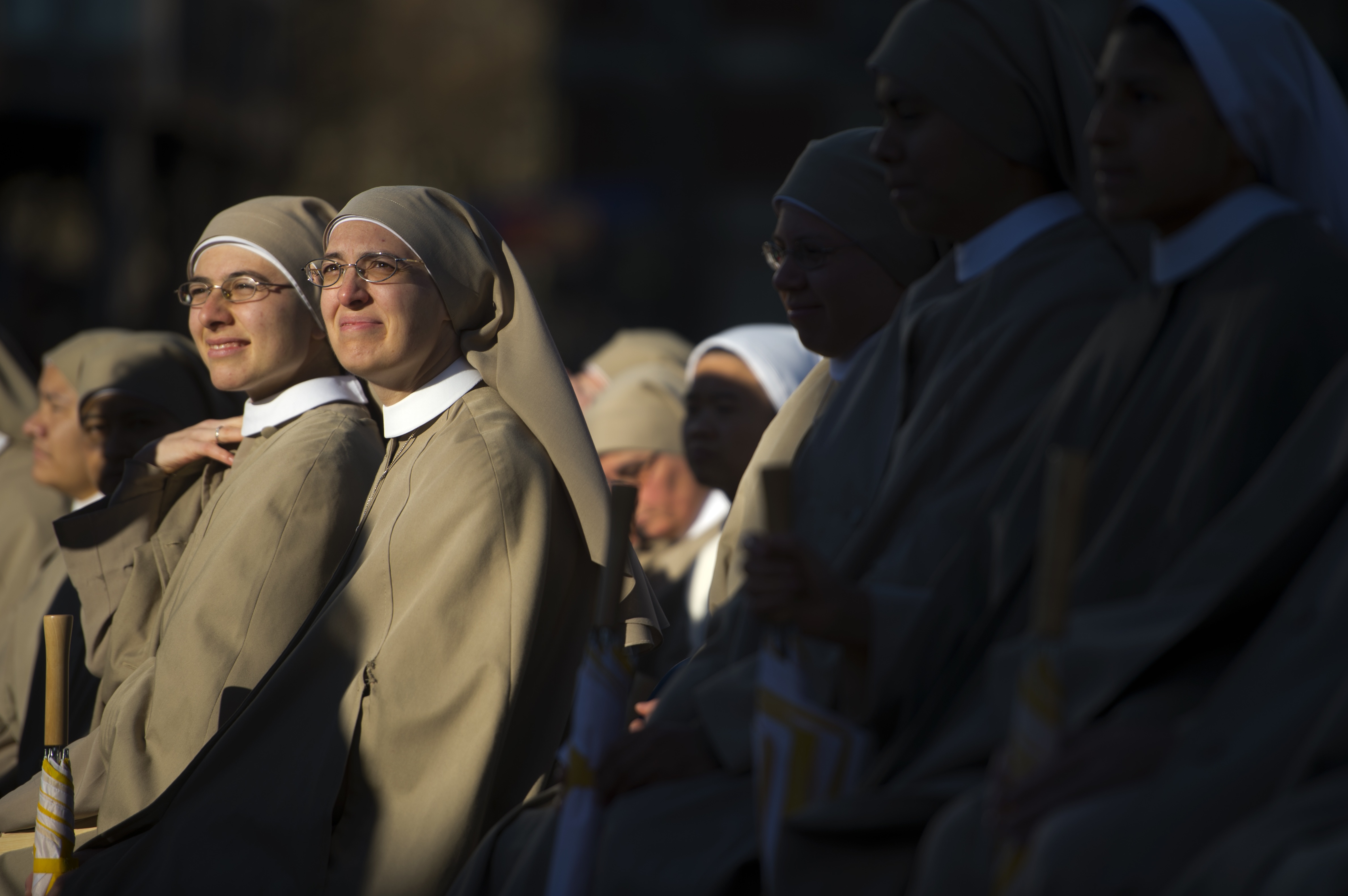
Nuns attend the mass for the Holy Family in Madrid on December 29, 2013. Tens of thousands of believers poured into central Madrid to celebrate an open-air Roman Catholic mass for the Holy Family just days after the Spanish government agreed to tighten the abortion law. By Pierre-Philippe Marcou/AFP/Getty Images.
Walter Russell Mead describes why he believes in a personal God:
For theists, the universe isn’t just a place with scattered bits of meaning in it. Meaning isn’t decoration or illusion, a subjective human response to hardwired stimuli in our brains or grace notes that accompany us on our meaningless way through the dark void. Existentialists and others who believe that the universe is ultimately meaningless but who still choose to act as if meaning was real are among the moral heroes of the world, but theists think there is more to life than the brave but doomed affirmation of meaningless ideals in the face of an idiot, uncaring universe.
Theists think meaning really means something, that it all adds up. The transcendence that comes to us in life doesn’t just happen in our heads; it points to the nature of ultimate reality. That ultimate reality transcends our ability to comprehend, and we only get scattered glimpses of it here and there, but whatever it is, it is greater than we are.
When theists think about that meaningfulness we experience in peak moments, we find ourselves thinking about its source. Theists believe that the source of meaning and existence hangs together and points to something greater than itself. “Meaning” for theists is like “justice” and “truth”; it is something we don’t completely see or grasp but it is real. And because meaning is the source of such meaningful ideas as justice and beauty, its existence is even more important and more consequential than the existence of these other ideals for which people are willing to die. Theists are people for whom this concept of the meaning of life is so powerful, so present, so active that they find that it can’t be talked about except as a supreme force of transcendence and world shaping power, the truth behind all truths. Something this beautiful, this lively, this intelligent, this powerful, this transcendent, theists believe, cannot be less than alive and self aware. It is not a Thing, but a Person.
As part of a Commonweal symposium on Terrence Malick’s 2011 film, The Tree of Life, Karen Kilby argues that “theological issues around loss and death in particular are right at the heart of the film”:
How can the suffering of the innocent, the sudden, pointless loss of life, be reconciled with the love of God? The question surfaces early in the film in connection with the death of the middle son in the family, but its centrality is signaled still earlier, in a quote that stands at the very opening of the film: “Where were you when I laid the foundations of the earth?… When the morning stars sang together and all the sons of God shouted for joy?”
To see how these lines can be taken as a kind of key to much of The Tree of Life, one needs to recall their place in the Book of Job. They come near its end. Most of the book has been taken up with an extended debate between the afflicted Job and his three friends. Repeatedly Job defends his integrity, rejecting the view of his “comforters” that some transgression must be at the root of his sufferings, and repeatedly he demands that God should appear. He wants to stage a trial: he wants God to show up and justify himself, to provide an answer to the question of why the innocent suffer. And then suddenly, shockingly, God does appear, speaking from a whirlwind. But the great oddity of the book of Job is that what follows is a massive non sequitur.
God pays no attention to questions of the injustice of the world, shows no interest in the suffering of the innocent in general, or in why Job in particular has been stricken. In fact, he seems to show no interest in humanity whatsoever. Instead he dwells boastfully, almost bombastically, on the sheer magnitude of creation, the terror and splendor of it.
What if one assumes, though, that it is not a non sequitur: what if God’s speech is not a rebuke of Job, or a rejection of his question, or a change of subject? What if one assumes that it is, in fact, somehow, a genuine answer? This, it seems to me, is part of what Malick is trying to imagine in The Tree of Life. “I want to see as you see,” prays the young Jack, and perhaps the film itself is trying to see as God sees: What does the world look like if God’s speech is not a rejection of Job’s question, but truly an answer to it?
TNC had an epiphany while reading books about WWII and its aftermath:
[Tony Judt’s] Postwar, and the early pages of [Timothy Snyder’s] Bloodlands, have revealed a truth to me: I am an atheist. (I have recently realized this.) I don’t believe the arc of the universe bends towards justice. I don’t even believe in an arc. I believe in chaos. I believe powerful people who think they can make Utopia out of chaos should be watched closely. I don’t know that it all ends badly. But I think it probably does.
I’m also not a cynic. I think that those of us who reject divinity, who understand that there is no order, there is no arc, that we are night travelers on a great tundra, that stars can’t guide us, will understand that the only work that will matter, will be the work done by us.
Or perhaps not. Maybe the very myths I decry are necessary for that work. I don’t know. But history is a brawny refutation for that religion brings morality. And I now feel myself more historian than journalist.
In the comments section, he clarifies his position:
It is not my contention that religion causes immorality, but that it isn’t an actual barrier against it.
Joe Berkowitz introduces the short film seen above, Noah, which premiered this week at the Toronto Film Festival:
The 17-minute, mildly NSFW Noah is unlike anything you’ve seen before in a movie–only because it is exactly like what many of us see on our computers all the time. Created by Canadian film students Walter Woodman and Patrick Cederberg, the film begins when our high school senior protagonist types in the password that opens up his laptop, and the narrative takes place entirely on his computer screen.
From the desktop photo of a young couple posing for the camera, we learn that Noah has a girlfriend. Their relationship serves as the centerpiece of this cautionary tale about digital culture. Through Noah’s perspective, we see the way the couple communicates, either in Facebook chat or Skype, with him flitting through any number of other online activities at the same time, while approximating being present for their conversation. Things really get interesting, however, when our protagonist hacks into his girlfriend’s Facebook account. The rest of the film deals with the fallout from this act.
A man with two penises has uploaded some NSFW pictures on Reddit, where he also answered reader questions. Despite doubts, it appears to be real:
Diphallia, also known as penile duplication, may seem like it belongs in a science fiction novel, but health care professionals are well aware of this condition. Affecting one out of every five and a half million boys in the United States, diphallia is a rare medical condition with around 100 confirmed reports since Johannes Jacob Wecker discovered it back in 1609.
Experts are unsure of what causes diphallia, but speculate it occurs after the 23rd day of gestation following an injury, chemical stress, or a gene malfunction. Unfortunately, men born with this condition tend to die at an earlier age due to infections and renal failure. Although both penises are able to function on their own, men with diphallia are usually sterile due to congenital defects. These men are also at a higher risk of developing spina bifida, a condition that results in malformation of the vertebrae designed to protect the spinal cord.
Caroline Bankoff rounds up “universal lessons” from the anonymous poster’s Ask Me Anything thread:
People are slightly more accepting of differences than you’d expect: In response to a question about how women react to seeing two penises on one guy, DoubleDickDude wrote, “It varies from girl to girl. Some have been like WOW. some have been like THATS FAKE! some have freaked out like, called me names. Most are pretty curious, but i dont have casual sex anymore, i stopped a few years back. Didnt like the empty feeling inside after a 1 night stand. did a lot of those in my late teens. A LOT of them. but for the most part, girls were nervous and some changed their mind at the last minute. dudes NEVER change their mind, they always want it even if they’re freaked out a little. lol”
 The Dish