Let’s Talk About Real Sex, Ctd

HBO revived its groundbreaking series Real Sex this week (NSFW):

Lila Seidman reviews the pilot:

Inspired by the near-extinction of classic peep shows that once dominated Times Square, and which were featured in an old episode of Real Sex, [director Chris] Moukarbel kicks off the pilot with a long segment focalizing their modern counterparts — cam girls and boys, who monetize their sex, and sometimes their interpersonal relationships, armed with little more than a webcam. Moukarbel manages to illuminate how “camming” has created one of the safest and self-empowered forms of sex work.

“The cam models are essentially crowdsourcing sex work so they only need a small amount of money from a lot of people,” Moukarbel says. “In an industry that traditionally favored men or the paying client, camming has shifted power in the direction of the sex worker. In the past you would have to share physical space with a client, and that brings a lot of potential hazards. If someone is disrespecting you while camming, they can be blocked forever.”

Christopher Glazek talked to Moukarbel about what viewers can expect in upcoming episodes:

One thing I’m very interested in is Grindr and dating apps like Tinder, which are creating this unified language for hooking up. Apps are super-convenient, of course, and also give you an opportunity to be more discerning or more specific about what you’re looking for. They can be great for people in rural areas who have a harder time meeting people. At the same time, they’re arguably killing street cruising culture. Even attendance at gay bars is affected. Part of the second episode would focus on hook-up apps. Its seems like something that people are really curious to learn about.

I’m also starting a segment on Ceara Lynch. Shes a Humiliatrix. Basically she’s an entrepreneur Cam model that provides online psychological humiliation. She doesn’t even really get naked. One service she provides is called “ignore.” For a couple dollars a minute, she’ll ignore you. She might turn on the cam so you can watch her ignore you, or maybe she won’t.

Previous Dish on the show here.

(Hat tip: Dan Savage)

The House That Heineken Built, Ctd

Researchers at the Polytechnic Institute of Tomar in Portugal have found that grains left over from beer brewing can enhance clay bricks’ ability to trap heat:

The same grains that are left over after the brewing process, which are often thrown out or used for animal feed, can be used to enhance the heat retention of clay bricks. As New Scientist reports, “the grains make the bricks more porous, and so they trap more air, which increases heat retention.” This isn’t a new discovery. Bricks are often embedded with materials–usually plastic–to enhance their heat retention. However, while the resulting energy-efficient bricks are desirable, the process is not exactly sustainable and energy restrictions, particularly in the European Union, have limited its use. Beer-battered bricks offer a more environmentally friendly method.

Previous Dish on beer and architecture here.

Face Of The Day

ITALY-ECONOMY-SALES

A man stand in his underwear in a Desigual fashion store as part of the ‘Semi naked party” offer at ‘Le Gru Store’ in Grugliasco, near Turin, on January 4, 2014. The event, marking the start of the winter sale season in Italy, offers the first 100 participants one free top and bottom as long as they come to the store dressed only in undergarments. By Marco Bertorello/AFP/Getty Images.

The Take-Down Artist

In a lively dual review of Craig Raine’s More Dynamite and James Wolcott’s Critical Mass, Leo Robson compares the critics’ wit:

If Raine is high table (notwithstanding a taste for London canapes), Wolcott is round table (his memoir Lucking Out recalled Diet Coke-fuelled late nights at the Algonquin), a university dropout who learned his trade writing about punk and television for the Village Voice in the early 1970s, around the time Raine, a life-long on-off Oxford don, started publishing reviews and poems in the TLS. Raine claims descent from Matthew Arnold and TS Eliot, a tradition that Wolcott calls “worthy, committed, subtly troubled”, preferring a virtually opposite cause, “a certain type of informal criticism”: spry, sardonic, gum-chewing, yawn-prone, streetwise, even street-fighting, and either dashing and debonair (Kenneth Tynan, Gore Vidal, Wilfrid Sheed) or exacting in its slangy scrappiness (Clive James, the Amises, Pauline Kael). For Raine, the worst thing you can be is vague; for Wolcott, lugubrious. (A Guardian editorial, “In praise of … the hatchet job”, offered as Rule No 3: “Puncture pretension with wit” – that’s the Wolcott way.)

Despite their conflicting sensibilities, Raine and Wolcott share various enthusiasms (Evelyn Waugh, Samuel Johnson, [Philip] Larkin), though the only writer given extensive treatment in both these books is [John] Updike. Wolcott praises the “deft, polite scalpeling” Updike performs on Saul Bellow (he peels away the “rugged prettinesses” to locate an “agitated sluggishness”), and his capacity to “dig beneath the hype and confetti of a book’s reception” (in this case, Kundera’s The Book of Laughter and Forgetting). But he also notes a “lack of heat and force”, exactly the qualities Wolcott himself aims for and attains, and calls for more “plainspokenness, even a whiff of woodsmoke from the old slash-and-burn”, just as Raine, writing about Updike’s essay on Andrew Wyeth, complains that at a certain point “he caves in”, and dismisses as “ludicrously indulgent” Updike’s comparison of Fairfield Porter to Matisse and Piero della Francesca. Updike stands as an object of worship to both Raine and Wolcott, a model of what can be done, except on those occasions when magnanimity limits honesty – cardinal virtue of any critic.

A Short Story For Saturday

This week’s short story marks our first foray into flash fiction.  From the opening paragraph of Ben Hoffman’s “So Much To Burn“:

My neighbor is burning his mail again. My neighbor is a postman so his mail is not the mail he receives but the mail he delivers, or the mail he should be delivering but instead is burning. We live in a duplex and I can smell the smoke, seeping through the walls. I bake a pie, which is a thing I do when the postman is burning his mail or when I miss Jane. I bake a pie but my apartment does not smell like pie. My apartment smells like burning envelopes and I am alone. I go next door. I bring the pie—in case you need a break, I tell the postman. He is thinner than last time and I am fatter. The postman says he has no time for breaks. He cannot burn his mail fast enough. Towers of mail are stacked on the counters, the coffee table, the mantle. Coupons are scattered across the floor. The fireplace crackles and churns. The postman sticks in hospital bills, report cards, appeals to alumni to give back. He says the investigators from the post office are closing in. I did not know they existed. I ask the postman if I can help. He says there is a reward for leads on the missing mail. I can turn him in if I need the cash. I do, but I won’t. I owe the postman too much. He was the one who let me know Jane was having an affair.

Continue reading here.  Hoffman’s chapbook of stories, Together, Apart, will be released in 2014. Previous SSFSs here.

The More Intelligent The Species … Ctd

Recent indications that dolphins may get high off puffer fish nerve toxins have not swayed Christie Wilcox, though she does admit that recreational “use of tetrodotoxin [TTX] by dolphins would be really, really cool.” She insists that TTX “simply doesn’t make sense as a drug (and let’s be honest—if it did, humans would be snorting it off bathroom counters already)”:

In very, very, very low doses, tetrodotoxin causes numbness, tingling, and the slight lightheadedness that fugu, the Japanese preparation of raw pufferfish flesh, is known for. … I find it tough to believe that dolphins are so careful that they can walk the fine line between tingly lips and maddening paralysis, especially when different individuals of the same species of pufferfish can carry vastly different amounts of toxin in their tissues.

Instead, what I hear in the BBC’s description [of the behavior] is naive animals learning a hard lesson: soon after ‘puffing’ on puffer, young male dolphins were filmed behaving strangely, even near-motionless at the surface. It doesn’t sound like a happy high; it sounds like the first stages of tetrodotoxin-induced paralysis, with the dolphins instinctively (and perhaps luckily) hovering in shallow water to retain the ability to breathe. It seems unlikely that they interact with puffers like this routinely. Even if the dolphins were pleasurably intoxicated, the inability to react quickly would leave them dangerously exposed to predators like large sharks, not to mention the inherent risks to their lives associated with the toxin involved.

Letters Of The Writer As A Young Man

Joshua Kotin praises the recently released second volume of Ernest Hemingway’s collected letters – which cover the years he spent in Paris, Toronto, and Spain as a young writer on the cusp of greatness – as a “real time version of A Moveable Feast.” One of the topics Hemingway covers? Bullfighting:

“It isnt just brutal like they always told us,” he writes his friend William D. Horne Jr. “It’s a great tragedy — and the most beautiful thing I’ve ever seen and takes more guts and skill and guts again than anything possibily could. It’s just like having a ringside seat at the war with nothing going to happen to you.” Bullfights will dominate his letters for the next two years. In 1924, he tells [Ezra] Pound that the bullring “is the only remaining place where valor and art can combine for success. In all other arts the more meazly and shitty the guy, I.E. Joyce, the greater the success in his art. There is absolutely no comparison in art between Joyce and [the matador] Maera — Maera by a mile.”

Kotin marvels at how the letters display Hemingway’s prose chops:

The letters to Pound are especially fascinating — despite their virulence or, perhaps, because of it. “You go on and learn everything,” he tells Pound. “I cant. I’m limited. But I’m going to know about Fucking and fighting and eating and drinking and begging and stealing and living and dying.” The sentence captures the form and content of Hemingway’s best work. All Hemingway fans — not only completists — will want to read the letters.

Sherlock For All

Late last month, a federal judge ruled (pdf) that Sherlock Holmes and Dr. Watson are now public domain characters. The plaintiff, publisher Leslie S. Klinger, celebrated the ruling:

Sherlock Holmes belongs to the world. This ruling clearly establishes that. Whether it’s a reimagining in modern dress (like the BBC’s Sherlock or CBS-TV’s Elementary), vigorous interpretations like the Warner Bros. fine Sherlock Holmes films, or new stories by countless authors inspired by the characters, people want to celebrate Holmes and Watson. Now they can do so without fear of suppression by [Arthur] Conan Doyle’s heirs.

Jesse Walker calls the decision “mostly good news”:

I call this mostly good news because the judge sided with the Doyle estate when it came to elements of the Holmes mythos introduced after 1923. Those are still under copyright protection in the U.S., so if you want to publish a story that mentions, say, Dr. Watson’s career as a rugby player, you still need to pay a fee to Doyle’s heirs.

Gavia Baker-Whitelaw considers the implications for “countless fan writers” over the last 125 years:

In the world of fanfic, Sherlock Holmes is the oldest and greatest source of what we think of as modern fandom, a culture that primarily subsists on the discussion and exchange of fanfiction and other transformative works. When Conan Doyle was still alive, readers often sent him samples of their own Holmes fanfiction, many of which he personally acknowledged. This even includes a Holmes parody by Peter Pan author J.M. Barrie, The Adventure of the Two Collaborators, which was originally thought by many readers to be the work of Doyle himself.

Zooming out, Michelle Dean takes a moderate view on the ruling:

I certainly agree that people’s great-grandchildren, and frankly corporations, are not entitled to unending streams of license revenue. But there is a significant constituency of people in between, say the recently widowed partners of artists, who I think have a case that they deserve some money. And the easiest way to achieve that is to extend a finite amount of protection after someone’s death. If that puts people, like the complainants in this case, at a disadvantage when they put together anthologies of Sherlock Homes stories knowing full well that such stories wouldn’t sell if they were called Herlock Sholmes stories, so be it. At least, for a while.

Meanwhile, M.H. Forsyth assesses the Victorian sleuth as “the Messiah who can save us all from Modernism”:

To Sherlock Holmes, there are no fragments. To Sherlock Holmes, there are no strangers. The signature action of Sherlock Holmes is his ability to tell a visitor his whole biography after mere glance, as he does at the opening of almost every tale. All stories are completed for him. There are no more fragments. This is why we remember Sherlock Holmes much more than we remember any particular crime that he solves. Sherlock Holmes is a vision of how modern man can cope with the modern city. He is an idea and an ideal. Through Sherlock Holmes, the Modern Condition of fragments and incomplete stories is vanquished. He is another way of looking at the city.

(Video: The BBC’s newest “mini-episode” of Sherlock, “Many Happy Returns”)

A Poem For Saturday

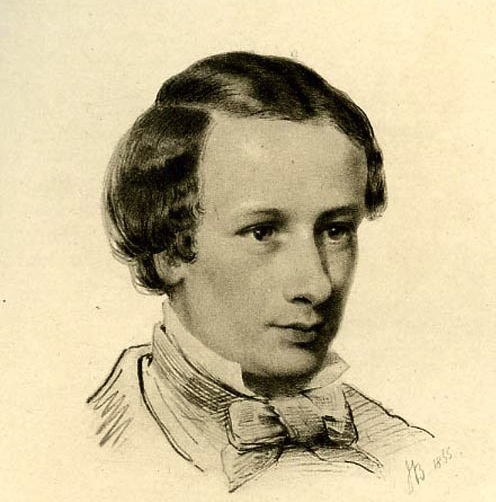
Drawing_of_Coventry_Patmore

Magna Est Veritas by Coventry Patmore (1823-1896):

Here, in this little Bay,
Full of tumultuous life and great repose,
Where, twice a day,
The purposeless, glad ocean comes and goes,
Under high cliffs, and far from the huge town,
I sit me down.
For want of me, the world’s course will not fail;
When all its work is done, the lie shall rot:
The truth is great, and shall prevail,
When none cares whether it prevail or not.

(Drawing of Patmore by John Brett, 1855, via Wikimedia Commons)