Finding The Words Worth Writing

series of articles by Steve Johnson about “tools and strategies” for the writing life prompted Alan Jacobs to notice a deeper problem would-be writers tend to ignore:

[L]et me encourage you to look again at Johnson’s posts. He tells you how to “keep your hunches alive,” how to use e-book annotations, how to keep researching as you write, and so on. All very good in its way. But: What if your ideas are crap? What good does it do — for you or the world — if you are clever and efficient in communicating thoughts that are carelessly arrived at, or ill-formed and incompletely worked through, or utterly unimaginative repetitions of what people in your would-be peer group have already said? … [I]f you want to do really good work, intellectually and/or artistically substantive work, then your first question can never be “How do I express my ideas?” but rather “How can I acquire ideas that are worthy of being expressed?”

In a follow-up post, Jacobs takes a stab at the latter question, imploring writers, “get out of your comfort zone, your echo chamber”:

But don’t do so by seeking out the crowd-pleasers and rabble-rousers from outside your typical group (unless you’re trying to understand sociological phenomena). If you’re a conservative who wants to understand liberalism, don’t bother with Michael Moore; if you’re a liberal who wants to understand conservatism, don’t bother with Sarah Palin; if you’re an unbeliever who’s curious about Christianity, ignore Joel Osteen; if you’re an orthodox Christian trying to get a fix on atheism, steer clear of Bill Maher.

If you seek out what’s strange to you in its better expressions, several things will happen. First of all, you’ll court being changed by the encounter, having your views altered, perhaps in significant ways. You’ll learn that the people who disagree with you are almost certainly, taken as a whole, morally and intellectually the equal of the people you agree with. … You’ll probably come to realize that any question that is fiercely debated is fiercely debated because there aren’t simple and obvious answers to it. … [I]f you want to have thoughts worth expressing, you’re going to have to take the risk of being slowed down and even seriously altered.


The View From Your Window Contest

vfyw_1-4

You have until noon on Tuesday to guess it. City and/or state first, then country. Please put the location in the subject heading, along with any description within the email. If no one guesses the exact location, proximity counts.  Be sure to email entries to contest@andrewsullivan.com. Winner gets a free The View From Your Window book or two free gift subscriptions to the Dish. Have at it.

A Half-Baked Development Project

Mat McDermott explains how and why cleaner cookstoves in the developing world aren’t delivering on their health and environmental promises:

It turns out that, at least in this circumstances examined by the study authors, the subsistence farmers of Nana Kenieba decided to put their cleaner cookstoves to use how they thought was best, and it wasn’t really the way they were intended (which was as a replacement for open fire stoves). Instead of turning their backs on open fire stoves, the women in this village—all the cooking there is done by married women with children—who had a cleaner cookstove simply used the new device as a supplement to their traditional cooking methods. It’s something the authors call “stove stacking.” They make the apt comparison to how pretty much no one who has a microwave or toaster oven uses it as a replacement for their stove top or regular oven. Even though in an absolute sense you could cook all your meals with any one of them alone, you quickly learn that some things cook best in one or the other.

The Craft Of Coming Attractions

J. Hoberman highlights one of Jean-Luc Godard’s most distinctive innovations – treating the trailers for his films as works of art themselves. Hoberman argues that Godard “would seem to be the only major filmmaker who regularly assumed responsibility for cutting (and occasionally shooting) his advertisements for himself—developing a form that was aesthetically more advanced than the features they publicized”:

Predicated on a rhythm as relentless as that of Tony Conrad’s Flicker, Godard’s Breathless trailer is a barrage of three-second shots with voice-over captions: “the pretty girl,” “the bad boy,” “the revolver,” “the police.” That the voice is female is characteristic of Godard’s trailers (and one of many things that distinguish his from Hollywood’s). The montage of attractions is intermittently interrupted by a title card and the voice of Godard bestowing credit on friends François Truffaut (for the screenplay) and Claude Chabrol (as technical adviser), as well as identifying himself and the movie’s stars.

Even more than Breathless, its trailer is a kind of manifesto. Narrative parameters established, its subsequent attractions include both the specific (“Humphrey Bogart,” “Picasso,” Jean Seberg’s “nice buns”) and the abstract (“tenderness,” “adventure,” “love,” the last accompanied by the image of a book of photographed nudes), and it ends with the filmmaker’s ringing declaration that Breathless is the “best film out now!”

China’s Tourist Army

Tibet-tourism

Pearl Sydenstricker reports on the rising number of Han Chinese tourists in Tibet and the politics behind it:

It’s government policy: tourism is an officially designated “pillar of the economy” in Tibet. The goal is to attract fifteen million tourists a year by 2015 in the so-called “Tibetan Autonomous Region,” which has a population of only three million. In the first half of 2013, tourist visits to Lhasa surged by 36 percent, according to state media. Rather than threatening Tibetan monks with army troops, the government is smothering them with throngs of pushy tourists, who show their sympathies with their fashion statements: green camouflage is in. On recent summer and autumn days, they wore camo hats, camo hoodies, and even camo leggings, as if each were playing a part in the paramilitary.

In the Chinese media, Tibetans are always portrayed as the poor beneficiaries of Chinese aid.

Their costumes are funny, their cultural beliefs hopelessly “backward,” tourists tell me. One villager I speak with in Hebei, thousands of miles away, complains that his taxes are going for charity for this distant group. The government seems to have drawn up a caricature—somewhat like Ronald Reagan’s “welfare queens”—depicting Tibetans as lazy. No surprise, then, that Han Chinese carry on loud cell phone conversations in prayer halls and walk counterclockwise against the flow of pilgrims, deliberately interrupting these “superstitious” rituals. As I walk through the Barkhor, the newly reconstructed “Old Quarter” of Lhasa—one of the holiest sites and top tourist destinations in all of Tibet—armored vehicles rumble past souvenir stands. I count forty-seven police stations in half a square mile, all of them clearly marked on the tourist maps set up in the streets, like at Disneyland. Tourists may fulfill their role in the soft-power paramilitary, but it’s no secret that the real paramilitary is here too.

A related Dish thread, “Why Do Chinese Tourists Have Such A Bad Rap?,” is here, with a post specifically addressing Tibet here.

(Photo by Desmond Kavanagh)

The First Funnies

J. Hoberman praises Peter Maresca’s Society is Nix: Gleeful Anarchy at the Dawn of the American Comic Strip, 1895-1915 for illustrating “just how sensational this newspaper art form was in its early years”:

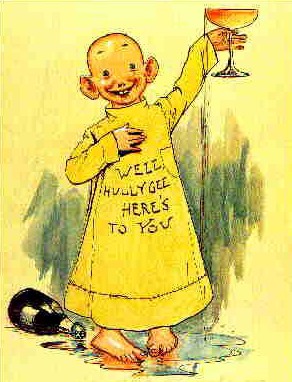
The comics were the high-tech weapon of the great newspaper circulation war and dish_yellowkid tumult, if not violence, was the new medium’s stock-in-trade. The term “yellow journalism” itself derived from the first comic-strip star, a denizen of the teeming, single-image slum tableaux Hogan’s Alley, who became known as the Yellow Kid. This jug-eared, barefoot urchin, draped in a canary-colored nightshirt, was created by thirty-three-year-old magazine artist Richard Felton Outcault at Pulitzer’s New York World….

Although replete with racial and ethnic stereotypes, the first newspaper comic strips were not so much an extension of vaudeville as precursors of the equally déclassé and temperamentally anti-authoritarian motion picture. The early strips thrived on choreographed violence, including runaway horse carts, baroque streetcar collisions, and a panoply of what [newspaper magnate William Randolph] Hearst might have termed polychromous explosions.

In an October review of Maresca’s book, Steven Heller summed up how the genre got its start:

The genesis of Sunday funnies began with technology providing a way to cheaply produce color newsprint pages, and out of a desire for an outlet to lampoon new social developments in transportation, communication, power. This was also a period of huge immigration, particularly from the poorer countries in Europe where English was limited and accents were the fuel of comic and stereotypical ridicule. A growing working class from different backgrounds shared a thirst for entertainment.

“With the masses specifically in mind, newspaper comics became the first popular culture as we know it today: synchronous, predictable, ephemeral, and with a near-universal appeal, well before cinema, radio, and TV,” Maresca says.

(Image of The Yellow Kid by Richard Felton Outcault, 1897, via Wikimedia Commons)

Talking Without Conversing

MIT psychologist Sherry Turkle worries that digital communication is no substitute for the real thing:

The conclusion she’s arrived at while researching her new book is not, technically, that we’re not talking to each other. We’re talking all the time, in person as well as in texts, in e-mails, over the phone, on Facebook and Twitter. The world is more talkative now, in many ways, than it’s ever been. The problem, Turkle argues, is that all of this talk can come at the expense of conversation. We’re talking at each other rather than with each other.

Conversations, as they tend to play out in person, are messy—full of pauses and interruptions and topic changes and assorted awkwardness. But the messiness is what allows for true exchange. … The logic of conversation as it plays out across the Internet, however—the into-the-ether observations and the never-ending feeds and the many, many selfies—is fundamentally different, favoring showmanship over exchange, flows over ebbs. The Internet is always on. And it’s always judging you, watching you, goading you. “That’s not conversation,” Turkle says.

On a similar note, cartoonist Matthew Thurber explains how the constant showmanship of social media turned him off. He says he quit Twitter after becoming “completely furious at the way people are packaging their identities”:

A lot of people are able to use social media more casually than I can and feel less conflicted about it. You go to an art-marketing class, and they tell you that you have to constantly remind people of your existence. Even if you’re not directly telling them to buy your thing, you should be promoting yourself ambiently. This is a picture of my studio, or This is something I’m reading, or This is somebody I bumped into at a party. It’s interesting when you see literary celebrities doing that, like Salman Rushdie or Margaret Atwood or Joyce Carol Oates. They’re constantly on Twitter, and it makes me wonder if they’re actually really lonely or bored.

The Big Bang Theory Of Consumerism

Sharkfin

In an excerpt from their new book, Larry Downes and Paul Nunes explain how disruptions in the tech market work:

[T]oday, new products and services enter the market better and cheaper right from the start. So producers can’t rely on a class of early adopters and high margins to build up a war chest to spend on marketing to larger and later markets. For better and for worse, thanks to near-perfect market information, consumers are too savvy for that. Everyone knows right away when some new offering gets it right — or, conversely, gets it wrong. The bell curve, once useful as a model of product adoption, has lost its value as a planning tool. This kind of disruption has its own unique life cycle, and with it its own best practices for marketing and sales, product enhancement, and eventual product replacement. Markets take off suddenly, or they don’t take off at all. Since adoption is increasingly all-at-once or never, saturation is reached much sooner in the life of a successful new product. So even those who launch these “Big Bang Disruptors” — new products and services that enter the market better and cheaper than established products seemingly overnight — need to prepare to scale down just as quickly as they scaled up, ready with their next disruptor (or to exit the market and take their assets to another industry).

They give the example of Kinect, an add-on to Microsoft’s Xbox 360:

Kinect was an enormous hit, selling eight million units in just the first sixty days. According to Guinness World Records, that made Kinect the fastest-selling consumer electronic device in history. A little over a year after launch, twenty-four million Kinects had been sold, pushing sales of Xbox 360 consoles and games along with it. In 2010, Microsoft took the top spot in the fiercely competitive console market for the first time since Xbox 360’s launch in 2001. For Big Bang Disruptors, however, catastrophic success invariably leads to rapid market saturation — and with it decline and sunset. Within six months, the pace of Kinect sales dropped precipitously. Though stragglers continued to buy the product in peaks and valleys over the next year, the product had largely fulfilled its mission in its first ten months. For Microsoft — and other game developers — it was time for another innovation.

Male, Female, Or Both? Ctd

A reader writes:

You quoted Nelson Jones: “The problem with surgical intervention isn’t just the theoretical one that it violates the integrity of the body but the practical one that the doctors might well make a mistake.” The possibility that the child grows up to express a gender different than the one assigned is real. However, it’s important to understand that the sexual surgeries usually performed on intersex infants are mutilating, even when the gender assignment is not “wrong.”

The most common surgeries are intended to make the child’s clitoris smaller. That is done by removing clitoral tissue. Lots of clitoral tissue. Psychologist Suzanne Kessler asked female college students to imagine having been born with the kind of clitoris that causes children to be targeted with these surgeries (any clitoris over 3/8 inch):

Students were then given the physician’s standards for genital lengths, and women were asked to imagine having been born with a clitoris between 1.0 and 2.5 centimeters. Under what conditions would they have wanted it surgically reduced? Ninety-three percent would not have wanted their parents to agree to clitoral reduction if the condition were not life threatening and if it resulted in the loss of orgasm or pleasurable sensitivity. Over half of the women would not have wanted surgery even if the condition were unattractive and made them feel uncomfortable. This was particularly true of the lesbian and bisexual women in the sample. Twelve percent of the women would not have wanted a clitoral reduction under any circumstance

— Kessler, S., 1998. Lessons from the intersexed. New Brunswick, New Jersey: Rutgers University Press. (page 100-101).

Other sexual surgeries performed on intersex children include:

* vaginoplasty (a part of the colon is transferred to the perineum to form or to lengthen a vagina)

* gonadectomy (the child’s gonads are removed, both sterilizing the individual and rendering her dependent upon exogenous hormones for life)

* hypospadias surgery (skin flaps are used to try to extend the penile urethra so that the penis urinates from the very tip instead of somewhere further back along the underside)

Intersexed people all over the world who have been subjected to these surgeries (including myself) are calling for them to be stopped because we have experienced them as mutilating rather than normalizing. The vast majority of us remain in the gender that we were assigned, so the harm is by no means limited to wrong gender assignment. Surgeons claim that most of their patients are happy with their surgical outcomes, but you will search in vain for such silent, happy graduates of the intersex normalization process.

Shame is even more crippling than mutilating sexual surgeries. These surgeries are a response to shame. Ironically, by delivering a message that intersexuality renders the individual unloveable without mutilating sexual surgeries, they actually serve to reinforce shame. Those of us who are speaking out are the ones who have managed to transcend shame.