Mangling A Myth

Jordan Jeffers considers how J.R.R. Tolkien approached fiction in The Hobbit:

Tolkien is a storyteller, a myth maker, for he believed that myths demonstrated truth, that truth cannot actually be understood apart from myth. We can have no true vision of the stars unless we can first see them as “songs of living silver,” no true understanding of the earth until we can first understand it as our mother. Our myths matter a good deal, and how we think of elves is of vital importance to how we think of ourselves.

He goes on to argue that such an understanding of Tolkien’s work is what Peter Jackson fails to grasp:

Jackson is neither a communicator nor a mythmaker. He is a spectacle maker, a ringmaster, a showman. And he is very, very good at this. The Hobbit: The Desolation of Smaug manages to be both overwhelmingly big and manageably entertaining, balancing the actions of all the important characters quite deftly, allowing each of them just enough heroic moments to justify their presence in the movie. Basically, Jackson made The Avengers: Middle-Earth, and it is this very bigness that breaks the movie so forcefully from the books.

Tolkien’s book is not a story about superheroes. It’s a story about a hobbit named Bilbo Baggins, one of the smallest of folk, shorter even than the dwarves—a fat, ordinary person who does a lot of brave, ordinary things.

Ethan Gilsdorf unreservedly pans the movie:

As a fan of Tolkien and a fan of Jackson’s first trilogy, it’s difficult to distance myself from my desire for the movie that I’d hoped The Hobbit would deliver. This Hobbit Peter Jackson is less impressive than the Peter Jackson I came to know, respect and love in Lord of the Rings. This is an undisciplined director on display, showing no restraint. To me, The Hobbit: The Desolation of Smaug is too too loud, too fast, too much focused on action and distracting plot threads. I prefer the relative simplicity of Tolkien’s first Hobbit to the over-inflated, overblown, over-the-top epic Jackson aims his bow at here.

Larison also has brutal review, writing that “the second installment in this trilogy is a mockery of Tolkien’s story and insult to the audience”:

It is well-known that Peter Jackson has added a large amount of material to the story of The Hobbit in his quest to expand a short adventure story into a bloated would-be epic, but it is hard to appreciate just how silly and unnecessary these additions are until you see them. Thus we are treated to quite a few characters that never appear in the book, plotlines that have no relevance to the main story, villains that serve no purpose except to remind us of The Lord of the Rings, one pointless love story that functions at most as a lazy plot device, needless rewriting and mangling of key scenes, and frequent additions of battles that exist solely to fill up time in a movie that should never have been made.

But Cromercrox defends the director:

Jackson couldn’t possibly have made a film of The Hobbit that was ‘true’ to the original text – whatever that means, and leaving out the significant alterations Tolkien himself made to it. For, unlike The Hobbit‘s original readership, and unlike Tolkien himself when he wrote it, we can only come to The Hobbit backwards, as it were, through The Lord Of The Rings. There are those for whom nothing but a word-for-word treatment will do. I am not one of them. For one thing, I see no artistic merit in such faithful transliterations. What would be the point? For another, I think that to do have done a vanilla treatment of The Hobbit would be to have done Tolkien and his audience a grave disservice. Jackson’s treatment has its flaws, of course it does. But it’s much deeper, more honest and more Tolkienian in its spirit and execution than many people appreciate.


“Marry ‘Em When They’re Fifteen”

In which the right to free speech for Phil Robertson continuesMoney quote:

Look, you wait ‘til they get to be twenty years-old and the only picking that’s going to take place is your pocket. You got to marry these girls when they’re about fifteen or sixteen and they’ll pick your ducks.

And it appears he practiced what he now preaches. Also: could Sarah Palin please tell me what “picking your ducks” means? Her role model didn’t explain. Update from a reader:

I grew up in the rural north, not Louisiana, but here’s my take. A woman who will pick your ducks means just that; she will pluck the ducks you’ve shot. I did a fair amount of duck hunting with my dad. Plucking the ducks is a messy, smelly job involving boiling water and melted paraffin. My mother wouldn’t do it. I didn’t know any wives/mothers who would. My mother’s attitude was, “You shot ’em, you clean ’em”. Only a woman wholly subservient to her husband would clean his ducks without complaint, the kind you could keep barefoot and pregnant in the kitchen.

When we would travel to Manitoba to some remote hunting camp, there was usually a native woman, dirt poor and uneducated, who for a few bucks would clean ducks for any hunter who didn’t want to do it himself. That’s the only kind of woman I know you’d clean your ducks for you – and even her you’d have to pay.

Quote For The Day II

Obama Expresses Support For Same-Sex Marriage During Television Interview

“Flashback 12/29/12 …. Hard to believe this was 1 year ago today … when I reached a critical milestone of 100 days post transplant … and KJ was finally allowed to come back home. Reading this comforts me and I hope the same for you: ‘If you are depressed, you are living in the past. If you are anxious, you are living in the future. If you are at peace, you are living in the present.’

At this moment I am at peace and filled with joy and gratitude. I am grateful to God, my doctors and nurses for my restored good health. I am grateful for my sister, Sally-Ann, for being my donor and giving me the gift of life.

I am grateful for my entire family, my long time girlfriend, Amber, and friends as we prepare to celebrate a glorious new year together,” – Robin Roberts, capping one helluva gay year.

And yes, this is not news to me; and yes, it’s a huge relief that the woman to whom Obama spoke of his own “evolution” on marriage equality is no longer closeted; and yes, I’m glad for her survival of cancer and her own evolution as a free woman.

(Photo: U.S. President Barack Obama participates in an interview with Robin Roberts of ABC’s Good Morning America, in the Cabinet Room of the White House on May 9, 2012 in Washington, DC. During the interview, President Obama expressed his support for gay marriage, a first for a U.S. president. By Pete Souza/White House Photo via Getty Images.)

A Visionary Artist After The Fact

Reviewing a documentary about Vivian Maier, the 20th-century Chicago street photographer whose work was only discovered after her death in 2009, Noah Berlatsky questions Maier’s posthumous incorporation into the institutional art world:

“People identify with her; they love the story, and then they love the work,” gallery owner Steven Kasher says in The Vivian Maier Mystery, and Kasher’s formulation— “they love the story, and then they love the work”—can mean that buyers love both story and work. But it might also mean that they love the story first, and then love the work because of the story. If that’s the case, people may be paying thousands of dollars not for a particularly striking composition, but for a chance to be part of Maier’s odd narrative—to participate in the story of the secret, humble genius, now revealed. …

My discomfort with the way Maier’s work is presented and used in the film and the art world is in no way a condemnation of the artist herself. She, after all, had no part in her own marketing, and certainly never planned for her images to be seen or lauded. The voice-over towards the end of the film insists that “her compulsion to take pictures was her life,” but that’s the film’s assessment, not hers. It’s a story the film has imposed upon her, for its own purposes. Watching the movie, you get the uncomfortable feeling that a whole lot of people want Vivian Maier’s life to be her pictures so that, in owning or looking at them, both can be consumed.

The Anti-Carb Dogmatist

Dr. David Perlmutter rails against carbohydrates:

The neurologist and president of the Perlmutter Health Center in Naples, Fla., believes all carbs, including highly touted whole grains, are devastating to our brains. He claims we must make major changes in our eating habits as a society to ward off terrifying increases in Alzheimer’s disease and dementia rates.

After reading Perlmutter’s best-selling book on the manifold evils of carbs, and after talking with supporters and critics of the Paleo diet in the medical community, James Hamblin is unconvinced by the anti-gluten crusader:

Even as someone who was seriously skeptical of Perlmutter’s story, after reading his 336 pages—and watching his whole YouTube channel and most every TV appearance—I have found myself hesitating around grain. His message is so ardently and unwaveringly delivered. That is how one-sided pop-science works, though. [Dr. David] Katz wrote a tongue-in-cheek case that the 1974 advent of the Post-it note was the cause of the obesity pandemic, to show how easily correlations can be spun. If I read 336 pages on the evils of Post-its, I might set our office supply room on fire. …

When a person advocates radical change on the order of eliminating one of the three macronutrient groups from our diets, the burden of proof on them should be enormous. Everything you know is not wrong. Perlmutter has interesting ideas that I would love to believe. I’d love it if a diet could deliver all that he promises. There is value in belief. It’s what the Empowering Neurologist literally markets. His narrative comes with the certainty that you are doing something to save yourself from cognitive decline and mental illness, which is probably the most unsettling of disease prospects. With that belief also comes guilt; an idea that something could’ve been done to prevent a mental illness, when in fact it was bigger than us. To think that every time you eat any kind of carb or gluten, you are putting your mental health and cognitive faculties at risk is, to me, less empowering than paralyzing.

The Birth Of Creativity

In an interview, the painter Kathryn Lynch describes how having children has impacted her art:

Children grow you. Painting is responding to life and being a mother expands who you are andnoname what you respond to. If you make more life rub up against you, you have more of a world to make art from. I like what Charlie Parker says: “If you don’t live it, it won’t come out of your horn.” I feel like my paintings are better and bigger because of my children. You respond to whatever is in your life, and the people you have in your life feed your painting. Perhaps I am painting my children. I think I am putting everything and everyone I know in my work.

Because I saw myself first and foremost as an artist, I never thought I wanted children. The desire to be a mother came out of the blue at age thirty-six. Perhaps that I paint makes me more animal than intellect.

The two fastest paintings I ever did, and which I felt were some of my strongest paintings, were done two weeks after each child was born. My children brought out my lioness. When I went to paint after giving birth, it was easy to give birth to a painting, the paint just knew where to put itself on the canvas. In those moments I realized that my painting, and my ability to paint, was very directly related to events and occurrences in my life.

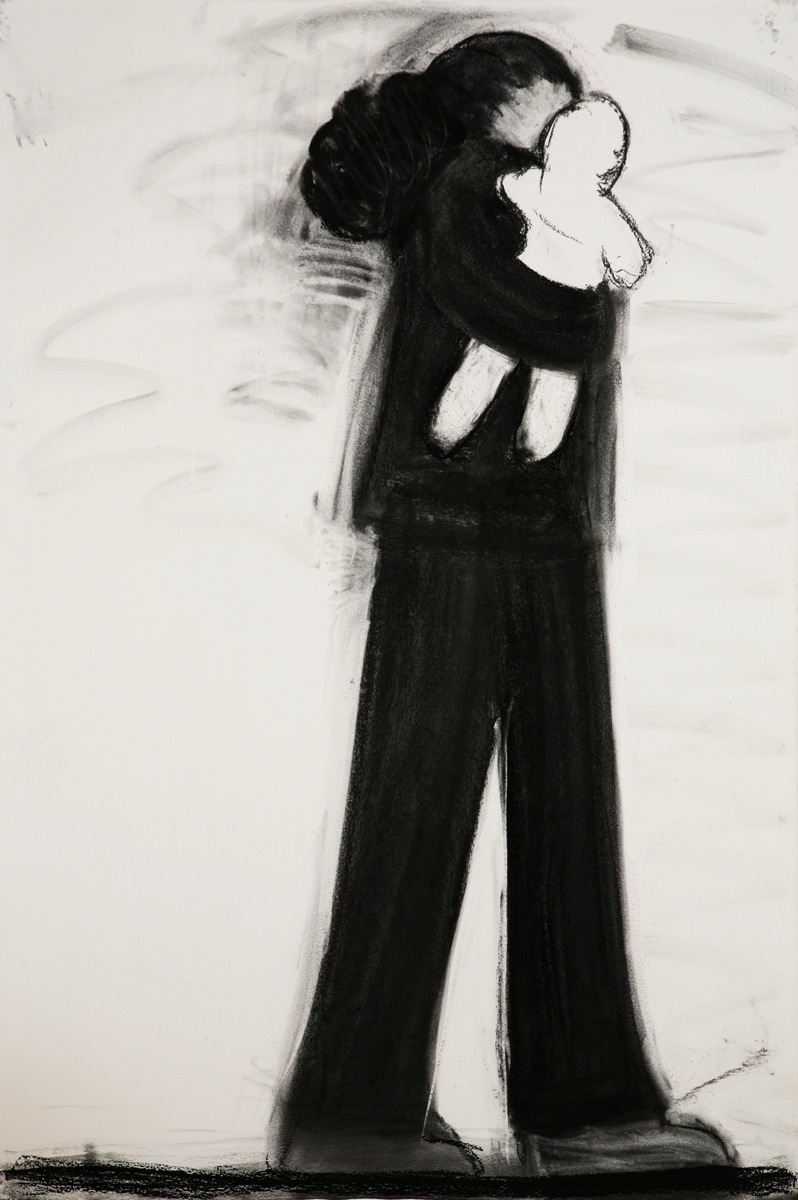
(Image: Mother and Child by Kathryn Lynch. For more of her work, visit her website here. Her painting will be featured at the Metro Show in January 2014)

How Nostalgia Helps Us

Nicholas Hune-Brown looks into research on the sentimental sensibility:

[A] study by Krystine Irene Batcho in The American Journal of Psychology examined the ways in which the nostalgia-prone cope with difficult situations. Batcho tested undergraduate subjects to see how predisposed to nostalgia they were before presenting them with a survey designed to see how they would react to stressful scenarios.

Batcho found that the nostalgia-prone were more likely to cope using helpful strategies, rather than dysfunctional ones. Counteracting the stereotype, the nostalgia-prone didn’t withdraw or go into denial: they sought social support and expressed emotions. The nostalgic had a deeper sense of connectedness to the past, and reflecting on earlier times could bring to mind coping strategies they had used before. Nostalgia proneness, Batcho concluded, came with real emotional and social benefits.