The joy for butterflies isn’t confined to people:
Author: Andrew Sullivan
Our Genetic Moral Code
Back in November, in an interview with Sam Harris, Paul Bloom explained the thesis of his new book, Just Babies:
Certainly some morality is learned; this has to be the case because moral ideals differ across societies. Nobody is born with the belief that sexism is wrong (a moral belief that you and I share) or that blasphemy should be punished by death (a moral belief that you and I reject). Such views are the product of culture and society. They aren’t in the genes.
But the argument I make in Just Babies is that there also exist hardwired moral universals—moral principles that we all possess. And even those aspects of morality—such as the evils of sexism—that vary across cultures are ultimately grounded in these moral foundations.
A very different misconception sometimes arises, often stemming from a religious or spiritual outlook. It’s that we start off as Noble Savages, as fundamentally good and moral beings. From this perspective, society and government and culture are corrupting influences, blotting out and overriding our natural and innate kindness.
This, too, is mistaken. We do have a moral core, but it is limited—Hobbes was closer to the truth than Rousseau. Relative to an adult, your typical toddler is selfish, parochial, and bigoted. I like the way Kingsley Amis once put it: “It was no wonder that people were so horrible when they started life as children.” Morality begins with the genes, but it doesn’t end there.
In an excerpt from his book, Bloom explores how toddlers make moral choices:
Children tattle. When they see wrongdoing, they are apt to complain about it to an authority figure, and they don’t need to be prompted to do so. In one study, 2- and 3-year-olds were taught a new game to play with a puppet; when the puppet started to break the rules, the children would spontaneously complain to adults. In studies of siblings between the ages of 2 and 6, investigators found that most of what the children said to their parents about their brothers or sisters counted as tattling. And their reports tended to be accurate. They were ratting their sibs out, but they were not making things up. …
Part of the satisfaction of tattling surely comes from showing oneself to adults as a good moral agent, a responsible being who is sensitive to right and wrong. But I would bet that children would tattle even if they could do so only anonymously. They would do it just to have justice done. The love of tattling reveals an appetite for payback, a pleasure in seeing wrongdoers (particularly those who harmed the child, or a friend ofthe child) being punished. Tattling is a way of off-loading the potential costs of revenge.
Another excerpt looks at the other side of morality:
Not all morality has to do with wrongness. Morality also encompasses questions of rightness, as nicely illustrated by a study of spontaneous helping in toddlers, designed by the psychologists Felix Warneken and Michael Tomasello. In one condition of the study, the toddler is in a room with his or her mother present. An adult walks in, his arms full, and he tries to open a closet door. Nobody looks at the child, or prompts him or her or asks for help. Still, about half do help—they will spontaneously stand up, wobble over, and open the door for the adult.
This is a small example for a small individual, but we see this kindness writ large when people donate time, money, or even blood to help others, sometimes strangers. This behavior too is seen as moral; it inspires emotions like pride and gratitude, we describe it as good and ethical. The scope of morality, then, is broad, encompassing both the harsh, judgmental elements and the softer, altruistic elements.
A Poem From The Year

“Little Eternities” by Mary Ruefle:
When are we happiest? he asked her.
Not one of them could get the seats
to go back, not one of them really knew
what was in the glove box, though
everything there was theirs.When they got to where they were going,
a park, a gray squirrel came jumping along.
Childhood! It was in one of the houses nearby.
Money! Every day it seemed to loose itself
from its lurking-place and drift away.So he smelled the underside
of his own arm. And the squirrel
paused, one of those little eternities
never mentioned again.
Please consider supporting the work of the Poetry Society of America here.
(From Trances of the Blast © 2013 by Mary Ruefle. Used by kind permission of Wave Books, Seattle & New York. Photo by Grant Loy)
Why Awe Is Awesome
Cayte Bosler unpacks a study that “shows there are residual health benefits to having your mind blown”:
“People increasingly report feeling time-starved, which exacts a toll on health and well-being,” states the study. Using three experiments, researchers Melanie Rudd and Jennifer Aaker of the Stanford University, and Kathleen Vohs of the University of Minnesota, examined whether awe can expand perceptions of time availability. They found that participants “who felt awe, relative to other emotions, felt they had more time available, were less impatient, were more willing to volunteer their time to help others, and more strongly preferred experiences over material goods.”
It can be hard to generalize what people consider jaw-dropping, but Vohs says research demonstrates what consistently creates an awesome experience. Travel ranks high. So does gazing at the cosmos on a clear night or watching a sensational film, as well as anytime we encounter massive quantities: colorful tulips in bloom, a bustling market in India, or a stunning school of fish. Novelty and perceptual vastness forces us into the present moment. The study underscores the importance of cultivating small doses of awe in the everyday to boost life satisfaction.
More on how “awe” works:
“The experience of awe is one where you are temporarily off-kilter in terms of your understanding of the world,” explains Vohs. “People mostly walk around with a sense of knowing what is going on in the world. They have hypotheses about the way people behave and what might happen; those are pretty air-tight. It is hard to get people to shake from those because that’s just how the brain works. We are always walking around trying to confirm the things we already think. When you are in a state of awe, it puts you off balance and as a consequence, we think people might be ready to learn new things and have some of their assumptions questioned.”
Face Of The Day
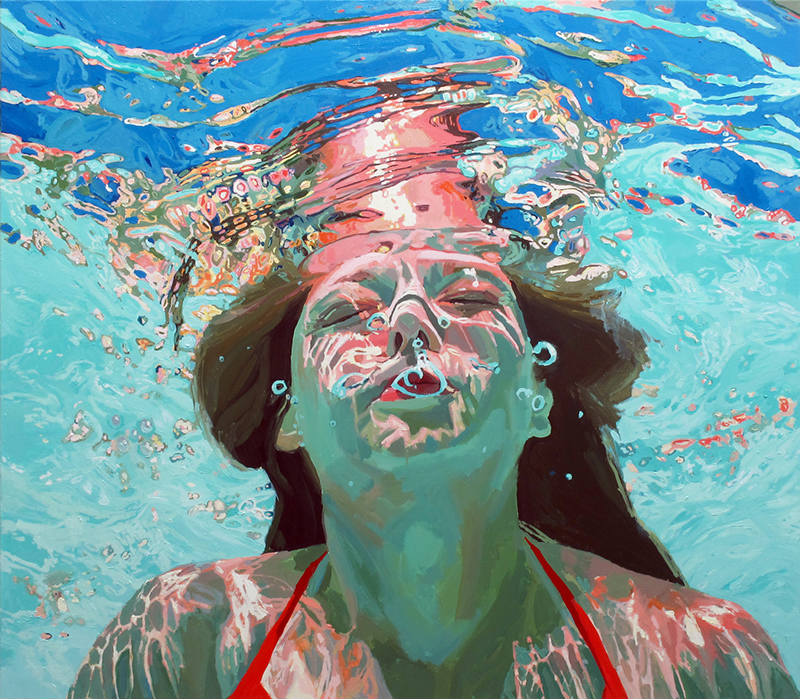
How artist Samantha French describes her work:
My current body of work is focused on swimmers underwater and above. Using vague yet consuming memories from my childhood summers spent immersed in the tepid lakes of northern Minnesota, I attempt to recreate the quiet tranquility of water and nature; of days spent sinking and floating, still and peaceful.
See more of her work here.
“The Clear Expression Of Mixed Feelings”
Recently the Dish featured the poetry of Mary Szybist, whose collection, Incarnadine, won the National Book Award in November. In an interview, she discusses the connection between her religious life and writing:
When I was young, spiritual faith had an enormous presence in my life. When I was a young adult, its absence, at times, felt enormous. Now my relationship to it is more complicated, and I try to let those complications into my poems. W. H. Auden once said that “poetry might be described as the clear expression of mixed feelings,” and my mixed feelings about faith and spirituality often drive my work…. I don’t think I was ever after spiritual clarity, at least not the kind that might be held as an enduring truth. An insight that helps me through the struggles of one day will not necessarily answer to the spiritual unrest of another. That is, I think, why artists keep creating and writers keep writing. We change; our world changes; what suffices one day will not necessarily suffice the next day. We need new visions. I like Robert Frost’s idea that a poem is a “momentary stay against confusion.” Clarity may be “momentary”—but that does not make it less valuable or needed.
She goes on to argue that the poems in Incarnadine could be seen as a feminist response to the Biblical tale of the Annunciation, when Christians believe an angel told Mary about her miraculous pregnancy:
Feminism means, in its most basic sense, a belief that men and women should have equal rights and opportunities. I do, of course, believe that. Feminism might also be described as activity in support of women’s interests, and I think Incarnadine does answer to that description. I grew up identifying with the icon of Mary, mother of God, since I was named after her. I also felt myself to be in her shadow. I think Mary is a problematic ideal to hold up to women for many reasons; she is celebrated for being both mother and virgin—an impossible ideal. It is particularly the virginity ideal that is held up to women (and not men) that I find problematic, and virginity is a concept and expectation that still has real and often dire consequences for women throughout the world. I wanted to complicate the figure of Mary and the way she relates to this “ideal.” So … I would say this is a feminist response.
The View From Your Window

Dushanbe, Tajikistan, 7.32 am
Taking Stock In Transit
Stuck in an airport for hours with nothing to do? Erika Kuever recommends seeking solace in the worship room:
Every airport has a non-denominational worship room, and many are worth a visit, if for no other reason than to get some quiet time. It’s rare to run into anyone else in these rooms, but when you do people tend to smile at you with kind eyes, recognizing another wayfarer considering their mortality in an enormous, climate-controlled, heavily secured, globally elite space.
Due to their essential in-between-ness, airports are fine places for reflection, for thinking broadly and deeply about the world and your place in it. Without consciously intending to I sometimes find myself in a terminal taking stock, thinking about my changing life goals, my strengths and weaknesses, and my hopes and fears, or just deciding this will finally be the year I read Infinite Jest. It’s an even better place to look outwards, to consider human hubris and the march of history.
Why Don’t We Talk About Jesus’ Sexuality?
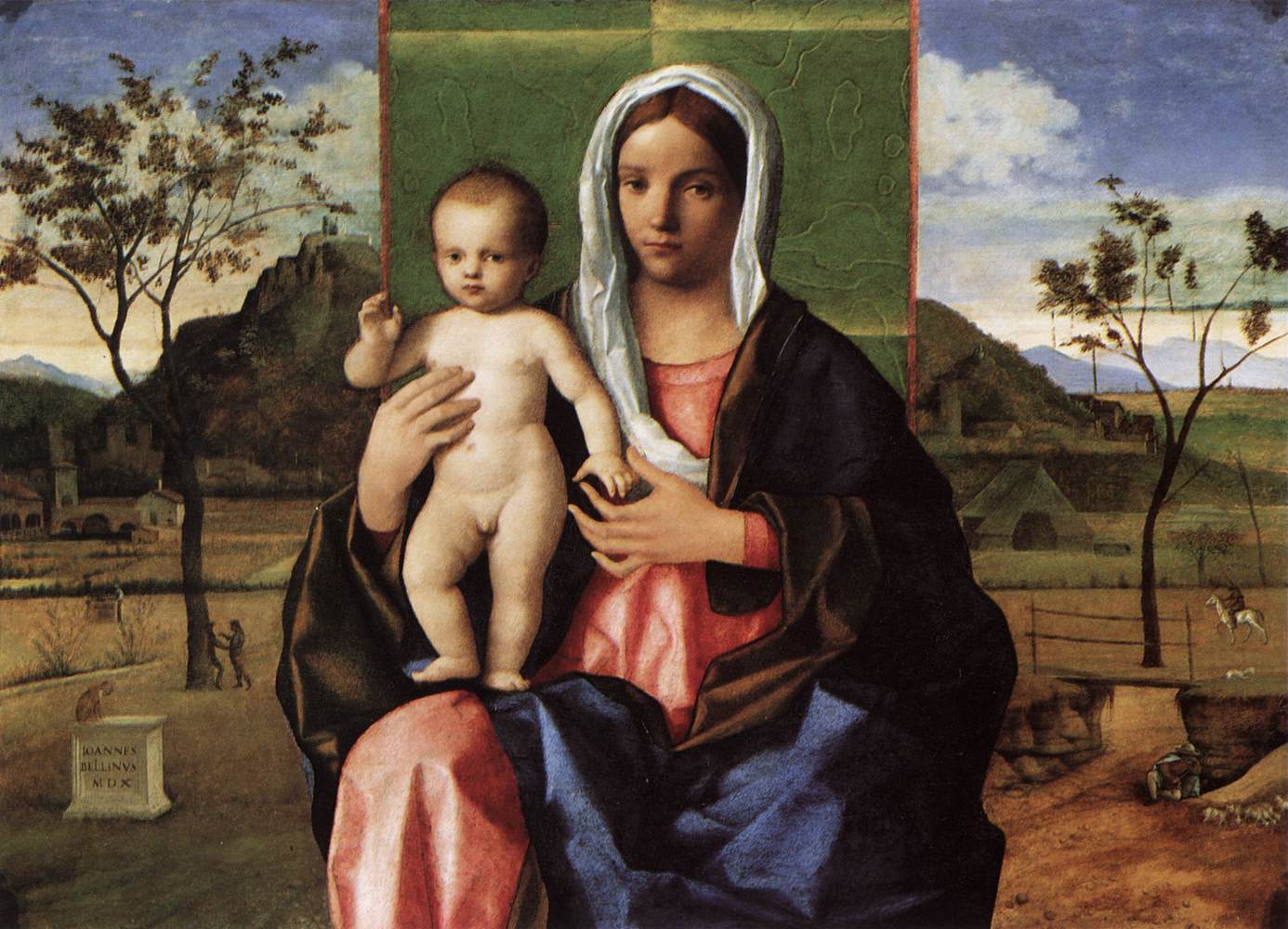
Lee Siegel revisits Leo Steinberg’s classic work of art history, The Sexuality of Christ in Renaissance Art and in Modern Oblivion, which details the centuries-long effort to conceal and ignore that Jesus was a man with a penis:
The “modern oblivion” of Steinberg’s subtitle was just that: centuries during which the central fact of Christ’s phallus in hundreds of Renaissance paintings was overlooked, denied, and, sometimes, bowdlerized. Steinberg adduces several examples of Christ’s genitalia being painted over or touched up to make them look like a mere blur. In one case, probably in the mid- to late nineteenth century, the Alinari brothers, famous for their photographic reproductions of paintings, blackened out the Christ child’s penis in their photograph of a fifteenth-century “Madonna and Child” by Giovanni Bellini. Such censorship, Steinberg believes, was meant as distraction from an uncomfortable theological premise: “A disturbing connection of godhead with sexuality.”
Steinberg’s point was more than prurient – it connects to theological debates about the meaning of the Incarnation, or God becoming man:
He held that artists used the evidence of Christ’s genitals to prove that Christ submitted to becoming human before returning to the godhead. The revelation of his penis demonstrates, as Steinberg puts it, Christ’s “humanation,” that moment of incarnation which proved Christ’s love for humankind. And the many representations of the Christ child’s circumcision are important as foretellings of his crucifixion—the blood of Christ’s penis is fulfilled in the blood from Christ’s wounds.
Entering with obvious relish the realm of Christian sexual hermeneutics, Steinberg relies on St. Augustine, who emphasized his surrender to and then escape from the “fleshpots of Carthage,” to argue that Christ’s erection was a singular way to demonstrate Christ’s chastity. Without the capacity to yield to lust, Christ’s triumph over carnal desire would have no human meaning. Unlike men after the fall of Adam, who fell victim to lust, Christ willed his erection; it was not an involuntary physiological event. By both willing and resisting it, he declared his victory over the stain of sin bequeathed to humanity by Adam and Eve, and over the death that their carnal weakness brought into the world. That, after all, is the significance of the resurrection.
(Image of Madonna and Child Blessing by Giovannia Bellini, 1510, via Wikimedia Commons)
“Midwives For The Dying”
Peg Nelson is a nurse practitioner experienced in palliative care, helping patients and their families deal with dying. In an interview, she describes what her role can teach us about our lack of control:
Once you admit to yourself that dying, like birth, is not something you can control, it frees you up to use your compassion to help people. For example, we can usually make dying patients comfortable and help them find ways to make the most of their remaining days. We are less like surgeons performing an operation ourselves than coaches helping someone else. And there is a lot we can control. We can always listen—really listen—to patients and families. We can always be with them—really with them—in the moment. And we can always care—really care for them—throughout the experience.
What she says to those just beginning to grapple with their impending deaths:
There are some phrases that we tend to use a lot. I can’t tell you how many times I have said, “I wish things were different,” or “I’m so sorry.” Of course, you must not only say it but mean it. And even in the midst of shock and anger and despair, there are always healing things you can say. For example, I often hear myself saying, “You have such a beautiful family,” or “I am feeling a lot of love in this room.” It is not only pointless but harmful to pretend that dying is not happening.
On the other hand, if you do it right you can help people find lasting meaning—even something beautiful in it. More important than anything we say is to listen—asking questions, being quiet and present.
 The Dish
