Ruble Trouble, Ctd

by Dish Staff

Screen Shot 2014-12-16 at 11.56.43 AM

Matt O’Brien highlights the latest piece of bad news for the Russian currency:

Russia’s central bank raised interest rates from 10.5 to 17 percent at an emergency 1 a.m. meeting in an attempt to stop the ruble, which is down 50 percent on the year against the dollar, from falling any further. It’s a desperate move to save Russia’s currency that comes at the cost of sacrificing Russia’s economy.

But even that wasn’t enough. After a brief rally, the ruble resumed its cliff-diving ways on Tuesday, falling another 14 percent to a low of 80 rubles per dollar. It was 60 rubles per dollar just the day before. The problem is simple. Oil is still falling, and ordinary Russians don’t want to hold their money in rubles even if they get paid 17 percent interest to do so. In other words, there’s a well-justified panic. So now Russia is left with the double whammy of a collapsing currency and exorbitant interest rates. Checkmate.

Neil Irwin elaborates, pointing out that even the central bank’s attempt to stanch the bleeding is a big risk:

Perhaps the higher interest rates will make those moving money out of Russia think twice, and a resulting reversal in currency markets will lead speculators to conclude that betting against the ruble is no longer a sure thing. But the move shows how Russian policy makers are stuck with no good options. Already the central bank has reportedly been intervening to try to short-circuit the sell-off, buying rubles to try to arrest the declines.

The problem is that if you try to defend your currency and lose, you are essentially throwing your money at currency traders for nothing. As Russia has deployed its reserves to (so far unsuccessfully) stop the currency collapse, it has made traders betting against the ruble richer while leaving the Russian government poorer. Poorer by $80 billion, to be precise.

“Putin’s policy choices in this matter,” Yglesias adds, “have important implications for the distribution of wealth in Russia”:

The collapse in the value of the ruble is a disaster for Russians who have debts denominated in foreign currencies, but it’s not necessarily the worst thing in the world for those who don’t. Indeed, Russians working in tourism (which, admittedly, isn’t that many people since Russia is mostly cold and empty) or in the country’s handful of export industries that aren’t oil and gas actually benefit from a cheap currency. Conversely, much higher interest rates will be devastating to the fortunes of Russians who need to roll over ruble-denominated loans or who depend on rate-sensitive sectors like construction for their employment.

Bershidsky suggests that Moscow’s next step might be to impose capital controls like Malaysia did in 1997. But the really troubling question is what the political implications are. Noah Millman wonders whether a currency crash will be Putin’s downfall, and if so, what happens next:

If an economic meltdown leads to widespread popular discontent, the regime will have to respond in some way. The most appealing way – because the least risky for the regime – would be to stage-manage a change in leadership that promises change while changing very little. But who is Putin’s Putin? Once upon a time, the obvious answer would have been Dmitri Medvedev. But in the wake of his administration, and his agreement to hand the Presidency back to Putin after one term, I’d argue Medvedev is too closely-identified with Putin to be a plausible replacement for the regime in the event of any real discontent. …

If the regime cannot stage a satisfactory bit of theater, then the remaining options are uglier. Putin could deliberately try to provoke the West in the hopes of blaming Russia’s economic troubles on foreigners. Or he could turn force inward against internal “enemies” of Russia. Or the regime could hand Putin’s head to the mob without a clear plan for succession, leading to a period without clear leadership at the top until someone emerges from the internal struggle for power. Least likely of all would be a genuinely revolutionary situation such as obtained in 1991. None of Russia’s organs of power are willing to take that kind of risk again.

Keating fears that the crisis will inspire even more belligerent behavior from the Kremlin:

Putin can’t do much of anything about oil prices and any steps to cooperate with NATO to secure sanctions relief will make him look weak. There’s a fair chance, then, that he may actually escalate tensions to get back the rally-round-the-flag effect that has sustained his popularity through the Ukraine crisis. Russian jets continue to buzz the airspace of NATO countries, and the military recently carried out snap drills in Russia’s westernmost region, Kaliningrad. This doesn’t look like a leader on the verge of de-escalating.

No, Elizabeth Warren Still Isn’t Running

by Dish Staff

Fed Chair Nominee Janet Yellen Testifies At Senate Confirmation Hearing

James Antle III quips that “Elizabeth Warren may be the last liberal in America who doesn’t want Elizabeth Warren to run for president”:

Warren was interviewed by National Public Radio Monday and was asked the standard question several times. “I’m not running for president,” she said. What is she telling liberal independent groups? “I told them, ‘I’m not running for president.’” Never ever? “I am not running for president,” she replied. “You want me to put an exclamation point at the end?”

Sounds pretty definitive, right? Except the Washington Post responded to the interview with a piece titled, “Why Elizabeth Warren is smart to not totally rule out running for president.” The political press clearly wants Warren to run.

Sargent doesn’t believe Warren “has any intention to run.” So why are progressive groups still talking her up?

Anything that boosts Warren’s visibility might also boost the potential power and influence that Warren may be able to exert within Congress — and over the Democratic Party in general — as their chosen vehicle for progressive policy ideas. That might boost the groups’ own influence over the debate.

Tomasky calls Warren the most powerful Democrat in the country:

But she does have this problem:

The media will always peg her as “left,” a word that in modern American media usage is clearly a pejorative. And if she just gets stuck there, her influence, however great among the Democratic base, will never grow outside of it. More centrist Democrats will make a few gestures in the Warren direction, but nothing more.

So Warren’s great challenge is to counter that dismissal by showing that her ideas do indeed have appeal outside the hard-shell Democratic Party base. They do, potentially—a number of polls have shown that Americans, including many in the center and even some on the right, have negative views of Wall Street and would back tighter regulation. She can speak to goo-goo eyed crowds in Boston and New York and San Francisco and Los Angeles, and while she’ll wow the already converted and rake in the money, she won’t be changing anything. But if she can take her message to Des Moines and Louisville and Columbus and Jacksonville and demonstrate that audiences are receptive there, then she’ll break out of the box the media wants to assign her. And if she can do that, she’ll become a figure of un-ignorable influence, and she’ll start making the likes of Clinton really pay attention.

Beinart rejects a comparison bandied about:

The better analogy is not between Elizabeth Warren and Ted Cruz. It’s been Warren and Rand Paul. Warren’s crusade against Wall Street may appeal to young blue collar Republicans in the same way Paul’s crusade against the national-security state appeals to young liberal Democrats. Both Warren and Paul are exploiting a divide in the other party. Democratic elites are more hawkish on foreign policy than their party’s rank and file; Republicans elites are more pro-Wall Street than theirs.

But Ed Kilgore is unsure how popular her politics would be:

To most Democrats most of the time, Warren is raising important and legitimate concerns about Wall Street that must be addressed, not just dismissed as “class warfare.” To some Democrats some of the time, she represents a decisive break with the Clinton and Obama traditions that is morally necessary.

But let’s don’t pretend there’s a slam-dunk “electability” case for this kind of politics. Yes, the “median voter theorem” of politics that dictates a perpetual “move to the center” by general election candidates has lost a lot of its power just in the last few years. But the countervailing “hidden majority” argument for more ideological politicians of the left and the right is hardly self-evident, and has in the past often been fool’s gold.

Sarah Mimms hears from Republicans who “see Warren as a way to paint the Democratic Party as increasingly beholden to its liberal wing and removed from moderates”:

Warren is hardly the only Dodd-Frank champion among congressional Democrats. And she’s far from alone in opposing the changes pushed by Republicans this week. …

But other members of the Democratic Conference in the Senate aren’t seen as rising stars the way Warren is. Few are considered potential presidential candidates. And none serves as well in the role of liberal specter over the next two years as Warren will, particularly now that she is a member of leadership. “The more exposure she gets, the better for us,” [RNC spokesman Sean] Spicer said. Warren could easily become a poster-woman for the Democratic Party over the next two years, he argued, serving the same purpose as Pelosi and Reid have in Republican advertising and strategy.

Dreher, for one, hopes Warren “will run for president in 2016 to force a national conversation on the Washington-Wall Street power nexus”:

A populist who talks like Elizabeth Warren and really means it is a Democrat a conservative like me would consider voting for, despite her social liberalism. As Phyllis Schlafly said back in 1964, in defending Goldwater against the Establishment Republican Nelson Rockefeller, a contest between Warren and Clinton, and a contest between Warren and just about any Republican would give the country a choice, not an echo. She almost certainly couldn’t beat Hillary for the 2016 nomination, but a Warren candidacy would get her name and her issues out there.

Andrew Prokop doubts it will happen:

[I]f Hillary doesn’t run, or her standing in the polls begins to plummet — it seems conceivable that Warren could heed the calls of various activists and jump into the race. But if Warren thought a presidential bid looked like a promising and appealing prospect under current conditions, she’d be floating the possibility of a run now, like Jeb Bush is. For the moment, it’s best to take her at her word that she’s focused on the Senate.

Larison thinks “it would probably be a better use of Warren’s time to concentrate on her role in the Senate”:

Warren hasn’t even finished her first term in office, and she is just now starting to have some real influence. That role may not be entirely incompatible with running a presidential campaign over the next year or so, but challenging Clinton will inevitably take her away from the job she was elected to do. It is there that she might stand a chance of achieving something. Running around Iowa and New Hampshire might provide the occasion for some interesting primary debates, but it isn’t going to have much of an effect.

(Photo by Alex Wong/Getty Images)

What The Hell Just Happened In Pakistan?

by Dish Staff

Pakistan

Nine Taliban gunmen disguised as soldiers attacked an army-run school in Peshawar this morning, killing at least 145 people, mostly children, and holding hundreds more hostage before dying in an eight-hour gun battle with security forces:

The militants’ assault on the school started at about 10 a.m., when the gunmen entered the Army Public School and Degree College in Peshawar, the capital of Khyber Pakhtunkhwa Province. Local news reports said the gunmen were disguised as paramilitary Frontier Corps soldiers and gained entry by scaling a wall at the rear of the main building. The attackers then opened fire on students with guns and grenades and, in a chilling echo of the Beslan school siege in Russia in 2004, took dozens of people hostage in the school’s main auditorium, according to news reports. … By late afternoon, the army said it had cleared three sections of the school compound and that troops were pushing through the remaining sections. After the last of the militants was killed, officials said, soldiers were sweeping the compound for explosives.

In taking credit for the attack, the Pakistani Taliban (TTP) said it was in retaliation for a recent military offensive against the group in the lawless region of North Waziristan. Sami Yousafzai rang up a TTP commander to ask why exactly his comrades believed that the mass murder of children was an appropriate act of revenge:

[Jihad] Yar Wazir justified the killings as fitting retribution. “The parents of the army school are army soldiers and they are behind the massive killing of our kids and indiscriminate bombing in North and South Waziristan,” which are the TTP strongholds. “To hurt them at their safe haven and homes—such an attack is perfect revenge.” But the children are innocents, I said. What about them, I asked?

“What about our kids and children,” he said. “These are the kids of the U.S.-backed Pakistani army and they should stop their parents from bombing our families and children.” Yar Wazir went on: “Those kids are innocent because they are wearing a suit and tie and western shirts? But our kids wearing Islamic shalwar kamiz do not come before the eyes of the media and the west.”

To Juan Cole, the attack is indicative of the TTP’s desperation:

North Waziristan had always been protected by military intelligence and so had become a haven for al-Qaeda offshoots. But in the past 6 months Pakistani army troops have killed nearly 2000 fighters and deeply disrupted what is left of the Pakistani Taliban. The group that took over the school complains of the perfidy of the government’s bombing. So this school attack was the Pakistani Taliban taking revenge for the government’s disruption of their terrorist activities. This is not a sign of strength but of weakness, and they lashed out at a soft target. They are facing a major defeat. That is its significance.

And Samira Shackle expects that “the sheer brutality of the event will answer some of the internal political debates about how best to tackle the terrorist threat”:

As recently as spring, the Pakistani government was pursuing talks with the Taliban, even as violent attacks across the country surged. Many in the mainstream political right wing still agitate for appeasement and negotiations rather than a military operation. And amongst the wider population, there is a fault-line of people who explicitly or tacitly support the actions of the TTP and associated groups, even as they suffer the effects of this campaign of terror. Some commentators have suggested that the sheer brutality of this assault will undermine the arguments of those who would like to see negotiations with the TTP, and will perhaps reduce that element of support amongst the wider populace. The group is seeking the destruction of the Pakistani state as its minimum, and speaks only the language of violence. That is no starting point for a meaningful settlement.

(Photo: A view of the coffins at Lady Reading Hospital where the casualties of a Taliban attack on a school were carried in the northwestern city of Peshawar, Pakistan, on December 16, 2014. By Metin Aktas/Anadolu Agency/Getty Images)

A Republican Pop Quiz

by Dish Staff

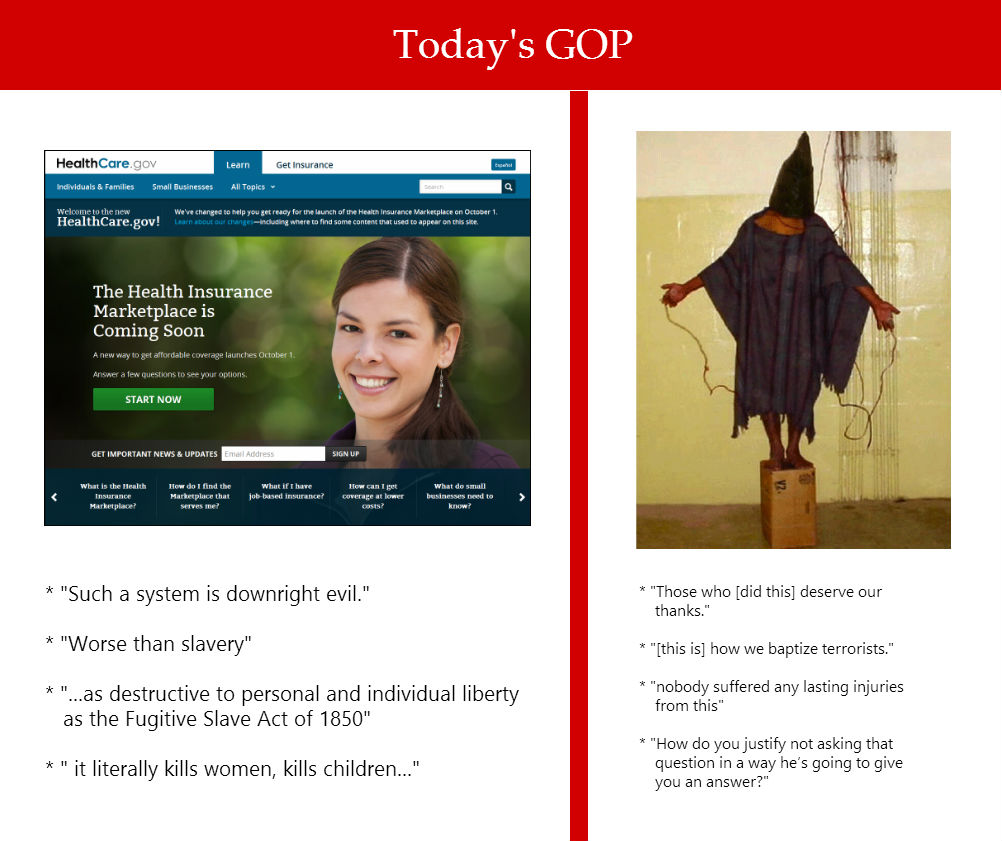
A reader sent this in:

unnamed (25)

Can you answer which Republican figure said each quote? Answers after the jump:

On Obamacare:

1. Sarah Palin, former half-term governor of Alaska, vice-presidential nominee, reality show star

2. Ben Carson, surgeon and 2016 presidential contender. (Though his exact words were: “the worst thing that has happened in this nation since slavery.”)

3. Bill O’Brien, New Hampshire state representative

4. Michele Bachmann, congresswomen

On torture:

1. Marco Rubio, senator

2. Palin

3. Peter King, congressman

4. Steve King, congressman

(Though the following quote from Dick Cheney would have made a better pick: “What are we supposed to do kiss him on both cheeks and say ‘please, please tell us what you know’?”)

Warning: This Tomato May Contain Blood, Sweat, And Tears

by Dish Staff

Reporter Richard Marosi and photographer Don Bartletti spent a year and a half investigating the awful conditions under which farm workers in Mexico labor to bring fresh produce to the American market. The first installment of their massive four-part exposé in the LA Times outlines the numerous human rights violations they discovered and calls out major US retail and restaurant chains, including Walmart and Subway, for buying produce from the offending farms:

At the mega-farms that supply major American retailers, child labor has been largely eradicated. But on many small and mid-sized farms, children still work the fields, picking chiles, tomatillos and other produce, some of which makes its way to the U.S. through middlemen. About 100,000 children younger than 14 pick crops for pay, according to the Mexican government’s most recent estimate. During The Times’ 18-month investigation, a reporter and a photographer traveled across nine Mexican states, observing conditions at farm labor camps and interviewing hundreds of workers. At half the 30 camps they visited, laborers were in effect prevented from leaving because their wages were being withheld or they owed money to the company store, or both. …

The practice of withholding wages, although barred by Mexican law, persists, especially for workers recruited from indigenous areas, according to government officials and a 2010 report by the federal Secretariat of Social Development. These laborers typically work under three-month contracts and are not paid until the end. The law says they must be paid weekly. The Times visited five big export farms where wages were being withheld. Each employed hundreds of workers. Wal-Mart, the world’s largest retailer, bought produce directly or through middlemen from at least three of those farms, The Times found.

Part 2 focuses on one particularly Dickensian labor camp, where those too sick to work were reportedly denied food and medical care, and where asking for a few extra tortillas for her children could earn a worker a beating. Tom Philpott stresses how heavily Americans rely on Mexican farms for our cheap and abundant fruits and veggies:

The US now imports nearly a third of the fruit and vegetables we consume, and Mexico accounts for 36 percent of that foreign-grown cornucopia, far more than any other country. And we’re only growing more reliant on our southern neighbor—imports of Mexico-grown fresh produce have increased by an average of 11 percent per year between 2001 and 2011, the USDA reports, and now amount to around $8 billion. The Times investigations demonstrates, with an accumulation of detail that can’t be denied or ignored, that our easy bounty bobs on a sea of misery and exploitation.

These revelations, Erik Loomis argues, strengthen the case for an international legal framework to hold American companies accountable for doing business with human rights abusers:

As I argue in Out of Sight, these conditions are precisely why central to our demands for a just world must be international labor standards enforceable in U.S. courts. Anything else will keep workers in these conditions. If Subway wants to use tomatoes grown in Mexico, fine. But those tomatoes have to be produced in conditions that stand up to a basic test of human rights. If wages are stolen, workers threatened, bathing facilities not provided, etc., then workers should have the right to sue for recompense in American courts. Subway, Safeway, McDonald’s, etc., must be held legally responsible for the conditions of work when people labor in growing food for them to sell. This has to be a legal framework. Mass movements are useful only in the short term because we will move on to the next issue.

The Peril Of Yak Poop

by Dish Staff

4782209145_dbce36fa23_b

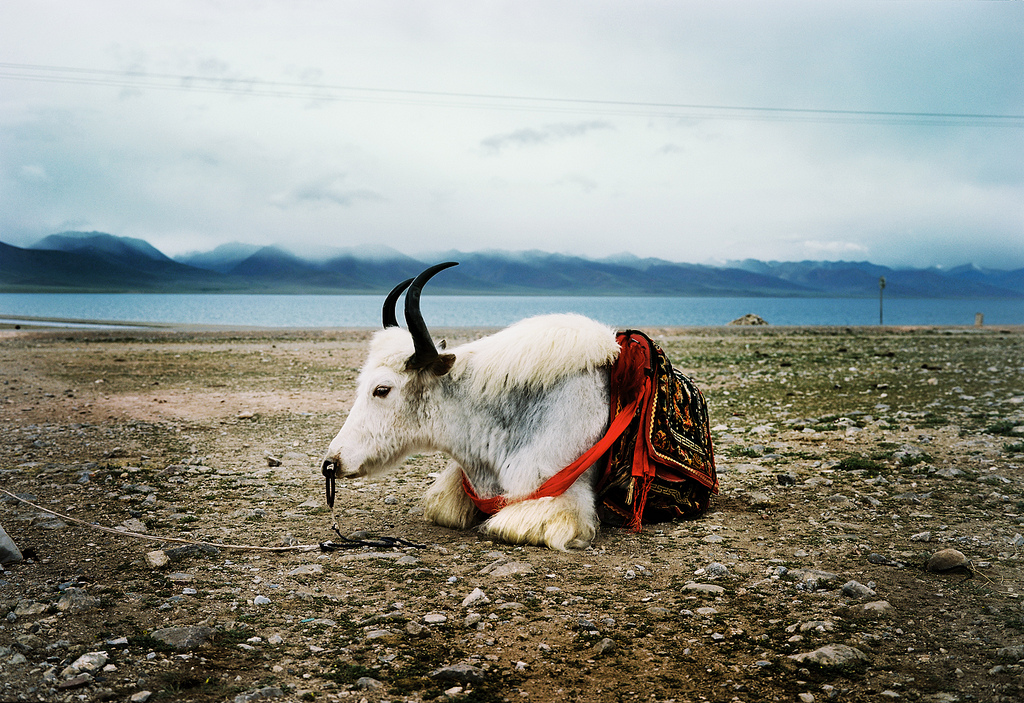
Eric Holthaus explains:

Yak dung, when used as fuel, is arguably dirtier than coal but is definitely much cheaper. Particulate pollution from burning animal dung greatly increases the risk of lung cancer and other respiratory ailments, the occurrence of which can be slowed by switching to cleaner ways of heating homes. …

A new paper accepted for publication in the journal Atmospheric Environment provides some of the first quantitative data on both black carbon and indoor air pollution during the cool season in Tibet. Via air samples and a survey of households in the Nam Co region of Tibet—the name means “heavenly lake”—researcher Eri Saikawa and her team learned things were even worse than they suspected. Her survey admittedly had a small sample—just 23 households responded—but is nevertheless illuminating.

A majority of residents had access to improved cookstoves, even solar power, but yet every single respondent still used yak dung for heating. Saikawa explains this by noting that average annual income per household is just $890 a year. Yak dung is simply the cheapest fuel available.

Previous Dish on poo-based energy here and here.

(Photo by Lyle Vincent)

Illiberalism In The Art World, Ctd

by Dish Staff

Elizabeth Nolan Brown highlights a case of political correctness gone awry at the University of Iowa, where a sculpture of a Ku Klux Klansman was labeled “hate speech” and taken down because apparently the very shape of a racist symbol, even when used to make an anti-racist statement, is now deemed too offensive for college students to handle:

Created by Serhat Tanyolacar, a UI visiting professor and printmaking fellow, the klansman sculpture was decoupaged in newspaper coverage of racial tension and violence throughout the past 100 years. The piece was meant to highlight how America’s history of race-based violence isn’t really history and “facilitate a dialogue,” as Tanyolacar told university paper The Gazette. But no matter: After several hours, UI officials decided that the display was “deeply offensive” and needed to be removed. …

To me, this case provides a good reference point for why we shouldn’t curtail freedom of expression even when it comes from despicable groups like the Klu Klux Klan. When you start casting for exceptions to the First Amendment, you never know what kind of other speech—perhaps speech designed to address the very problems you’re fighting against—will get caught up in the net. Unfortunately, the kids and faculty at UI seem to have learned a different lesson: reacting to the statue as art or as a political statement was a reflection of cluelessness, insensitivity, and white privilege.

Tiffany Jenkins picks up on a similar trend of art censorship in Europe:

The travelling Exhibit B, by the white South African artist Brett Bailey, is a recreation of a human zoo from the 19th century that features 12-14 African performers from the host city and a choir of Namibian singers exhibited as artifacts. It’s meant to provoke a conversation about slavery, colonization, and present-day racism, but many protesters accuse it of being racist itself. In London in September, the Barbican pulled the entire run of Exhibit B after a petition calling on the arts center “not to display” the work achieved 22,988 signatories and criticized Exhibit B as “simply an exercise in white racial privilege.” …

Such debates aren’t new, of course, but there are important differences between the demands for censorship of the past and those of the present. Historically, those calling for censorship were often concerned that an artworkperhaps of a sexual naturewould have a coarsening effect and a negative moral impact. Today’s activists have a different rationale. They argue that they are the only ones who have the right to speak about the experience depictedand thus, have the right to silence those who have no comparable experience. So those protesting Exhibit B suggest they, as members of the black community, are the only ones who can create an artwork exploring slavery and colonization.

Previous examples of illiberalism in the art world here and here.

No Such Thing As A Good War

by Dish Staff

Bundesarchiv_Bild_183-08778-0001,_Dresden,_Tote_nach_Bombenangriff

With an eye toward recent history, Geoffrey Wheatcroft assails the usual distinctions made between the First and Second World Wars, asserting that “we have returned to fighting a kind of war grimly prefigured not by the supposedly evil Great War but instead by the seemingly noble Good War”:

The myth of the Bad War and the Good War has become very dangerous, insofar as it has conditioned our attitude to war as a whole. The notion that the second world war was finer and nobler than the first is highly dubious in itself, since it sanitises so much, from the slaughter of civilians by Allied bombing to the gang rape of millions of women by our Russian allies at the moment of victory.

And it may be that the sanctification of the later war has had more pernicious consequences than the anathematisation of the former. Any argument that the Great War was uniquely wicked and wasteful is plainly false in statistical terms, and the idea that the Good War was uniquely noble is absurd in view of its moral ambiguities.

Worse than that, the glorification of the second world war has had practical and baleful consequences. It has led us to an easier acceptance of “liberal interventionism”, founded on the assumption that we in the west are alone virtuous and qualified to distinguish political right from wrong – and the conviction that our self-evidently virtuous ends must justify whatever means we employ, lighting up a bomber flare path from Dresden to Baghdad to Tripoli.

(Photo of a pile of bodies awaiting cremation in Dresden, Germany, after Allied bombing in 1945, via Wikimedia Commons)

The Pursuit Of Happiness Leads To The Suburbs

by Dish Staff

3039442-inline-i-1-the-geography-of-happiness-where-americans-are-happiest-and-why

Ben Schiller runs down the research of Stephan Goetz, who tracked “the number of days people said they were in a negative mood” on a county-by-county basis:

Goetz says suburban counties tend to be happier than urban or rural ones, and that non-white counties tend to be happier than whiter ones. People were also happier when they commuted less, moved homes less often, and lived in places deemed to have more closely-knit communities (higher levels of “social capital”).

For example, a 1% increase in the share of non-whites in a county reduced the average number of poor mental health days by 0.08%—which is actually a larger number than it might seem, when you consider the whole country. “After controlling for other factors including income, educational attainment, place of residence, commuting time, social capital, there is still a residual, unexplained factor that leaves whites a little bit less happy than non-whites,” Goetz says via email. “One possible factor that may explain this difference could be religious adherence, to the extent that it varies between whites and non-whites.”

(Image: the results of Goetz’s study plotted on a map of the United States, with the highest number of “poor mental health days” in red and the lowest in green.)