Thank you so much for continuing the discussion on rape. My rape story is a little different. I never felt a tremendous weight of shame, but rather anger that some jerk could think it was okay to do that to me. And anger at the ways our culture fosters that kind of thinking.
I was a college student living in an off-campus house with several people. My birthday party that night was the usual: a decent amount of drinking and a lot of fun with friends and friends of roommates. I eventually went to bed, alone. My roommate wasn’t in bed yet, so I left the bedroom door unlocked for her. A little while later I woke up from a heavy, drunken sleep to an acquaintance beginning to rape me. He was a college basketball star, and a very tall imposing one. He is black and I am white. I fought him and started screaming, which finally caused him to stop the rape and leave.
I did not report the rape to the police or to the university because who would believe an underage drunk girl against a college basketball star? They would undoubtedly claim I led him on, and if I argued I did not, I felt there was a very good chance they would pull the race card. After all, why wouldn’t I be interested in the attentions of the local sports hero, unless I’m actually a racist?
I will echo some of your other writers and simply say that in a case such as this, of he-said, she-said, I felt it was not worthwhile to fight to be taken seriously. We all have a lot of battles to fight in life, and this isn’t one that I necessarily wanted to spend my efforts on, only to be interrogated, dismissed and have my reputation tarnished.
In the aftermath of this incident, my friends barely took my story seriously and continued to be his friend. I eventually moved away and graduated college elsewhere.
I abhor the worship of university sports heroes and “frat culture,” with its repulsive, dangerous combination of male entitlement and female objectification. I believe it is that kind of misogynist thinking that led my perpetrator to justify what he did to me. But I don’t want you to get the impression that I hate all men. I have been married for more than 15 years to a really great guy, and we are raising two smart, strong girls. I simply feel our culture has for too long tolerated certain behaviors that are not respectful or healthy for women (or men, for that matter).
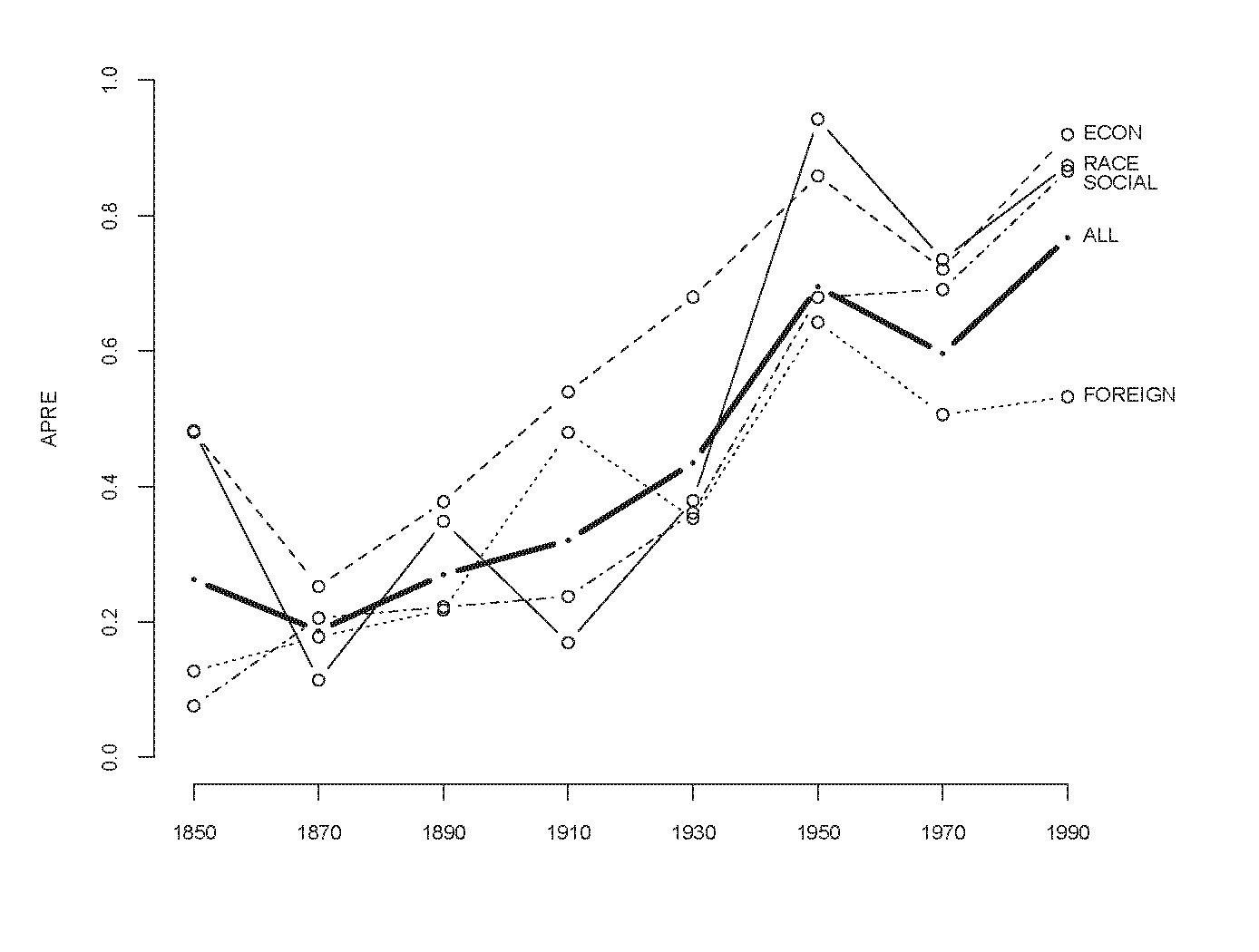
That’s the contention of Brendan Nyhan, who calls the bipartisanship of the mid-20th century “a historical anomaly.” Hans Noel compares our period of polarization to previous ones using the above chart:
The parties were definitely polarized 100 years ago, but not on the basis of such widely held ideologies. There were ideological conflicts, to be sure, but they were not organized around a liberal pole opposed to a conservative pole. Those poles emerged, largely coming into full force by about 1950. It is hard to compare ideological conflict in the era of ideological blogs, cable news and talk radio to an era of pamphleteering and partisan newspapers. But the analysis in Political Ideologies and Political Parties in America suggests that ideology was less one-dimensional in the 19th century. Over time, liberal and conservative ideology has been sharper on every issue area, including race but also economics, social issues and foreign policy. This figure shows how well a one-dimensional model fits the opinions of writers in major political journals over time. The ideological organization increases in all issue areas from 1850 to 1990.
Why does this shift from party to ideology matter?
Parties – even ones that are ideologically sorted – are collective enterprises. They’re organizations and coalitions. Leading a party involves brokering among interests and distinct groups. Articulating an ideology does not. To the extent that presidential rhetoric shapes public expectations about what leaders will be able to accomplish, laying out an ideological agenda makes compromise even more difficult to achieve. As Hans points out, “Speaker Boehner has to placate a Tea Party faction that mostly differs with mainstream Republicans over how much they should compromise with Democrats.” When the president tells the nation that the election was a contest between highly distinct governing visions, it’s even harder for members of Congress to defend compromise to their constituents.
When presidents cast themselves as the vessels of new political visions, they contribute to the idea that the right leader, with the right words and enough political will, can simply cut through the “mess in Washington” – i.e., the organized interests of the people of the United States, and the Constitutional checks and balances – in order to bring about wholesale change and costless problem-solving. (Nyhan has smartly labeled this the “green lantern theory of the presidency,” and president scholars like George Edwards and the late Richard Neustadt have long noted the gap between expectations and actual presidential capacity.)
Monday morning (Sunday night in the US), a man wielding a gun and a black flag similar to that used by ISIS walked into the Lindt Chocolat Café in the Australian city’s central business district and proceeded to hold the customers and staff hostage for 16 hours before police stormed the shop around 2 am Tuesday, ending the standoff. According to the Sydney Morning Herald’s ongoing live coverage, the gunman and at least one other person are dead, with several others injured.
The gunman, an Iranian immigrant and self-styled “cleric” by the name of Man Haron Monis, tried to portray himself as an agent of ISIS but came off as more of a delusional, attention-seeking psychopath (though to be fair, those often go hand in hand):
Monis, also known as Sheik Haron, was convicted of sending offensive letters to the families of Australian soldiers who died serving in Afghanistan. He is out on bail as an alleged accessory to the murder of his ex-wife, as well as a string of 40 indecent and sexual-assault charges in connection to his time as a self-proclaimed spiritual leader. Monis used a YouTube account to post a series of three videos of hostages reciting his demands, which included the delivery of the black flag of ISIS. He asked “to please broadcast on all media that this is an attack on Australia by the Islamic State,” and to speak to Prime Minister Tony Abbott. The demands would be met with the release of more hostages, according to the videos. YouTube has since removed the videos from the account.
Juan Cole wishes the press would stop playing into the hands of such criminals by hyping them as terrorists, implicitly tarring innocent Muslims in the process:
Sydney had another hostage crisis, in 1984, in a bank. A formerly wealthy (secular) Turkish-Australian became unhinged at losing his fortune. Today’s incident is not more important than that one, which few now remember. Both of these hostage-takers were common criminals. Neither is a “terrorist.” Today’s Sydney hostage-taker is not representative of a new activity. He isn’t important, and ordering a black flag won’t make him so. The only one who can bestow recognition on this criminal is the mass media and the press. They shouldn’t do it. … Criminals and gangsters should not be fetishized as “terrorists.” It is just a way for them to inflate their egos.
Peter Hartcher excoriates the Australian media for doing just that, by rushing “to cheerlead the hype and to provide a ready platform to any politician who wanted to insert himself into the event”:
Terrorism is a tool of the weak against the strong. It is designed to turn the enemy’s strength against itself. One man showed how to get extraordinary attention and inflict serious disruption using only a gun and a Muslim prayer banner. Successful terrorism is so rare in Australia that the overreaction is perhaps understandable. The police response seemed exactly right. But our political and media systems need to get better at measured reaction.
Abbott said on Monday evening that the incident had been “profoundly shocking”. He added: “I think I can also commend the people of Sydney for the calmness with which they have reacted”. With no help from the politicians.
By comparison, this response from Sydney residents was spot-on:
Australians offer to go with Muslim Australians in public places if they fear racist backlash #illridewithyou So much better than bigotry
A young Sydney woman, Rachael Jacobs, appears to have inspired the campaign after posting a moving Facebook status about her encounter with a Muslim woman earlier in the day. “…and the (presumably) Muslim woman sitting next to me on the train silently removes her hijab,” Ms Jacobs wrote. “I ran after her at the train station. I said ‘put it back on. I’ll walk with u’. She started to cry and hugged me for about a minute – then walked off alone.” The inspiring status quickly circulated on social media before inspiring the #illridewithyou hashtag.
Uber, meanwhile, came under fire yet again for turning on surge pricing during the crisis, charging users in downtown Sydney a minimum of $100 for a ride (they later backtracked, offering refunds to customers who had paid the extortionate rates and making all rides in the area free). That sounds pretty despicable, but Danny Vinik offers a qualified defense of the rideshare company:
I’m one of the few people here who doesn’t think Uber is actually doing anything wrong. A terrorist attack will understandably cause many people to try to get home at the same time and make many drivers fearful to go on the road. Raising rates will deter some people from using the service while incentivizing more drivers to get on the road. That’s simple supply and demand. Uber almost certainly earns higher profits as well.
Critics are right that this isn’t a fair system—the rich will be able to get home easily in the case of a terrorist attack and the poor won’t. But you also have to look at the alternative. If rates stayed the same, fewer drivers would go on the road and wait times would increase. It would be harder for everyone to get home. People will differ on which they value more: economic efficiency or fairness. But there is an economic rationale behind Uber’s moves.
Update from a reader:
That’s some unqualified horseshit; Uber isn’t up front about it’s price-gouging. Unsurprisingly, it’s pretty hard to get an accurate estimate of just how much you’re getting screwed by them until after the fact. Passengers generally don’t realize they’ve had their pockets picked until well after they’ve arrived at their destination or checked their credit-card statements. The driver doesn’t tell you beforehand that you’ll be charged 3x, 4x, or 50x the standard rate. Most people treat hailing an Uber as one would hail a cab. Except, unlike with a normal cab, there’s a hidden danger of spending triple-digits on a short ride and not even knowing it, since no physical currency is handed over.
Another counters that reader:
That’s simply not true. Uber tells you when surge pricing is in effect. If you don’t believe me, here’s a photo of the type of message Uber provides its customers when surge pricing is in effect.
Another backs him up:
On two counts your “reader” is grossly misinformed. I suspect willfully so – for people of a certain politics its pretty fun to hate on Uber. But Uber actually does notify users when price surging is in effect. The app uses a surge confirmation screen. The user has to physically type in the surge pricing in effect. (This policy is on Uber’s page.) Pretty hard for people to claim afterwards “they didn’t know”.
And Uber also makes it easy to get an estimate of the fare you’re getting. You see when you get ready to order a car, there is a screen with a button called “Fare Estimate.” And yes, this is also clearly stated on Uber’s page.) After using Uber for several years, I’ve never had a fare be unreasonably outside the fare estimate. It’s probably about as reliable as a yellow cab driver estimating what my fare will be.
I’d give your reader a pass on surge pricing if he’s never used Uber in a New York snowstorm. But when he/she claims Uber doesnt make it easy to get a fare estimate? I’m thinking they’ve never used Uber in their life.
Brad Plumer unpacks the UN climate deal stuck in Lima, Peru:
Over the next six months, each nation will be required to submit a plan for how it will address future emissions. These plans will form the basis of a major new climate agreement to be negotiated in Paris at the end of 2015 and take effect by 2020.
The actual content of each country’s plan, however, is entirely voluntary. In principle, countries are supposed to pledge to do more on climate than they’ve already been doing. But there are no rules about how emissions actually get restrained or what the timetable should be.
Rebecca Leber looks at how the agreement was watered-down:
To ensure more than 190 countries were on-board, particularly the developing world, negotiators weakened much of the requirements for individual countries in the final 30 hours.
Lima set out to establish a minimum guidelines for what information countries must disclose about cutting carbon pollution. The seemingly small detail is important because it lets countries compare apples to apples, and potentially push for more cuts. Except now the review process won’t be as vigorous as it could be, thanks to a single word change. Now, most of the information for these plans will be voluntary, rather than mandatory, because the text says countries “may” include detailed information, rather than “shall.”
In the end, some of the toughest decisions were simply postponed until Paris.
Eric Holthaus declares that the “U.N. process isn’t where the action is on climate anymore”:
Progressive cities, transformative industries, and mass protests have the best chance of providing the tipping point that’s needed. These talks are a distraction from the kind of urgent, on-the-ground work that needs to happen in order to steer the world’s economy toward a carbon-free path and prepare for the impacts of increasingly extreme weather.
While new numerical commitments may work for smaller, more cohesive groupings of countries, such as the European Union, the global approach has since shifted to a different strategy, which is based on the realization that the main push for climate-friendly policies must come from within countries. The purpose of international agreements and institutions is to help those domestic groups that favor emission curbs, not to set central standards that the international community can’t enforce. This fits the insights from politicalscientists that the effect of many treaties depends on domestic politics.
So how does the Lima agreement help domestic groups that favor carbon reductions? A first, and very important, feature is that it brings the issue on the agenda in every U.N. member state. Every country has agreed to develop a national action plan, although the language on what exactly needs to be in that plan was watered down during the negotiations. Still, anyone who has ever participated in or studied an activist movement knows that getting an issue on the agenda is a major hallmark.
The target of the United Nations-hosted climate process is to limit the rise in global temperatures to under 2 degrees Celsius above pre-industrial levels. But the architecture of the emerging plan rests on a series of nationally decided commitments that are unlikely to ensure the steep emissions cuts that experts say are needed to meet that target. Environmental watchdogs said the Lima deal would not achieve the stated aim. “The outcome here does little to break the world from a path to 3 degrees warming or higher,” Oxfam said in a statement.
Robert Stavins responds to such criticisms. He argues that “these well-intentioned advocates mistakenly focus on the short-term change in emissions among participating countries … when it is the long-term change in global emissions that matters”:
They ignore the geographic scope of participation, and do not recognize that — given the stock nature of the problem — what is most important is long-term action. Each agreement is no more than one step to be followed by others. And most important now for ultimate success later is a sound foundation, which is what the Lima decision can provide.
(Photo: Environmental well wishes are seen written on a wall on December 13, 2014 in Lima, as work continued on the final draft of a UN climate agreement. By Cris Bouroncle/AFP/Getty Images)
Once 9/11 happened, Dick Cheney ceased to believe that the CIA should be subject to the U.S. Constitution, statutes passed by Congress, international treaties, or moral prohibitions against torture. Those standards would be cast aside. In their place, moral relativism would reign. Any action undertaken by the United States would be subject to this test: Is it morally equivalent to what Al Qaeda did on 9/11? Is it as bad as murdering roughly 3,000 innocent people? If not, then no one should criticize it, let alone investigate, charge and prosecute the CIA. Did a prisoner freeze to death? Were others anally raped? Well, what if they were?
If it cannot be compared with 9/11, if it is not morally equivalent, then it should not be verboten.
That is the moral standard Cheney is unabashedly invoking on national television. He doesn’t want the United States to honor norms against torture. He doesn’t want us to abide by Ten Commandments, or to live up to the values in the Declaration of Independence, or to be restrained by the text of the Constitution. Instead, Cheney would have us take Al Qaeda as our moral and legal measuring stick. Did America torture dozens of innocents? So what. 9/11 was worse.
With the last installment of The Hobbit about to hit American theaters, The Telegraph pulled a long profile of J.R.R. Tolkien from their archives. The entire piece makes for fascinating reading, but his thoughts on turning the novels into films seem worth noting:
Tolkien receives innumerable offers for film rights, musical-comedy rights, TV rights, puppetry rights. A jigsaw-puzzle company has asked permission to produce a Ring puzzle, a soap-maker to soap-sculpt Ring characters. Tolkien worshippers are outraged by these crass approaches. “Please,” wrote a 17-year-old girl, “don’t let them make a movie out of your Ring. It would be like putting Disneyland into the Grand Canyon.”
The song cycle, the only commercial venture so far, began when Donald Swann, half of the “At the Drop of a Hat” team, set to music six of the poems which punctuate the Ring. One is in Elvish.
When we asked Tolkien how Elvish should be sung, he replied, “Like Gregorian chants.” Then, in a wavering churchly counter-tenor, he intoned the first lines of the farewell song of Galadriel, the Elf Queen:
Ai! laurië lantar lassi súrinen,
Yéni únótime ve radar aldaron!
He feels strongly that the Ring should not be filmed: “You can’t cramp narrative into dramatic form. It would be easier to film The Odyssey. Much less happens in it. Only a few storms.”
Jane Mayer fears that “torture is becoming just another partisan issue”:
This wasn’t always the case—it was Ronald Reagan who signed the U.N. Convention Against Torture, in 1988. But polls show both a growing acceptance of the practice and a widening divide along party lines. “It’s becoming a lot like the death penalty,” [political science professor Darius] Rejali said.
The 1975 Church Committee report, which was conducted following revelations of, among other things, covert operations to assassinate foreign leaders, was, until now, the best-known public airing of C.I.A. practices. According to Loch K. Johnson, a professor of political science at the University of Georgia, who was a special assistant to Senator Frank Church, its findings were broadly accepted across the political spectrum. “No one challenged it,” he said.
She argues “there was a way to address the matter that might have avoided much of the partisan trivialization”:
In a White House meeting in early 2009, Greg Craig, President Obama’s White House Counsel, recommended the formation of an independent commission. Nearly every adviser in the room endorsed the idea, including such national-security hawks as Secretary of State Hillary Clinton, Secretary of Homeland Security Janet Napolitano, and the President’s chief of staff, Rahm Emanuel. Leon Panetta, the C.I.A. director at the time, also supported it.
Obama, however, said that he didn’t want to seem to be taking punitive measures against his predecessor, apparently because he still hoped to reach bipartisan agreement on issues such as closing Guantánamo.
And look at how well that turned out. Allahpundit, looking at the above chart, ponders the partisan split:
Both sides are way more comfortable with sleep deprivation and hitting a prisoner than they are with sticking one in a de facto coffin for a week or rectally feeding hunger-strikers. You can tease out a certain logic to that. Practices that the average joe can relate to, like being slapped or deprived of sleep, are more acceptable; practices that are more baroque, like trapping a guy in a box for days on end, or that involve some sort of sexual humiliation, like forced nudity or threats of sexual violence, are out of the ordinary and more likely to be seen as sadistic. (Note how there’s more support in both parties for actual violence against a detainee than threatening to use physical or sexual violence against him. It’s the “sexual” part of the question that produces that result, I bet.)
The one outlier is waterboarding, another baroque practice but one that’s acceptable to many Republicans and a bit more acceptable to Democrats than the box is. Why is that? Maybe it’s because waterboarding’s become familiar over time after so much public debate about it. Maybe it’s because GOPers know it’s closely linked to Bush and Cheney and feel a partisan tug to defend it. Or maybe it’s that lots of righties remain unconvinced that being waterboarded is as terrible as it’s supposed to be, at least compared to being enclosed in a coffin-sized crate for days.
As things stand, Steve M. bets that the next Republican president will torture:
I don’t know if the gloves are going to come off again on the first day of the next GOP presidency, but if we have a Sidney siege with a Republican in the White House and any of the perpetrators are captured alive, it seems likely to me that the waterboarding equipment is coming out of mothballs.
Waldman wants the question raised during the next primary:
My guess is that if asked directly, the GOP presidential candidates would say, “That’s all in the past.” But at the very least, we ought to get them on record now making clear whether they would ever consider using torture again.
Rape on college campuses is undoubtedly a real and serious problem, but as Michael Brendan Dougherty reminds us, it pales in comparison to rape in prisons, where victims get no publicity, no sympathy, and no justice. Hell, we even joke about it, even in children’s cartoons (as seen above):
In prison, men may become the victim of repeated gang rapes. Prisoners can be locked into cells with the men who prey on them. Some live under the constant threat of sexual assault for decades. Their efforts to report their rape are ignored or even punished, both by prison personnel and an inmate culture that destroys “snitches.” The threat of rape is so pervasive it causes some inmates to “consent” to sex with certain prisoners or officers as a way of avoiding rape by others.
Acceptance of prison rape is a stinking corruption. No conception of justice can include plunging criminals into an anarchic world of sexual terror. And obviously it thwarts any possibility of a rehabilitative justice that aims to restore criminals to lawful society. Inmates are not improved or better integrated into society through physical and psychological torture. Prison rape also vitiates any sense of retributive justice, since rape is not a proper punishment for a crime. Allowing prison rape is just a vindictive horror, and when accepted under the name of punishment makes criminals the victims of justice.
Sadly, some Senators are looking to defang the Prison Rape Elimination Act:
PREA required states to certify by May of 2014 that they were in compliance with the standards, or promise that they would eventually comply. States that refuse to do either can be penalized with a loss of five percent of their federal funding for prison-related purposes. But a proposal that originated in the Senate Judiciary Committee would almost completely eliminate financial penalties for states that defy the rape prevention law. The proposal, written by Senator John Cornyn, Republican of Texas — the most vocally defiant state — was agreed on by the committee in an after-midnight session in September and was attached to an unrelated bill.
The bill carrying the PREA amendment failed to pass, but members of the National Prison Rape Elimination Commission, a federal body that spent years developing the PREA standards, say efforts are already underway to reintroduce the amendment during the next legislative session.
A reader’s story of prison rape posted here. Update from another:
Thanks for posting that piece on prison rape. I thought you might be interested in the following scene from Rectify, a TV drama about a death row prisoner who is exonerated after nearly two decades in jail. It features the main character, Daniel, talking to his stepbrother, Ted, about his experience of being raped in prison. This scene conveys a sense of visceral agony that reports and columns cannot and it helped me realize the extent to which prison rape is a silent crisis:
For a riveting memoir on the subject, check out Fish by T.J. Parsell, who was gang-raped upon entering prison at the age of 17.
Congress’s spending bill interferes with the legalization of pot in DC. But Josh Voorhees focuses on another provision in the bill, which “stops the Justice Department from spending a dime to prosecute patients or medical marijuana dispensaries that are acting in accordance with state law but running afoul of federal ones”:
In shear terms of people impacted, the medical provision will dwarf that of the more publicized D.C. ban, even assuming the latter survives a potential legal challenge. The District is home to roughly 640,000 people; California, one of 23 states where medical pot is legal, is home to more than 38 million. Forcing the federal government to respect state medical marijuana laws has long been a goal of the legalization movement, but one that had previously proved unattainable.
He finds it telling that “a sweeping provision that could fundamentally reshape how the federal government treats medical marijuana slipped through with hardly a peep”:
That just goes to show how far the battle lines have shifted in the favor of the pro-pot crowd and suggests that, in spite of the potential setback in the District itself, the future for their side in Washington is a brighter one.
Having Congress not longer actively opposing medical marijuana is a big victory for the reform movement, but not a complete solution. The provision is only a short-term and incomplete fix. Medical marijuana is still technically illegal under federal law which will continue to causes issues with things like taxes for medical marijuana business. The provision also only applies to this one year funding bill.
What will this mean on the ground? It should mean that DEA and other branches of the Dept. of Justice can no longer threaten medical marijuana providers (or more theoretically, patients) with arrest or prosecution, and that landlords should no longer face the threat of asset forfeiture for property being rented to medical marijuana businesses. But the precise language, which focuses on states’ implementating medical marijuana systems, could be argued as applying more narrowly, giving reassurance to state officials about their participation but not going further. Another concern is that a prosecutor could argue, for example, that a given marijuana business is not operating in strict accordance with a state’s law. Our perspective in the movement is that that determination should be up to state authorities, not federal, but that’s not necessarily the perspective of federal law enforcement. Those are some reasons why it remains to be seen just how thoroughly and reliably the protections that the new law provides will turn out to be, and these questions are being debated right now.
Meanwhile, Walker urges Obama to intervene on DC’s behalf:
If the Obama administration uses their power to move marijuana to Schedule II or III, this legal impediment on D.C. taxing and regulating marijuana would theoretically be removed. Potentially, there might still be a legal fight over whether raw marijuana would count as a tetrahydrocannabinols derivative, but one can argue that legal term is meant to apply only to newly-discovered and potentially dangerous synthetic tetrahydrocannabinols derivatives, which are often being sold as “incense.” Once again, if both the D.C. Council and the Obama administration share support for this interruption of the law, any legal challenge is unlikely to succeed.]
And Dylan Matthews, who voted for legalization in DC, wants his vote counted:
It’s easy to dismiss the importance of ensuring marijuana legalization in DC. Pot policy tends to be treated as a laughing matter, and DC is admittedly the third smallest state/quasi-state by population. But it’s still, substantively, among the most important riders in the CRomnibus. DC had a higher marijuana possession arrest rate in 2010than any other state (perhaps understandably, as it’s the only city-state): 846 arrests per 100,000 residents, which works out to about 5,091 arrests total.
That’s over 5,000 people a year paying fines, doing community service, and going through probation; it’s over 5,000 people who’ll forever have to check the box on job applications asking if they’ve ever been arrested, among many other consequences for employment, government benefits, child custody, and more. DC also has the second biggest gap between black and white arrests of any state: 1,489 arrests per 100,000 black residents versus 174 per 100,000 white residents. Black Washingtonians are over eight times likelier to be arrested for the same crime, when there’s no evidence of any racial gaps in actual marijuana usage.
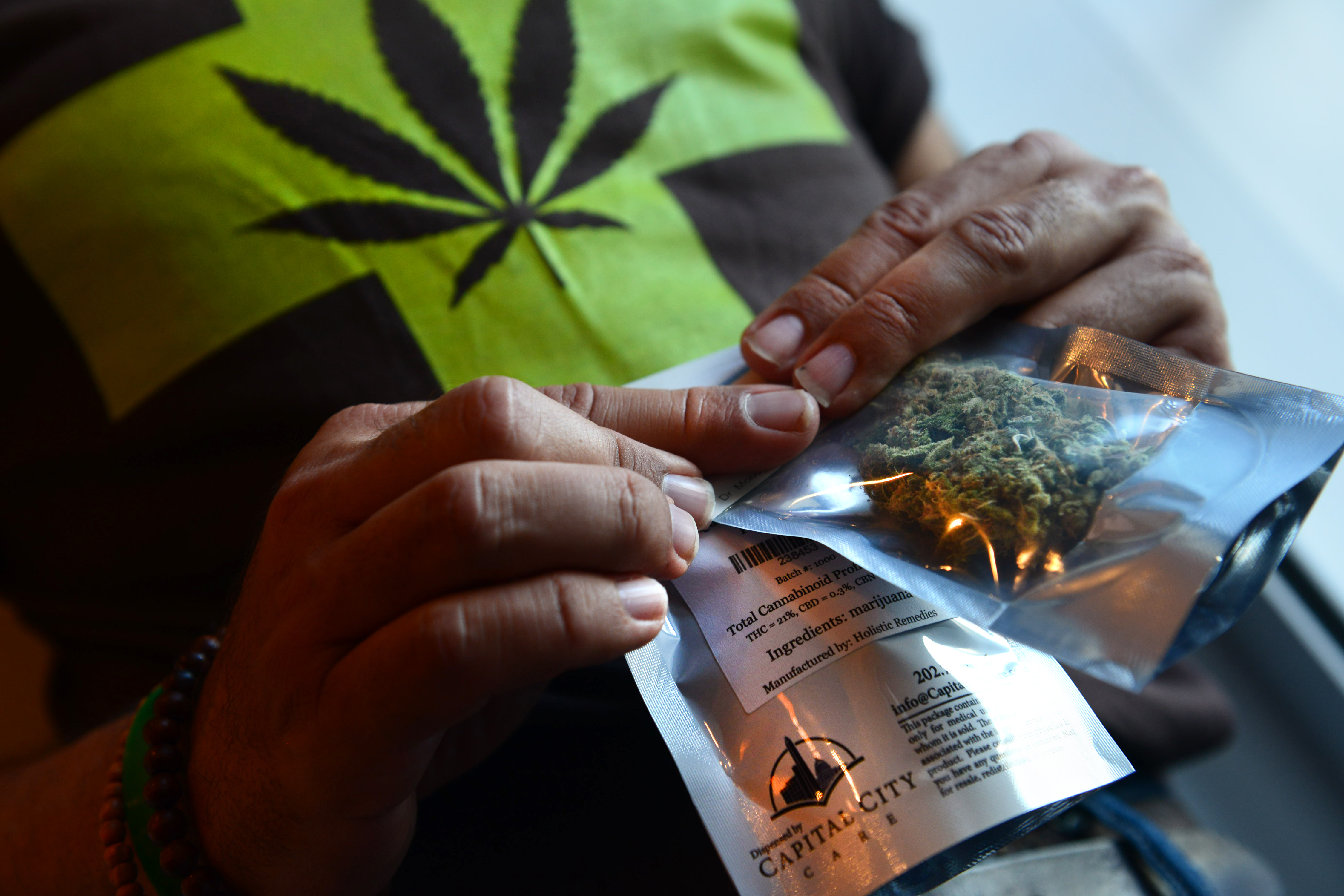
(Photo: A man purchases medical marijuana, the first legal sale, at Capital City Care in Washington, DC on July 29, 2013. By Linda Davidson / The Washington Post via Getty Images)
That’s what Abraham Riesman concludes in his post-mortem for the magazine:
In their defense, they had no idea they were doing it. But in recent years, the nature of cat adoration (and I must offer full disclosure here: I am the parent of two cats) has changed radically. Though Cat Fancy tried to adapt, it never totally broke free from its origins in a different era of cat enthusiasm. To understand the seismic shift in cat culture, you can start by picking apart Cat Fancy‘s name. It used to be much more than a whimsical reference to the enjoyment of felines. When the magazine launched in 1965, animal lovers were very familiar with something called “the cat fancy.” The term referred to a connoisseurlike approach to cats: following professional cat shows, maintaining directories of cat breeders, and recognizing the importance of purebred bloodlines. “Back then, the people who had all the knowledge tended to be the people who were showing cats, breeding cats, everything like that,” said Melissa Kauffman, senior editorial director for I-5. …
[R]eaders of Cat Fancy in its early decades would likely be aghast at the shape of today’s cat passions. Modern feline icons like Grumpy Cat and Lil Bub are mutts with genetic deformities. They wouldn’t have made it past the front door at a Golden Age cat show. And their many public appearances are filled with fans who would disdain anyone who gets a cat from a breeder rather than a shelter.
Here’s what Cat Fancy‘s replacement, Catster, looks like:
But beyond the covers, what will Catster the magazine be? Much of that won’t be clear until the first issue hits stands in February, but all evidence indicates that it will be extremely photo-oriented, very lighthearted, filled with lists and confessionals, and committed to treating cat ownership as a lifestyle rather than a hobby or a medical burden.
“Catster is for the cat-selfie generation,” Huey-Steiner said. “It’s for people who consider cats an integral part of their social lives. It’s about fun things and knowing that cats rule the roost.” That means lists like “19 Crazy Cat Superstitions” and “Litter-Box Accidents Waiting to Happen,” as well as pieces like “How to Cat-ify Your Cubicle.” There will still be some breed information and veterinary advice, but neither will be a major focus. And then there’s the celebrity aspect. “We want to capitalize on the role that cats play in the lives of celebrities, whether that’s somebody like a Taylor Swift and how she talks about her cats or someone else,” Huey-Steiner said. “You’d never see that in Cat Fancy.”


 radically. Though Cat Fancy tried to adapt, it never totally broke free from its origins in a different era of cat enthusiasm. To understand the seismic shift in cat culture, you can start by picking apart Cat Fancy‘s name. It used to be much more than a whimsical reference to the enjoyment of felines. When the magazine launched in 1965, animal lovers were very familiar with something called “the cat fancy.” The term referred to a connoisseurlike approach to cats: following professional cat shows, maintaining directories of cat breeders, and recognizing the importance of purebred bloodlines. “Back then, the people who had all the knowledge tended to be the people who were showing cats, breeding cats, everything like that,” said Melissa Kauffman, senior editorial director for I-5. …
 The Dish