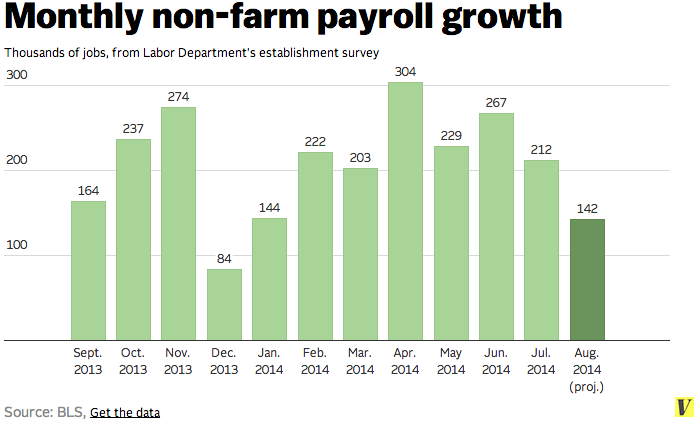
The Jobs Report Could Have Been Better

by Dish Staff

Monthly Payroll

Annie Lowrey grades today’s report:

Today, the Labor Department said that the economy added 142,000 jobs last month and the unemployment rate fell a tick to 6.1 percent. It’s a fine report, not great, not good, not bad. There’s little evidence of the acceleration in the recovery that economists keep holding their breath for. But there’s nothing to worry about either, especially given that these are provisional numbers that will get revised.

In short, the recovery is a B-minus.

Neil Irwin’s synopsis:

This report is like a sitcom showed on the in-flight screen on a flight to Chicago: It is certainly not good, but it is far from offensive. It just is.

Jared Bernstein thinks the report is “enough to remind us we’re not at all out of the woods yet”:

August’s lousy report notwithstanding, we are solidly in the midst of a moderate jobs recovery. Payrolls are reliably growing at a pace slightly north of 200K per month. That’s neither a breakneck nor a dismal rate of job growth, but it does mean that given the existing extent of remaining slack in the job market, full employment is still years, not months, away.

Vinik reminds everyone that this is “only one report and those numbers will be revised twice more”:

A better way to look at job growth is through the three-month moving average. When you look at it that way, you can see that the economy still has taken a slight step forward in the past few months, but Friday’s report is clearly disappointing.

moving_average

Jim O’Sullivan’s analysis:

[T]here has been a tendency for the August data to be underreported initially and then revised up later.  There is certainly no sign of the trend weakening in the latest jobless claims data — or growth indicators in general recently.  Even with the weaker August reading, payrolls gains have averaged 215,000 per month so far this year, up from 194,000 last year.  Gains in the household survey employment measure have averaged 223,000.  That pace is more than strong enough to keep the unemployment rate coming down.  In turn, we expect hourly earnings to start accelerating soon as unemployment continues to decline. That said, the earnings data have remained fairly stable so far.

James Pethokoukis points out that “wages are still a problem, with average hourly earnings up just 2.1% the past year”:

Not that the number should be so surprising. The anemic economy is generating jobs at the top and bottom, not so much in the middle. “Average is over” as economist Tyler Cowen has put it  And data yesterday from the Federal Reserve show that while income rose by 10% for the most affluent 10% of American families in 2010 through 2013, incomes were flat or falling for everybody else.

Drum takes a closer look at the unemployment rate:

The headline unemployment rate ticked down to 6.1 percent, but that’s mostly because of rounding. The real decline was about one-twentieth of a point, from 6.19 percent to 6.14 percent.

What’s worse, even that tiny drop was illusory: the number of employed people in August was virtually the same as in July. The drop in the unemployment rate was due entirely to the fact that 268,000 people dropped out of the labor force. The labor force participation rated dropped from 62.9 percent to 62.8 percent, and that’s what caused the “drop” in unemployment.

Ezra wants Congress to do more:

[T]he job report’s divergence from expectations is pretty marginal — especially considering how unreliable these initial data releases are. What’s more notable is how similar it is to recent jobs reports. The labor market is recovering steadily, but there’s no sign yet of the extended period of 300,000 or 400,000-a-month job growth that would rapidly close the gap between where we are and where we would have been absent the Great Recession.

“The jobs report,” however, is not like the weather. It is not a force of nature, or an impersonal whim of the universe. Congress has taken to waiting anxiously for the monthly jobs numbers and then passively applauding or lamenting them, as if they’re a summer rainstorm. But, in fact, there’s much Congress could do to change them.

A Ruling Worth Reading

by Dish Staff

Yesterday, Judge Richard Posner stuck down the marriage equality bans in Wisconsin and Indiana. His ruling is getting rave reviews from the pro-equality crowd. Dale Carpenter finds “some gems in the opinion that make it good reading for lawyers and non-lawyers alike”:

In short, the opinion is a tour-de-force Posner special. It avoids constitutional-law jargon in favor of substance, omits unnecessary string citations (indeed, whole pages are free of anycitations), and eschews footnotes altogether.  It doesn’t hurt the cause of same-sex marriage that, after Learned Hand, Posner is the most influential and prolific federal judge never to serve on the Supreme Court. He’s not always right, but he’s always formidable.

Tisinai loves this part of the opinion:

Heterosexuals get drunk and pregnant, producing unwanted children; their reward is to be allowed to marry. Homosexual couples do not produce unwanted children; their reward is to be denied the right to marry. Go figure.

Dan Savage, who calls the ruling “amazing”, highlights this meatier section of Posner’s:

The harm to homosexuals (and, as we’ll emphasize, to their adopted children) of being denied the right to marry is considerable. Marriage confers respectability on a sexual relationship; to exclude a couple from marriage is thus to deny it a coveted status. Because homosexuality is not a voluntary condition and homosexuals are among the most stigmatized, misunderstood, and discriminated-against minorities in the history of the world, the disparagement of their sexual orientation, implicit in the denial of marriage rights to same-sex couples, is a source of continuing pain to the homosexual community. Not that allowing same-sex marriage will change in the short run the negative views that many Americans hold of same-sex marriage. But it will enhance the status of these marriages in the eyes of other Americans, and in the long run it may convert some of the opponents of such marriage by demonstrating that homosexual married couples are in essential respects, notably in the care of their adopted children, like other married couples.

Garrett Epps wonders how Justice Kennedy will react to Posner’s arguments:

Posner’s major appeal is to an issue dear to Kennedy’s heart: the welfare and dignity not of gays and lesbians but of their children. “Formally these cases are about discrimination against the small homosexual minority in the United States,” Posner writes. “But at a deeper level, as we shall see, they are about the welfare of American children.” Allowing same-sex marriage will allow the adopted children of gay couples equal status with their schoolmates; it will increase their material welfare by allowing benefits and tax deductions; it will increase the number of loving families available to adopt unwanted children; and it will reduce abortion: “The more willing adopters there are, not only the fewer children there will be in foster care or being raised by single mothers but also the fewer abortions there will be.”

It is a roaring steam engine of an opinion, at times exhilarating and at other times puzzling. Is it likely to change minds? No. Its flip dismissal of the political process argument makes it less persuasive than it could have been; Feldman did have a point, even if Posner (and I) think the counterargument is much stronger.

But Ari Ezra Waldman thought the ruling was fitting:

When we started on this journey, states were arguing that gay marriage would do manifest, irreparable damage to the institution of marriage. No one was ever sure what that meant, but even that argument has been sidelined to the trash. By now, the arguments make literally no sense.

Judge Posner, a lion of the appellate judiciary, has had enough. His playful opinion is his way of expressing frustration at the continued life of these anti-equality bromides.

Reflecting on the slew of recent marriage equality decisions, Marc Solomon hopes SCOTUS to rule in favor of equality, and soon:

Just last week, Arizonan Fred McQuire lost his life partner of 45 years—and husband of less than one—to pancreatic cancer.  But because Arizona continues to discriminate, he wasn’t allowed even to submit the paperwork for his deceased husband’s VA burial benefits, nor would the state issue him a death certificate for his husband, let alone let him be identified on it as the spouse. Instead, the state insists on listing each of them as “never married.”  As a result, McQuire—even as he grieves his profound loss—was forced to file a lawsuit to fight for what the Constitution says he deserves, the dignity and legal respect of marriage.

Every day that goes by while discrimination persists means children throughout the country whose families are denied protections and treated as second-class, and parents and grandparents who don’t live to see the chance to dance at their child’s wedding.

Joan Rivers, RIP, Ctd

by Dish Staff

The tributes to the comedienne continue. Josh Israel illustrates how she was a gay icon:

In one of her earliest roles, Rivers appeared opposite Barbra Streisand in a play in Greenwich Village in the 1960s. The two played a same-sex couple and kissed. “This was before she was singing, before anything. I knew she was talented, but you never know what someone will be. She was a fabulous kisser, that’s what I knew,” Rivers recalled in 2010. She talked a great deal about gay culture on her TV shows. When the 1990 documentary Paris Is Burning came out, Rivers had the cast and director on The Joan Rivers Show.

Rivers was an enthusiastic backer of marriage equality. In 2012, prior to President Obama’s historic announcement she criticized him and other politicians for cowardice on the issue. “It is outrageous. The politicians are all such ass-kissers. No one is saying the truth. They are saying what they think people want to hear,” she observed.

Megan Garber pens a broader appreciation:

Hollywood generally relegates the celebrities whose relevance expires before their lives do to predictable fates: Lifetime Achievement Awards, calcium supplement ads, respectable anonymity. Rivers would have none of this.

She knew she would never be Norma Jeane; that didn’t mean, she insisted, that she must become Norma Desmond. She kept working. And, in the process, she became more biting. She became more outrageous. She became, you could argue, more entertaining. She did her stand-up. She did the red carpet. She did Fashion Police. She had an Internet chat show called In Bed With Joan. She competed on The Celebrity Apprentice. She won.

And then, not being content with all this vaguely self-mocking ubiquity—she titled one of her books I Hate Everyone … Starting With Me— she took her B-list status and went meta with it: She starred, four years ago, in a documentary about her life, and about having a career in one’s late 70s. It was titled Piece of Work. Which was appropriate in part because of her acerbic humor (discussing the group Florence and the Machine, she remarked, “I hope the machine is a vibrator”). But it was also appropriate because of the work—in, almost, the thermodynamic sense of the word—that went into both her appearances and her appearance. She kept getting work done. And she also, you know, kept getting work done.

Hanna Rosin brings a personal perspective:

This July my mother came to Washington, D.C., to see me interview Rivers about her new book, Diary of a Mad Diva. Rivers walked into the greenroom with an entourage, a jewel-encrusted leather jacket, her bizarro mask of a face denuded of all its ethnicity. But she did not stink like a diva. She dispensed dating advice to the two stylists on hand to touch up her hair (no sex on the first date), and instantly bonded with my mother about Gaza. (The Palestinians started it. Hamas was re-elected “by a lot of stupid people who don’t even own a pencil”). Given how Rivers talked, it would be absurd to say she was nice. She was, however, tribal. If she judged you to be on her team, she could relax, act like she’d known you forever. In this case, my mother and I were in, largely because we were New Yorkers, Jews, and in my mother’s case at least, on the right side of the war.

Yael Kohen reflects on Rivers’ inspiration:

[One of the events that helped bring it all together for Rivers] was watching a performance of Lenny Bruce. “I had seen Lenny Bruce very early on when I was on a date,” Joan told me in an interview for my book. “He just was talking about the truth: He wasn’t doing mother-in-law jokes because he didn’t have a mother-in-law. He was talking from his life experiences. I thought to myself, my god, he’s doing what I’m doing. I was talking about things that were really true. I was talking about having an affair with a married professor and that wasn’t a thing a nice Jewish girl talked about. And I was talking about my mother, desperate to get my sister and me married. I was talking about my gay friend Mr. Phyllis, and you just didn’t talk about that. It sounds so tame and silly now but my act spoke to women who weren’t able to talk about things. How nice it was to have a girl that’s fairly attractive stand up and say, my mother wants me to get married but I don’t want to.”

Today, this material may sound cliché. But we forget that in the 1950s, airing your dirty laundry in public was the ultimate taboo.

Rivers herself gets the last word:

During women’s lib, which was at its height in the ’70s, you had to say: “F— the men. I could do better.” I think women did themselves a disservice because they wouldn’t talk about reality. Nobody wanted to say, “I had a lousy date” or “He left me.” But if that’s your life, that’s what they wanna hear. If you look around, very few women comics came out of the ’70s. It really started again in the ’90s, when they realized, it’s all right to say you wanna get married. It’s all right to say I wanna be pretty. That’s also part of your life. Thank God. Because now you know, we’ve got Whitney. I love Whitney. I think what she does is so smart. Sarah Silverman, oh my God. You just look at them and go: Good girls.

… The one thing I brought to this business is speaking the absolute truth. Say only what you really feel about the subject. And that’s too bad if they don’t like it. That’s what comedy is.

Is ISIS A Threat To Us? Ctd

by Dish Staff

Not at the moment, according to someone who ought to know:

The United States’ senior counterterrorism official said on Wednesday that there is “no credible information” that the militants of the Islamic State, who have reigned terror on Iraq and Syria, are planning to attack the U.S. homeland. Although the group could pose a threat to the United States if left unchecked, any plot it tried launching today would be “limited in scope” and “nothing like a 9/11-scale attack.” That assessment by National Counterterrorism Center Director Matthew Olsen stands in sharp contrast to dire warnings from other top Obama administration officials, who depict the group formerly known as ISIS or ISIL as the greatest threat to America since al Qaeda before it struck U.S. soil on Sept. 11, 2001.

Zack Beauchamp downplays the threat posed by American jihadists who travel to Syria and Iraq, noting that few of them come home to plot attacks, and they are pretty easy to catch when they do:

“We’re going to know who these guys are, and we’re going to watch them closely as they transit home,” Will McCants, director of the Project on US Relations with the Islamic World at the Brookings Institution, told me. McCants admits that’s it’s hard to catch ISIS volunteers on their way to Syria or Iraq. However, it’s much, much easier to identify them on their way home.

“Once they’ve gone in,” McCants says, “US intelligence is going to find them.” Partly that’s because the US and other Western countries are obsessive about monitoring their borders and are keenly aware of this threat, but it’s also because jihadis love to talk on social media. “I’ve been told by people in US intel that publicly posted statements in Twitter are an absolute gold mine,” he says.

The Atlantic Ocean is the US’ friend here. Airports have the most “robust systems” for detecting returning fighters, according to McCants. It’s very hard to get back to the United States from Iraq or Syria without flying, and ISIS veterans who check in an airport will likely get detected pretty quickly. Once that happens, their numbers are small enough that US intelligence and law enforcement will be able to keep a very close eye on them.

John Cassidy, meanwhile, looks into where Western jihadists come from and what motivates them:

Shiraz Maher, a senior fellow at the I.C.S.R., divides the Western recruits into three types: adventure-seekers, idealists, and devoted jihadis. In each case, there is a common factor—the intoxicating appeal of radical Islam, with its promise of empowerment through a new beginning (and, in the case of ISIS, the establishment of a new state). As Maher pointed out last weekend in the Wall Street Journal, ISIS, through its strong social-media presence and, especially, its military success, has exerted a special attraction. “Other organizations didn’t have the same glamour,” Maher said. “And we’re dealing with young men. They want to be with a strong horse, with a winning team. At the moment, ISIS has momentum.”

Reversing ISIS’s gains could conceivably change all of this. And Maher, for one, doesn’t believe the situation to be hopeless. Until 2005, and the London subway bombings, he was himself a member of a radical Islamic group, Hizbut Tahrir, which operates inside of Britain and supports the formation of a global and puritanical Islamic state. Since the bombings, he and other moderate British Muslims have been campaigning against the jihadis, and the would-be jihadis, with some success. At one time, Maher told the Journal, Hizbut Tahrir rallies could draw twenty thousand supporters, but these days “they struggle to get one thousand.”

Offline Adventures

by Dish Staff

https://twitter.com/JessGrose/status/505162305395781632

David Roberts reflects on choice to spend a year away from blogs and social media:

By the end of 2012 I was, God help me, a kind of boutique brand, with a reasonably well-known blog, a few cable-TV appearances under my belt, and more than 36,000 Twitter followers. I tweeted to them around 30 times a day, sometimes less but, believe it or not, gentle reader, sometimes much more. I belong to that exclusive Twitter club, not users who have been “verified” (curse their privileged names) but users who have hit the daily tweet limit, the social-media equivalent of getting cut off by the bartender. The few, the proud, the badly in need of help.

It wasn’t just my job, though.

My hobbies, my entertainment, my social life, my idle time—they had all moved online. I sought out a screen the moment I woke up. 
I ate lunch at my desk. Around 6 p.m., I took a few hours for dinner, putting the kids to bed, and watching a little TV with the wife. Then, around 10 p.m., it was back to the Internet until 2 or 3 a.m. I was peering at one screen or another for something like 12 hours a day.

And a break from social media proved relaxing:

By January, my days had settled into a rhythm. When I wasn’t walking or at yoga, I was doing yard work, reading novels, visiting with friends, fumbling away at a bass guitar, or enjoying time with the kids. Since I wasn’t working, they were no longer in after-school care, and in those hazy, unstructured afternoon hours before dinner we’d play catch or lie around the living room trading comic books. I spent hours at a time absorbed in a single activity. My mind felt quieter, less jumpy.

The balance his is going to try to strike going forward:

When I’m writing, I want to write with full focus. When I’m pinging, I want to ping without angst or guilt. When I’m with my family, I want to be with my family, not half in my phone. It is the challenge of our age, in work and in life: to do one thing at a time, what one has consciously chosen to do and only that, and to do it with care and attention.

I hope I’m up to it. That any of us are.

During his guest-blogging stint, Freddie deBoer mulled Roberts’ internet break and those of other writers.

Line By Line

by Dish Staff

Fishing

Nick Ripatrazone explores the connection between writing and fishing, reflecting that he “only got serious about fishing when I got serious about writing, as an undergraduate in central Pennsylvania”:

Water, sunlight, shadow, hunt, patience, search, silence: the elements of fishing are perfect fodder for writing, but they can also lead to sentimental lines and sentences. For every hour I spent in the soft current of Penn’s Creek, comfortable and warm in my waders, there were days when catfish snapped my lines. Fishing and writing hindsight are much the same. As Stephen L. Tanner says, “some of the best trout fishing is done in print rather than in streams.” Writing and fishing are both art forms built for optimists.

When Jim Harrison arrives at a fishing destination, “a number of centuries drift away. There’s no conscious sense of the atavistic, only that everything you’ve learned in school, university, your business life is of no use to you now.” I feel that sentiment when I run at an old moss farm near my home. The land is state-owned. Unkempt paths curl into the woods. One trail leads into a lake. There is no end; it simply goes into the water. I usually turn around. There is always so much to do. But some days I want to run straight into that silent lake and stand waist-deep. Fishing is not merely recreation; it is a source of creation. It is an art. I will always be haunted by waters.

(Photo by Jeff Attaway)

Will The South Ever Warm Up To Obamacare?

by Dish Staff

Beutler contends that fighting Obamacare has “become a war on minorities and the poor”:

[T]he GOP-controlled states that have expanded Medicaid, or are considering Medicaid expansion, are pretty white relative to GOP-controlled states where expansion is out of the question. Deep Southern states, where poverty is most concentrated and black population rates approach 30 percent, aren’t calling up the Department of Health and Human Services in Washington to negotiate a conservative Medicaid expansion compromise. To the contrary, that’s probably where resistance to the expansion runs strongest.

But Stuart M. Butler hasn’t given up hope:

[L]et’s remember that, in 2017, Section 1332 of the ACA takes effect. This provision permits states to apply for sweeping waivers from the ACA, including exemptions from the individual mandate, the employer mandate, many constraints of the essential benefits, and even the requirement to have an exchange, provided that the state can achieve the broad coverage goals of the law. Little wonder that former Ted Kennedy senior adviser John McDonough describes the provision as “state innovation on steroids” and as “a significant and unpredictable game changer” for future reform.

True, some sponsors of the 1332 saw it as a way to sneak in a single payer system down the road in Vermont and possibly other states. But the same provision could allow more conservative southern states to craft very different health systems in the future under the loose framework of the ACA.


Inside The Minds Of Writers

by Dish Staff

Jennifer Hodgson relays research into how writers experience the voices of their characters:

Writers describing the formative years of a career have spoken of character formation as a case of “throwing” their voice, frequently tasking characters with voicing what they, the author, do not feel able to express. At this time, the inner voice tends to be experienced as integral, direct and personal; authors’ engagement with the inner voice through writing may be inflected by a sense of distress or turmoil, and motivated by the need to negotiate their position in the world.

Over time, however, interviewees report that they have noticed transformations in the dialogism, empathic and imaginative qualities, and polyphony of the inner voice. These changes may be informed by many different registers of experience – both conscious and subconscious – as the inner voice begins to contain echoes of other voices harvested from life and literature.

The survey has also found that “many writers are unable to ‘see’ the faces of their protagonists,” with the “main character often [registering] as a blank.” Meanwhile, Tammy Ruggles, who is legally blind, shares what it’s like to write without sight in a more literal sense:

You might think that being a freelance writer would be impossibly difficult for a blind (or legally blind) person, but that’s a misconception. Before the computer age, the visually impaired could dictate their words to be set down in print or use a stylus to write in braille and have it transcribed, but today’s accessible technology makes writing so easy that you may not realize I used a screen reader, speech recognition software and a magnification program to write this. If you aren’t familiar with accessible technology, let me describe a few applications: My Windows 7 came with Speech Recognition, which types what you say. I also downloaded a screen reader called Non-Visual Desktop Access, which reads out loud the items on my screen, from a text document like this article to posts from my Facebook friends. Additionally, I have a magnification program that enlarges items on my 47-inch computer monitor. …

[Y]ou may now be wondering if blind writers would be able to carry on without all of this technology. I can’t speak for every visually impaired scribe, but I know that I would find a way, somehow, to keep writing, whether that meant learning braille or dictating the old-fashioned way. It’s hard to keep a creative spirit down.

Reproductive Rights, Texas Style

by Dish Staff

Emily Bazelon analyzes a recent abortion ruling in Texas:

Judge Lee Yeakel struck down the state’s “brutally effective system of abortion regulation,” as he put it, saying it was not likely to improve women’s health, would impact poor women the most, and “would operate for a significant number of women in Texas just as drastically as a complete ban on abortion.” The judge was clear and convincing on these essential points. But his ruling, as well as another one over the weekend that’s keeping clinics open in Louisiana, may well be in danger on appeal.

The case centers on a 2013 Texas law that “required all clinics to be outfitted as ambulatory surgical centers,” one example of the “far-reaching regulations that are enacted in the name of protecting women’s health and result in shutting down clinics”:

[T]he underlying legal question—how far a state can go to restrict access without crossing the constitutional line into saddling women with an “undue burden,” in the Supreme Court’s magical mystery words—remains unresolved. Yeakel took a crack by finding that in combination, the constellation of provisions in the 2013 Texas law creates “unreasonable obstacles” that have “reached a tipping point.”

Ramesh Ponnuru accuses Bazelon of ignoring constitutionality:

At no point in the article’s discussion of the Texas law does the article mention the Constitution it supposedly violates. … To come up with a clear rule distinguishing permissible from impermissible abortion regulations, the Court would have to be willing to limit its own discretion, and to sustain the pretense that this rule has something to do with the Constitution. So far it has balked.

Elizabeth Nolan Brown, meanwhile, gives an overview:

[I]n general TRAP (“targeted regulation of abortion providers”) laws haven’t fared so well in the Southern states lately. In early August, a federal district judge ordered Alabama legislators to reconsider a requirement that abortion-clinic doctors have hospital admitting privileges. And in July, the notoriously-conservative 5th Circuit court ruled that Mississippi’s admitting-privileges law—which would have forced the state’s one remaining abortion clinic to close—was unconstitutional.

The Real Phil Hartman

by Dish Staff

Bryan Curtis gets to the heart of the late, great comedian’s appeal:

When “Hartman” spoke, it was in a language of lies. Keyrock the Caveman jived his way through a closing statement; Clinton emoted feel-your-pain liberalism; for [Simpsons character Troy] McClure, it was the golden patter of the announcer reading a bogus script. “Hartman” affected a common touch: I’m just a caveman … As Steve Lookner, who joined SNL’s writing staff in 1993, put it, “It’s taking it to the limit of how cocky you can be and still fool people into thinking you’re simple.”

His con was ludicrously obvious: It’s more of a Shelbyville idea … But because we knew he was swindling us, that made the swindle easier to enjoy. “You appreciate the artifice,” [Newsradio co-star Stephen] Root said. “Even if you know what he is doing. Because he is doing it so well. ‘Oh, I don’t mind. That’s OK. It’s not that much money …’”

The final thing about “Hartman” is that he was just a bit remote. This is key to understanding why Hartman the actor may be tough to properly appreciate. We could spend a long weekend with Wayne and Garth, and tolerate at least a lunch with Lovitz’s Tommy Flanagan. Hartman’s creations were highly polished and vacuum-sealed, easy to laugh at but harder to hug.

(Video: Hartman auditions for SNL in 1985)