The Midterms Just Got Interesting

by Dish Staff

Kansas Senate

The big political news from last night:

The race for U.S. Senate in Kansas no longer has a Democrat in it. In a stunning development, candidate Chad Taylor asked Wednesday that his name be removed from the ballot, paving the way for independent candidate Greg Orman to face U.S. Sen. Pat Roberts head-on in November.

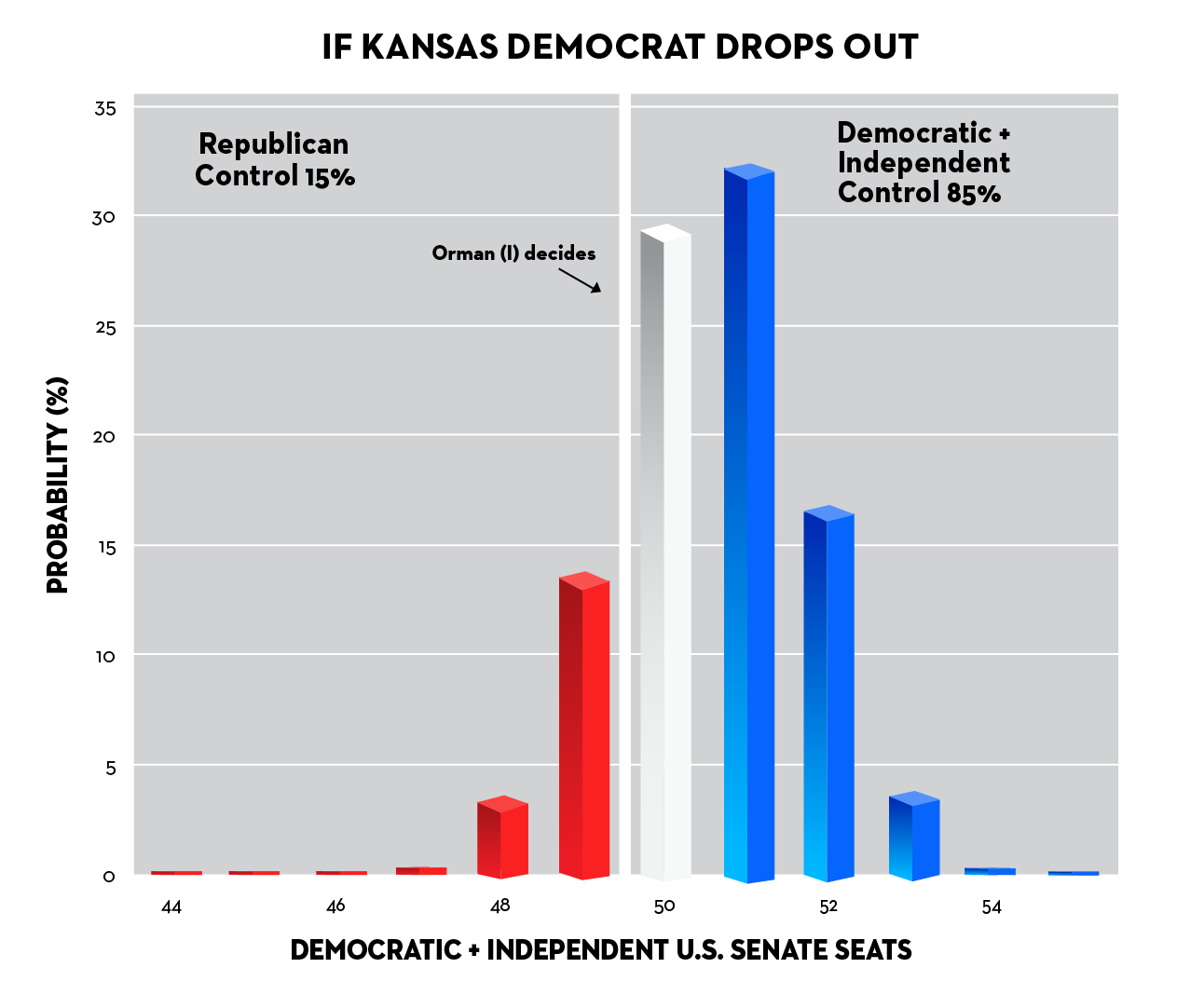
Sam Wang, who posts the above chart, calculates that the Democrats’ odds of keeping the Senate have skyrocketed:

Right before Taylor’s announcement yesterday, according to data from the Princeton Election Consortium, the Democrats had a sixty-five per cent chance of retaining control of the Senate. (Polling wonks will notice that this number is significantly different than what has been put out by outlets like theWashington Posts Monkey Cage, the New York Times’ Upshot, and Nate Silver’sFiveThirtyEight, all of whom give an edge to the Republicans. The Princeton Election Consortium, which I founded, only relies on polling data and does not factor in so-called “fundamentals,” such as campaign finances and incumbency. In the past, our purely poll-based approach has yielded extremely accurate results.) As noted here, with Orman facing off alone against Roberts, the probability of Democratic control shot up to eighty-five per cent.

Silver’s analysis is less favorable to the Democrats. He remarks, that “if Roberts winds up beating Orman by a few percentage points, it wouldn’t be so surprising”:

Another question is which party Orman might caucus with should he win. The default answer would be the Democrats. Orman was formerly a Democrat, he’s mostly taken the political positions of a moderate Democrat, and the Democratic candidate just dropped out of the race. But the more Orman appears to be affiliated with the Democratic Party, the less attractive he might be to Kansas’s red-leaning electorate. … If we do program the model to treat an Orman win as a Democratic pickup, then the Democrats’ chances of retaining the Senate would improve to 38 percent from 35 percent.

Andrew Prokop also wonders who Orman will caucus with:

Orman has said that if he wins, and if one party ends up clearly in the majority, he will “seek to caucus” with that party. But if the Democrats end up with 49 seats to the Republicans’ 50, a victorious Orman would be the vote deciding Senate control, and would be intensely courted by both sides. “Ultimately, I’m going to caucus with the party that’s … most willing to address some of the biggest issues we have,” Orman said Wednesday, according to Politico’s Manu Raju and Kyle Cheney.

Orman describes himself as “someone who is fiscally responsible and socially tolerant,” and has criticized both parties and their leaders. However, he is pro-choice, a critic of the Citizens United decision, and a supporter of comprehensive immigration reform. And, as McCaskill’s actions indicate, Democratic support will likely coalesce behind Orman, while Republicans will try very hard to help Roberts keep his seat, which seems like it could have some impact on Orman’s decision about who to caucus with.

Sabato’s Crystal Ball sizes up the race:

Our Kansas sources stressed two things Wednesday evening. First, Republicans are absolutely furious at Roberts for turning in such a clumsy, second-rate primary performance and allowing this contest to linger in a year when every Senate battle could determine control of the chamber. Second, these same sources — when pressed — believed that ultimately Roberts would be able to fight off the challenge with enough outside assistance.

We’ll see whether the latter view turns out to be realistic or optimistic. For the moment, we’ll put a thumb on the scale for “realistic.” However, Orman has gone to great lengths to emphasize his independence by noting his vacillation between the two parties. He obviously hopes that Kansans will be more amenable to voting for him if they don’t think of him as a Democrat. Republicans, inevitably, are going to try to make Orman as much of a Democrat as possible. Conservative journalists on Twitter are already discussing attack ads aimed at Orman with this theme: “The O in Orman stands for Obama.” In fact, Orman considered running as a Democrat in the 2008 Senate race against Roberts before declining to become a candidate.

Before the Kansas news broke, Nate Cohn looked more broadly at the Senate landscape:

Anything, of course, is still possible. Labor Day is traditionally the start of the campaign, not the end. But what may be more likely than a Republican rout is that 2014 ends up somewhere between 2010 and 2012. Not a Republican landslide or a Democratic victory, but a fairly neutral if Republican-tilting year in which the G.O.P. benefits from a large number of competitive races in red and purple states.

John Sides’ model now gives Democrats nearly a 50-50 chance of keeping the Senate:

[It’s] not that races have narrowed, but that the model has begun weighting information differently — mainly by (a) incorporating polling data (where possible) after the relevant primaries, and by (b) increasing the weight that polls have in the forecast.  What this suggests is that in several states, Democrats are arguably ‘out-performing’ the fundamentals. This doesn’t always translate into a high chance of the Democrat actually winning (see: Kentucky) but it does help the Democrats’ overall chances of retaining a majority.

Peak Obamacare Outrage

by Dish Staff

It appears we’ve passed it:

A new George Washington University “Battleground” poll shows that, on the list of things that people think are wrong with this country, Obamacare actually ranks pretty low. As in behind-“other” low. The poll shows seven in 10 likely voters think the country is off on the wrong track. But unlike other pollsters, it then asked a follow-up question about why people were unhappy. Of the 70 percent who said the country was off on the wrong track, just 5 percent offered a reason having to do with Obamacare. In other words, only about 3.5 percent of all Americans think Obamacare is the bane of American existence right now.

Chait passes along other good news for the ACA – the DC Circuit court will re-hear Halbig:

The short explanation of what this means is that it has closed off the easiest path to crippling Obamacare. … What happens next is that the entire D.C. Circuit will hear the case. Since the logic of the lawsuit is so ludicrous only a wildly partisan Republican jurist would ever accept it, it stands zero chance of success.

Jason Millman unpacks the news:

The entire D.C. circuit is expected to uphold subsidies through the federal-run exchanges, which would eliminate conflicting decisions in the appellate courts. That makes it less likely that the Supreme Court will eventually take the subsidy challenges, though the justices can still decide to do so.

Cohn also eyes SCOTUS:

Most legal experts I know think the justices will, at the very least, wait to see how the full D.C. Circuit rules before taking the lawsuits seriously. The D.C. Circuit rehearing is set for November and that court probably won’t issue a ruling until spring or summer of next year. If those judges end up reversing the decision, the Supreme Court justices might pass on the case altogether, although two other cases are in much earlier stages of the judicial process and could still produce conflicting rulings. As Andrew Koppelman, a constitutional law expert at Northwestern University, notes, “If the Court was going to blow up Obamacare, it would have done so in the big case in 2012. After Roberts paid a big political cost for doing that, why would he now adopt this hyper-technical and unpersuasive legal argument, yanking away benefits that a lot of people are already receiving?”

But remember: It takes only four Supreme Court justices to vote in favor of hearing a case. We know, from that 2012 Obamacare case, that four conservative justices were prepared to throw out not just the individual mandate but also the rest of the law.

Marriage Equality Update

by Dish Staff

Yesterday, a Louisiana judge upheld the state’s marriage ban:

Throughout his thirty-two-page opinion, the judge noted the near unanimity that has prevailed in other courts on the same-sex marriage issue, and he did not criticize other courts for having done so.   He said those rulings amounted to “a pageant of empathy” for same-sex couples. But he concluded his opinion with an essay on the virtue of leaving such a vigorously debated topic to the choice of the people, acting as legislators at the ballot box or through their state legislative representatives.

An appeal of this decision to the U.S. Court of Appeals for the Fifth Circuit is nearly certain.

Mark Joseph Stern notes that Judge Martin Feldman, “is not the first judge since 2013’s United States v. Windsor to uphold a gay marriage ban. He is, however, the first federal judge, a key distinction that gives his ruling significant clout”:

The thrust of Feldman’s ruling rests on a misinterpretation of the so-called animus doctrine. According to the Supreme Court, laws motivated exclusively by anti-gay animus toward gay people violate the equal protection clause of the 14th Amendment. After the court struck down a federal gay marriage ban in Windsor, the vast majority of judges have concluded that all gay marriage bans are presumptively motivated by animus. That’s a logical conclusion, given the Windsor court’s assertion that the federal ban’s “principal purpose and necessary effect” was to “demean” and “degrade” gay people.

But as I’ve written before, the animus doctrine has a weak spot: It’s pretty easy for an eager judge to put a fig leaf over the hostility that motivates anti-gay laws. Feldman, for instance, is shocked that gays would even suggest such a motive, berating them for insisting that Louisiana’s ban “could only be inspired by hate and intolerance.” Rather, denying gay people the right to marry is a perfectly reasonable way “to achieve marriage’s historically preeminent purpose of linking children to their biological parents.” To insinuate that the law was passed to “vilify” gays, Feldman scoffs, is absurd and insulting.

Rob Tisinai pokes holes in the ruling:

[A]bout that societal interest in ensuring that fundamental social change be cultivated via the ballot or legislature instead of the courts: this is an invitation never to find any law unconstitutional, no matter how great an affront to the Constitution it may be. Feldman hedges his way out of this with the qualifier, “in this case.” But why, in this case? He never explains. The closest he comes is in his comments about linking children to their biological parents. But this is inadequate. Such a policy goal explains why the state permits biological parents to marry. It explains not at all why other marriages should be banned. This is a huge hole in Feldman’s reasoning, and I suspect there really is nothing that could fill it.

Savage extends Feldman’s logic:

Preventing same-sex couples from marrying does not prompt opposite-sex couples to marry. If the state has an interest in “intact” families headed up by “two biological parents,” it would make more sense—and come far closer to achieving the state’s supposedly legitimate interest—if the state made pre-marital sex illegal, compelled straight men to marry the women they’ve impregnated, and banned divorce for straight couples with children.

Garrett Epps suggests that “not coincidentally, [the ruling’s] heart is drawn from an opinion written earlier this year by Justice Anthony Kennedy—whose vote will very likely determine the result when the marriage issue reaches the Court”:

Kennedy is a man with a large but complex heart. On the one hand, it tugs him toward his beloved “dignity” for gay couples and their children; on the other, it draws him toward the privileges of the states and the newly discovered “fundamental right” of majorities. The outcome of that contest is still in doubt, and Feldman’s opinion shows why.

Allahpundit bets Kennedy will side with equality:

One of the core points in Kennedy’s prior landmark opinions in gay-rights cases, especially the case striking down sodomy laws, is that gays are entitled to the same constitutional protections for intimate behavior that straights are. It would be odd if he followed that up by reading the right to marriage the way Feldman does, as a right inherently limited to people of different genders. And it’s not just RINOs who think so: Scalia, dissenting in the Windsor case, laughed at Kennedy’s opinion for being a transparent precursor to eventually finding that the Due Process Clause grants citizens the right to marry another person, not a right to marry only a person of the other gender. I think Feldman’s destined to be overturned, but this is a hopeful note at least for opponents of SSM.

Talking Tough-ish On Eastern Europe

by Dish Staff

NATO

David Frum applauds Obama’s remarks on the Ukraine crisis from Estonia yesterday, calling them “the sharpest language any U.S. president has used toward Russia since Ronald Reagan upbraided the Evil Empire” and “the most important speech about European security … of the post-Cold War era”:

One by one, President Obama repudiated the lies Vladimir Putin has told about Ukraine: that the Ukrainians somehow provoked the invasion, that they are Nazis, that their freely elected government is somehow illegal. He rejected Russia’s claim that it has some sphere of influence in Ukraine, some right of veto over Ukrainian constitutional arrangements. And he forcefully assured Estonians—and all NATO’s new allies—that waging war on them meant waging war on the United States. “[T]he defense of Tallinn and Riga and Vilnius is just as important as the defense of Berlin and Paris and London,” Obama said. “Article 5 is crystal clear. An attack on one is an attack on all. So if, in such a moment, you ever ask again, who’ll come to help, you’ll know the answer: the NATO alliance, including the armed forces of the United States of America, right here, present, now.” This is the ultimate commitment, given by the ultimate authority, in the very place where the commitment would be tested—and would have to be honored. There’s no turning back from that. Today, for the first time perhaps, Eastern Europeans have reason to believe it.

Max Fisher, who passes along the above map, interprets the speech as signaling that the US will not go to war to save Ukraine:

This does not mean that the US and Europe are indifferent to Ukraine’s plight. They have sanctioned Russia’s economy repeatedly and heavily, sending it to the precipice of recession. They have isolated Russia politically, for example by booting it from the G8. But these sanctions are about punishing Russia to deter it from future invasions, or at best an attempt to convince Putin that invading Ukraine is not worthwhile.

But Putin’s actions have demonstrated very clearly that he is willing to bear Western economic sanctions for his Ukraine invasion, and the US is not escalating further, so the invasion continues. The US is taking some tougher steps in Ukraine, but they are not very much. Obama, in his speech, called for “concrete commitments” to help Ukraine modernize its military, but it’s not clear what he meant, and even if Ukraine were armed to the teeth it would still lose any open war with Russia, which has the second-largest military in the world. So building up the Ukrainian military, while a nice symbolic gesture, will not stop Putin.

Apparently the president wasn’t clear enough for Michael Scherer:

“NATO must send an unmistakable message in support of Ukraine,” Obama said. “Ukraine needs more than words.” The rhetoric hit its marks. The message, however, was muddled. As he finished his speaking engagements, several questions remained about how he intends to deal with the multiple foreign policy crises facing his administration. He again condemned Russian incursions into Ukraine, and promised new U.S. and European help to train, modernize and strengthen the Ukrainian military. But his “unmistakable message” of support stopped short of defining or ruling out any additional U.S. military role should Russian aggression continue. While he pointedly promised to defend those countries in the region who are signatories to the North Atlantic Treaty Organization (NATO), Obama offered no similar assurances to Ukraine, even as he highlighted that country’s voluntary contributions to NATO military efforts. … This was not the only issue on which he left gray areas.

Drum shoots that down:

For excellent reasons, foreign policy statements nearly always include gray areas, so it would hardly be news if that were the case here. But it’s not. Obama’s statement was unusually straightforward. He said the same thing he’s been saying for months about Ukraine, and it’s really pretty clear:

  • We are committed to the defense of NATO signatories.
  • Ukraine is not part of NATO, which means we will not defend them militarily.
  • However, we will continue to seek a peaceful settlement; we will continue to provide military aid to Ukraine; and we will continue to ratchet up sanctions on Russia if they continue their aggression in eastern Ukraine.

You might not like this policy. And maybe it will change in the future. But for now it’s pretty straightforward and easy to understand. The closest Obama came to a gray area is the precise composition of the sanctions Russia faces, but obviously that depends on negotiations with European leaders. You’re not going to get a unilateral laundry list from Obama at a press conference.

But Michael Brendan Dougherty worries that even these limited commitments involve us too deeply in another crisis we can’t really fix:

If Ukrainians want to maintain control of Donetsk, they must make compromises with its population, or get on with the ugly business of subjugating or murdering them while retaining control of their own border. But the United States should not be a party to it, no matter how satisfying it is for American hawks to defeat a rebel group that symbolically represents Russian power. Indeed, it is precisely the sense that the Ukraine is a cathartic proxy war that fuels the sentiments of Russian nationalism there. The hawks will say that it will never come to hard questions about whether our sons and daughters will die for Estonia or Donetsk. We can just create deterrents with arms shipments and paper promises forever. But these are the credit-default swaps of national security, a moral hazard that jeopardizes more than our retirement plans.

Movin’ On Out

by Dish Staff

John Metcalfe takes note that “being non-white and being relatively low-income” is associated with being willing to pack up house:

Minorities across the U.S. were significantly more amenable to a hypothetical move than whites, at 42 percent and 33 percent, respectively. Among minority groups, African Americans were the most likely to consider moving (46 percent), while 39 percent of those who identified as Hispanic said they’d be willing to move.

Income also played a big role. Those who make less than $30,000 a year were much cozier with the notion of moving (44 percent) than those who make between $30,000 and $75,000 (35 percent) or those who make more than $75,000 (31 percent). Perhaps that has something to do with housing situations: More than half (54 percent) of those dreaming about living elsewhere were renters, compared to 26 percent among those who own their homes.

The Gay Women’s Health Crisis

by Dish Staff

Well Being Gallup

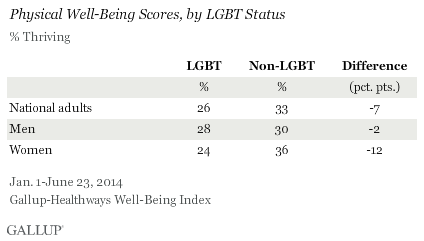
Shannon Keating flags a recent Gallup survey on well-being that shows “queer women lag behind straight women where queer men do not lag behind straight men as much – or even at all”:

Differences in physical well-being between straight and queer men, for example, are too small to be statistically significant; the overall deficit in physical well-being for the LGBTQ community at large is driven entirely by the low scores of queer women (24 percent to straight women’s 36 percent). Gallup indicates that reportedly high levels of smoking and drinking among lesbians and bi women could be a potential contributor to the discrepancy. I’ve seen from accompanying girlfriends on many a smoke break outside of bars how cigarettes and alcohol remain an obstinate fixture of queer girl culture.

Further, where queer men assess their communities with close to as much contentedness as straight men, queer women feel less connected to where they live than their straight female counterparts. Just 31 percent of queer women feel they are thriving in terms of community involvement, safety, and security, a full 9 percent less than straight women.

A recent national survey from Stop Street Harassment helps explain why queer women feel unsafe. The major finding – that two-thirds of American women have experienced street harassment at some point in their lives – is bolstered by two smaller key findings: Seven in 10 LGBT people have experienced street harassment by age 17, compared to 49 percent of straight people, and 41 percent of people of color say they experience street harassment regularly, compared to just a quarter of white people.

Relatedly, a reader flags this item:

A federal study to determine why 75 percent of lesbian women are obese and gay men are not has totaled nearly $3 million. … Researchers at Brigham and Women’s Hospital have come to several conclusions since studying “the striking interplay of gender and sexual orientation in obesity disparities,” which is slated to last until 2016. They have determined that gay and bisexual males had a “greater desire for toned muscles” than straight men, lesbians have lower “athletic self-esteem” that may lead to higher rates of obesity, and that lesbians are more likely to see themselves at a healthy weight even though they are not, the Free Beacon reported.

Update from a reader:

It astonishes me that anyone can look at those numbers and only see a crisis for gay women. True, they are the worst off by a big margin – I am not trying to minimize the main point of the article at all. But almost as shocking is the 6- to 8-point gap between men and straight women. Why is it not even mentioned that men generally are much worse off than women in this regard? (At ~5% of the female population, the lesbian numbers would bring women’s overall score down by about half a percent.)

Possibly because the suffering of men tends to get erased in favor of focusing on the suffering of women? Just saying, the fact that the male population as a whole is significantly less healthy than the female is also a big. fucking. deal, and one that affects far more people in absolute numbers. I guess us dudes are just so privileged to get to live sicker and die sooner.

Boozing Your Sense Of Smell

by Dish Staff

New research indicates that our “natural olfactory talents may be even greater when we use modest amounts of alcohol to reduce our inhibitions”:

A team led by Yaara Endevelt-Shapira tested participants on two days: on one, tests took place before and after drinking a cup of grape juice, and on the other day, before and after a drink containing a dose of alcohol (vodka). Even though the alcohol dose was based on a single measure (35ml) adjusted for the participants’ weight, differences in how people’s bodies process alcohol meant that breathalyser measures of Blood Alcohol Content (BAC) varied from as low as 0.01 to as high as 0.1 across participants.

A smell-detection experiment involved participants indicating which of three jars of oil contained a highly diluted scent. Higher BAC did not influence performance, but when a dose of alcohol produced a low BAC (below .06), participants were able to identify more highly diluted scents than they could on their no-booze day.

In a second experiment, participants sniffed three scents and tried to tell which one differed from the other (identical) two. High BAC made this discrimination task harder, but again, low BAC had a facilitative effect, making it easier to determine the odd smell out.

Celebrities: They Sext Like Us, Ctd

by Dish Staff

A reader responds to a previous one:

It amazes me how casually people presume to dictate to others what they can and can’t do with their own bodies, in the privacy of their own homes (or in the privacy of their own phones, as the case may be).  “Is your life going to suck if you can’t take nude pics on your telephone?”  What the hell kind of question is that?  Why exactly “can’t” a person take nude selfies?  Because of the inevitability that someone else will break into their phone/laptop/cloud storage account, steal this personal information or images and disseminate them without consent?  Do the people asking these questions not hear themselves and recognize they might as well ask women, “Is your life going to suck if you can’t wear a short skirt?”

I was the victim of identify theft last week; somebody got my debit card info and made some fraudulent purchases at Macy’s.  My bank, to their credit, immediately alerted me, canceled the card, reversed the charges, etc.  At no point in the process did anyone think to ask, “Would your life really suck if you just paid cash for your purchases?”  At no point did anyone suggest that if I didn’t want to have money stolen from me, that I shouldn’t purchase anything over the Internet.

Of course, our right to our own money is considered sacrosanct.  Women’s right to their own privacy? Their right to control the images they take of their own bodies and they keep private, by any reasonable measure? Not so much …

Another asks:

Why is it so important for everyone to argue about who’s ultimately at fault here? There’s plenty of blame to go around. The person who released these pictures is a terrible human being. If Apple has flaws in iCloud, then shame on them. And anyone taking naked pictures of themselves and sending them across the Internet is creating risk. There are a bunch of parties at fault here. Some are certainly more morally wrong than others, but that doesn’t mean that there are valid lessons to be learned for the rest of them.

If I don’t bother to lock my front door when I leave the house, is there any question that I made a mistake? That doesn’t mean I deserved to be robbed, but I should’ve known better. It doesn’t absolve the guy that wandered in and stole my stuff from his guilt at all, but it’s fair to criticize me as well. I wish we lived in a world where I could leave my doors unlocked, but that’s not the world that exists, and that should be obvious.

These celebrities did not deserve to have their pictures distributed, but they made decisions that made this event possible. If they’ve been paying any attention to the world around them, they’d have understood that there is a huge market for naked celebrity photos, and that being the case, maybe allowing them into “the cloud” wasn’t the best idea.

Is it fair that celebrities have to be extra wary of this sort of thing? Maybe not, but very little of the world is fair, and we have to live our lives accordingly.

Another makes a very similar argument and concludes:

This does circle back to the rape conversation on the Dish.  And it pains me to go here, but it neither bad nor victim-blaming for people of either sex to be educated on some steps to take to lower the probability of being assaulted (mainly having to do with very heavy alcohol consumption).  It does not mean anyone deserves to be assaulted in any way.  And when rape and other terrible assaults occur, our legal system should investigate and prosecute.  But even when a rapist is convicted, it doesn’t undo the trauma.  It would have been much better not to happen, and every reasonable* effort to reduce the chance of this is smart.  (*maybe this is where people differ – what is reasonable and what is overly cautious.)

But can we stop equating some thoughtful prudent advice with victim-blaming? I figured if there is a place where this can be posted and intelligent conversation can ensue, it’s the Dish.

The Good Soldier Story

by Dish Staff

Vanessa M. Gezari, author of The Tender Soldier: A True Story of War and Sacrificereflects on the US news media’s tendency to both lionize and demonize warfighters:

War stories reflect on our national character as many other stories don’t; they are also notoriously slippery, especially when told and retold back home. All kinds of falsehoods ensue, because war is complicated, messy, and inscrutable, even to those who witness it firsthand and certainly to those who occasionally watch it on TV thousands of miles away. Plots from books, movies, and TV shows like Homeland mix with real life; gaps get filled, missing minutes reconstructed. The press holds up a mirror to the rest of us, and what the rest of us know and want to hear over and over are folktales. To grapple with the idea that Bowe Bergdahl is not a carbon copy of the square-jawed men we see on recruiting billboards, or of the skulking deserters of wars past, is too laborious. Stories, after all, serve many purposes. They do not just help us know what happened. They also console, strengthen, or shame us. The United States in particular has excelled at telling stories about itself. We are a nation of idealists. We believe that we win wars because we are better than our opponents – not just better fighters, but better, period.