Words For The Wasted

by Dish Staff

Planning to get blotto, schnockered or plonked this Labor Day weekend? David Crystal reflects on assembling an “almost complete list of every word we’ve ever used to mean ‘drunk'”:

Being drunk cuts across barriers. The list … shows only the occasional indication of a class preference (such as genteel whiffled vs thieves’ cant suckey), and occupational origins are seen only in some nautical expressions (three sheets, oversparred, up the pole, tin hat, honkers), though the etymology is not always definite. There are very few formal terms in the list, apart from a few expressions fostered by the law (intoxicated, over the limit), and some early scholarly words (inebriate(d), temulent, ebrious). Local regional variations are sometimes apparent, such as from Scotland (fou, strut, swash, blootered, swacked), England (bottled, pissed, rat­arsed), and Australia (blue, rotten, shickery, plonked, on one’s ear); and since the eighteenth century most new words in this semantic field have started out in the United States. But it’s rare to find a word that stays in one country for long, and these days online slang dictionaries have largely broken down geographical boundaries.

Why has this field developed to the extent that writers regularly make a special collection of these words?

We see it early on in John Ray’s collection of proverbs (1678) or Benjamin Franklin’s Drinker’s Dictionary (1737), and artful classifications of degrees of drunkenness antedate these (see fox­drunk, 1592). It’s tempting to think that the linguistic innovation is a direct result of the uninhibited behaviour which follows a bout of drinking. Certainly there are some highly idiosyncratic (and often inexplicable) coinages in the list, such as pepst, pottical, fap, paid, muckibus, stocious,and schnockered. Many words are represented by just a single citation. And several seem to be motivated by the sound of the word as much as by any meaning it might have: jingled, whift, whiffled, squiffy, whittled, spiflicated, zonked. 

Beauty As Investment, Ctd

by Dish Staff

Autumn Whitefield-Madrano has more to say on the social significance of beauty-product consumption, turning from high-end splurges to the relatively affordable world of “masstige” creams and cosmetics:

[T]he temporary self-esteem boost one gets from bargain shopping becomes exaggerated when the shopper is able to attribute the bargain to her own skills—for example, proffering a coupon, or bargaining for a lower price, as opposed to simply purchasing a low-cost item. Another way a shopper might attribute a bargain to her own skills is recognizing a good deal when she sees it. Enter “masstige” products, i.e. products meant to be seen as prestige products that are sold at price points affordable to the masses. For New Yorkers, masstige is most evident in the aisles of Duane Reade drugstores, which in the past few years has revamped its beauty section to look more like something you’d see at Sak’s Fifth Avenue—softer lighting, island displays, skin care consultants. Along with that comes products that are more expensive than usual drugstore fare but still less than what you’d pay were you actually at Sak’s. (I’m a fan of a retinol cream I buy at Duane Reade that features sleek packaging and sounds all fancy but is just a brand of L’Oréal. A brand that costs three times as much as products labeled “L’Oréal,” mais oui.)

Indeed, masstige beauty is growing, with CVS entering the market, and with other major drugstore chains already in it. It’s gotten to the point where premium beauty brands are seeing masstige as a threat that supposedly confuses consumers into thinking they’re getting a higher-quality product than they actually are. Which brings us back to square one: The more that high-end beauty brands try to set themselves apart by seeming exclusive and catering to a consumer who sees purchasing that brand as evidence of her good taste, the more that reinforces the appeal of masstige products to a somewhat different consumer, who sees purchasing a masstige brand as evidence of her good sense. The masstige consumer might look at the prestige buyer and think, What a fool; the prestige buyer might look at the masstige buyer and think, Poor thing, or simply assume that the masstige route is a financial choice, ignoring or oblivious to its nonfinancial rewards.

The View From Your Window Contest

VFYWC-220

You have until noon on Tuesday to guess it. City and/or state first, then country. Please put the location in the subject heading, along with any description within the email. If no one guesses the exact location, proximity counts.  Be sure to email entries to contest@andrewsullivan.com. Winner gets a free The View From Your Window book or two free gift subscriptions to the Dish. Have at it.

Browse previous contests here.

A Short Story For Saturday

by Dish Staff

This weekend’s short story selection is Tobias Wolff’s “Bullet in the Brain,” which begins with these arresting paragraphs:

Anders couldn’t get to the bank until just before it closed, so of course the line was endless and he got stuck behind two women whose loud, stupid conversation put him in a murderous temper. He was never in the best of tempers anyway, Anders – a book critic known for the weary, elegant savagery with which he dispatched almost everything he reviewed.

With the line still doubled around the rope, one of the tellers stuck a “POSITION CLOSED” sign in her window and walked to the back of the bank, where she leaned against a desk and began to pass the time with a man shuffling papers. The women in front of Anders broke off their conversation and watched the teller with hatred. “Oh, that’s nice,” one of them said. She turned to Anders and added, confident of his accord, “One of those little human touches that keep us coming back for more.”

Anders had conceived his own towering hatred of the teller, but he immediately turned it on the presumptuous crybaby in front of him. “Damned unfair,” he said. “Tragic, really. If they’re not chopping off the wrong leg, or bombing your ancestral village, they’re closing their positions.”

Read the rest here. For more of Wolff’s short fiction, including “Bullet in the Brain,” check out his collection Our Story Begins: New and Selected Stories. Previous SSFSs here.

Face Of The Day

by Dish Staff

dish_davidsamuelstern

David Samuel Stern creates dizzying portraits by weaving together two separate vellum prints:

This way of abstracting the images does not only offer his subjects a way to hide within themselves, but also turns digital photography into physical objects by adding geometric texture. Being poets, choreographers, artists or programmers, all of the models featured in “Woven Portraits” are creative types in their own field.

How one of Stern’s models described his reaction to first seeing the woven portrait a few years ago:

I find it interesting; it captures some kind of duality, or time/motion – reminiscent of Francis Bacon’s portraits, even in it’s literal hard edged grid. I like how the image fluctuates, it almost forces me not to focus. And in fact, while looking at it I like to actually take my eyes in and out of focus, the piece seems to encourage viewing through multiple ways of perceiving with the eye.

See more of Stern’s work here.

Auto-Admiration?

by Dish Staff

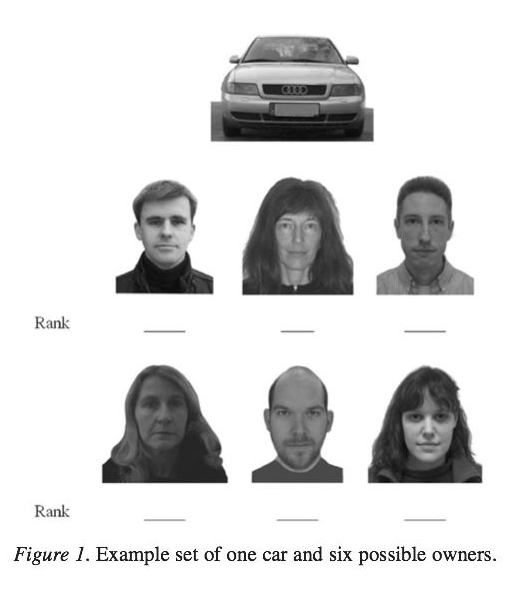
Jesse Bering reviews research suggesting that not only can people accurately match dogs’ faces to their owners, but also that “our faces also bear an uncanny resemblance to the frontend views of our automobiles.” Participants in a study were given a picture of a car and asked to rank its possible owners on a scale of 1 to 6:

[T]he authors suspected that the judges in their study would be able to match cars dish_carfaces3 with their correct owners above chance levels. And that’s what they found. “The real owner was in fact assigned rank 1 most frequently,” they write, “and rank 6 least frequently.” This proved true regardless of the subjects’ sex and age. There were an equal number of male and female judges, and they ranged widely in age—from 16 to 78 years. In case the sheer bizarreness of these data hasn’t quite registered, let me put it to you more bluntly: The average person can detect a physical similarity in the “faces” of cars and their owners. …

Implied in these results is the startling fact that most car owners are unwittingly purchasing cars that look like them. If that’s the case, figured [researchers Stefan] Stiegar and [Martin] Voracek, then is it possible that judges can even take it one step further, matching dogs to their masters’ cars? After all, we know now that it’s not a myth: dogs really do look like their owners. And since we choose both cars and dogs that physically resemble us, shouldn’t our dogs and our cars look alike too? Here, frankly, the data just get weird. Nevertheless, they’re genuine. In their third and final study, the authors added 36 portraits of dogs into the mix. Half of these were of purebreds, and the others were mutts. In a twist to the previous studies, a new group of judges saw an image of a car (again, either the front, side, or rear view) and beneath that, six individual dogs. Subjects ranked each dog on the likelihood of its master being the owner of the car shown. Amazingly, the participants were able to pull this feat off as well.

Meanwhile, Laura Bliss considers the oddly human attachments people form to their vehicles:

To many of us, [cars] are beloved, person-like companions. More than 70 percent of respondents to a recent AutoTrader survey were at least “somewhat” if not “very attached” to their cars, with 36 percent describing their vehicle as “an old friend.” In another study, nearly half of all drivers assigned a gender to their cars, and about one-third actually name them.

For many car-owners, emotional attachment can also come hand-in-hand with socio-economic mobility. For example, there’s research that suggests for certain low-income families, owning a car is linked to the ability to live in neighborhoods with lower poverty rates and lower health risks, as well as higher neighborhood satisfaction and stronger chances of employment.

Car-owners often assign human-like attributes to our cars, too. A 2006 study found significant differences between how participants understood their own personality and how they described their cars’.  And in that same AutoTrader report, more than a quarter said they felt “sad” when they thought about parting ways with their internally combusting pal.

The Essential Creepiness Of DFW Fandom, Ctd

by Dish Staff

dish_dfwlego2

An 11-year-old DFW superfan recreated Infinite Jest with Legos:

[English professor Kevin] Griffith and his son [Sebastian] had the idea to “translate” Infinite Jest into Lego after reading Brendan Powell Smith’s The Brick Bible, which takes on the New Testament. “Wallace’s novel is probably the only contemporary text to offer a similar challenge to artists working in the medium of Lego,” they write, grandly, on their website. …

Sebastian didn’t read Infinite Jest himself. “Let me be clear – Infinite Jest is not a novel for children,” says Griffith. “Instead, I would describe a scene to him and he would recreate it in a way that suited his vision.  All the scenes are created by him and he then took photos of them using a 10-year-old Kodak digital camera he received for a present long ago.  I think that having the scenes reflect an 11-year-old’s perspective gives them a little extra poignancy, maybe.”

The caption for the above image is from page 409 of Infinite Jest: “Clipperton plays tennis with the Glock 17 held steadily to his left temple.” Meanwhile, Matthew Nolan looks for lessons from DFW about why American men aren’t playing the sport better:

Wallace’s discerning tennis essays and fiction made it clear that elite tennis players cannot simply be manufactured through training by academies and player development programs. The fact that there are aspects of success that go beyond the academy helps to explain why the current top 20 players in the world represent 14 different countries, and almost all come from different training backgrounds. The recent success of junior male players, like U.S. Open Wild Card Noah Rubin from the training facility run by John McEnroe (another Wallace favorite), will excite Americans, but enthusiasm needs to be tempered with Wallace-ian recognition of the nature of the game. Wallace would not likely have lamented the state of American men’s tennis but instead would have probably sympathized with the ongoing struggles of all players, regardless of national origin. Likening tennis to life itself, a veteran player and coach in Infinite Jest respectfully sums up the game: “It is tragic and sad and chaotic and lovely.”

(Image via Brickjest)

Map Of The Day

by Dish Staff

School Demographics

Reed Jordan spotlights our schools’ racial segregation:

Despite our country’s growing diversity, our public schools provide little contact between white students and students of color. We’ve mapped data about the racial composition of U.S. public schools to shed light on today’s patterns at the county level. These maps show that America’s public schools are highly segregated by race and income, with the declining share of white students typically concentrated in schools with other white students and the growing share of Latino students concentrated into low-income public schools with other students of color.

In every state but New Mexico and Hawaii, the average white student attends a school that is majority white. This is unsurprising for large swaths of the Northwest, Great Plains, Upper Midwest and Northeast, which are home to very few kids of color. But even in diverse states like Illinois, Michigan, Pennsylvania and New York, few white children attend diverse schools.

Abortion By Mail

by Dish Staff

Emily Bazelon profiles doctor and reproductive-rights activist Rebecca Gomperts, who “started Women on Web, a ‘telemedicine support service’ for women around the world who are seeking medical abortions.” Why Gomperts’ work matters:

Almost 40 percent of the world’s population lives in countries, primarily in Latin America, Africa, Asia and the Persian Gulf, where abortion is either banned or severely restricted. The World Health Organization estimated in 2008 that 21.6 million unsafe abortions took place that year worldwide, leading to about 47,000 deaths. To reduce that number, W.H.O. put mifepristone and misoprostol on its Essential Medicines list. The cost of the combination dose used to end a pregnancy varies from less than $5 in India to about $120 in Europe. (Misoprostol is also used during labor and delivery to prevent postpartum hemorrhage, and global health groups have focused on making it more available in countries with high rates of maternal mortality, including Kenya, Tanzania, India, Nepal, Cambodia, and South Africa.) Gomperts told me that Women on Web receives 2,000 queries each month from women asking for help with medical abortions. (The drugs are widely advertised on the Internet, but it is difficult to tell which sites are scams.)

The Slums Of The Future, Ctd

by Dish Staff

We know that the world’s slums are growing, but are the world’s major urban centers growing into slums? Joel Kotkin details the massive social, economic, and environmental challenges facing most emerging megacities:

Emerging megacities like Kinshasa or Lima do not command important global niches. Their problems are often ignored or minimized by those who inhabit what commentator Rajiv Desai has described as “the VIP zone of cities,” where there is “reliable electric power, adequate water supply, and any sanitation at all.” Outside the zone, Desai notes, even much of the middle class have to “endure inhuman conditions” of congested, cratered roads, unreliable energy, and undrinkable water.

The slums of Bangladesh’s capital, Dhaka, swell by as many as 400,000 new migrants each year. Some argue that these migrants are better off than previous slum dwellers since they ride motorcycles and have cellphones. Yet access to the wonders of transportation and “information technology” don’t compensate for physical conditions demonstrably worse than those endured even by Depression-era poor New Yorkers. My mother’s generation at least could drink water out of a tap and expect consistent electricity, if the bill was paid, something not taken for granted by their modern-day counterparts (PDF) in the developing world. … Over these environmental problems loom arguably greater social ones. Many of the megacities—including the fastest growing, Dhaka—are essentially conurbations dominated by very-low-income people; roughly 70 percent of Dhaka households earn less than $170 (U.S.) a month, and many of them far less. “The megacity of the poor,” is how the urban geographer Nazrul Islam describes his hometown.