Hollywood Handouts

by Dish Staff

California Governor Jerry Brown has approved a bill offering up to $330 million in tax credits to subsidize film and TV production in the state over the next five years. Dennis Saffran blasts a similar program in New York, which costs taxpayers millions and offers little in the way of a return:

Its $420 million price tag makes it the state’s second-largest tax subsidy, trailing only the credit for redevelopment of contaminated “brownfields” (itself a program of dubious merit benefitting a politically favored industry). Both were blasted in a report prepared last year for Cuomo’s tax-reform commission, which recommended cutting the film-credit program by $50 million because “it does not appear to pay for itself.” The report spelled out how lucrative the film credits—which equal at least 30 percent of qualifying production costs—can be to their recipients. The “credit exceeds tax liability many times over,” the report’s authors noted. And because the credit is “refundable”—meaning that the taxpayer is entitled not only to a tax refund but also to a cash payment if the credit exceeds tax liability—the state in fact receives no tax revenue, but rather pays recipients to film here.

These payments go to a tiny sliver of the state’s businesses. The report noted that the “film production credit accounts for 22 percent of the total cost of New York’s business tax credits, but the industry accounts for less than one percent of the state’s employment.”

The Dish last took a look at film and TV production credits back in February, when the producers of House of Cards tried to shake down Maryland for a bigger tax break.

Chart Of The Day

by Dish Staff

Swear Words

Swearing may be getting more common:

Kristin Jay, a psychologist at Marist College who’s collected data on public swearing says that, on the whole, it seems to be getting somewhat more common. Recently, she and her husband Timothy Jay asked a group of American adults to rigorously record every time they heard a swear word in public for an entire year. When they compared their data to a similar study conducted in 1986, they found that the frequency of most words had increased over time.

In an interview, Jay cautioned from reading too deeply into the findings — especially on the individual word level — because the volunteers might not have perfectly recorded every curse they heard, and the subjects weren’t spread out across the country (they were clustered in New England and Southern California). That said, Jay notes one possible reason that swearing may be on the upswing. “We see changing speech standards in the media we consume,” she says. “The media we used to consume were much more sanitized, and we had fewer things to choose from and less control over what we exposed ourselves to.”

Counting The Poorest Among Us

by Dish Staff

Jordan Weissmann highlights some recent attempts to ascertain how many Americans live in extreme poverty—under $2 a day—that came up with very different numbers:

According to H. Luke Shaefer of the University of Michigan and Kathryn Edin of Johns Hopkins, the number of families living under that low, low line has grown 159 percent since 1996. … Part of the reason Shaefer and Edin’s headline number was so startlingly high—they calculated that the extreme poverty rate among households with children was a chilling 4.3 percent—could be attributed to a very narrow definition of income that ignored all noncash safety net benefits. Today, most of the government’s poverty-fighting efforts don’t involve straightforward cash. Food stamps? Housing vouchers? Tax credits? None were included. Once they accounted for those programs, only 613,000 families were living below the $2-a-day mark in 2011—still up by about half since the Clinton years.

At a bare minimum, then, hundreds of thousands of American households are living in true destitution. (For a family of three, the federal poverty line works out to about $17 per day, per person.) According to the new Brookings report, however, even Shaefer and Edin’s most conservative estimates of extreme poverty might have been too high. If you look at data on income, the pair’s estimates essentially hold up. But Brookings fellow Laurence Chandy and MIT Ph.D. student Cory Smith found that if you examine U.S. consumption statistics, then the number of families surviving on less than $2 each per day falls close to zero.

Chandy explains how he arrived at that conclusion:

Part of the reason for this is that even the poorest people surveyed in America appear to find a way to meet their most basic material needs (valued above $2 a day) even if their reported income is zero or close to zero. Furthermore, the poor in America have access to public goods—public education, criminal justice and infrastructure—that would be the envy of the poor in the developing world.

However, poverty is manifested in different ways in the U.S. and developing countries. Focusing narrowly on material needs means missing other critical components of welfare that may be especially lacking among America’s poorest people. For instance, those whose survival depends on in-kind assistance may be assured that their most basic material needs are met, but the absence of a reliable source of income makes it extremely difficult to cope with the unexpected, such as replacing broken or stolen assets or emergency travel. These individuals face a virtual exclusion from the cash economy implying a dearth of agency that directly affects their welfare.

Face Of The Day

by Dish Staff

Ebola outbreak in Sierra Leone

A soldier inspects a woman with an infrared thermometer for signs of fever, one of the symptoms of Ebola, at a checkpoint in Nikabo, a village in Kenema, Sierra Leone, on August 27, 2014. According to the World Health Organization, the outbreak has now killed more than 1,500 people across four West African countries, including at least 120 healthcare workers. Photo by Mohammed Elshamy/Anadolu Agency/Getty Images.

Also, a reader passes along this heartbreaking update on Saah Exco, the ten-year-old Liberian boy we featured last week on the Dish.

Teaching A Fish To Walk

by Dish Staff

Carl Zimmer unpacks a fascinating new study on bichirs (a type fish that “mostly live in lakes and rivers” but “will sometimes crawl across dry land with their fins”):

McGill scientists wondered what would happen if they forced the fish to grow up out of the water. To find out, they reared eight bichirs in a terrarium with a pebble-strewn floor. To prevent the bichirs from drying out, the scientists installed a mister to keep their skin moist. The fish grew for eight months, clambering around their terrarium instead of swimming.

Then the scientists examined these fish out of water. They found that eight months on dry land (or at least moist land) had wreaked profound changes to the bichirs.

For one thing, they now walked differently. Overall, they were more efficient. In each step, they planted their fins on the ground for less time, and they took shorter strides. Instead of flapping their fins out to each side, they placed their fins under their bodies. Their fins slipped less when they pushed off of them. They made smaller movements with their tails to go the same distance as a bichir raised underwater. Aquatic bichirs walk on land with an irregular gait. The terrestrial bichirs, on the other hand, walked more gracefully, planting their fins in the same spot relative to their bodies time after time.

Noah Baker adds that, beyond the fishes’ new walking style. “their bone structure and musculature changed to be more suited to a walking lifestyle”:

The results provide evidence for developmental plasticity, in which organisms alter their anatomy and behaviour in response to environmental change. The team suggests that this process, as demonstrated by the bichir, could have given the earliest tetrapod ancestors the ability to venture onto land. In doing so, claims [lead author Emily] Standen, they would have become exposed to the selective pressures of a terrestrial environment, thereby speeding up the evolutionary transformation from fins for swimming into limbs for walking.

Is The Islamic State A State?

by Dish Staff

bbf8f007b

D.B. revisits the question of whether ISIS can really live up to its self-proclaimed “statehood“:

IS’s mission is to create its own caliphate, but until now many of its sources of revenue have depended on its host states. … IS has not proven adept at running anything other than the most basic functions of a state in the past—dispensing justice and, in most cases, providing bread, the staple food. In 2013 in Raqqa it attempted to take over the opposition’s civilian-run local council, which had continued to pay road sweepers and keep ambulances on the road. Locals say it soon handed back control after it failed to deliver, angering residents. The IS model of stealing from and feeding off the Syrian and Iraqi states has worked well so far. But it will become much more difficult for IS to rule its territory if the Damascus and Baghdad governments stop being so helpful.

That’s why a massive humanitarian aid effort is a big part of Zalmay Khalilzad’s suggested action plan for how to defeat ISIS:

The humanitarian catastrophe resulting from the conflicts in Iraq and Syria requires a massive response. This is essential strategically. Friendly countries who host large number of refugees, such as Jordan and the Kurdish region of Iraq are at risk of destabilization. For displaced Sunni Arabs, poor refugee conditions can lead to radicalization and opportunities for IS to recruit them. If we allow IS to exploit this opportunity, the threat could expand exponentially. Moreover, IS is seeking to establish itself as a quasistate, providing humanitarian aid and services in areas it controls. The international community and its local partners must compete for the hearts and minds among refugees and communities seeking protection from or willing to align against IS. This competition will be waged in part in the provision of humanitarian relief and basic services. It is a competition that we must win.

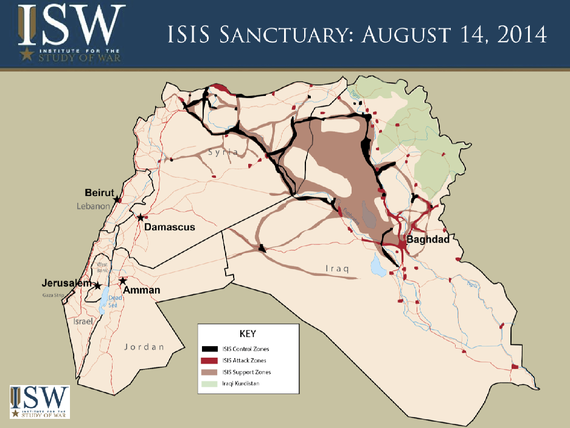
Looking at the varying maps of ISIS’s sphere of influence, such as the one above from the Institute for the Study of War, Kathy Gilsinan asks whether the group really controls all of the territory in which it operates, and whether that matters:

Crucially, while those control zones don’t amount to 35,000 square miles worth of territory, they do encompass major population centers, which tend to be concentrated along major roads. “The aims of the ‘Caliphate’ explicitly include population control, and ISIS has continued to prioritize the acquisition of populated geography,” [ISW Syria analyst Jennifer] Cafarella writes. So the key elements of the Islamic ‘State’ are its network of population centers, oil resources, and military infrastructure, connected by roads. With its territorial expansion, then, ISIS is something more than an al-Qaeda-like terrorist organization enjoying safe haven in a defined geographic area. Syria and Iraq are not sheltering the group as the Taliban did for al-Qaeda in Afghanistan. In some respects, ISIS bears more of a resemblance to the Taliban, which similarly terrorized civilians but, unlike al-Qaeda, held clear, albeit incomplete, sway over a defined territory.

Literary “Self-Segregation”

by Dish Staff

Jess Row ponders why “most white writers, like most white Americans, particularly those over 30, still feel a profound psychic distance between themselves and black people”:

[T]he defining experiences for people my age (that is, Generations X and Y) fall in the tumultous years between 1988 and 1992—the years of Tawana Brawley, Howard Beach, the Central Park Five, and the L.A. Riots—when a furious debate over canonicity and inclusion raged in the academy, when Louis Farrakhan and Al Sharpton came to prominence, Malcolm X superseded MLK, when Ice Cube talked about killing blue-eyed devils, and t-shirts everywhere said “It’s a Black thing…you wouldn’t understand.”

That era seems like ancient history now, but it has everything to do with why American fiction and poetry remain relentlessly segregated spaces, even though many of our greatest and most visible artists are artists of color. For many white Americans, the takeaway message of that complicated time, consciously or sub- or un-, was like a second, post-Civil-Rights response to “The White Negro”: that for a white person to try to say anything meaningful about race, or racism, was not only ridiculous, but shameful, and also somehow dangerous.

Row concludes by addressing a likely counterargument: So what if white writers ignore race?

It’s a valid question, and one I’ve asked myself many times: if the world is full of artists of color talking about race, why do I need to get in on that action? If there’s this vibrant, rich, visceral, scary conversation already underway, who cares if white writers choose not to participate? The best answer I can give, the only honest answer a writer can give, is a selfish one: it’s interesting to me. It’s good material: the tension, the friction, the rich possibilities of embarrassing oneself for a good cause. (As the white rapper Sage Francis says of himself, “Poorly developed, yet highly advanced / the black music intertwined with the white man’s line dance.”) It’s about writing honestly and going deeper into life, yes, but it’s also just a source of happiness. You could even take a cue from Talib Kweli and call it “the beautiful struggle.” For me, it’s been a relief, too: to realize that this bitter earth is the one place we all have standing.

The Sex Offender Next Door

by Dish Staff

Jesse Singal argues that registered sex offenders should be able to live wherever they please:

[L]aws designed to restrict where sex offenders can live are really and truly useless, except as a means of politicians scoring easy political points by ratcheting up hysteria. There are many tricky social-scientific issues on which there are a range of opinions and some degree of debate among experts, but this isn’t one of them. Among those whose job it is to figure out how to reduce the rate at which sex offenders commit crimes (as opposed to those whose job it is to get reelected, in part by hammering away at phantom threats), there is zero controversy: These laws don’t work, and may actually increase sexual offenders’ recidivism rates.

As for where sex offenders do live, Alyssa Coppelman interviews Noah Rabinowitz, who photographed a Florida religious community the majority of whose residents are part of that population:

I read that there’s quite a demand from sex offenders to live there. Have many of the community members lived there long, or do they move on at a certain point?

“The smallest infraction of the community’s rules by one the residents will get them kicked out. Though, it very rarely happens. Only a few miles away, there is a community of sex-offenders, not allowed to inhabit Miracle Village, living under a bridge. Only a small fraction of housing in the state of Florida is available for a convinced sex-offender. Application numbers are very high and admission, based on a voting system, is very selective. Moral and ethical judgments aside, the residents are trying to live out their American Dream, in the only way the law and society will allow. Some discuss their hopes for life after their time in Miracle Village, but many find it to be a safe place and wish to stay.”